Category Archives: anthropology

VicNews: Rebirth through Reburial

Burial cairn on Race Rocks. Source: RaceRocks.com

While I was away over the summer the local free paper, the Victoria News, did a (to my mind)   high quality series on reburial and respect in Songhees and Esquimalt communities (cache). The three articles by Lisa Weighton include comments from numerous aboriginal spiritual and political leaders, and sensitively describes how Straits Salish faith asserts that the dead are always with the living.  The dead do not conveniently depart to some other place, but continue in a world alongside and intersecting the world of the living.

Hence ancestral remains are not something belonging to a past which can be “gotten over” but are very much part of the present world.  Laying a person to rest, or back to rest after disturbance, requires food, clothing and prayer.  I don’t pretend to understand the concept well, but I have been to some such ceremonies and the power of the moment is impossible to deny.  In my limited experience the article fairly represents the spiritual and emotional needs that must be met under the sad circumstance of disturbing the dead.  It is incumbent on archaeologists and all citizens to not only work to minimize disturbance of the dead but to respect traditional practices.  It has been impressed on me that such practices are meant to protect us, the living, First Nations or not, as well as to give comfort and respect to the dead.  This should now be considered absolutely part of mainstream archaeology.

Continue reading

Images from the Likeness House

Cover of Dan Savard's new book. The RBCM caption reads: "This man has been variously identified as a chief from four different areas of BC’s interior, including possibly Tyee Jim from the central interior (tyee means “chief” in Chinook, a trade language). John Wallace Jones or Thomas McNabb Jones photograph, about 1897." Source of this photo: Amazon.ca

There is an exciting new book in the pipeline on early photography and First Nations of the historic period.  The author, Dan Savard, is senior collections manager of the Royal BC Museum’s anthropology audio and visual collection.  The promotional blurb reads:

On a winter’s day in 1889, Tsimshian Chief Arthur Wellington Clah visited Hannah and Richard Maynard’s photography studio in Victoria to have his portrait taken. “Rebekah ask if I going likeness house,” Chief Clah wrote in his diary, “So I go, to give myself likeness. Rebekah stand longside me.” In Images from the Likeness House, Dan Savard explores the relationship between First Peoples in British Columbia, Alaska and Washington and the photographers who made images of them from the late 1850s to the 1920s.

I won’t be here (have some bottom sampling to attend to in Haida Gwaii), but Dan is giving a free public lecture and will sign copies of his book next week at the RBCM.

Continue reading

More on Comox Harbour Fishtraps

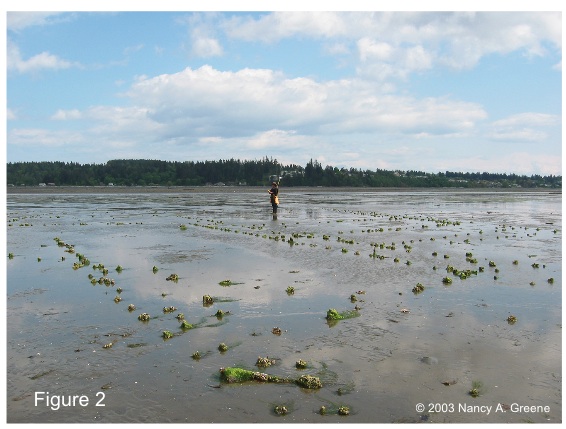
Fishtrap stakes delineating chevron patterns in the intertidal zone of Comox Harbour. Photo credit: Greene 2010.

I posted once before some time ago on the incredible fishtrap complexes in Comox Harbour on eastern Vancouver Island, highlighting Megan Caldwell’s M.A. thesis (downloadable) on the topic, and mentioning in passing that primacy of investigation should perhaps go to Nancy Greene, who has been mapping and dating these features for about a decade.  I was glad to find the other day that Nancy Greene has a 2010 downloadable poster on the topic (link starts a 4 meg PDF)  from an academic conference: WARP, the Wetland Archaeological Research Project, which itself has a nifty new website.

These Comox Harbour fishtraps are one of the wonders of B.C. Archaeology and it is highly welcome to see some more of Greene’s reconstructions and mapping.

Continue reading

Russian Plastic Tlingit Warrior Models. And more!

Model of a Tlingit warrior. Source: http://www.modelsculpt.org, click for original page.

Well, there’s another headline I never thought I’d write!  Don’t ask me how I found it but these Russian guys have a passion for modelling human figures and one of their subjects is a Tlingit warrior.  It’s actually pretty impressive, with slat armour faithfully rendered, a wooden helmet and the circular gorget or throat protector. Scroll around on that forum for more images of the model.  We’ve looked at Tlingit slat armour on this site once before, as well.  The narrow slit between the helmet and the gorget or collar might seem exaggerated, but it agrees with this picture (also perhaps exaggerated) and this drawing, both apparently from Russian sources.

But there was an ancillary benefit to looking through this Russian-language forum: one of the participants has scanned some amazing pages of Tlingit art and artifacts from a Russian book, stuff I had never seen before that perhaps has its origins in colonial Russian Alaska.

Continue reading

More on the Sea-to-Sky Cultural Journey

Sign at the Horsehoe bay kiosk. Source: tad McIlwraith flickr.com account.

A month or two ago I commented on the Squamish and Lil’wat Cultural Journey website, which explores oral history and place names in the traditional territory of these two southwestern British Columbia First Nations.  I was really happy to see that Douglas College Anthropologist (and occasional commenter here) Dr. Tad McIlwraith has carried the review much further.  He’s even taken it into the field, so to speak, by documenting and discussing the actual cultural centre itself, and also the roadside kiosks which bring Squamish and Lil’wat histories to the travelling public.

Tad’s review has two parts.

Continue reading

Houses on Stilts

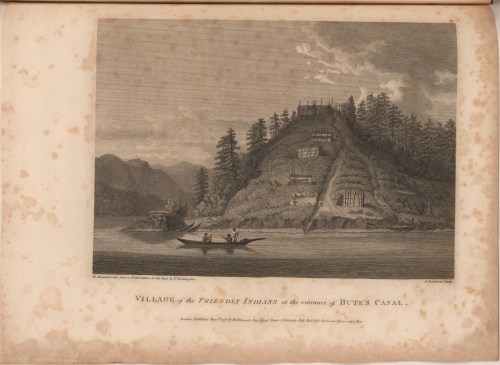
"Village of the Friendly Indians at the Entrance of Bute's Canal", 1792. Click for zoomable version.

The above image shows a seemingly improbable Kwiakah Kwakwaka’wakw Village (EDIT: probably Homathko Coast Salish Village) at the entrance to Bute Inlet, as drawn in 1792 by a member of Captain Vancouver’s expedition.  With the houses scattered up a steep hillside, the top one apparently partially cantilevered out, it does not fit the average archaeologist’s mental model of a typical Northwest Coast village.  The setting would undoubtedly have some defensive advantages, at least for those at the top.  I know of another image of a steeply-tiered village site which is apparently not strictly a defensive site.  Hard to live on the side of such a steep hill, you might think.  Wouldn’t it be nice to have photographs of such a village?  Aha.

Continue reading

Basket Conservation at the Langley Centennial Museum

N'laka'pamux Basket undergoing conservation treatment. Source: LangleyMueum.org

I know I occasionally grumble about how regional, publicly funded museums in B.C. are almost devoid of archaeological and aboriginal substance, especially on the web.  A happy exception to this is the Langley Centennial Museum near Vancouver, which has an unusual and interesting virtual exhibit of N’laka’pamux basketry.  The museum is in the possession of a large collection of these baskets, made by an interesting historical figure from the Yale-Lytton area of the Fraser River: one Kathleen Pearson. The exhibit consists of a number of pages, including a short essay (5 pages) which is strangely not clearly linked, based around Boas et al.’s 1928 Bureau of American Ethnology Publication.  The museum goes beyond the historical frame by discussing recent named weavers such as Mary Ann James, and the continuing tradition of N’laka’pamux basket making.

It is really great to see a relatively small museum explicitly recognizing that the world didn’t begin in 1846 and going beyond the story of white settlers as if they were a self contained pod of culture beamed down from Queen Victoria’s forehead.  The other thing  I particularly like about this small web exhibit is that the museum highlights the activities of another group of unsung heroes in the world of heritage conservation: the conservators who restore, stabilize and protect the artifacts entrusted to museums.

Continue reading

New Finds from NWT Ice Patches

340 year old bow made from willow wood - bow was found in multiple fragments. Photo: Tom Andrews via livescience.com.

In many parts of Northwest North America glaciers and ice patches are melting at unprecedented rates.  In some cases, these are revealing extraordinary archaeological remains, as I have noted before for Alaska.  There’s recently been some short news reports about new finds in the Northwest Territories, to add to the substantial work already done there.  Most of these reports rehash the same news release from the Arctic Institute of the Americas, which sponsored the research through International Polar Year funding (now ended).  Only a few sites have photos, though.

Continue reading

Making Yuxwch’ee Yakw, a Tlingit Spruce Canoe

Working on Yuxwch’ee Yakw, the Spruce Canoe. Source: Sealaska Picasa page.

Most people are familiar with the use of red cedar to make dugout canoes on the Northwest Coast.  It is not as commonly known that Sitka spruce was also used for this purpose, especially on the northernmost coast where red cedar did not thrive or was absent completely.

Via the Sealaska Heritage Institute Special Collections blog, I just found a nice, extensive photo set from 1987 of the carving of a spruce canoe near Hoonah, a Tlingit village in Southeast Alaska.  The introduction to the photo set reads:

As part of the bicentennial of the Constitution celebration of 1987, the National Park Service and the Sealaska Heritage Foundation (now Sealaska Heritage Institute) sponsored the carving of a Tlingit canoe using traditional tools and methods at Bartlett Cove, which is near Hoonah, Alaska. The canoe, called Yuxwch’ee Yakw in Tlingit, means Sea Otter Canoe, which was the indigenous canoe of Hoonah and was photographed by the Harriman Expedition in Glacier Bay in 1899. The canoe was constructed at Bartlett Cover in August 1987. George Dalton, Sr, born in Hoonah in 1879, and other elders with personal knowledge of canoe making traditions served as cultural advisors to the project. Lead carvers Nathan Jackson, Steve Brown, Richard Dalton, and Mick Beasley carved the canoe using a Sitka Spruce log using traditional tools, such as the xot’ah or Tlingit adze.

Continue reading

Sealaska Heritage Institute Blog

Stone artifact recently donated to the Sealaska Heritage Institute Special Collections. Source: SHI.

Sealaska Heritage Institute (SHI) is a regional Native nonprofit organization founded for the Tlingit, Haida and Tsimshian people of Southeast Alaska. SHI was established in 1981 by Sealaska Corp., a for-profit company formed under the Alaska Native Claims Settlement Act (ANCSA). SHI, formerly Sealaska Heritage Foundation, administers Sealaska Corp.’s cultural and educational programs.

I know this because I got linked the other day by SHI’s Special Collections Research Center Blog, which I hadn’t seen before.  While not updated as frequently as this corner of the internavel is, it contains a lot of great posts going back to 2007 – you can see links to their archives down on the lower right hand side of their front page.

The most recent post concerns the artifact shown above.  It looks to my eye like a, possibly unfinished, hand maul. They seem a little uncertain about the function though, so someone should go over to their site and give some opinions – they take comments.  People with dirty minds are excluded from this request.

Continue reading