Category Archives: anthropology

Tree Burials at Tsaxis

"Arriving for a tree burial by canoe, in British Columbia, a traditional Indian ceremony", c. 1920. Watercolour by Joanna Simpson Wilson.

One of the most distinctive burial methods on the Northwest Coast was the creation of platforms in trees, on which coffins would be placed.  While the practice is commonly recorded and discussed in the Anthropological literature, photographs of tree “burials” are rare — and even if they were not, then reproduction of these images might well be problematic.

I recently ran across the image above by the little-known Canadian author Joanna Simpson Wilson (1896-1987), which shows numerous bentwood boxes attached to trees as a throng of mourners gathers below.  The platforms are rather insubstantial and the coffins are stacked several-high in places, with red cloth attached — perhaps the remains of blankets.  After a number of years, the boxes would deteriorate and the remains of the body would fall from the tree.  At this time, a secondary burial at a village site cemetery or other place might be performed.  I have seen the remains of several tree burials in the field, with human remains scattered beneath the branches of a large spruce — looking up, there are large branches with ring-like pathologies where the bark grew around rope, and other evidence of cultural modification. Archaeologically, there is a trend over the long term along the coast for inhumation of human remains to give way to sky burials or mortuary houses.

According to this site, the setting of the painting is the Kwakwaka’wakw village of Tsaxis (near Fort Rupert / Port Hardy on Vancouver Island), specifically a place called Storey Beach (more pics).

Boas 1934: Geographical Names of the Kwakiutl Indians. Click to enlarge. Strangely, Tsaxis (#13) is not plotted on the map.

Council of the Haida Nation Youth Videos

Scene from Our World, a film created by Kiefer Collison.

The Council of the Haida Nation has an informative website with many links to documents and other material, giving a vivid picture of the vibrancy, and challenges, of contemporary Haida culture.

Among the interesting items on that page, the “Our World” series of short videos which deftly mix ancient and modern are particularly worth checking out:

These are the among the visions of young Haida today.

Geist: Memory and the Valley Photo Essay

Sxwòyeqs (The Place that Everyone Died) | Stave Lake. Source: Geist Magazine.

A while ago I linked to a beautiful photo-essay from Geist Magazine on decaying towns on the BC coast.  I see they have another excellent photo essay, this one on the subject of the superposition of Euro-Canadian towns and spaces onto Aboriginal archaeological sites and significant places.  The text by Sandra Shields and David Campion is sensitive and evocative and the photographs are well taken — in some ways they are banal – an overpass, and access road – yet knowing what lies underneath triggers emotional reactions. UVIC’s own Duncan McLaren is featured as well so it must be a good article – Stave Lake (above) has two of the oldest archaeological sites in Canada (each more than 12,000 years old), parts of which miraculously survived the reservoir inundation.

The Geist authors are interviewed here, which is also well worth reading:

Interviewer: it’s not only peo­ple that are miss­ing in “Memory and the Valley”; you touch on the dis­ap­pear­ing salmon, the white pine, the waters drained away. There’s def­i­nitely that tone of loss through­out the whole work.

Campion: That is why we’re hav­ing the exhibit here in the old city hall in Chilliwack, with a wall of the orig­i­nal pio­neers look­ing down on the work. It’s because you strug­gle with these two nar­ra­tives. One says: When Canada started, we came to a land that had no peo­ple in it and we strug­gled really hard and made a won­der­ful life for our­selves and a future for our chil­dren. Whereas, for abo­rig­i­nal peo­ple, it’s a story of huge pain and suf­fer­ing, and a huge loss of peo­ple to dis­ease, even before con­tact. Then res­i­den­tial schools, cul­tural mod­i­fi­ca­tion, and so on.

So you’ve got this prob­lem at the base of Canadian soci­ety. For soci­ety as a whole to move for­ward, we need to find a way to acknowl­edge that loss, not just to have it mean some­thing in that on/off, negative/positive sense. As non-Natives, we need to find a way to absorb the real­i­ties of our com­ing here into our national narrative.

The notion of a “palimpsest” in archaeology is common, borrowed from manuscript studies: parchments would be scraped clean and re-used, yet, the older writing can still be seen and read, a ghostly precursor image.  Writing over writing, material culture over material culture, names over names and the living over the dead.  Every time you walk across the concrete apron in front of the MacPherson Library at UVIC you walk across an archaeological site.  Every time you leave the Elliot Lecture hall you walk across a site.  The Legislature is on a site, the Fraser Arms Hotel, the Willows Beach Tea House, all superimposed, a collective blotting.  Our feet tread the scraped parchment of the dead.

Leq’á:mél | Nicomen Island

Another Haida Argillite Pipe for Sale

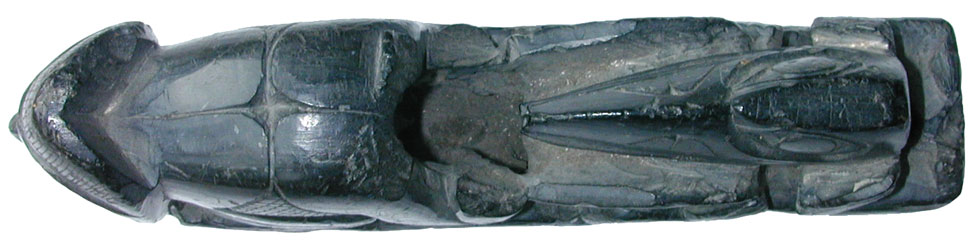
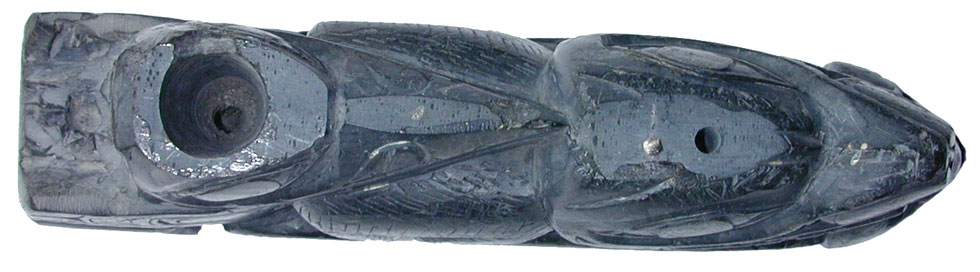
Haida panel pipe, nineteenth century.

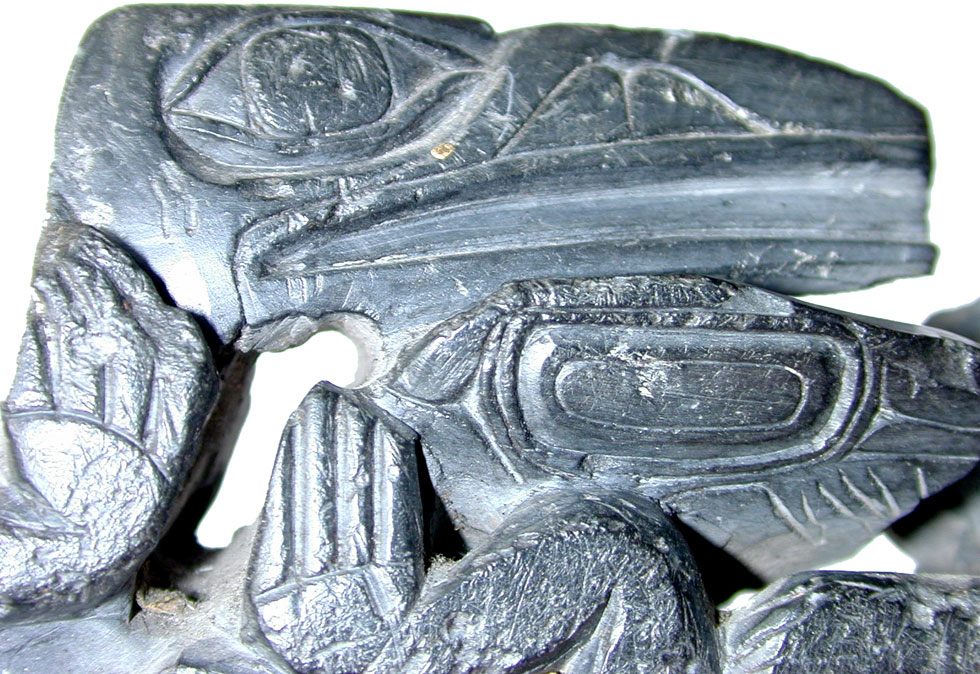
A few days ago I featured photographs of a stunning 19th century Haida argillite pipe for sale at a UK web site.  They have a second pipe for sale, a more complex design but in poorer condition.  The photos are similarly revealing of carving strokes and rock grain; even more so in some ways as this piece appears to be unfinished.  The design is complex focusing on Raven and Bear (not the Frog as the description below says, I don’t think), but it is not for me to try to decode the story being told.

The description is given as follows:

19thC. HAIDA ARGILLITE PIPE PANEL. #asc004 #asc004

Probably from the Raven Tribe, the panel carved with various mythological figures including a raven, a man, a frog and the thunder bird, this is possibly part of a larger panel and the top has been slightly filed flat for mounting on a stand, (not photographed). Overall 13.5cm.

From the Haida tribes of the Northwest Pacific Coast of British Columbia and Queen Charlotte Island

£2,500.00

Again, for posterity, here are nine views of this pipe: 1, 2, 3, 4, 5, 6, 7, 8, 9.  As I noted before, while not as sharp as the other set, these photographs surpass most of what one finds on many, many museum sites, where the rule seems to be: offer a single view of an object, offer it at low resolution, do not allow direct hyperlinks to the file, and break the URL as soon as possible.

Front view of panel pipe.

Top view of pipe.

Wapato, Camas, Tyee

4,000 year old Wapato tubers from archaeological site in Katzie territory.

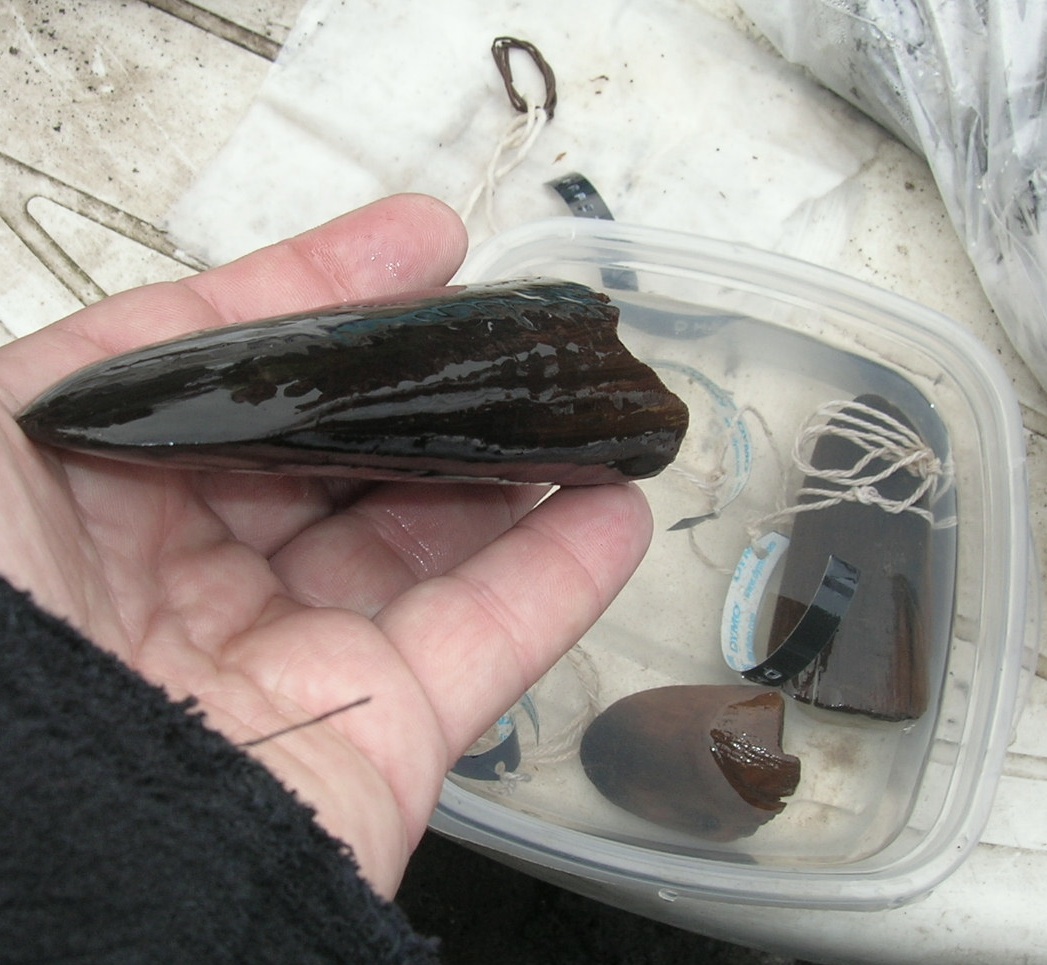
The Tyee has a nice feature on invigoration of traditional use of Wapato (“Indian Potato”) and Camas.  I visited an open house at an archaeological site in Katzie territory a year or two ago and so here’s a couple of pictures of 4,000 year old Wapato tubers and a digging stick of presumably the same age which would have been used to help cultivate the wet beds.  At that site (almost completely destroyed by the new Golden Ears suburban commuter bridge), there were signs of the creation of enhanced “water gardens” for Wapato, and not just the harvesting of what occurs naturally.  Similarly, camas productivity was greatly enhanced by selective weeding and by the practice of tilling and selective bulb harvesting as well as deliberate burning to manage the camas fields.  All in all, exploitation of many plant foods (and shellfish) formed a practice intermediate between farming and gathering, and thereby are a powerful line of evidence for traditional use of large areas of SW British Columbia.  The Tyee article seems to me to be clear, accurate and informative.  I recommend it.

Tip of a wooden digging stick, ca. 4000 years old, Katzie territory. Two others of the dozens found can be seen in the background.

Even more on the Wilson Duff – SGang Gwaay Musical

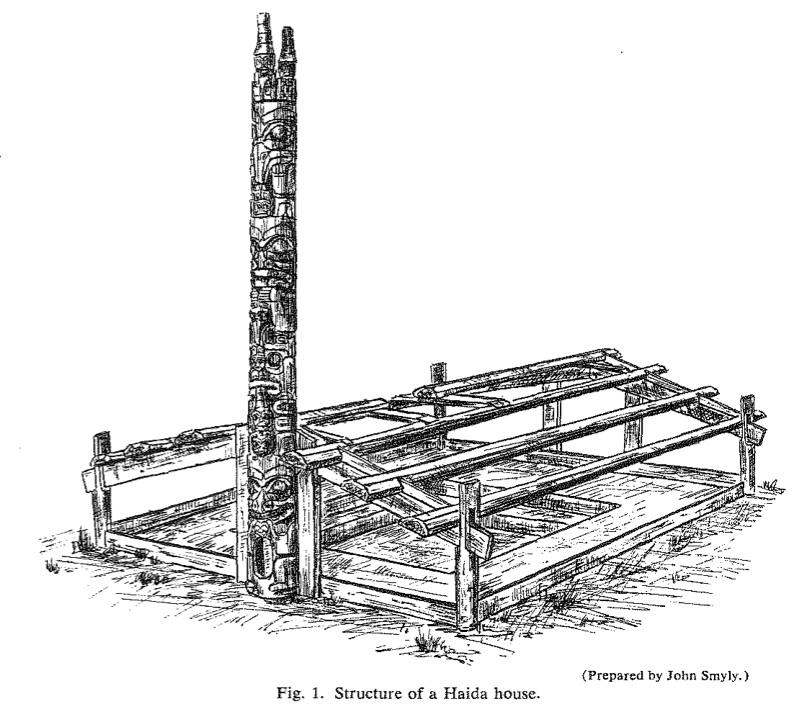
Haida House and pole. Source: Duff and Kew, 1957.

A month or two ago I made several posts (1 , 2, 3) about a forthcoming musical called Beyond Eden, which tells the story of the 1957 expedition to ‘rescue’ poles from the Haida Town of SGang Gwaay (PDF).

I notice The Tyee has a very good overview of this musical (which opens tonight) including some comments from Roy Jones Sr. of Skidegate, last seen on this blog as a young man climbing poles in 1957 CBC archival footage.  Says The Tyee:

Now in his mid-80s, he is reflective about the experience, having enjoyed the physical work and the company of members of the crew — but about cutting the poles? “It didn’t feel right,” he said. However, the Skidegate Band Council had approved the work and many felt it was the right thing to do. Further to that, Jones was on a recent trip to The Chicago Field Museum and saw one of the poles taken from Skedans (an expedition he was also on). “If they hadn’t taken it at that time, it would have been ruined, I think,” he said.

It is good to see some Haida perspective on both the events of 1957 and on this musical.  I also didn’t realize Nathalie at the Qay museum was a student of Wilson Duff’s — I’ll have to buy her a coffee and pump her for stories next time I am up on the islands. It’s a good article — The Tyee is doing some of the best journalism in BC right now.

Poster for "Beyond Eden" musical. Click to buy tickets; scroll down for title song.

Replica Tlingit Armour

Replicated Tlingit body armour.

The Tlingit artist Tommy Joseph has replicated a traditional set of armour:

… body armor made of alder slats and rods and woven together with hemp. Wooden panels are stitched together with leather lacing. Moosehide straps. Two alder toggles fasten the armor around the body.

It’s for sale: $3,500.

I was looking into this because of a recent post on Linen Armour (!) at Heather Pringle’s blog — I tried to leave a comment there in response to a question about NW Coast armour but wordpress ate it — probably because I had a bunch of links.  Dan form there, if you read this, most likely the armour Simon Fraser saw was made of two or more layers of stiffened elk hide.

Nettle winding around wooden slats and rods plus toggle fastening.


Decaying resource towns of the BC coast.

Inside the school library at Ocean Falls.

Inside the school library at Ocean Falls.

Photographer Christopher Grabowski has a beautiful photo-essay at Geist magazine on the subject of decaying resource towns of the British Columbian coast, with emphasis on Alert Bay and  Ocean Falls.  You can read the essay alone, or as the multi-page photo essay, and also read an interview with Grabowski here.  A fuller set of his Ocean Falls photographs can be seen here. (2018 edit: here)

It is striking how Europeans and other settlers were so active on the coast.  Hundreds of communities have come and gone, and settlers are now concentrated in only a few major towns.  Meanwhile, the First Nations remain on their land – in the long term, perhaps, European presence on the remote coastal lands will come to resemble a blip more than an occupation.

In the meantime, these fantastic photos remind us of the wasteful ways of the culture with perhaps the shortest attention span on earth: Canada.

The inscribed fireplace in the ballroom at Ocean Falls: Archie Martin … Ocean Falls community is a monument to his memory. Indeed.

Google and the Indigenous Mapping Network

Nisga'a Place Names. Click for interactive version.

Google is putting together a workshop together with the Indigenous Mapping Network:

On February 25th and 26th, 2010, Google and IMN will host a workshop on the Google campus for members and staff of indigenous groups who want to learn about Google geospatial and mobile technologies. This hands-on workshop will approach Google technologies with the special concerns of indigenous communities in mind, and will focus on the technical aspects of using Google Earth, Google Maps, Sketchup, Android mobile phones and Open Data Kit, among other technologies.

I’m pretty sure both parties are on it, but despite Google’s corporate motto of “Do No Evil” uploading sensitive, spatially-referenced cultural information to their servers seems like something that would need some thought.  Nonetheless, it is interesting to see this as a pro-active direction Google is taking.  Canadian First Nations are some of the most GIS-savvy anywhere in the world.  One of their main networks seems to be the Aboriginal Mapping Network, who have an excellent-looking book coming out soon called Living Proof: The Essential Data-Collection Guide for Indigenous Use-and-Occupancy Map Surveys by Terry N. Tobias.  Also see their handy link to data sources especially for BC.

Duff and Kew: 1957 article on SGang Gwaay Town

Map of SGang Gwaay Town. Duff and Kew, 1957

As promised, I am linking to a copy of the 1957 report (PDF) by Wilson Duff and Michael Kew on the Kunghit Haida town of  SGang Gwaay, which has also been known erroneously as Ninstints. Little mention is made of the pole recovery aspect which was the subject of previous posts, though if you scroll all the way down in Duff and Kew’s article I append Duff’s report from that same issue of the “Report of the Provincial Museum of Natural History and Anthropology”.  In that report, the personnel involved are noted and there is also a discussion of  the activity of the  “B.C. Totem Pole Restoration Committee.”

Anyway, Duff and Kew describe in full the environment and setting of Anthony Island, the town site and associated archaeological sites, and also gives a full account of the early period conflict between Haida and trading ships.  In particular, vivid detail is given of the rise and fall of Chief Koyah and the serial raids he led on trading ships.  As Duff notes, this escalation in violence may well have been the resulted of an ill-advised power-play by Captain Kendrick who temporarily held Koyah hostage, a mortal insult in Haida society:

What Kendrick regarded as a simple” lesson” must to Koyah have been a monstrous and shattering indignity. No Coast Indian chief could endure even the slightest insult without taking steps immediately to restore his damaged prestige. To be taken captive, even by a white man, was like being made a slave, and that stigma could be removed only by the greatest feats of revenge or distributions of wealth. This humiliating violation of Koyah’s person must have been shattering to his prestige in the tribe. The Indian account of the incident told to Captain Gray a year later (but before Gray had heard Kendrick’s version) states this very clearly.

“On Coyah the chief’s being asked for, we were informed by several of the natives . . . that Captain Kendrick was here some time ago . . . that he took Coyah, tied a rope around his neck, whipped him, painted his face, cut off his hair, took away from him a great many skins, and then turned him ashore. Coyah was now no longer a chief, but an ‘AWiko,’ or one of the lower class. They have now no head chief, but many inferior chiefs. . . .” (Hoskins, in Howay, 1941, p. 200).

Kendrick had hurt Koyah more than he knew.  On Koyah’s part, if we understand the motivations of a Haida chief correctly, only bloody revenge or a great distribution of wealth would restore his lost prestige. To capture and destroy Kendrick’s ship, for example, and then distribute the loot, would fill the bill nicely. Koyah watched for his chance, and John Kendrick’s carelessness soon gave it to him.

Continue reading