Google and the Indigenous Mapping Network

Nisga'a Place Names. Click for interactive version.

Google is putting together a workshop together with the Indigenous Mapping Network:

On February 25th and 26th, 2010, Google and IMN will host a workshop on the Google campus for members and staff of indigenous groups who want to learn about Google geospatial and mobile technologies. This hands-on workshop will approach Google technologies with the special concerns of indigenous communities in mind, and will focus on the technical aspects of using Google Earth, Google Maps, Sketchup, Android mobile phones and Open Data Kit, among other technologies.

I’m pretty sure both parties are on it, but despite Google’s corporate motto of “Do No Evil” uploading sensitive, spatially-referenced cultural information to their servers seems like something that would need some thought.  Nonetheless, it is interesting to see this as a pro-active direction Google is taking.  Canadian First Nations are some of the most GIS-savvy anywhere in the world.  One of their main networks seems to be the Aboriginal Mapping Network, who have an excellent-looking book coming out soon called Living Proof: The Essential Data-Collection Guide for Indigenous Use-and-Occupancy Map Surveys by Terry N. Tobias.  Also see their handy link to data sources especially for BC.

Duff and Kew: 1957 article on SGang Gwaay Town

Map of SGang Gwaay Town. Duff and Kew, 1957

As promised, I am linking to a copy of the 1957 report (PDF) by Wilson Duff and Michael Kew on the Kunghit Haida town of  SGang Gwaay, which has also been known erroneously as Ninstints. Little mention is made of the pole recovery aspect which was the subject of previous posts, though if you scroll all the way down in Duff and Kew’s article I append Duff’s report from that same issue of the “Report of the Provincial Museum of Natural History and Anthropology”.  In that report, the personnel involved are noted and there is also a discussion of  the activity of the  “B.C. Totem Pole Restoration Committee.”

Anyway, Duff and Kew describe in full the environment and setting of Anthony Island, the town site and associated archaeological sites, and also gives a full account of the early period conflict between Haida and trading ships.  In particular, vivid detail is given of the rise and fall of Chief Koyah and the serial raids he led on trading ships.  As Duff notes, this escalation in violence may well have been the resulted of an ill-advised power-play by Captain Kendrick who temporarily held Koyah hostage, a mortal insult in Haida society:

What Kendrick regarded as a simple” lesson” must to Koyah have been a monstrous and shattering indignity. No Coast Indian chief could endure even the slightest insult without taking steps immediately to restore his damaged prestige. To be taken captive, even by a white man, was like being made a slave, and that stigma could be removed only by the greatest feats of revenge or distributions of wealth. This humiliating violation of Koyah’s person must have been shattering to his prestige in the tribe. The Indian account of the incident told to Captain Gray a year later (but before Gray had heard Kendrick’s version) states this very clearly.

“On Coyah the chief’s being asked for, we were informed by several of the natives . . . that Captain Kendrick was here some time ago . . . that he took Coyah, tied a rope around his neck, whipped him, painted his face, cut off his hair, took away from him a great many skins, and then turned him ashore. Coyah was now no longer a chief, but an ‘AWiko,’ or one of the lower class. They have now no head chief, but many inferior chiefs. . . .” (Hoskins, in Howay, 1941, p. 200).

Kendrick had hurt Koyah more than he knew.  On Koyah’s part, if we understand the motivations of a Haida chief correctly, only bloody revenge or a great distribution of wealth would restore his lost prestige. To capture and destroy Kendrick’s ship, for example, and then distribute the loot, would fill the bill nicely. Koyah watched for his chance, and John Kendrick’s carelessness soon gave it to him.

Continue reading

Speaking of Wilson Duff and Bill Reid

Roy Jones of Skidegate climbs a pole at SGang Gwaay. Source: CBC.

Yesterday I noted the upcoming musical about the Bill Reid-Wilson Duff expedition to “rescue” carved poles at the Haida Village of SGang Gwaay (Ninstints).  I’ve just found that the CBC has posted online a short documentary, (2013:edit, use this link)  first broadcast in 1959 and narrated by Bill Reid, showing the removal of these poles to the Museum of Anthropology at UVIC.  The expedition also included Wayne Suttles and Michael Kew, as well as Wilson Duff of course.  The Haida crew consisted of Roy Jones, Clarence Jones and Frank Jones of Skidegate. Some aspects of the trip are recounted in the BC Provincial Museum Annual Report of 1957, which I will scan and post some other day.

The spoken component of the documentary is a fascinating account by Reid, at that time just beginning his carving career, but the real jaw-dropping element is the depiction of the use of axes and saws and climbing spikes to log this forest of poles.  Necessary, of course, but jarring nonetheless.

Broadcast Date: May 21, 1959

A small boat ferrying Bill Reid and a team of anthropologists approaches the southern tip of the Queen Charlotte Islands. Reid documents the rescue mission to salvage and relocate the last of the crumbling Haida totems as revealed in this CBC documentary. With a sense of excited urgency, Reid describes and catalogues the enormous poles on the approaching shore. As they are gently felled, the majestic cultural landmarks will creak and groan before they are prepared for transport.

It’s low resolution and grainy, but the general impression is a very powerful one.

Felling a tree, surely, not a pole at SGang Gwaay. Source: CBC.

Upcoming musical about Wilson Duff (!)

John Mann of Spirit of the West in "Beyond Eden"

I can hardly believe this, but the Vancouver Playhouse is mounting a new musical based on an event familiar to to all students of archaeology and anthropology n BC.  The musical stars John Mann from the band Spirit of the West.  From Tom Hawthorn’s blog:

Written by Bruce Ruddell with musical direction by Bill Henderson, formerly of Chilliwack, the musical premieres on Jan. 16 at the Vancouver Playhouse. The musical is based on a 1957 expedition to the Queen Charlotte Islands by the archeologist Wilson Duff and his Haida friend, the artist Bill Reid.

Mr. Mann portrays a character based on the archaeologist, a man who travelled to Haida Gwaii to preserve totem poles, which he bought for $50 each. These can now be seen at the Royal B.C. Museum in Victoria and the Museum of Anthropology in Vancouver.

“Off the top he believes his job is to keep those poles alive because you can learn from them,” Mr. Mann said. “If they rot, they’re lost, they’re gone forever. No one will be able to study them.

“In the course of those three days, his mind is changed. Then all hell breaks loose.”

This is remarkable and interesting on a number of levels.   I’d love to see it.

Wilson Duff was one of the first modern Anthropologists and Archaeologists to work in British Columbia and it seems he had just got started when he died by his own hand in 1976, at the age of 51.

Haida Archaeology at the Virtual Museum of Canada

Rodney Brown at the Cohoe Creek Site, 1998. Source: CHIN.

The Canadian Heritage Information Network (the venerable CHIN) has, via the Virtual Museum of Canada,  a small online exhibit of Haida Gwaii archaeology posted.

I hate to be all grumpy since such initiatives should be supported, but seriously – the problems with this exhibit are manifold.  First, a number of the facts are wrong, despite the content being copyrighted 2009.  They use a figure of 9,000 years for first occupation, not the figure of 12,500 which is more reasonable.  That’s more than a 30% difference.  They state it was a grassland 10,000 years ago, when the better number would be 14,000 or more. It’s written in the first person, so apparently a Haida person wrote it – but really should that be an excuse? Maybe the details don’t really matter.

So, factual errors are unfortunate.  But they also have completely crap illustrations – low resolution, poorly lit images from ethnological collections are used to represent the archaeological record.  This is misleading on a number of levels.  Archaeologists do not usually find beautifully decorated clubs, for example, and it diminishes understanding of the archaeological record and process to imply they do. Indeed, the text of the exhibit lists the following “learning outcomes:

Learning Objectives

The learner will:

  • Describe the history of Haida people revealed by archeology
  • Describe some Haida objects found in archeological excavations

As far as I can tell, not a single object “found in archaeological excavation” is shown and essentially no archaeological facts are given.

Also, all the pages, including “Haida Society since European Contact” are under the header of “Haida Ecology” which is a bit unfortunate.  Put the whole thing under “Haida history”.

It’s also regrettable that the pictures are of such poor quality, like this one of fish hooks.  I mean, this is a national institution, and the year of the web is 2009, not 1995.  People expect more and will tune out if you don’t offer them some substantial eye candy.  I think they have a right to receive it from the Ottawa heritage establishment – after all the NMC is sitting on a superb collection that most of us never get to see.

Finally, the information content is miniscule.  The whole thing can’t add up to more than 500 words and is cluttered with jargon like “Print this Learning Object” and “View the complete asset”.  What kind of robotic geek came up with that sort of bullshit management-speak? And every bit of this information has a copyright notice on it, even pictures from other institutions.  This page has SEVEN separate, identical copyright notices “© 2009, CHIN-Canadian Heritage Information Network. All Rights Reserved.”

Memo to CHIN and the VMC:  no one wants to copy your minimalist, factually incorrect and low-resolution information anyway.  If you can’t do decent eye candy then do decent information.  If you can’t do either, then don’t try to bully me with copyright notices.

C’mon guys, you can do so much better than this, especially if your goal is to educate.  Email me, I’ll send you some pictures and fact-check your page.  No fancy consultancy charge will apply!
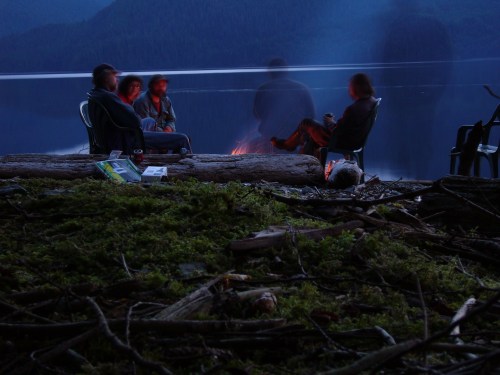
I just noticed this was NW Coast Archaeology blog post #100. To counteract this being so grumpy, here's a nice picture of camp life on Tanu Island.

UCLA-Stó:lō Field School at Welqámex

s’iltexwáwtxw

I see UCLA is running a fieldschool again this coming summer in Stó:lō territory at Welqámex, a village site on the  small island in the Fraser River near Hope.  Instruction is by Anthony Graesch (UCLA) and Dave Schaepe  (Stó:lō Research and Resource Management Centre).  The UCLA web site has been down as much as up recently (because it has so  many bells and freakin’ whistles it doesn’t know if it is coming or going — idiot web designers make such fragile shit these days), so you can also check the AIA web site.  Here is a direct link to their pamphlet (PDF).

Note the students wearing protective ochre daubing.

McLennan & McFeely 1908-1914 Catalogue (update)

Railroad wheelbarrows from McLennan and McFeely catalogue.

I posted previously about this excellent resource which the City of Vancouver Archives has put online: the McLennan and McFeely catalogue of industrial, farm and fishing equipment, 1908-1914.  In that post, I moaned a little about how nice it would be to be able to download a single PDF of all 1400+ pages.  To my delight and happiness (and surprise, I must admit, because it can have been no trivial task) Sue Bigelow of the  Archives has posted a note indicating that they have now made such a document available for download (link in upper right hand corner of this page).  It is 270 megs, but I have it now and what an amazing resource.  Thanks so much to Sue and to the City of Vancouver Archives – as I said, this is potentially a huge aid for historical archaeologists and indeed any archaeologist who encounters historical debris.

Mangles!

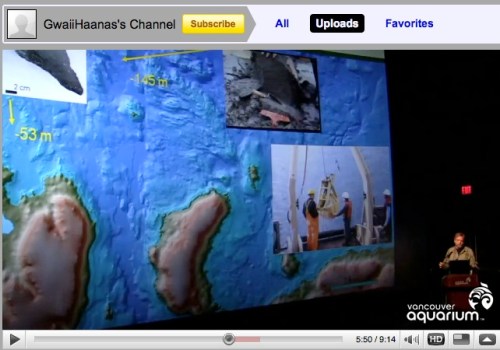
Videos of Gwaii Haanas Archaeology

Daryl braves the barrage of bras to set the Vancouver Aquarium straight on the value of dead fish over living fish. Click to play part 1.

Rockwash superstars Nicole and Daryl show off their cool wares in a couple of videos I just found online – I vaguely remember them going off to give this talk at the Vancouver Aquarium.  It’s in two parts: 1 and 2.  Nicole looks fabulous and Daryl has trimmed his beard!  Win-Win.  The projects they describe sure were a lot of fun to take part in.   There are a few other talks up including Lyle Dick and Norm Sloan on Sea Otters on the Gwaii Haanas Youtube Channel.

A sandhill crane is a tough act fo follow but Nicole hammers home the righteous message of dead fish. Click to play part 2.

Archaeology in Action: a flickr.com photo pool

Archaeologists? No -- "Pothunters" destroying a site on the Columbia River, ca. 1966. Source: flickr user gbaku.

Archaeology in Action is a large set of pictures of archaeologists doing archaeology on the photo sharing website flickr.com.  Not too much Northwest Stuff there that I could find with the notable exception of many pictures put up by a former University of Oregon professor under the name of gbaku (you can find his real name easily enough).  His pictures are a wonderful tour of Oregon and Alaskan archaeology of the 1960s and 1970s – these are not sets of pictures of stratigraphy, or backdirt (interesting though those things are) but are predominately of, well, archaeologists in action.  It would be fun to see more NW Coast pictures up here — I know Grant has a large collection of pictures of archaeologists going about their business and I am sure we all have some pictures of people in with the endless pictures of yet another bone.

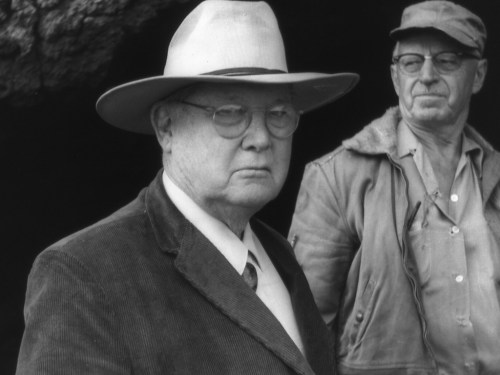
Erle Stanley Gardner, the author of the Perry Mason mysteries and many other books, and Luther Cressman, pioneering archaeologist and ex-husband of Margaret Mead, at Fort Rock Cave in 1966.

Somenos Creek: Update 2

CHEK-TV video clip on the Somenos Creek archaeological situation. Click to play.

Someone passed along this CHEK-TV news item showing George Schmidt of TimberCrest Estates, Ltd., the development company wishing to put houses on top of a major archaeological site in the Cowichan Valley at Somenos Creek, which I’ve written about before: 1, 2.

Listen to the favourable treatment he gets from the newscaster. Loaded language like “In limbo”. “Pony Up”.

Hey, CHEK-TV, since you’re the voice of the people now and all that and also “journalists”, how about you dig around in the zoning history of the land before you just repeat the mantra “government must pay”.  Did the developer buy this land already zoned for residential development?  How much did he pay in 1972?  Does he deserve compensation for having a risk turn out the wrong way for him?  Does he have the right to destroy a cemetery?  Is he, in fact, losing anything that he already had, or is he losing a perceived entitlement?  He took a risk, he has gained mightily, and now he wants a slice of the First Nation’s pie as well.

I’d seriously suggest CHEK-TV also looks into the $500,000 amount he claims to have spent on archaeology at Somenos Creek.  From what little I know of the site, I am very skeptical about that figure.

Truly, there needs to be a mechanism by which true hardship cases of conflict between development and archaeology, or where the impact assessment process has failed, can be resolved.  That, indeed, may mean some government financial input.  But these should be reserved for instances where other options have run out and where there is demonstrable financial hardship.  This case does not pass the smell test – vast profits have assuredly been made and now legal and moral constrains are drawing a line under this development.

I say this company should stop going cap in hand to the government and just give the land up as a heritage park in return for a tax receipt.  Unless I am mistaken, most entrepreneurs are not socialists, and I  am sure the last thing the typical developer would want is to be perceived as a corporate welfare bum.