Monthly Archives: January 2010

Geist: Memory and the Valley Photo Essay

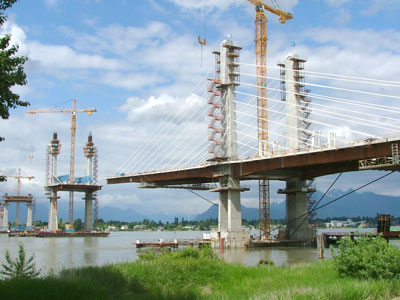
Sxwòyeqs (The Place that Everyone Died) | Stave Lake. Source: Geist Magazine.

A while ago I linked to a beautiful photo-essay from Geist Magazine on decaying towns on the BC coast.  I see they have another excellent photo essay, this one on the subject of the superposition of Euro-Canadian towns and spaces onto Aboriginal archaeological sites and significant places.  The text by Sandra Shields and David Campion is sensitive and evocative and the photographs are well taken — in some ways they are banal – an overpass, and access road – yet knowing what lies underneath triggers emotional reactions. UVIC’s own Duncan McLaren is featured as well so it must be a good article – Stave Lake (above) has two of the oldest archaeological sites in Canada (each more than 12,000 years old), parts of which miraculously survived the reservoir inundation.

The Geist authors are interviewed here, which is also well worth reading:

Interviewer: it’s not only peo­ple that are miss­ing in “Memory and the Valley”; you touch on the dis­ap­pear­ing salmon, the white pine, the waters drained away. There’s def­i­nitely that tone of loss through­out the whole work.

Campion: That is why we’re hav­ing the exhibit here in the old city hall in Chilliwack, with a wall of the orig­i­nal pio­neers look­ing down on the work. It’s because you strug­gle with these two nar­ra­tives. One says: When Canada started, we came to a land that had no peo­ple in it and we strug­gled really hard and made a won­der­ful life for our­selves and a future for our chil­dren. Whereas, for abo­rig­i­nal peo­ple, it’s a story of huge pain and suf­fer­ing, and a huge loss of peo­ple to dis­ease, even before con­tact. Then res­i­den­tial schools, cul­tural mod­i­fi­ca­tion, and so on.

So you’ve got this prob­lem at the base of Canadian soci­ety. For soci­ety as a whole to move for­ward, we need to find a way to acknowl­edge that loss, not just to have it mean some­thing in that on/off, negative/positive sense. As non-Natives, we need to find a way to absorb the real­i­ties of our com­ing here into our national narrative.

The notion of a “palimpsest” in archaeology is common, borrowed from manuscript studies: parchments would be scraped clean and re-used, yet, the older writing can still be seen and read, a ghostly precursor image.  Writing over writing, material culture over material culture, names over names and the living over the dead.  Every time you walk across the concrete apron in front of the MacPherson Library at UVIC you walk across an archaeological site.  Every time you leave the Elliot Lecture hall you walk across a site.  The Legislature is on a site, the Fraser Arms Hotel, the Willows Beach Tea House, all superimposed, a collective blotting.  Our feet tread the scraped parchment of the dead.

Leq’á:mél | Nicomen Island
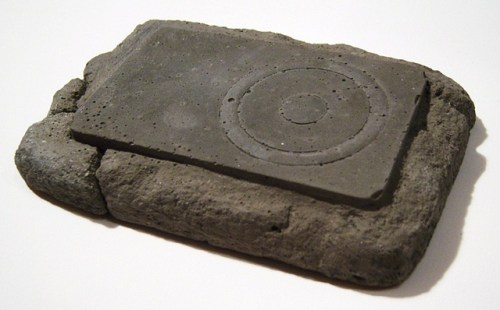
Christopher Locke’s modern fossils.

Egosiliqua malusymphonicus

Christopher Locke is an artist whose work includes a number of fun “modern fossils“, like his palaeofuturistic rendering of an iPod (Egosiliqua malusymphonicus), above, or a Nintendo game controller (Dominaludus sexagentaquad) below.  I take the work to be a slightly sarcastic commentary on the work of palaeontologists and archaeologists as well as on the flukey preservation of ephemera – see his specimen notes alongside each piece at his website.

They are also very reasonably priced — tempting!

Dominaludus sexagentaquad.

Another Haida Argillite Pipe for Sale

Haida panel pipe, nineteenth century.

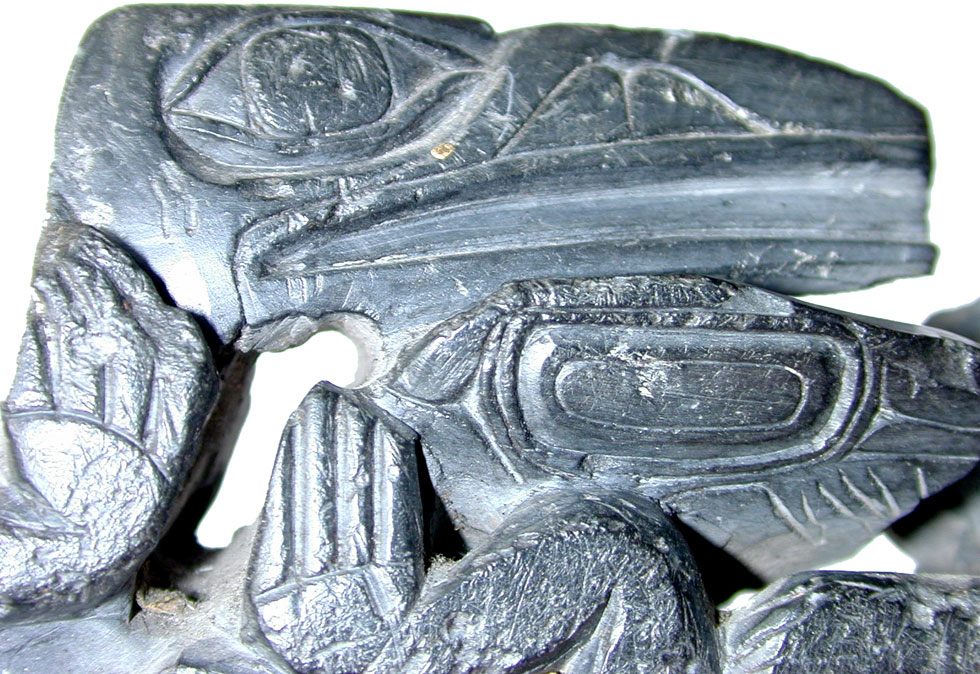
A few days ago I featured photographs of a stunning 19th century Haida argillite pipe for sale at a UK web site.  They have a second pipe for sale, a more complex design but in poorer condition.  The photos are similarly revealing of carving strokes and rock grain; even more so in some ways as this piece appears to be unfinished.  The design is complex focusing on Raven and Bear (not the Frog as the description below says, I don’t think), but it is not for me to try to decode the story being told.

The description is given as follows:

19thC. HAIDA ARGILLITE PIPE PANEL. #asc004 #asc004

Probably from the Raven Tribe, the panel carved with various mythological figures including a raven, a man, a frog and the thunder bird, this is possibly part of a larger panel and the top has been slightly filed flat for mounting on a stand, (not photographed). Overall 13.5cm.

From the Haida tribes of the Northwest Pacific Coast of British Columbia and Queen Charlotte Island

£2,500.00

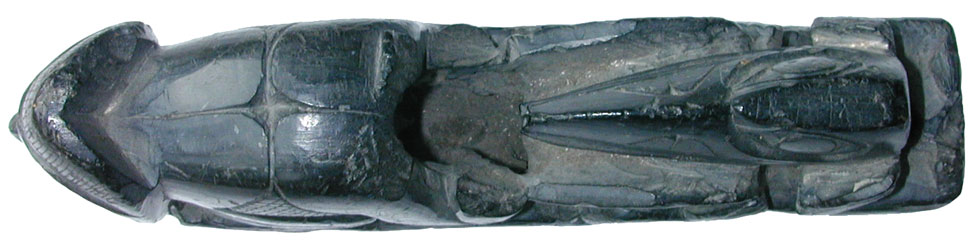
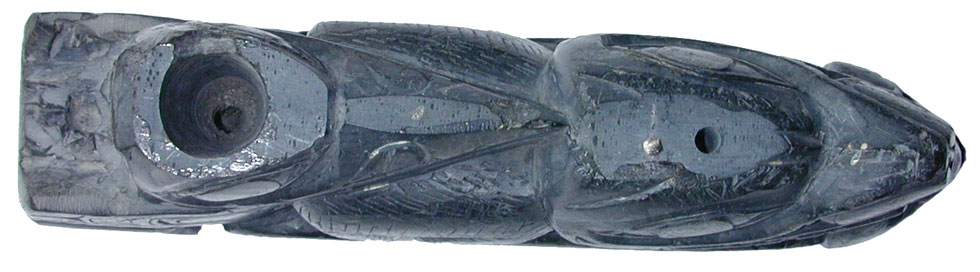
Again, for posterity, here are nine views of this pipe: 1, 2, 3, 4, 5, 6, 7, 8, 9.  As I noted before, while not as sharp as the other set, these photographs surpass most of what one finds on many, many museum sites, where the rule seems to be: offer a single view of an object, offer it at low resolution, do not allow direct hyperlinks to the file, and break the URL as soon as possible.

Front view of panel pipe.

Top view of pipe.

Wapato, Camas, Tyee

4,000 year old Wapato tubers from archaeological site in Katzie territory.

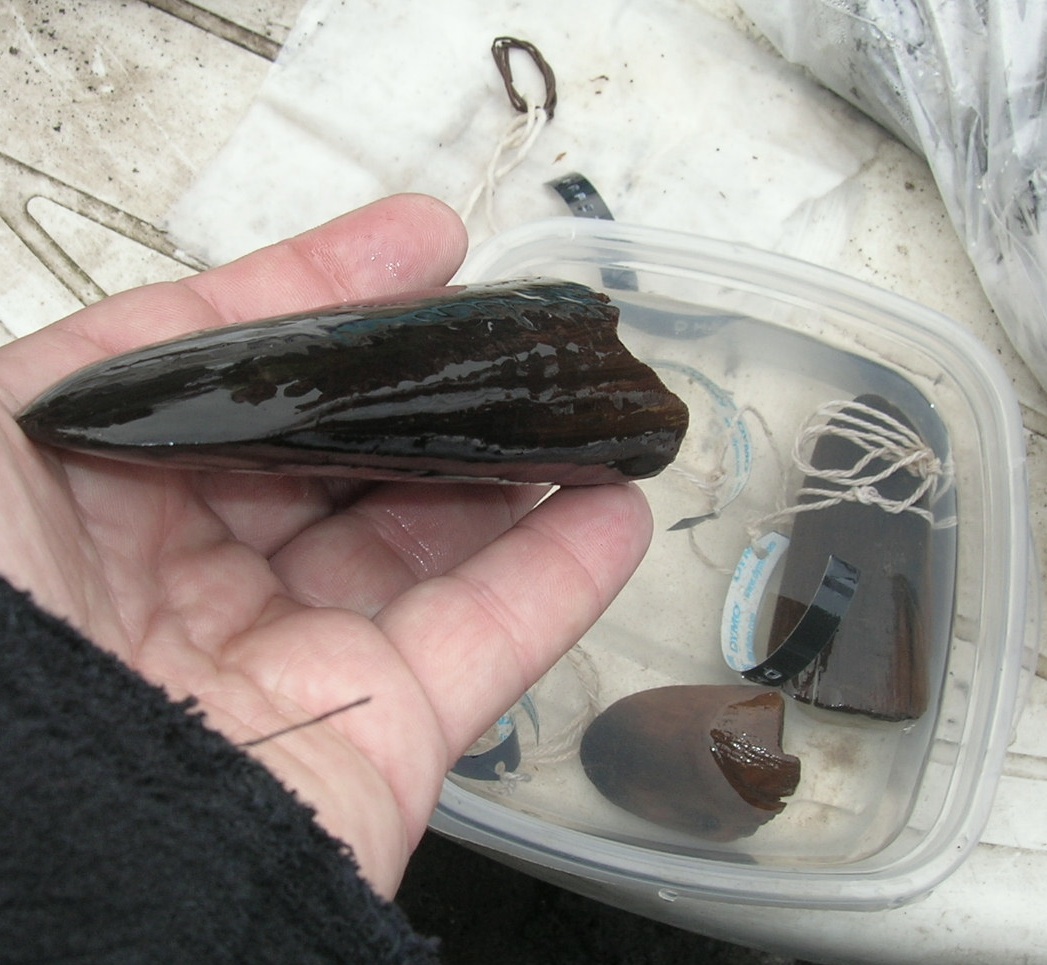
The Tyee has a nice feature on invigoration of traditional use of Wapato (“Indian Potato”) and Camas.  I visited an open house at an archaeological site in Katzie territory a year or two ago and so here’s a couple of pictures of 4,000 year old Wapato tubers and a digging stick of presumably the same age which would have been used to help cultivate the wet beds.  At that site (almost completely destroyed by the new Golden Ears suburban commuter bridge), there were signs of the creation of enhanced “water gardens” for Wapato, and not just the harvesting of what occurs naturally.  Similarly, camas productivity was greatly enhanced by selective weeding and by the practice of tilling and selective bulb harvesting as well as deliberate burning to manage the camas fields.  All in all, exploitation of many plant foods (and shellfish) formed a practice intermediate between farming and gathering, and thereby are a powerful line of evidence for traditional use of large areas of SW British Columbia.  The Tyee article seems to me to be clear, accurate and informative.  I recommend it.

Tip of a wooden digging stick, ca. 4000 years old, Katzie territory. Two others of the dozens found can be seen in the background.

Even more on the Wilson Duff – SGang Gwaay Musical

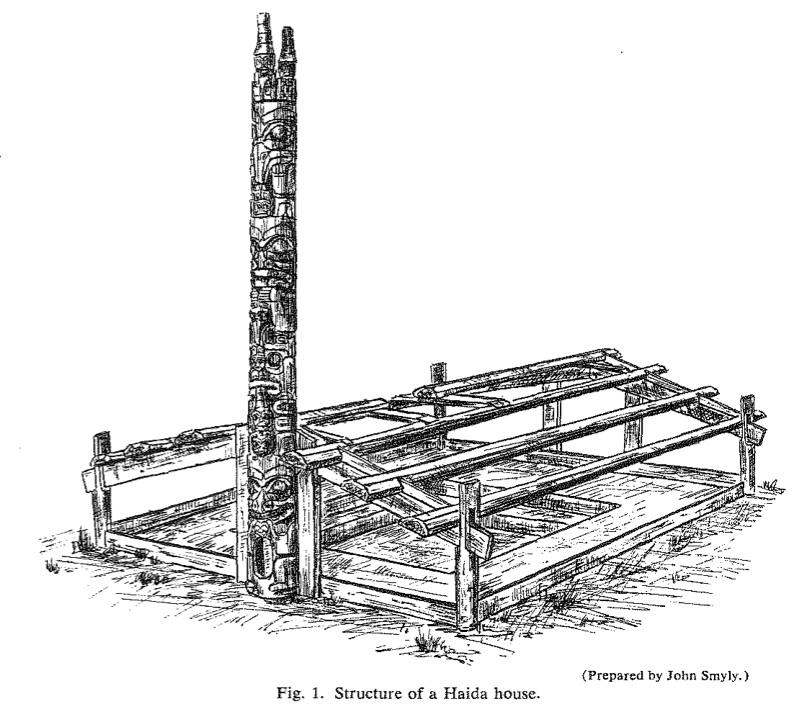
Haida House and pole. Source: Duff and Kew, 1957.

A month or two ago I made several posts (1 , 2, 3) about a forthcoming musical called Beyond Eden, which tells the story of the 1957 expedition to ‘rescue’ poles from the Haida Town of SGang Gwaay (PDF).

I notice The Tyee has a very good overview of this musical (which opens tonight) including some comments from Roy Jones Sr. of Skidegate, last seen on this blog as a young man climbing poles in 1957 CBC archival footage.  Says The Tyee:

Now in his mid-80s, he is reflective about the experience, having enjoyed the physical work and the company of members of the crew — but about cutting the poles? “It didn’t feel right,” he said. However, the Skidegate Band Council had approved the work and many felt it was the right thing to do. Further to that, Jones was on a recent trip to The Chicago Field Museum and saw one of the poles taken from Skedans (an expedition he was also on). “If they hadn’t taken it at that time, it would have been ruined, I think,” he said.

It is good to see some Haida perspective on both the events of 1957 and on this musical.  I also didn’t realize Nathalie at the Qay museum was a student of Wilson Duff’s — I’ll have to buy her a coffee and pump her for stories next time I am up on the islands. It’s a good article — The Tyee is doing some of the best journalism in BC right now.

Poster for "Beyond Eden" musical. Click to buy tickets; scroll down for title song.

ASBC Victoria January Meeting

Haida Gwaii watershed above Sunday Inlet.

The Archaeological Society of British Columbia is a long-established society which promotes knowledge and conservation of BC Archaeology.  The Victoria Chapter is particularly active (though they need to update their website and blog).  They aim for a public lecture every month. There are also chapters in Nanaimo and Vancouver.

This month’s Victoria talk, which is free and open to the public, is:

Watersheds and Coastal Archaeology: A Northwest Coast Perspective.

Jan. 19, 2010, 7:30 pm Pacific Forestry Centre, 506 West Burnside Road.

Rich Hutchings

The watershed or basin has been considered a primary unit of analysis for hydrologists, geologists, ecologists, human geographers, and historians. On the Northwest Coast, the economic significance of riverine settlement has long been a central focus, yet it is only in the last decade that anthropologists have begun to contemplate the social, political and ideological implications of rivers, river edges, and, to a lesser degree, basins. In this lecture, I will explore the concept of watersheds as a unit of analysis for archaeologists working on the Coast. Specifically, I consider the notion of what I call ‘watershed identity’, the issue of territorial boundaries, and the social implications of changing basin landscapes. Finally, these issues are highlighted in relation to the increasing threat of coastal erosion and its impact on maritime heritage, a concern for archaeologists and communities alike in this region.

Biography: Rich Hutchings was born and raised in Seattle, Washington. Having trained and worked as a diver in the marine industry, Rich completed his undergraduate degree at the University of Idaho, Moscow. He then undertook research in the area of alluvial and coastal geoarchaeology on the Nooksack River, earning his Masters degree from Western Washington University, Bellingham in 2004. Rich is currently pursuing Doctoral research at the University of British Columbia, looking at maritime cultural landscapes, coastal erosion, and marine heritage management in the Sechelt area. For information, phone 384-6059 or e-mail asbcvictoria@gmail.com

Haida Argillite Pipe: High Resolution Pictures

Detail: Haida Argillite Pipe ca. 1880. http://www.antiquearms.co.uk

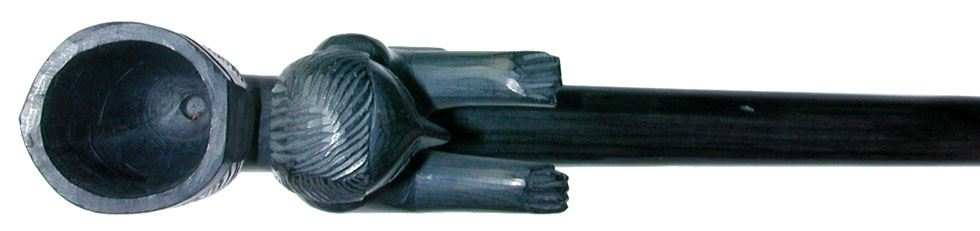
I occasionally complain about the lousy pictures that professional organizations put on the web.  I guess I should know that when you have something to sell, you put it’s best face forward; when you don’t, you might not care as much.  Check out the high resolution pictures of this Haida argillite pipe for sale (4,800 GBP).  Multiple angles of the pipe, each one sharp and crisp: you can see each stroke of the knife and the grain of the slate.  Yes there is some glare but the images are much better than most museums make available on the web.  Amazing stuff.

Described as:

19thC. HAIDA ARGILLITE EFFIGY PIPE. #4213 #4213

a bowl carved in the form of a European sailor’s head with large rounded eyes and long straight nose, a figure seated astride the stem also with large rounded eyes and long straight nose and with arms extended wearing European costume with a stripe incised along the sides of the tunic arms and the trousers. Overall 20cm. From the tribes of the Pacific Northwest Coast of North America, principily Northern Columbia and Queen Charlotte Island. 20cm

This pipe was brought back and formed part of the collection of John Madden (1837-1902) of Hilton Park Clones Co, Monaghan Ireland, he left the Irish family estate at the age of 24 to travel by horse across the eastern states of America as far as the Great Lakes just before the start of the Civil War. During his later travels between 1870-1890 he is known to have reached British Columbia where he bought this pipe, it stayed in the family home until the collection was sold at an auction of part of the contents of Hilton Park on the 8th July 1985 where this item was aquired.

For the record, here are the seven views offered by the dealer: 1, 2, 3, 4, 5, 6, 7.

Haida Pipe: detail as if looking down the stem to the bowl.

Replica Tlingit Armour

Replicated Tlingit body armour.

The Tlingit artist Tommy Joseph has replicated a traditional set of armour:

… body armor made of alder slats and rods and woven together with hemp. Wooden panels are stitched together with leather lacing. Moosehide straps. Two alder toggles fasten the armor around the body.

It’s for sale: $3,500.

I was looking into this because of a recent post on Linen Armour (!) at Heather Pringle’s blog — I tried to leave a comment there in response to a question about NW Coast armour but wordpress ate it — probably because I had a bunch of links.  Dan form there, if you read this, most likely the armour Simon Fraser saw was made of two or more layers of stiffened elk hide.

Nettle winding around wooden slats and rods plus toggle fastening.


The Gabriolan

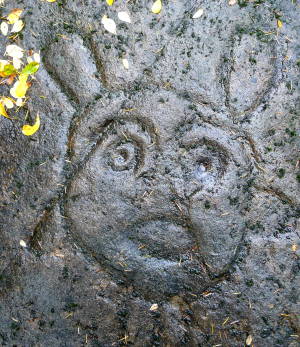
Gabriola Petroglyph. Source: The Gabriolan.ca

Another blog linked to me the other day: The Gabriolan. This is a lovely blog, whose mysterious author has a great eye for the quirky and beautiful things about that Island. I especially like the various pictures of unusual things found in the woods, like antlers on trees. On my quick browse through the site I noted the excellent photograph of a Gabriola Island petroglyph which I am posting above. This is not a petroglyph I am familiar with though I don’t have my books in front of me.  I’ll look it up.  With its double-rendered eyes and protruding ears, it may be Mouse-Woman.  But anyway, anonymous Gabriolan, thanks for the link, and look after those petroglyphs.

Capital Regional District Report

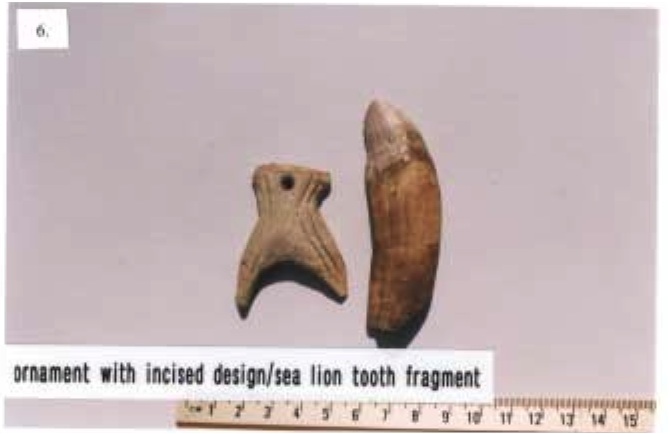
Decorated antler?, and a worked sea lion tooth from the Elchuk collection, Mill Hill.

I just came across this interesting document from 1999 by Liz Crocker (PDF) which is a cultural history of three CRD Parks: Mill Hill, Francis/King and Thetis Lake.  While I wouldn’t put a lot of stock in the archaeological component of this report, there are at least two notations of considerable interest.

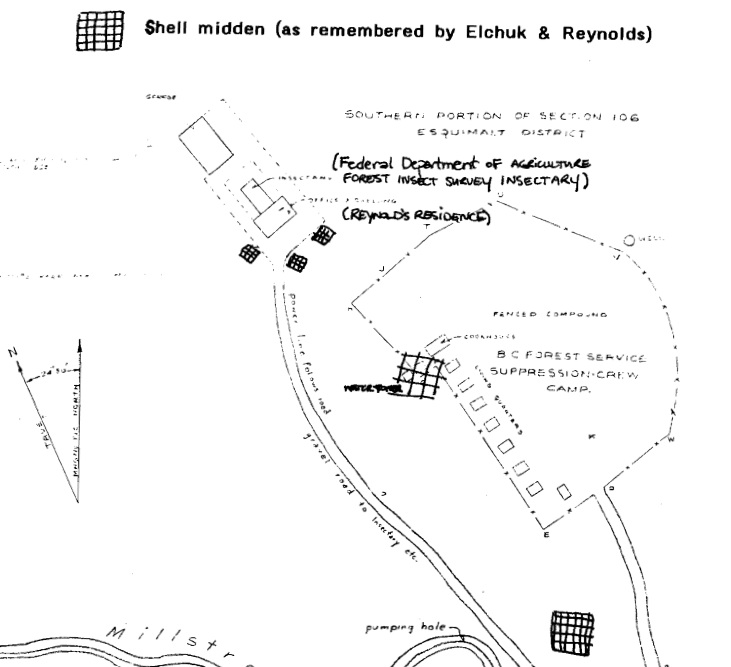
The first is the documentation of an unrecorded shell midden at Mill Hill, not DcRu-70 but another site, including a sketch map of the location which is about 2 to 3 kilometres inland.  There are also reports of unrecorded inland shell middens at Thetis Lake Park. Since such sites are rare and poorly know,  then this is something worth following up.  Indeed, I wish the CRD took their stewardship role seriously enough to commission an intensive, comprehensive, and professional inventory of the archaeological heritage of all their Parks.  This kind of baseline information is so essential that I honestly don’t understand how they think they can discharge their duties without it.

The other point of interest in Crocker’s report is the documentation of a fairly large private collection, also from Mill Hill and also well inland.  Included in this collection are Locarno-style artifacts as well as more recent ones such as a flat-topped handmaul.  Appendix 2 of the linked report includes some snapshots  of this collection.  Despite the poor quality, it is great to see private collections being documented.  The small decorative piece shown above is interesting and unusual, and the abundance of organic remains suggests again that these were collected from or near a shell midden.  Again, something to follow up. If only there were a Ph.D. student at UVIC, say, who was interested in inland shell middens…..

Sketch map of reported but unrecorded inland shell midden patches at Mill Hill.