Tag Archives: Haida

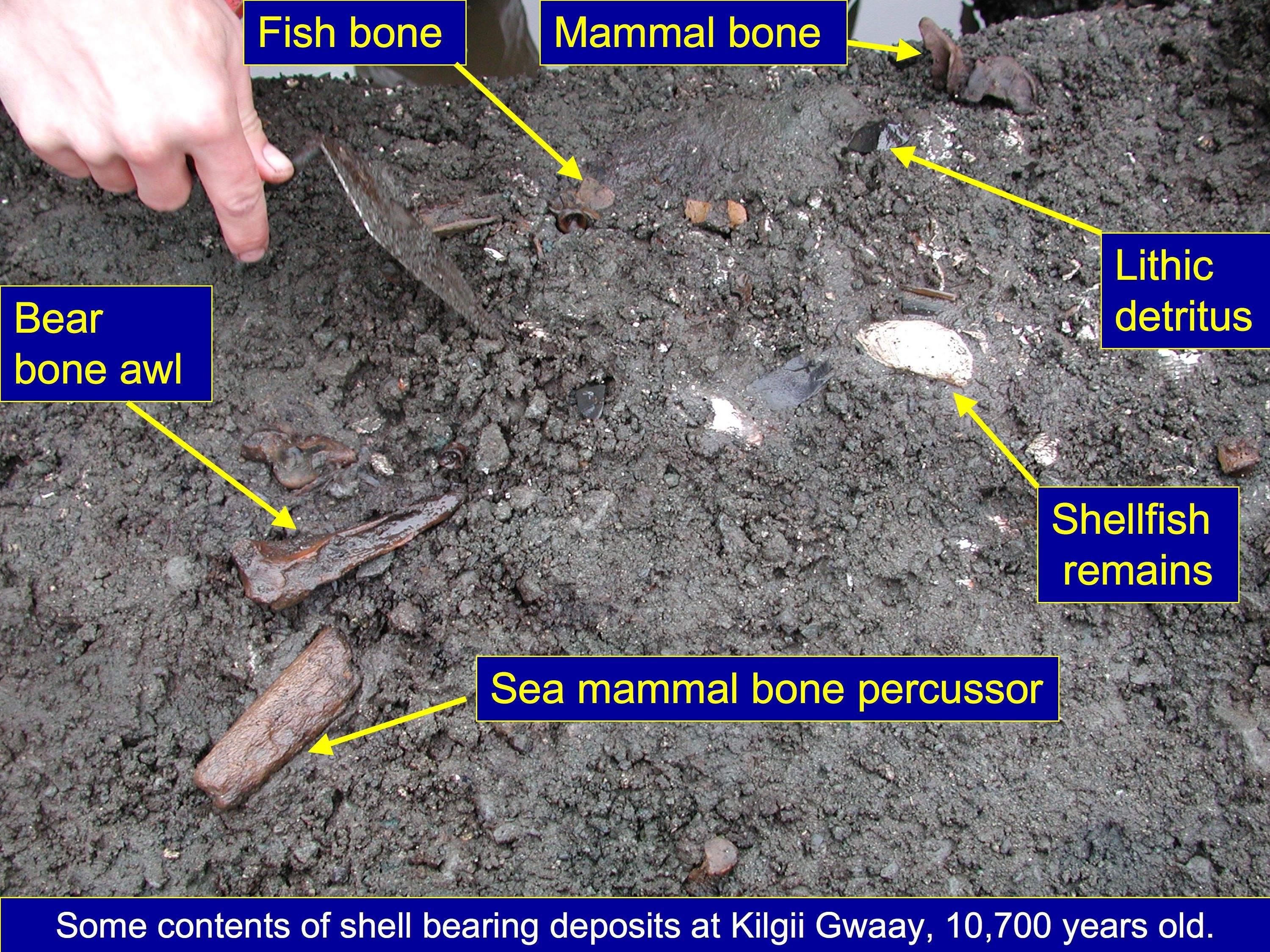
Annotation: Kilgii Gwaay excavations.

Excavation at Kilgii Gwaay, southern Haida Gwaii.

I’ve found that individual powerpoint slides can be saved as JPG images, complete with their annotations.  Since I have a lot of these I may share some.  The above shows excavation in the shell-rich component of the intertidal site at Kilgii Gwaay.  The combination of shellfish remains and saturation in slightly alkaline sea water has produced remarkable preservation for a site which is firmly dated via about 20 carbon samples to 9450 14C BP, or around 10,700 calendar years ago.  In this picture you can see some of the evidence: bone tools, stone tools, and the remains of shellfish, fish and mammals which, together with birds, formed the basis of the diet at this summertime camp.

Continue reading

Raven-Walking & Geological Transformation

Haida History starts at least 14,500 years ago. (Image credit: Daryl Fedje).

Three things we know about Haida Gwaii:

1.  About 14,500 calendar years ago it was a temperate tundra environment, with no trees.  The first trees, pine, appear about 14,000 years ago and there is progressive forest infilling thereafter, with the modern species mixture in place by about 3,000 years ago.

2. It has an impoverished suite of large land mammals – historically, these were limited to black bear, caribou, marten, ermine, a vole and a shrew.  We know that 13,000 years ago there were also deer and brown bear on the islands, and quite likely other species as well.

3.  It used to be much larger than in the present.  With lower sea levels at the end of the last ice age, Hecate Strait was largely dry land, exposing a large, unglaciated, coastal plain that became rapidly flooded.

It seems to me that we can add a fourth thing we know:

Continue reading

Mechanical representation in a Haida Pipe

Haida Pipes, 1837. From U. Washington Collection.

I don’t know much about these early historic Haida argillite pipes.  These ones are illustrated in Edward Belcher’s Narrative of a voyage round the world, 1843, v.1, p. 309.  The lower one captured my attention, with its representation of a conveyor belt (?!) – or, more likely, a block-and-tackle/pulley setup.  The playful seriousness of these pipes is astounding – as can be seen in my earlier post on the SS Beaver pipe.  I would like to see a photograph of this one but I have no idea where it may have ended up.

The image is via the superb University of Washington Digital NW collections.

dSpace: The Indian History Film Project

Haida Town of Chaatl. Source: NMC

There is an interesting archive of interview transcripts housed in dSpace at the University of Regina.  Most of the interviews were by CBC Radio’s Imbert Orchard and so share the flaws of Journalism and Anthropology.   The preamble says,

The original intent of The Indian History Film Project was to conduct interviews with First Nations elders across Canada and to produce a television series portraying Canadian history from a First Nations’ perspective.

The Indian History Film Project was an initiative of Direction Films and was conceived and developed by Tony Snowsill. The project leaders were Tony Snowsill and Christine Welsh. The project evolved over time, and eventually it was decided to access libraries and archives across the country to incorporate existing interviews with First Nations elders. All interviews, whether original or archival, were cross indexed by word and theme and housed in the C.P.R.C [Canadian Plains Research Centre].

A number of these interviews are with Haida people, notably Solomon Wilson and Florence Edenshaw, who discussed her arranged marriage, the meaning of Tow Hill, and the artistic tradition of her family, the Edenshaws and Davidsons.  It appears tapes of these are also available through the BC Archives, but not online.

Note: anytime you see (Indian) it means that a Haida word was not transcribed — an eerie effect.  Searching for British Columbia brings up 91 documents.

The following excerpt from an interview with Solomon Wilson of Skidegate sees him relating a tale of smallpox blankets:

Continue reading

Pitt Rivers Museum Haida Collection on flickr.com

Any idea what activity is being represented on this Haida argillite carving?

The Pitt Rivers Museum in Oxford is one of the world’s great ethnological museums.  Indeed, it is largely presented as a “museum of a museum”, with artifacts and curios displayed in glass cases in juxtapositions that made sense to anthropologists.  Now I see they are putting some of their collection online – one of many interesting innovations going on at that museum.  The Haida Collection which Cara Krmpotich has worked on consists of 200 really well composed and lit photos on the flickr.com website.  Cara notes that she hopes making this material available in this manner will facilitate its use by Haida people and I expect they will (indeed one person with a Haida name has been commenting on some of the photos).  Coincidentally, I see there has recently been a Haida delegation to the Pitt-Rivers museum.

In any case, the flickr set is a fantastic set of images of Haida art and technology. It would be nice to have the full catalogue information or other information associated with these, or at least a statement that such information is lacking.  While there are visually spectacular items throughout the set, also check these plain spoons from SGang’gwaay, Tanu’uu and Masset,  this bird bone whistle, and this tidy little loop of twine.

Haida wooden labret at Pitt Rivers museum.

Argillite Beaver

Haida argillite pipe representing the SS Beaver. Photo: University of Aberdeen.

The SS Beaver was a prominent early side-wheel trading ship on the NW Coast.  Nice to see it memorialized by Haida argillite pipe in the Marischal Museum collection of the University of Aberdeen, along with some other exceptional Haida pipes.  Apparently donated to the museum by the former Captain of the SS Beaver, William Mitchell, this pipe sports a rotating side wheel carved from whale bone, a beaver figurehead, and someone peeking out of the cabin windows, perhaps Capt. Mitchell himself who probably commissioned this carving.  Some other close ups (in an awkward zoomable interface) are  available on the Scots and Aboriginal People in the Fur Trade site.  More on the SS Beaver here.

A figure looking out the window of the SS Beaver pipe.

Sgaawsid K’uuljaad, the Boss Lady Potato.

Sgaawsid K'uuljaad gets funky.

Silly season in Haida Gwaii must have started, as Carey’s potato of unusual size is stolen (and returned), but not before a star appearance or two on youtube.

NW Coast Objects in Madrid

Tlingit adze with quillwork and copper insets in the Museo de América, Madrid.

Tlingit adze with quillwork and copper insets in the Museo de América, Madrid.

Even though the Spanish were among the first outsiders to eplore the NW Coast, you don’t hear much about collections they may have made while out here.  So it is welcome to see this (now, 10 year old) writeup on NW Coast items in Madrid’s Museo de América.  The article suggests that many such objects were collected but not retained in Royal Collections, perhaps because they were considered inferior to, say, Aztec and Inka pieces.  Either way, there are some spectacular objects illustrated in the article, though the photographs are not very sharp at all.

Going to the Museo de América’s website shows they have a search function and some online thumbnails.  This link should take you to their 52 pieces labelled as NW Coast, while this takes you to six pieces listed as from BC.   Most of the illustrations are extremely low resolution, though I found one or two which aren’t such as the outstanding Haida waterfowl, below.  Look how fluid the form-line rendering is in this 18th century piece.  Click the images on the Museo site for slightly higher resolution or go to the records page by clicking on “Ficha Completa” and then on “Ampliar Imagen”, where you can zoom in slightly using the magnifying glass.  Also worth checking out, this Tlingit clap-board style “rattle”, this foreshaft and point, and this rather spectacular hat.  Anyway, something to poke more: online catalogues in Spanish Museums.

EDIT:  I see their search function makes links to search results expire after a short time so I crossed them out, above.  Pretty lame, but there you go.  Get into the system via the generic system and then browse around, if you want.

18th Century Haida Waterfowl.

18th Century Haida waterfowl, listed as made from"Ivory".

Skidegate Haida Model Village

Model of Skidegate (hlgaagilda 'llnagaay) as installed at Chicago Exhibition, 1893.

Model of Skidegate (hlgaagilda 'llnagaay) as installed at Chicago Exhibition, 1893.

The Burke Museum in Seattle is doing excellent work.  I just found the project which they are spearheading, together with the Haida Museum at Kaay’llnagaay and the Field Museum in Chicago, to reassemble the famous model village of Skidegate (hlgaagilda ‘llnagaay) created for the 1893  Chicago World Fair.  This exhibition was organized by Putnam, implemented by Boas, who hired James Deans (a well known Victoria antiquarian) to collect some NW Coast stuff.  Deans outdid himself by arranging for the carving of a complete model of Skidegate Village  – amounting to some 27 model houses (most with frontal poles), 2 model mortuary houses, and 17 free standing model poles.  (Deans also apparently collected three boxcars of other material including an entire house, canoe and other material, but that’s another story).

The Burke Museum now allows you to view an interactive panorama of the model village.

The website is designed both to showcase these model houses and also to help find the 13 houses and poles which have gone missing.   The intention is to return the model village to Kaay in 2011.  Replacement poles and houses will be commisioned for those that cannot be found.   A highlight are the videos of Skidegate residents such as Captain Gold, Niis Wes, Percy Williams, Kii7iljuus, and Kwiaahwah Jones talking about the model village, about family, and above all about being Haida yesterday, today and tomorrow.

House of Contentment, model carved by George Dickson

House of Contentment, model carved by George Dickson

Vancouver [Native] Art in the Sixties

GOOGA!

GOOGA!

This 1962 picture of Haida artist Robert Davidson at age 13 caught my eye, not least because he looks a lot like his nephew, Haida archaeologist and great guy Allan “Googa Boy Lefty ClamBone Monica Sunshine” Davidson. Here’s Allan tending to his espresso pot at Richardson Island.  Very shareable.  I am pretty sure this was before I accidentally tossed a grub into his cup.