Tag Archives: First Nations

Boundary Maintenance

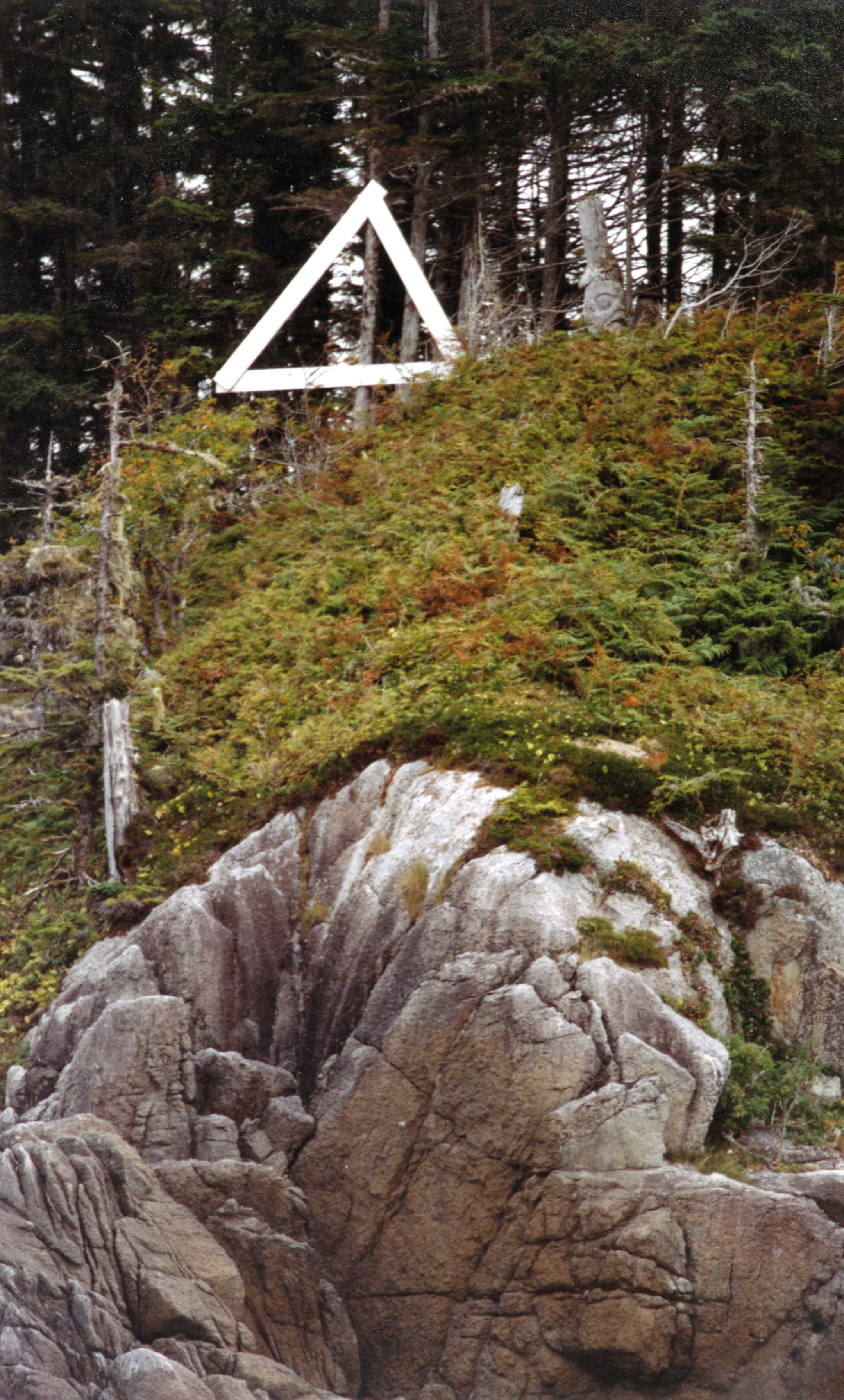
Headland with wooden markers. Click to zoom.

This is one of my favourite pictures of B.C. Archaeology, even though  it doesn’t look like much.  It’s a bit fuzzy: I took it with a zoom lens in about 1985 , rounding a headland in a small boat  on the Central Coast.  In fact, you might think it doesn’t look all that archaeological.  Look closer: sticking up to the right of the white triangle you can see the carved head of a pole.

The white triangle is a standard device used by Fisheries to demarcate the different fishing zones on the coast, for management purposes.  On one side of the triangle there might be different catch limits or closures or seasons of harvest enforced than on the other.

I don’t know much about the pole, but its location on such a prominent headland, facing the open Pacific, next stop Japan, is suggestive it marked a change of territory, a boundary shift, a movement from the control of one lineage or house to another. You don’t often see such a pole away from a village site.

Both wooden markers may ultimately serve the same purpose: boundary maintenance between zones of control; advertisements for power; watchful symbols of formal rights; the means of resource management.  It is intriguing and almost poetic to see them standing, side by side, on the same headland, guarding the same water.

Detail of wooden markers.

Canoe Steaming

Carl and Joe Martin steam a canoe near Tofino. Click to play video.

The Northwest Coast is rightly famous for the superb dugout canoes made by First Nations, a craft which continues to the present day.  It takes weeks or months to carve  a canoe from a single log of red cedar – imagine then the tension inherent in having a big part of the success or failure “boil down” to a single event the steaming process.  The video above shows master carvers Joe and Carl Martin of the Nuu-chah-nulth nation steaming a canoe at a beach near Tofino, on western Vancouver Island.

Steaming softens the cedar and makes it more flexible, allowing the insertion of carefully-measured, carefully-planned wooden spacers which spread the middle of the canoe into a graceful curve, increasing its buoyancy, resistance to capsizing, and introducing subtle yet beautiful lines, as seen in this enormous example mis-labelled (I think) as Salish.  After the canoe cools and dries, the wood returns to its natural properties. The process means the canoe can in principle be wider than the single piece of cedar from which it is carved.

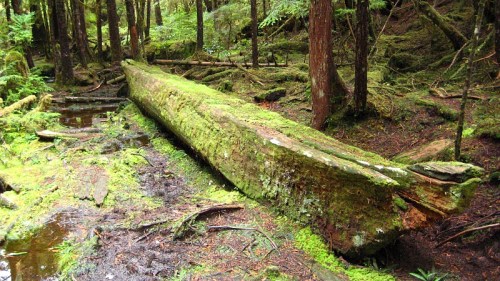
You can click here to see a slide show of the steaming of a Haida canoe carved by the team of Jaalen Edenshaw and his father Guujaw. In the old times, a canoe might be roughed out in the bush then hauled to the beach for finishing.  Sometimes flaws in the wood or other interruptions mean a canoe was never finished.  Such half-finished vessels are a known, but uncommon archaeological site in the woods of coastal British Columbia.

The carving of such canoes is increasingly common.  Nowadays, the canoe log is likely to be hauled to a carving shed.  Sadly, a major constraint  on canoe construction is the difficulty in obtaining prime, straight, clear, old-growth cedar logs.

Partially finished Haida canoe in forest. Photo by Martin Lalune.

Geist: Memory and the Valley Photo Essay

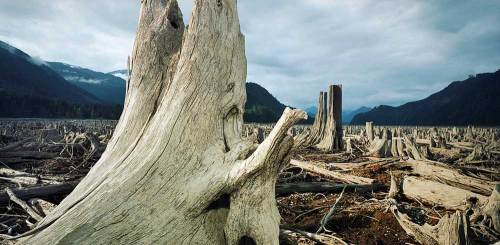
Sxwòyeqs (The Place that Everyone Died) | Stave Lake. Source: Geist Magazine.

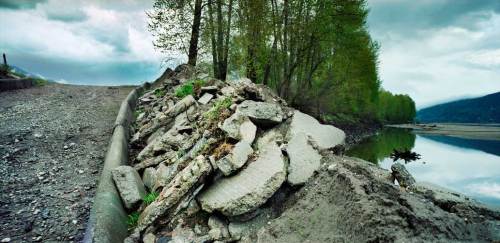
A while ago I linked to a beautiful photo-essay from Geist Magazine on decaying towns on the BC coast.  I see they have another excellent photo essay, this one on the subject of the superposition of Euro-Canadian towns and spaces onto Aboriginal archaeological sites and significant places.  The text by Sandra Shields and David Campion is sensitive and evocative and the photographs are well taken — in some ways they are banal – an overpass, and access road – yet knowing what lies underneath triggers emotional reactions. UVIC’s own Duncan McLaren is featured as well so it must be a good article – Stave Lake (above) has two of the oldest archaeological sites in Canada (each more than 12,000 years old), parts of which miraculously survived the reservoir inundation.

The Geist authors are interviewed here, which is also well worth reading:

Interviewer: it’s not only peo­ple that are miss­ing in “Memory and the Valley”; you touch on the dis­ap­pear­ing salmon, the white pine, the waters drained away. There’s def­i­nitely that tone of loss through­out the whole work.

Campion: That is why we’re hav­ing the exhibit here in the old city hall in Chilliwack, with a wall of the orig­i­nal pio­neers look­ing down on the work. It’s because you strug­gle with these two nar­ra­tives. One says: When Canada started, we came to a land that had no peo­ple in it and we strug­gled really hard and made a won­der­ful life for our­selves and a future for our chil­dren. Whereas, for abo­rig­i­nal peo­ple, it’s a story of huge pain and suf­fer­ing, and a huge loss of peo­ple to dis­ease, even before con­tact. Then res­i­den­tial schools, cul­tural mod­i­fi­ca­tion, and so on.

So you’ve got this prob­lem at the base of Canadian soci­ety. For soci­ety as a whole to move for­ward, we need to find a way to acknowl­edge that loss, not just to have it mean some­thing in that on/off, negative/positive sense. As non-Natives, we need to find a way to absorb the real­i­ties of our com­ing here into our national narrative.

The notion of a “palimpsest” in archaeology is common, borrowed from manuscript studies: parchments would be scraped clean and re-used, yet, the older writing can still be seen and read, a ghostly precursor image.  Writing over writing, material culture over material culture, names over names and the living over the dead.  Every time you walk across the concrete apron in front of the MacPherson Library at UVIC you walk across an archaeological site.  Every time you leave the Elliot Lecture hall you walk across a site.  The Legislature is on a site, the Fraser Arms Hotel, the Willows Beach Tea House, all superimposed, a collective blotting.  Our feet tread the scraped parchment of the dead.
Leq’á:mél | Nicomen Island

Replica Tlingit Armour

Replicated Tlingit body armour.

The Tlingit artist Tommy Joseph has replicated a traditional set of armour:

… body armor made of alder slats and rods and woven together with hemp. Wooden panels are stitched together with leather lacing. Moosehide straps. Two alder toggles fasten the armor around the body.

It’s for sale: $3,500.

I was looking into this because of a recent post on Linen Armour (!) at Heather Pringle’s blog — I tried to leave a comment there in response to a question about NW Coast armour but wordpress ate it — probably because I had a bunch of links.  Dan form there, if you read this, most likely the armour Simon Fraser saw was made of two or more layers of stiffened elk hide.

Nettle winding around wooden slats and rods plus toggle fastening.


Victoria-Songhees reburial

Mayor Fortin builds a bridge to the Songhees First Nation. Picture: Johnstonstreetbridge.org

Last summer there was a sad incident with human remains being disturbed in the Dallas Road area of Victoria. The remains, of a young SLENI (woman) were subsequently reburied and since then a burning ceremony has been held.  I’ve been privileged to attend burning and reburial ceremonies and they are powerful and sincere events.  Interesting then to see this news snippet today , focusing on the cost ($9,400) — I can hardly wait for the informed and balanced commentary to ensue.  But kudos to Dean Fortin for doing the right thing – it is no more (or less) than most developers have done over the last decade when human remains were disturbed.  I have to say, though, it is disingenous for Mayor Fortin to note the Songhees reserve is not in the City of Victoria — memo to the Mayor: Victoria is within Songhees territory; the remains are from Songhees territory, the current reserve boundaries are completely irrelevant to this issue.

Victoria News

The cost of being freindly [sic]

By Lisa Weighton – Victoria News

Published: January 11, 2010 3:00 PM

Updated: January 11, 2010 3:34 PM

Mayor Dean Fortin is making First Nations relations a priority.

Last month, the city invested $9,400 in a traditional reburial ceremony after discovering 300-year-old human bones during a sewer retrenching project on Dallas Road, Aug. 27.

“We feel like we have an obligation to work with all other levels of government including our First Nations,” said Fortin.

The cost was a drop in the bucket in the overall $2.4 million-project said Derk Wevers, the city’s sewer and storm water quality technician.

Following consultation with Esquimalt First Nation elder Mary Anne Thomas and Songhees First Nation elder Elmer George, a reburial service was held Dec. 8.

The city also financed a traditional burning ceremony and feast on the Songhees First Nation reserve late last month, which included wages for a city contractor, gifts, food and the gravestone.

Fortin said he was eager to take part despite the reserve not being within Victoria’s boundaries.

Decaying resource towns of the BC coast.

Inside the school library at Ocean Falls.

Inside the school library at Ocean Falls.

Photographer Christopher Grabowski has a beautiful photo-essay at Geist magazine on the subject of decaying resource towns of the British Columbian coast, with emphasis on Alert Bay and  Ocean Falls.  You can read the essay alone, or as the multi-page photo essay, and also read an interview with Grabowski here.  A fuller set of his Ocean Falls photographs can be seen here. (2018 edit: here)

It is striking how Europeans and other settlers were so active on the coast.  Hundreds of communities have come and gone, and settlers are now concentrated in only a few major towns.  Meanwhile, the First Nations remain on their land – in the long term, perhaps, European presence on the remote coastal lands will come to resemble a blip more than an occupation.

In the meantime, these fantastic photos remind us of the wasteful ways of the culture with perhaps the shortest attention span on earth: Canada.

The inscribed fireplace in the ballroom at Ocean Falls: Archie Martin … Ocean Falls community is a monument to his memory. Indeed.

Haida, Argillite, and the Pig War

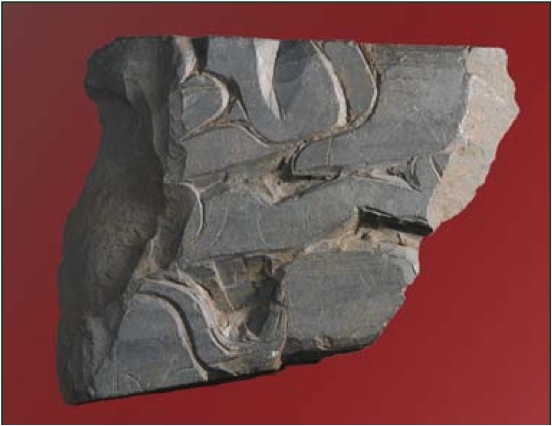
Carved argillite from Belle Vue Sheep Farm, San Juan Island. Source: NPS.

I don’t know as much about the 1859 Pig War as you might think, having spent an awful lot of time on San Juan Island. This “war”, which was more of an armed standoff between British and American troops, was a key event in the various mid-19th century boundary disputes.  One key location was Belle Vue Sheep Farm, near the southern tip of San Juan Island, where there has recently been some interesting historical archaeological work by the U.S. National Parks Service.

One interesting find at this dig is a piece of carved argillite, shown above, which most likely stems from Haida Gwaii (see page 7 of this PDF report, browse other NW NPS reports here).  Around this time there were plenty of Haida and other North Coast Nations around the Victoria area, and so it is not surprising, really, to see this piece.  And yet, it is also a stroke of massive good fortune to have such a distinctive piece of the turbulent 19th century history of First Nations.

Intriguingly, a key figure on the American side of the Pig War was George Pickett, who later achieved substantial fame for leading Pickett’s Charge at the Battle of Gettysburg in the American Civil War,

Ironically for someone who later fought for the racist Confederacy, Pickett was once married to a Haida woman by the name of Sâkis Tiigang.   (More often known as “Morning Mist”, this site gives her Haida name as beSakkis Tiigang while the Pickett Society in a detailed article gives her the slightly more authoritative-seeming name Sâkis Tiigang, meaning “Mist Lying Down”).  They had a son together, the artist James Tilton Pickett who, without wanting to generalize overly, certainly looks like a Haida man.  Shortly after the birth of young James in 1857, Sâkis Tiigang passed away.

Probably there is no tangible connection between Morning Mist/Sâkis Tiigang and this carved piece of her homeland, but surely there is a poetic one.

James Tilton Pickett, son of Sâkis Tiigang and George Pickett/ 1857-1889. Source: Pickett Society.

Google and the Indigenous Mapping Network

Nisga'a Place Names. Click for interactive version.

Google is putting together a workshop together with the Indigenous Mapping Network:

On February 25th and 26th, 2010, Google and IMN will host a workshop on the Google campus for members and staff of indigenous groups who want to learn about Google geospatial and mobile technologies. This hands-on workshop will approach Google technologies with the special concerns of indigenous communities in mind, and will focus on the technical aspects of using Google Earth, Google Maps, Sketchup, Android mobile phones and Open Data Kit, among other technologies.

I’m pretty sure both parties are on it, but despite Google’s corporate motto of “Do No Evil” uploading sensitive, spatially-referenced cultural information to their servers seems like something that would need some thought.  Nonetheless, it is interesting to see this as a pro-active direction Google is taking.  Canadian First Nations are some of the most GIS-savvy anywhere in the world.  One of their main networks seems to be the Aboriginal Mapping Network, who have an excellent-looking book coming out soon called Living Proof: The Essential Data-Collection Guide for Indigenous Use-and-Occupancy Map Surveys by Terry N. Tobias.  Also see their handy link to data sources especially for BC.

Speaking of Wilson Duff and Bill Reid

Roy Jones of Skidegate climbs a pole at SGang Gwaay. Source: CBC.

Yesterday I noted the upcoming musical about the Bill Reid-Wilson Duff expedition to “rescue” carved poles at the Haida Village of SGang Gwaay (Ninstints).  I’ve just found that the CBC has posted online a short documentary, (2013:edit, use this link)  first broadcast in 1959 and narrated by Bill Reid, showing the removal of these poles to the Museum of Anthropology at UVIC.  The expedition also included Wayne Suttles and Michael Kew, as well as Wilson Duff of course.  The Haida crew consisted of Roy Jones, Clarence Jones and Frank Jones of Skidegate. Some aspects of the trip are recounted in the BC Provincial Museum Annual Report of 1957, which I will scan and post some other day.

The spoken component of the documentary is a fascinating account by Reid, at that time just beginning his carving career, but the real jaw-dropping element is the depiction of the use of axes and saws and climbing spikes to log this forest of poles.  Necessary, of course, but jarring nonetheless.

Broadcast Date: May 21, 1959

A small boat ferrying Bill Reid and a team of anthropologists approaches the southern tip of the Queen Charlotte Islands. Reid documents the rescue mission to salvage and relocate the last of the crumbling Haida totems as revealed in this CBC documentary. With a sense of excited urgency, Reid describes and catalogues the enormous poles on the approaching shore. As they are gently felled, the majestic cultural landmarks will creak and groan before they are prepared for transport.

It’s low resolution and grainy, but the general impression is a very powerful one.

Felling a tree, surely, not a pole at SGang Gwaay. Source: CBC.

Videos of Gwaii Haanas Archaeology

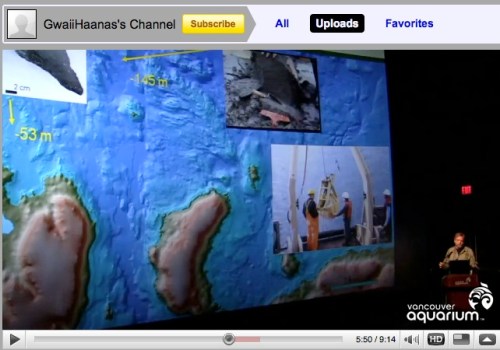
Daryl braves the barrage of bras to set the Vancouver Aquarium straight on the value of dead fish over living fish. Click to play part 1.

Rockwash superstars Nicole and Daryl show off their cool wares in a couple of videos I just found online – I vaguely remember them going off to give this talk at the Vancouver Aquarium.  It’s in two parts: 1 and 2.  Nicole looks fabulous and Daryl has trimmed his beard!  Win-Win.  The projects they describe sure were a lot of fun to take part in.   There are a few other talks up including Lyle Dick and Norm Sloan on Sea Otters on the Gwaii Haanas Youtube Channel.

A sandhill crane is a tough act fo follow but Nicole hammers home the righteous message of dead fish. Click to play part 2.