Yuungnaqpiallerput: Yup’ik Science and Survival

Inflating the stomach of a beluga whale. Source: Yupikscience.org

Yuungnaqpiallerput (The Way We Genuinely Live): Masterworks of Yup’ik Science and Survival” is a fascinating and informative (and large!) website companion to a 2008 exhibition by the same name at the Anchorage MuseumBooks and catalogues are also available and look to be excellent.

I know that Yup’ik territory, on the southern flanks of the Bering Straits, is a long way from the Northwest Coast.  But there are many similarities in the ingenious tricks and tools of the trade needed for a maritime lifestyle, and this exhibition deftly combines historical, archaeological and ethnographic accounts into a compelling vision of people at ease on land and sea.

.

Continue reading

Montana Creek Fish Trap, Alaska

Montana Creek Fishtrap being excavated, 1989. Source: Sealaska

In 1989 a nearly complete fish trap was found in Montana Creek, near Juneau Alaska in Aak’w Kwáan Tlingit territory. The cylindrical trap, measuring 3 metres long and 1 metre in diameter, was excavated and found to date to about 600 years ago.  The trap was preliminarily reported in Kathryn Bernick’s 1998 book Hidden Dimensions (UBC Press).  Fishtraps were supported by wood and/or stone weir structures which also  act to direct fish into the trap.  The trap would be removed at the end of each season and stored nearby or at camp.  Of course, being wood, they intrinsically don’t preserve very well except in anaerobic and wet conditions.  They are therefore rather rare since they would need to be left in the creek after use in order to preserve.  So this one is very unusual, and especially so since it was essentially complete (other than being flattened).  All credit to the finder, Paul Kissner, for being alert, recognizing the trap, and reporting it promptly.

But now, the fishtrap has become very much a living object.

Continue reading

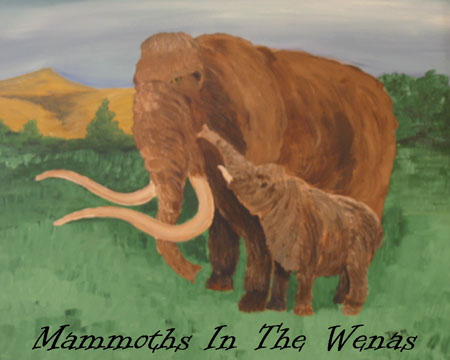
Mammoth Wenas

Mammoth Wenas. Source: CWU.edu; painting by Bronwyn Mayo.

For the past few years, students and faculty from Central Washington University have been excavating terminal Pleistocene fauna, including a partial mammoth skeleton, from the Wenas Creek area just north of Yakima (map), and they have a nice website documenting their work.  Radiocarbon dates on the mammoth came back at 13,400 and 14,000  radiocarbon years ago, or about 16,000 calendar years ago.  Too old for archaeological interest!  Right?

Continue reading

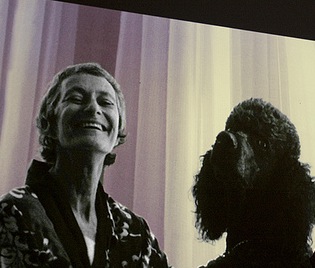
Sally Binford

Sally Binford with her poodle, Jake. Photo credit: Honey Lee Cottrell, source: SFMOMA (click); cropped from original.

There is not much question that Lewis Binford was one of the most influential archaeologists of the 20th century – if not the founder, then the loudest exponent of “The New Archaeology“.  Like a lot of archaeologists not of a certain age, nor of a certain geography, I had never really focused on the co-editor of one of his more influential books, New Perspectives in Archaeology: Sally Binford.  Insofar as I had thought of her, I imagined some sort of academic liaison followed by her giving up her career, this being the 1960s and all – a not uncommon pattern.  Who was this other Binford, this flash in the pan?  I can’t be the only one who has wondered that, and not being plugged into the grandest social circles of the discipline, I’m turning to the internet.

Turns out she was superbly interesting in her own right.  I just came across a blog post recounting an interview excerpted from this book, which she gave not long before her death in 1994 (a death by her own hand on a date she had set 20 years ahead – one day before her 70th birthday.  She took her poodle, Jake, with her).  I  found the whole thing from A Very Remote Time Indeed.

I don’t endorse the interview in any particular way, clearly it is her perspective, but since Lewis Binford is a well known blowhard it can’t hurt to hear something from the other side of those days – especially as it also implicates the academic culture of Anthropology in the 1960s as including strong anti-semitic and racist undertones.  So, it is rather voyeuristically fascinating for me to read the lengthy interview,  but I warn it is a somewhat not-safe-for-work link.  There are some nude bodies and so forth, reflecting her post-archaeology career as a sex educator and sexual liberationist of some note.  Scroll down about halfway for the meetup with Lewis.  I’m pasting in some excerpts “below the fold”.

This whole thing is only tangentially related to the Northwest Coast and may be much too “inside baseball” for many readers, but the entire interview is quite compelling as a portrait of a cutting edge feminist and free thinker who intersected briefly, yet, brightly, with archaeology.

Continue reading

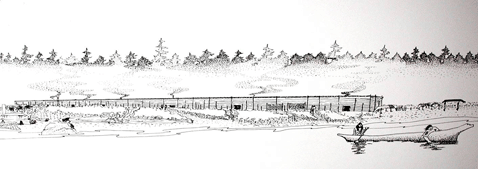
D’Suq’Wub: Old Man House – a Poster

Old Man House: computer reconstruction of one end. Source: Suquamish Tribe.

“Old Man House” is on the Kitsap Peninsula just north of Bainbridge island, across Puget Sound from modern downtown Seattle.  The “house” was the subject of one of the earlier excavations on the NW Coast by Warren Snyder and team from the University of Washington.  The house formed the locus of a major village of the Suquamish Tribe, and its most famous historic resident was Chief Sealth, also known as Chief Seattle.  The Suquamish Tribe has a very nice poster on the history and archaeology of Old Man House which can be downloaded from their website – clicking here will start a moderately sized JPG file. (Edit 2018: archived copy here)

Interpretive sketch of Old Man House. Source: Suquamish Tribe.

It is a bit of misnomer to call this structure a “house” though.

Continue reading

The Schieffelin Brothers Yukon River Prospecting Trip of 1882

Tanana woman returning from the hunt, 1882. Source: AKDC

Browsing in the Alaska Digital Archives I found an interesting photo album documenting a prospecting trip up the Yukon River by the Schieffelin Brothers, Ed and Al, who just a few years earlier had founded the famous desert mining town of Tombstone, Arizona.  Two pictures from this album struck me as particularly interesting, though the whole thing is worth browsing.

The first of these is the remarkable picture above, showing a Tanana woman with a long-gun, powder horn, and a couple of large rabbits.  While anthropologists and archaeologists have grudgingly revised their “Man the Hunter” stereotypes in recent years, it is nonetheless rare to see such a frank portrait of a competent woman with her prey.  I’ll be using this one in class, starting next week.

Continue reading

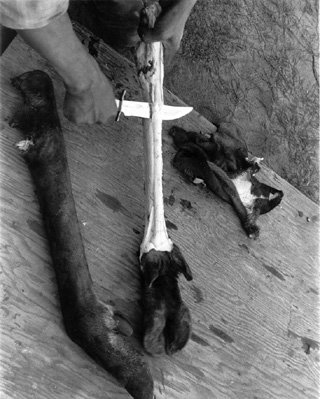
Caribou Metatarsal Hide Scraper

John Shea stripping ligaments from a caribou metatarsal in preparation for making a hide scraper. Source: SFU.ca

I haven’t really mined the SFU Archaeology museum website yet – they seem to have had a bit of a makeover recently, though many of their online resources are achieving “vintage” status.  One such is the photo-essay on making a hide scraper from a caribou metatarsal, or the long, straight bone between the caribou ankle and its hoof – the long bone of the foot (ungulates walk on their tip toes).

The essay is a series of over 20 pictures showing step-by-step the process of making the scraper:

Continue reading

Photos of Victoria and Esquimalt, 1859

Victoria 1859. Source: LOC

In 1846, the Oregon Treaty established the boundary between British and American territory west of the Rockies (and unintentionally established the benchmark date for whether archaeological sites are automatically protected under the Heritage Conservation Act, but that’s another story).  Vancouver Island was to remain in British hands in its entirety, but otherwise the 49th parallel was to be the boundary on land.  The ocean boundary through the Salish Sea was resolved later, after the armed standoff on San Juan Island known as the “Pig War“.   An International Boundary Commission was struck, with the mandate of surveying the 49th parallel and one of its base camp headquarters in 1858 and 1859 was Esquimalt.  At this time, a series of photographs of the young Fort Victoria and surrounding buildings were taken, some of the earliest photographs from British Columbia I know of – including some remarkable pictures of First Nations people.

Continue reading

Vanishing Eulachon

Eulachon. Source: Sitnews.net

I often use eulachon (Thaleichthys pacificus, a small, anadramous smelt) as an example of “archaeologically-invisible” food. They are also known as “candlefish”, on account of being so oily that a wick jammed down their throat will burn like a candle.

These small fish run by the millions up rivers to spawn, where they could be intercepted.   Traditionally, many or most eulachon would be processed into eulachon oil, or grease: a highly nutritious, calorie-dense substance that preserved very well and could also be used to preserve other foods such as berries.  The means of processing was to put them into a large container, perhaps an old canoe, known colloquially as a “stink box”, let them “rest” there for a week, and then heat them up, enabling the oil to rise and then be skimmed off, or pressed out.  The residue (bones, guts, brains, etc.) would then be returned to the river and few or no bones would make it away from the processing site.  In this way, eulachon provided a staple food, a nutritional supplement, a means of preservation, and an extremely valuable trade item – when Alexander Mackenzie arrived near Bella Coola in 1793, “Over Land, From Canada”, he did so on one of the well-worn grease trails that linked coast to interior. Since the fish arrive in the early Spring, they were hailed as starvation busters in lean years.  Nonetheless, archaeologically they are almost invisible, relative to their importance.
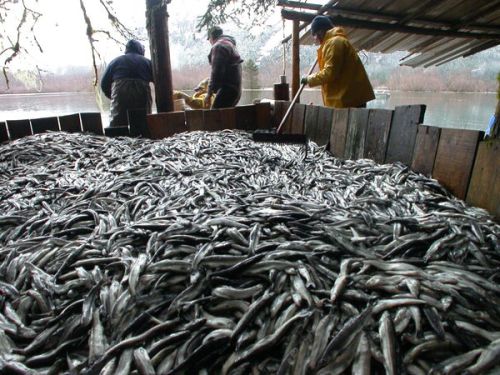
Haisla eulachon catch from the Kemano River. Source: living landscapes.

It is therefore sobering to read that U.S. President Obama has listed the Columbia River eulachon as an endangered species: eulachon are becoming almost invisible relative to the real world now, it seems.

Continue reading

Northwest Research Obsidian Studies Lab

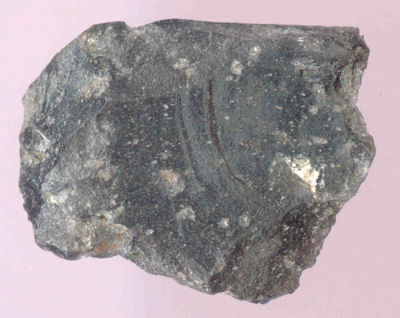
A flake of obsidian from DhRr-18, southern British Columbia. This visually-distinctive glass is from the Mount Garibaldi obsidian source.

Obsidian is a kind of volcanic glass and was highly prized for making certain kinds of stone tools.  Obsidian forms at places of relatively small outflows of magma, or liquid rock.  Small flows can cool quickly, which allows the formation of a glassy crystalline structure ideal for stone tool manufacture.  Small flows also represent a small sample of well-mixed magma, and thus each little patch of obsidian may share a very distinctive chemical signature.  This signature, usually identified by trace elements such as Strontium, Zirconium, Yttrium and Rubidium, then allows for the chemical fingerprinting of each source.  Any obsidian artifact found, whether at a source or not, can also be “fingerprinted” and then compared to a catalogue of known obsidian ources.  Since the artifacts don’t move around on their own but only through the agency of humans, the distribution of obsidian artifacts is a proxy measure for the movement and interaction of people.  When you have hundreds or thousands of such artifacts and a large database of known sources, then you can start to see large scale, long-term social interaction emerge from the silent archaeological record.  Most obsidian isn’t visually distinctive enough to sort out by eye alone, so these geochemical methods are essential.

So far, so Archaeology 101.  I was really happy to find that Oregon’s Northwest Research Obsidian Studies Laboratory has a web site not which not only solicits business, but is a highly educational and informative site about many aspects of obsidian analysis, with a focus on the Northwest. Continue reading