Category Archives: Vancouver Island

More on Comox Harbour Fishtraps

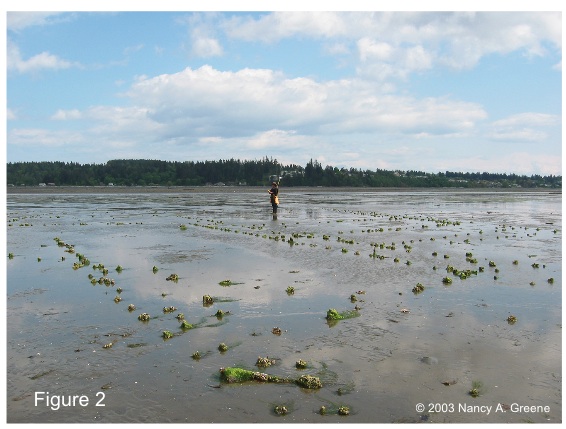
Fishtrap stakes delineating chevron patterns in the intertidal zone of Comox Harbour. Photo credit: Greene 2010.

I posted once before some time ago on the incredible fishtrap complexes in Comox Harbour on eastern Vancouver Island, highlighting Megan Caldwell’s M.A. thesis (downloadable) on the topic, and mentioning in passing that primacy of investigation should perhaps go to Nancy Greene, who has been mapping and dating these features for about a decade.  I was glad to find the other day that Nancy Greene has a 2010 downloadable poster on the topic (link starts a 4 meg PDF)  from an academic conference: WARP, the Wetland Archaeological Research Project, which itself has a nifty new website.

These Comox Harbour fishtraps are one of the wonders of B.C. Archaeology and it is highly welcome to see some more of Greene’s reconstructions and mapping.

Continue reading

How to Make a Petroglyph

Replica sandstone petroglyph made by Christine Stathers. Photo credit: Stathers.

I’ve often said the graduate student work is the backbone of the archaeological discipline in British Columbia.  Today I get to report on more student work – but this time its a fascinating study done by an undergraduate student at Camosun College here in Victoria.  The student, Christine Stathers, did an experimental archaeology project for her Anthropology 240 course, and she kindly agreed that I could post some of the results here.  The results are highly informative for our interpretation of petroglyphs, I think.

Continue reading

William Alexander’s Watercolours of Vancouver’s Voyage

Village of the Friendly Indians near Bute's Canal. Watercolour by William Alexander. Source: University of Illinois.

Yesterday I posted an engraved  view of  a village near the entrance to Bute Inlet, the view seen in 1792 during the voyage of Captain Vancouver.  Much as with the earlier posts on John Webber (1, 2, 3), there are multiple versions of these scenes.  The above shows a watercolour rendering made by William Alexander, a well known artist and draughtsman of the late 18th century.  It seems his series of works on the NW Coast was not done from life but was a commissioned finalization of the drawings of William Daniell, who was actually on Vancouver’s voyages, and perhaps other artists/oficer’s sketches.  At least that is the story I’ve been able to winkle out, starting from a position of sheer ignorance.  Nicely, though, Alexander’s watercolours from the Vancouver Voyage series, covering Alaska, the Northwest Coast and some views of California and Chile, are all available online through the Newberry Library at the University of Illinois.  These renderings were not familiar to me and perhaps not to you, either.

Continue reading

The Bison at Ayer Pond on Orcas Island is archaeological.

Cranium of 14,000 year old Bison antiquus from Ayer Pond, Orcas Island, Salish Sea. Source: Kenady et al. 2010 (in press)

One of the challenges in archaeology is to take a familiar landscape and, by considering the known data from the paleo sciences, make it strange and unfamiliar and ripe with possibilities for strange and unfamiliar archaeology.  Right here in the southern Salish Sea there is an excellent example of this coming to light.  As the ice retreated at the end of the last glacial period, the Salish Sea saw dramatic changes in sea level (both higher, and lower), in vegetation (tundra, grassland, and forest) and in the animals present on that dynamic landscape.

Location of known Bison antiquus remains in Salish Sea. Source: Wilson et al. 2009.

For years now, we have known that one of the large land mammal species of the Salish Sea around 14,000 years ago was bison — and not just any bison, but Bison antiquus, the extinct giant bison.  A number of remains of this creature have been found, mostly on the Saanich Peninsula and on Orcas Island,  which is one of the largest islands in the Salish Sea, sitting just south of Saturna Island, close to the Canadian Border.  Since these remains mostly clocked in at around 13,000 to 14,000 years ago, most archaeologists were interested in them primarily for their coolness factor and not because they seriously thought there might be relevance to early human presence here – these bison pre-date the Clovis Culture which was the consensual evidence for the first peopling of the Americas.  I have previously posted on this with reference to Clovis in Puget Sound, to the controversial Manis Mastodon site, as well as to the nearby Wenas Mammoth and even the Paisley Cave finds in Oregon – evidence is coming together for both a Clovis and a pre-Clovis occupation of the Salish Sea and environs.

Now with a new paper by Kenady et al. in press, these numerous bison finds take on a new importance: one of them is most likely archaeological.

Continue reading

CRM problem at Englishman River

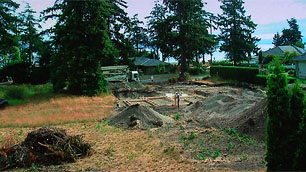
Excavation of house foundations at Englishman River. Source: CBC

Hmm, I just noticed today is the first anniversary of this blog.  Mind you, it was a slow and intermittent affair at first but with more regular posting has come steady increase in readership.

But you know who else had a birthday on April 20th?

With that in mind, what better way to celebrate than by checking out the firestorm brewing on the Englishman River, where some landowners, perhaps wilfully ignorant, have had an unfortunate series of events transpire regarding an archaeological site on their property. The Archaeology Branch has responded to the story with a terse memo.

A little background to start:

All archaeological sites in B.C. dating to before 1846 A.D. are protected under the Heritage Conservation Act.  This is true whether or not they are known to the Archaeology Branch or unknown and unrecorded.  In some ways, then, it is not relevant that the site under these people’s house was first recorded, I am told, in 1975.  Even if it was first discovered by the application of a backhoe in April 2010, it would be accorded the same protection under the law. The fact that the landowners claim to have not known about the site until recently is an interesting issue that does not really materially affect the facts of this case. And, under the standard procedures in place, they are indeed responsible for paying the costs of the archaeological investigations, in this case reported to be $35,000.  Whether or not they have the money also doesn’t affect the facts of the case – incidentally, these people who self-portray as poor and unemployed are finding archaeology because they are building a new house on their property, which must be costing them several hundred thousand dollars.

So, these facts may not actually alter the legal responsibilities, but they do however very strongly affect the way this issue is seen to be unfolding.

Continue reading

Waatch River: a raised beach site on the Olympic Peninsula

View from West up Waatch River Valley to Neah Bay; Vancouver Island in the distance. Source: Panoramio user Sam Beebe.

The Waatch River flows in a low valley that connects Neah Bay across the Olympic Peninsula to Makah Bay.  When sea levels were higher, it would flood with sea water and turn Cape Flattery into an island.  Interesting, then, to see that an old raised beach site has been found on the Waatch River at an elevation of about 13 metres above, and 2 km away from, the modern shoreline.

Continue reading

Historic Maps and Dioramas of Victoria and Environs

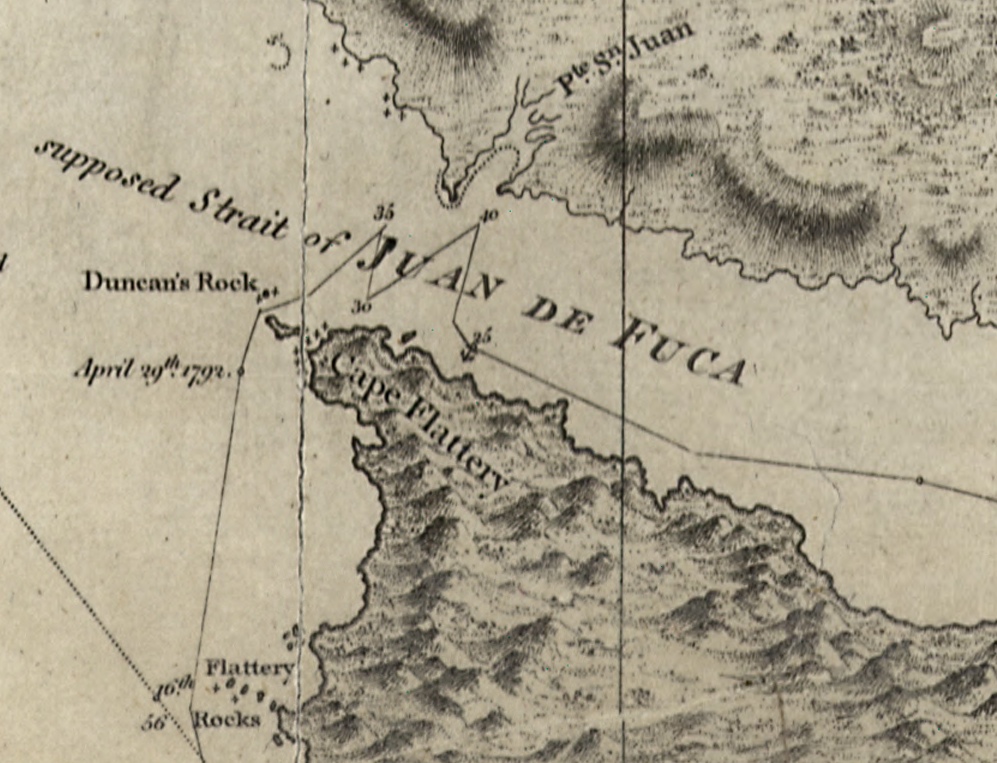
Detail of Capt. Vancouver's 1792 chart showing the "supposed strait of Juan de Fuca". Source: viHistory

vihistory is a web site designed to aid in historical research of Vancouver Island, at which it succeeds admirably.  You should poke around and have fun with their census data and the other worthy, if dreary, pursuits it affords the serious scholar.

One feature which is not immediately clear on first glance, perhaps deliberately as has entertainment potential, is a large selection of very high-resolution maps and images which you can download from this page. The file sizes are large, of course, but increasingly that is less of an obstacle in the past.  The maps are mostly of historic Victoria, but there are some regional maps such as telegraph and lighthouse maps of British Columbia, and a couple of maps of Nanaimo.  As usual, I have surfed through the maps so you don’t have to – and some of them are remarkably fun, and informative.

Continue reading

Photos of Victoria and Esquimalt, 1859

Victoria 1859. Source: LOC

In 1846, the Oregon Treaty established the boundary between British and American territory west of the Rockies (and unintentionally established the benchmark date for whether archaeological sites are automatically protected under the Heritage Conservation Act, but that’s another story).  Vancouver Island was to remain in British hands in its entirety, but otherwise the 49th parallel was to be the boundary on land.  The ocean boundary through the Salish Sea was resolved later, after the armed standoff on San Juan Island known as the “Pig War“.   An International Boundary Commission was struck, with the mandate of surveying the 49th parallel and one of its base camp headquarters in 1858 and 1859 was Esquimalt.  At this time, a series of photographs of the young Fort Victoria and surrounding buildings were taken, some of the earliest photographs from British Columbia I know of – including some remarkable pictures of First Nations people.

Continue reading

Webber’s Village in Nootka Sound: Original Watercolour

Painting of a village in Nootka Sound, 1778, by John Webber. Source: State Library of New South Wales. Click for larger original.

Yesterday I linked to the original watercolour of a 1778 Nootka Sound house interior by John Webber, which is the basis for the widely reproduced engraving.  Today we can take a look at Webber’s original painting of a Nootka Sound village, presumably Yuquot but not so labelled, as found at the State Library of New South Wales (though yesterday’s post brought forth questions as to whether these are watercolours or coloured engravings – see the comments).  The first and most important point is, see that lumpy, dissected landform in front of the houses?  That, my friends, is what an active shell midden looks like.  No wonder they can be such stratigraphic nightmares.

Continue reading

Webber’s House Interior: Original Watercolour

1778 Watercolour by John Webber of the interior of a house in Nootka Sound. Source: State Library of New South Wales. Click for original.

A few days ago I posted a beautiful watercolour of Nootka Sound by John Webber, artist on Cook’s third voyage.  In the ensuing discussion, it was brought up how nice it would be to see the original watercolours of more of his paintings, which often formed the basis for the  numerous engraved reproductions which are what one normally sees.  The loss of information in moving from the original to the engraving is something of an unknown quantity, and I for one had never seen the watercolours.  Until yesterday!

Continue reading