Category Archives: Vancouver Island

Willows Beach Archaeological Site Landowner to Appeal, Again

These darn, hidden sites that no one expects: archaeology at the Willows Beach Site, ca. 1990. (Not the MacKay Property) Source: Millennia Research 1990.

I apologize to readers from afar who may not be interested in the apparently parochial matter of a local woman’s encounter with archaeology on the Oak Bay waterfront, and the incomplete journalism which accompanied it.

But with the news Saturday (PDF*) that the Willows Beach landowner, Wendi MacKay, intends to appeal the earlier decision of Justice Fitzpatrick to the B.C. Court of Appeal, it becomes possible this case (previously 1, 2) will have repercussions for the practice of archaeology across the entire province.  I hadn’t really thought about the implications of an appeal since, well, Fitzpatrick (section 33-38)] essentially says, “I would find the case in your favour if I could, but you gave up your rights to appeal, so I can’t.”

I might be calling wolf in my fears aired below.

But, bear with me.

Continue reading

Update – Willows Beach Site Controversy

Landowner Wendi MacKay in front of her house at DcRt-10. Source: Oak Bay News.

There is a new local newspaper article out on the Willows beach issue, below, which contains some important information and I think warrants  new post.  The article (PDF) from the Oak Bay News, confirms what was proposed in my previous post.

Namely,  the archaeological work at the site did not cost anywhere near the  $600,000 which was widely reported.

Continue reading

Willows Beach Site Controversy

Archaeological site DcRt 10, Willows Beach, at 2072 Esplanade Avenue, in 2007. Source: Bruce Stotesbury, Timescolonist.com

Sorry for the lack of recent updates everyone, and also for jumping in with a “feel-bad” story, but since the Willows Beach site (DcRt-10) takes up a decent chunk of the most expensive waterfront near me,  I was interested to read the coverage of a recent court judgment with an archaeological focus.  The Times-Colonist‘s coverage is notable for an egregious misrepresentation in their opening sentence:

“An Oak Bay woman who built a house on an unregistered aboriginal midden has had her bid to recoup $600,000 from the provincial Archeology Branch struck down.”

This is true only for meanings of “unregistered” which include “a site recorded since approximately 1965, and subsequently the object of dozens of archaeological studies, including at least two on that very lot”.  Sheesh.

Continue reading

Victoria’s history through cartoons

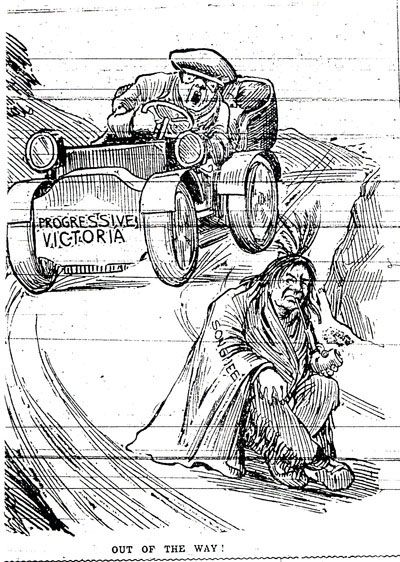
"Progressive Victoria" about to run over the Songhees. Was there ever a Songhees man with feathers in his hair, fringed buckskin, and a peace pipe? Source: Vincent's Victoria.

I mentioned it in a comment the other day so you may have seen it already, but there are a couple of great posts at the blog “Vincent’s Victoria“.  The first post is the already-mentioned review of John Lutz’s talk “Getting the Indians Out of Town: Race and Space in Victoria’s History” – Victoria, British Columbia, that is, better known as World Headquarters to this blog.   In Vincent’s post we find out about the slow process by which First Nations had their presence in the city core steadily reduced, mainly by moving the reserves, but through other means too.  The post then discusses the “Signs of Lekwungen” project which I posted on before. it’s really a shame I didn’t hear about John’s talk until after he had given it – there are other talks in the series but his would have been the most interesting to regular readers here.

The second post is extremely interesting, as it uses editorial cartoons from the Victoria Daily Times newspaper to tell the story of the movement of the Songhees reserve in 1910.

Continue reading

Revisiting the Salt Spring Island Archives

Part of the Charles Sampson collection from Salt Spring Island. Source: saltspringarchives.com

Salt Spring Island is a large island in the Salish Sea, close to Vancouver Island’s southeast corner (map).  Quite a while ago I highlighted the photographs of the “Bob Akerman” museum, which comes via the comprehensive Salt Spring Island archives.  There are a few other photo records of archaeological collections there which I thought were worth a quick look.  For example, the picture above from the Charles Sampson Collection shows some fairly spectacular ground slate points to the left, and what may be a Charles phase (ca. 4,000 year old)  contracting stem point to the bottom right.  It’s not just archaeological collections that the archives has going for it, though. Continue reading

Signs of Lekwungen

Signs of Lekwungen "Walk in Two Worlds", near corner of Fort and Wharf Street in Victoria. Source: Flickr.com user ngawangchodron

The city of Victoria in collaboration with the Songhees and Esquimalt First Nations has fairly recently created a series of outdoor art installations which mark culturally-significant places.   As the City’s online brochure explains,

Established in 2008, the Signs of Lekwungen (pronounced Le-KWUNG-en) is an interpretive walkway along the Inner Harbour and surrounding areas that honours the art, history and culture of the Coast Salish people who have resided in the Victoria area for hundreds of years.

The Songhees and Esquimalt Nations are part of the Coast Salish family and are descendants of the Lekwungen family groups. Lekwungen is the original language of this land.

The Signs of Lekwungen consist of seven unique site markers – bronze castings of original cedar carvings, conceptualized and carved by Coast Salish artist, Butch Dick. The markers depict spindle whorls that were traditionally used by Coast Salish women to spin wool. The spindle whorl was considered the foundation of a Coast Salish family.

Continue reading

Two upcoming events in Vancouver and Victoria


1936 Field Trip by the Vancouver Natural History Society to Musqueam. Source: Vancouver Public Library. VPL Accession Number: 19483

In Vancouver this Sunday, September 19 at 1.00 there is a guided walk of the Ancient Salmon Stream and Musqueam Village, starting at Jericho Beach (details here) with Victor Guerin, “a cultural/linguistic consultant and historian, a member of the Musqueam First Nation and a speaker of the Musqueam dialect of the Central Coast Salish language Halkomelem. He has been learning about his people’s culture and history his entire life, including some 16 years of consultation and documentation with family elders and 4 years formal training in the Musqueam language with linguistic analysts at UBC.”

This talk/walk is one in a series from the False Creek Watershed Society, most of which look like they hold promise for an interesting conversation between historical ecology, traditional knowledge, and landscape development.  It would be good to see connections built or strengthened between restoration groups and archaeologists, who share many of the same values.  You can see the other talks and walks they sponsor here – two of them are actually today, Saturday September 18th.  OK, go to those as well!

The other upcoming event is the  Archaeology Society of B.C. monthly public lecture in Victoria, which is on Tuesday 21 September.  This month’s speaker is Grant Keddie from the Royal B.C. Museum.

Continue reading

VicNews: Rebirth through Reburial

Burial cairn on Race Rocks. Source: RaceRocks.com

While I was away over the summer the local free paper, the Victoria News, did a (to my mind)   high quality series on reburial and respect in Songhees and Esquimalt communities (cache). The three articles by Lisa Weighton include comments from numerous aboriginal spiritual and political leaders, and sensitively describes how Straits Salish faith asserts that the dead are always with the living.  The dead do not conveniently depart to some other place, but continue in a world alongside and intersecting the world of the living.

Hence ancestral remains are not something belonging to a past which can be “gotten over” but are very much part of the present world.  Laying a person to rest, or back to rest after disturbance, requires food, clothing and prayer.  I don’t pretend to understand the concept well, but I have been to some such ceremonies and the power of the moment is impossible to deny.  In my limited experience the article fairly represents the spiritual and emotional needs that must be met under the sad circumstance of disturbing the dead.  It is incumbent on archaeologists and all citizens to not only work to minimize disturbance of the dead but to respect traditional practices.  It has been impressed on me that such practices are meant to protect us, the living, First Nations or not, as well as to give comfort and respect to the dead.  This should now be considered absolutely part of mainstream archaeology.

Continue reading

“From the Islander” blog

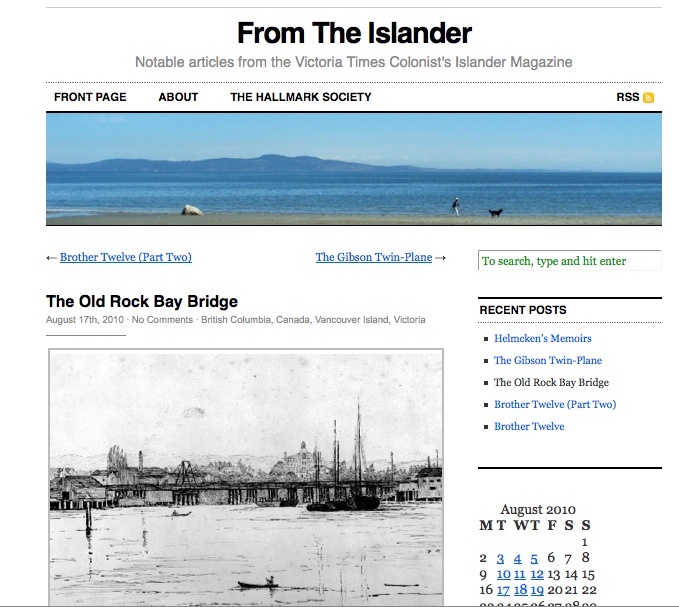
Screenshot of "From the Islander" blog

The Hallmark Society sponsored a nice blog called “From the Islander” through the summer of 2010.  This is a retrospective set of commentaries about excerpts from the weekend newspaper insert “The Islander”, which used to be published in the Victoria Daily Colonist and the Victoria Times-Colonist.  There’s not any archaeology that I have seen, and surprisingly (or not) there is no coverage of First Nations, but all the same it is an interesting read if you have a shine for Vancouver Island history, and a well-done, informative blog.  Apparently the Hallmark Society (or the blogger, who goes by wpbradley and was their summer student intern) has digitized a fair bit of The Islander and indexed it here – though full text is not available for the most part.

Fieldschool Update, and Public Lectures

Screenshot of Times Colonist article - click to go to the story.

I am in town briefly and see the Time-Colonist has an article and photo gallery about the UVIC-Parks Canada archaeological fieldschool in the Gulf Islands.  It’s a pretty good article with some nice quotes from the students about their experience, and which emphasizes how threatened some archaeological sites are.  It would have been nice to see more acknowledgment of local First Nations and of the hard work Parks Canada’s liaison team is doing to help build relationships around cultural resource management.  It’s very early days for the field school but in the medium term it hopes to be of service to First Nations and their archaeological questions and concerns. A big part of that is the specific focus on archaeological site assessment and management skills being taught by the course instructor, Dr Duncan McLaren, and another big part is the presence of paid First Nations interns who will be taking the field school – only one this year but more in the future it is hoped.  Anyway, the article tells part of the story very effectively and the reporter and photographer had an interesting time with the fieldschool and vice versa.

In related news, I’ll be giving a public talk about Salish Sea archaeology with a fieldschool update this Friday July 30 on Pender Island at 7.00 in the Anglican Hall.  Then, my mini road trip takes me to Saturna Island on July 31 for a talk at 7.30 at the Community Hall.  Otherwise, there probably will be no updates here until the middle of August.

Times-Colonist screenshot - click to go to story.