Category Archives: Northwest Coast

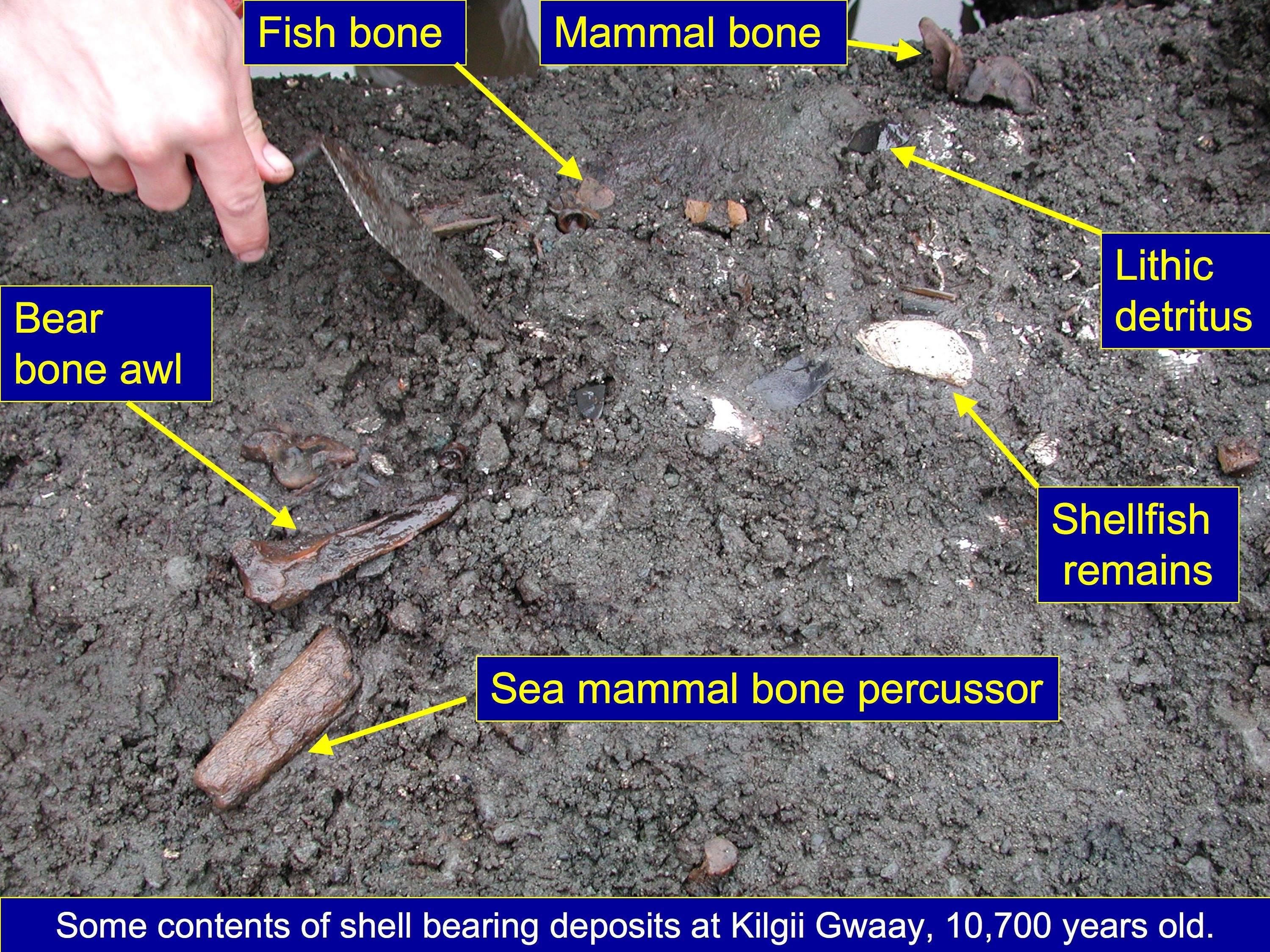
Annotation: Kilgii Gwaay excavations.

Excavation at Kilgii Gwaay, southern Haida Gwaii.

I’ve found that individual powerpoint slides can be saved as JPG images, complete with their annotations.  Since I have a lot of these I may share some.  The above shows excavation in the shell-rich component of the intertidal site at Kilgii Gwaay.  The combination of shellfish remains and saturation in slightly alkaline sea water has produced remarkable preservation for a site which is firmly dated via about 20 carbon samples to 9450 14C BP, or around 10,700 calendar years ago.  In this picture you can see some of the evidence: bone tools, stone tools, and the remains of shellfish, fish and mammals which, together with birds, formed the basis of the diet at this summertime camp.

Continue reading

Raven-Walking & Geological Transformation

Haida History starts at least 14,500 years ago. (Image credit: Daryl Fedje).

Three things we know about Haida Gwaii:

1.  About 14,500 calendar years ago it was a temperate tundra environment, with no trees.  The first trees, pine, appear about 14,000 years ago and there is progressive forest infilling thereafter, with the modern species mixture in place by about 3,000 years ago.

2. It has an impoverished suite of large land mammals – historically, these were limited to black bear, caribou, marten, ermine, a vole and a shrew.  We know that 13,000 years ago there were also deer and brown bear on the islands, and quite likely other species as well.

3.  It used to be much larger than in the present.  With lower sea levels at the end of the last ice age, Hecate Strait was largely dry land, exposing a large, unglaciated, coastal plain that became rapidly flooded.

It seems to me that we can add a fourth thing we know:

Continue reading

Northwest Anthropology Conference: NWAC 2010

The web site for NWAC 2010, to be hosted at Central Washington University March 24 – 27, 2010 in Ellensburg, Washington,  is up and running.  NWAC is a great conference which we were lucky to host in Victoria a couple of years ago.  In case you are wondering where Ellensburg is (no offence), it’s just to the east of the Cascades from Seattle, north of Yakima, about a 350 km drive from Victoria: map.

The theme of this year’s conference is the very welcome “At a Crossroads”:

Anthropology at the Crossroads” is the theme for the Northwest Anthropology Conference (NWAC), Ellensburg, Washington, March 24 – 27, 2010. While all submissions will be considered, this conference will offer opportunities for multiple perspectives on where we are as a discipline, society, and species, with a special emphasis on people and the environment. The “Anthropology at the Crossroads” conference will include symposia and presentations on subjects from archaeology, cultural and linguistic anthropology, paleoanthropology, primatology, medical anthropology, visual anthropology, and others. We invite submitters to use their own preposition in describing their presentation/symposia as “Anthropology at/of/on/etc the Crossroads.” Studying the past, understanding the present, and preparing for the future, makes Anthropology even more relevant today as the discipline continues to assert the importance of an appreciation for culturally diverse modes of interacting with our environment. Thus, this conference is a crossroads where the exchange of ideas better prepares us, our students, and our work to serve the communities we live in as we maintain our commitment to exchanging and transmitting our under-standings of all people, in all places, and at all times. “Anthropology at the Crossroads” also implies interaction among sub-disciplines and communities in an integrated fashion and in this manner encourages self reflection on the relevance of Anthropology today at a moment when we appear to be at several global crossroads.

New Westminster, 1903

Aboriginal women at New Westminster, 1903.

There is something about the above picture that is so evocative: Native women washing clothes or getting water while in the background the first construction of the Fraser River Bridge at New Westminster rises.  With a different caption this could be the Ganges River, or the Colorado: always women, always squatting, always the back turned to the viewer and the colonial future in the background.

From the idiosyncratic New Westminster online photo archives – this uses the LoC system so you have to search for, say, “Indians” rather than “First Nations”.

New Westminster, ca. 1865

Somenos Creek: Update

Somenos Creek site. Picture this with 20 houses on it. Photo credit: anonymous.

Further to my post below, here is another news item on the Somenos Creek (Cowichan Valley) situation.  It mostly rehashes the Times-Colonist piece but does have new comments from Eric and from the developer, notably:

Schmidt, who has tried but failed to have the six-acre site, known as Lot B, rezoned for development, said it would be worth up to $3 million if it weren’t for the presence of the artifacts and burial site.

Timbercrest has built about 300 homes on the land so far and would like to put up another 20 on Lot B.

So, lets see 20/300 = 6.7% of the 100 acres.  The 100 acres was bought in the 1970s.  I am going to go out on a limb and suggest that much less than 1 million was paid for the 100 acres back then.  The current valuation of these six acres would value the entire parcel at 45 million.  Let’s halve that:m 22 million.

So this developer has turned a one million dollar piece of land into a 20 million dollar piece of land.  A 2000% return.  And he wants financial consideration and compensation from the public because he happens to have a legally-protected (and morally protected, I might add) site of the highest archaeological significance on the residual piece?

This is the 21st century: Greed is no longer good, Timbercrest Estates Ltd.  Give the land up, get a tax writeoff, and count your blessings you live in a country that is so extremely friendly to rampant development of land, enabling fortunes to to be made.

Mechanical representation in a Haida Pipe

Haida Pipes, 1837. From U. Washington Collection.

I don’t know much about these early historic Haida argillite pipes.  These ones are illustrated in Edward Belcher’s Narrative of a voyage round the world, 1843, v.1, p. 309.  The lower one captured my attention, with its representation of a conveyor belt (?!) – or, more likely, a block-and-tackle/pulley setup.  The playful seriousness of these pipes is astounding – as can be seen in my earlier post on the SS Beaver pipe.  I would like to see a photograph of this one but I have no idea where it may have ended up.

The image is via the superb University of Washington Digital NW collections.

dSpace: The Indian History Film Project

Haida Town of Chaatl. Source: NMC

There is an interesting archive of interview transcripts housed in dSpace at the University of Regina.  Most of the interviews were by CBC Radio’s Imbert Orchard and so share the flaws of Journalism and Anthropology.   The preamble says,

The original intent of The Indian History Film Project was to conduct interviews with First Nations elders across Canada and to produce a television series portraying Canadian history from a First Nations’ perspective.

The Indian History Film Project was an initiative of Direction Films and was conceived and developed by Tony Snowsill. The project leaders were Tony Snowsill and Christine Welsh. The project evolved over time, and eventually it was decided to access libraries and archives across the country to incorporate existing interviews with First Nations elders. All interviews, whether original or archival, were cross indexed by word and theme and housed in the C.P.R.C [Canadian Plains Research Centre].

A number of these interviews are with Haida people, notably Solomon Wilson and Florence Edenshaw, who discussed her arranged marriage, the meaning of Tow Hill, and the artistic tradition of her family, the Edenshaws and Davidsons.  It appears tapes of these are also available through the BC Archives, but not online.

Note: anytime you see (Indian) it means that a Haida word was not transcribed — an eerie effect.  Searching for British Columbia brings up 91 documents.

The following excerpt from an interview with Solomon Wilson of Skidegate sees him relating a tale of smallpox blankets:

Continue reading

Mt. Rainier Archaeology

Some artifacts from Mt. Rainier. Source: Tacoma News-Tribune.

The Tacoma News-Tribune has a nice story about high-altitude archaeology on the flanks of Mt. Rainier.  Sites date back to over 9,500 cal.BP (presumably cal. BP, that is) and some include microblade technology.  If I read the article right, the microblade component dates to about 7600 years ago.  There is an older report on Mt. Rainier archaeology here by Greg Burtchard, but it seems this recent work is what has produced the older dates.  It’s also very intriguing to see ancient “cooking pits” including some that the authors suggest were continuously used for the full 9,600 years of occupation:

The site has also produced other ash evidence, coming from cooking pits.

“They’re small and not elaborate, but pretty clearly they were cooking with hot stones. But I don’t know what they were cooking,” Mierendorf said. “That implies more than just traveling through the area.

“These are repeatedly used, including one individual pit used and reused for all 9,600 years. I’ve never seen anything like that in 40 years of professional archaeology.”

It’s good to see work done in the higher elevations, and is reminiscent of Rudy Reimer‘s more theoretically-driven  work in the highlands of Squamish territory. It will be great to see if there is a full report put out soon so I can see the microblades and the cooking pits – if it is put on the web like the earlier report, so much the better!

Pitt Rivers Museum Haida Collection on flickr.com

Any idea what activity is being represented on this Haida argillite carving?

The Pitt Rivers Museum in Oxford is one of the world’s great ethnological museums.  Indeed, it is largely presented as a “museum of a museum”, with artifacts and curios displayed in glass cases in juxtapositions that made sense to anthropologists.  Now I see they are putting some of their collection online – one of many interesting innovations going on at that museum.  The Haida Collection which Cara Krmpotich has worked on consists of 200 really well composed and lit photos on the flickr.com website.  Cara notes that she hopes making this material available in this manner will facilitate its use by Haida people and I expect they will (indeed one person with a Haida name has been commenting on some of the photos).  Coincidentally, I see there has recently been a Haida delegation to the Pitt-Rivers museum.

In any case, the flickr set is a fantastic set of images of Haida art and technology. It would be nice to have the full catalogue information or other information associated with these, or at least a statement that such information is lacking.  While there are visually spectacular items throughout the set, also check these plain spoons from SGang’gwaay, Tanu’uu and Masset,  this bird bone whistle, and this tidy little loop of twine.

Haida wooden labret at Pitt Rivers museum.

Vapourware: Journal of Northwest Archaeology

Looks like someone at SFU is about to launch a new archaeology journal focusing on archaeology of the Northwest.  (Presumably NW North America, but you never know when it comes to SFU).  The pages are formatted, but blank, except for the instructions to authors.  I hope this journal template turns into something real.