Category Archives: Northwest Coast

Annotation: Richardson Island Stratigraphy

Annotated stratigraphy of lowest Richardson Island archaeological deposits.

Richardson Island is a remarkable archaeological site in southern Haida Gwaii.  When it was occupied, sea levels were about 10 metres higher than today, and rising.  Then, sea levels stopped rising and occupation continued.  We have dates ranging from 10,500 cal BP to 2900 cal BP (calendar years before present).  However, the early part of the record includes the most impressive stratigraphy.  The shoreline configuration at that time likely included a supra-tidal marine berm feature, which would have had a flattish top and have been well-drained and probably vegetation free: a perfect place to camp.  Occasional storms or even tsunamis would build this berm in the winter, and with rising sea levels the berm was “pushed uphill” so to speak.  The berm-building process would have involved sudden dumps of sorted pea-gravel onto the occupation layers at the site, sealing and preserving them.  Overall, though, the site is in a well-protected location, at least relative to the enormously dynamic winter sea conditions of Haida Gwaii. Continue reading

Haida, Argillite, and the Pig War

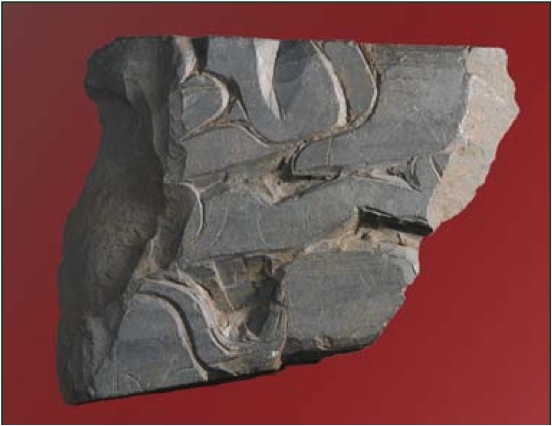
Carved argillite from Belle Vue Sheep Farm, San Juan Island. Source: NPS.

I don’t know as much about the 1859 Pig War as you might think, having spent an awful lot of time on San Juan Island. This “war”, which was more of an armed standoff between British and American troops, was a key event in the various mid-19th century boundary disputes.  One key location was Belle Vue Sheep Farm, near the southern tip of San Juan Island, where there has recently been some interesting historical archaeological work by the U.S. National Parks Service.

One interesting find at this dig is a piece of carved argillite, shown above, which most likely stems from Haida Gwaii (see page 7 of this PDF report, browse other NW NPS reports here).  Around this time there were plenty of Haida and other North Coast Nations around the Victoria area, and so it is not surprising, really, to see this piece.  And yet, it is also a stroke of massive good fortune to have such a distinctive piece of the turbulent 19th century history of First Nations.

Intriguingly, a key figure on the American side of the Pig War was George Pickett, who later achieved substantial fame for leading Pickett’s Charge at the Battle of Gettysburg in the American Civil War,

Ironically for someone who later fought for the racist Confederacy, Pickett was once married to a Haida woman by the name of Sâkis Tiigang.   (More often known as “Morning Mist”, this site gives her Haida name as beSakkis Tiigang while the Pickett Society in a detailed article gives her the slightly more authoritative-seeming name Sâkis Tiigang, meaning “Mist Lying Down”).  They had a son together, the artist James Tilton Pickett who, without wanting to generalize overly, certainly looks like a Haida man.  Shortly after the birth of young James in 1857, Sâkis Tiigang passed away.

Probably there is no tangible connection between Morning Mist/Sâkis Tiigang and this carved piece of her homeland, but surely there is a poetic one.

James Tilton Pickett, son of Sâkis Tiigang and George Pickett/ 1857-1889. Source: Pickett Society.

Speaking of Wilson Duff and Bill Reid

Roy Jones of Skidegate climbs a pole at SGang Gwaay. Source: CBC.

Yesterday I noted the upcoming musical about the Bill Reid-Wilson Duff expedition to “rescue” carved poles at the Haida Village of SGang Gwaay (Ninstints).  I’ve just found that the CBC has posted online a short documentary, (2013:edit, use this link)  first broadcast in 1959 and narrated by Bill Reid, showing the removal of these poles to the Museum of Anthropology at UVIC.  The expedition also included Wayne Suttles and Michael Kew, as well as Wilson Duff of course.  The Haida crew consisted of Roy Jones, Clarence Jones and Frank Jones of Skidegate. Some aspects of the trip are recounted in the BC Provincial Museum Annual Report of 1957, which I will scan and post some other day.

The spoken component of the documentary is a fascinating account by Reid, at that time just beginning his carving career, but the real jaw-dropping element is the depiction of the use of axes and saws and climbing spikes to log this forest of poles.  Necessary, of course, but jarring nonetheless.

Broadcast Date: May 21, 1959

A small boat ferrying Bill Reid and a team of anthropologists approaches the southern tip of the Queen Charlotte Islands. Reid documents the rescue mission to salvage and relocate the last of the crumbling Haida totems as revealed in this CBC documentary. With a sense of excited urgency, Reid describes and catalogues the enormous poles on the approaching shore. As they are gently felled, the majestic cultural landmarks will creak and groan before they are prepared for transport.

It’s low resolution and grainy, but the general impression is a very powerful one.

Felling a tree, surely, not a pole at SGang Gwaay. Source: CBC.

Upcoming musical about Wilson Duff (!)

John Mann of Spirit of the West in "Beyond Eden"

I can hardly believe this, but the Vancouver Playhouse is mounting a new musical based on an event familiar to to all students of archaeology and anthropology n BC.  The musical stars John Mann from the band Spirit of the West.  From Tom Hawthorn’s blog:

Written by Bruce Ruddell with musical direction by Bill Henderson, formerly of Chilliwack, the musical premieres on Jan. 16 at the Vancouver Playhouse. The musical is based on a 1957 expedition to the Queen Charlotte Islands by the archeologist Wilson Duff and his Haida friend, the artist Bill Reid.

Mr. Mann portrays a character based on the archaeologist, a man who travelled to Haida Gwaii to preserve totem poles, which he bought for $50 each. These can now be seen at the Royal B.C. Museum in Victoria and the Museum of Anthropology in Vancouver.

“Off the top he believes his job is to keep those poles alive because you can learn from them,” Mr. Mann said. “If they rot, they’re lost, they’re gone forever. No one will be able to study them.

“In the course of those three days, his mind is changed. Then all hell breaks loose.”

This is remarkable and interesting on a number of levels.   I’d love to see it.

Wilson Duff was one of the first modern Anthropologists and Archaeologists to work in British Columbia and it seems he had just got started when he died by his own hand in 1976, at the age of 51.

Haida Archaeology at the Virtual Museum of Canada

Rodney Brown at the Cohoe Creek Site, 1998. Source: CHIN.

The Canadian Heritage Information Network (the venerable CHIN) has, via the Virtual Museum of Canada,  a small online exhibit of Haida Gwaii archaeology posted.

I hate to be all grumpy since such initiatives should be supported, but seriously – the problems with this exhibit are manifold.  First, a number of the facts are wrong, despite the content being copyrighted 2009.  They use a figure of 9,000 years for first occupation, not the figure of 12,500 which is more reasonable.  That’s more than a 30% difference.  They state it was a grassland 10,000 years ago, when the better number would be 14,000 or more. It’s written in the first person, so apparently a Haida person wrote it – but really should that be an excuse? Maybe the details don’t really matter.

So, factual errors are unfortunate.  But they also have completely crap illustrations – low resolution, poorly lit images from ethnological collections are used to represent the archaeological record.  This is misleading on a number of levels.  Archaeologists do not usually find beautifully decorated clubs, for example, and it diminishes understanding of the archaeological record and process to imply they do. Indeed, the text of the exhibit lists the following “learning outcomes:

Learning Objectives

The learner will:

  • Describe the history of Haida people revealed by archeology
  • Describe some Haida objects found in archeological excavations

As far as I can tell, not a single object “found in archaeological excavation” is shown and essentially no archaeological facts are given.

Also, all the pages, including “Haida Society since European Contact” are under the header of “Haida Ecology” which is a bit unfortunate.  Put the whole thing under “Haida history”.

It’s also regrettable that the pictures are of such poor quality, like this one of fish hooks.  I mean, this is a national institution, and the year of the web is 2009, not 1995.  People expect more and will tune out if you don’t offer them some substantial eye candy.  I think they have a right to receive it from the Ottawa heritage establishment – after all the NMC is sitting on a superb collection that most of us never get to see.

Finally, the information content is miniscule.  The whole thing can’t add up to more than 500 words and is cluttered with jargon like “Print this Learning Object” and “View the complete asset”.  What kind of robotic geek came up with that sort of bullshit management-speak? And every bit of this information has a copyright notice on it, even pictures from other institutions.  This page has SEVEN separate, identical copyright notices “© 2009, CHIN-Canadian Heritage Information Network. All Rights Reserved.”

Memo to CHIN and the VMC:  no one wants to copy your minimalist, factually incorrect and low-resolution information anyway.  If you can’t do decent eye candy then do decent information.  If you can’t do either, then don’t try to bully me with copyright notices.

C’mon guys, you can do so much better than this, especially if your goal is to educate.  Email me, I’ll send you some pictures and fact-check your page.  No fancy consultancy charge will apply!
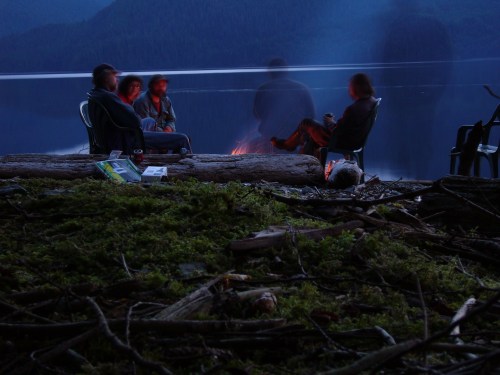
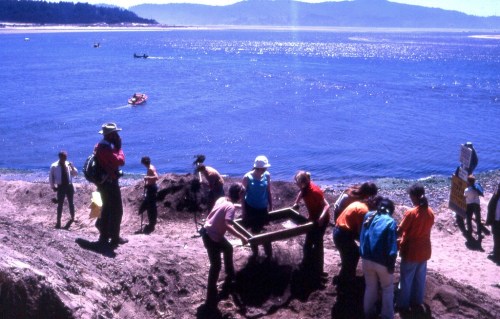
I just noticed this was NW Coast Archaeology blog post #100. To counteract this being so grumpy, here's a nice picture of camp life on Tanu Island.

UCLA-Stó:lō Field School at Welqámex

s’iltexwáwtxw

I see UCLA is running a fieldschool again this coming summer in Stó:lō territory at Welqámex, a village site on the  small island in the Fraser River near Hope.  Instruction is by Anthony Graesch (UCLA) and Dave Schaepe  (Stó:lō Research and Resource Management Centre).  The UCLA web site has been down as much as up recently (because it has so  many bells and freakin’ whistles it doesn’t know if it is coming or going — idiot web designers make such fragile shit these days), so you can also check the AIA web site.  Here is a direct link to their pamphlet (PDF).

Note the students wearing protective ochre daubing.

Videos of Gwaii Haanas Archaeology

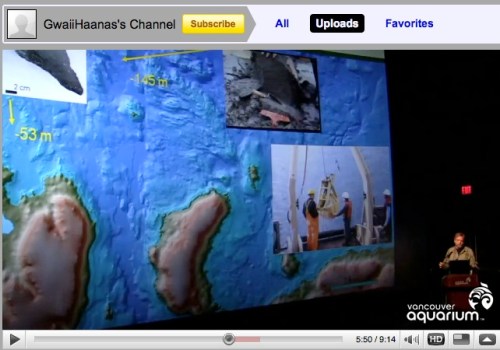
Daryl braves the barrage of bras to set the Vancouver Aquarium straight on the value of dead fish over living fish. Click to play part 1.

Rockwash superstars Nicole and Daryl show off their cool wares in a couple of videos I just found online – I vaguely remember them going off to give this talk at the Vancouver Aquarium.  It’s in two parts: 1 and 2.  Nicole looks fabulous and Daryl has trimmed his beard!  Win-Win.  The projects they describe sure were a lot of fun to take part in.   There are a few other talks up including Lyle Dick and Norm Sloan on Sea Otters on the Gwaii Haanas Youtube Channel.

A sandhill crane is a tough act fo follow but Nicole hammers home the righteous message of dead fish. Click to play part 2.

Archaeology in Action: a flickr.com photo pool

Archaeologists? No -- "Pothunters" destroying a site on the Columbia River, ca. 1966. Source: flickr user gbaku.

Archaeology in Action is a large set of pictures of archaeologists doing archaeology on the photo sharing website flickr.com.  Not too much Northwest Stuff there that I could find with the notable exception of many pictures put up by a former University of Oregon professor under the name of gbaku (you can find his real name easily enough).  His pictures are a wonderful tour of Oregon and Alaskan archaeology of the 1960s and 1970s – these are not sets of pictures of stratigraphy, or backdirt (interesting though those things are) but are predominately of, well, archaeologists in action.  It would be fun to see more NW Coast pictures up here — I know Grant has a large collection of pictures of archaeologists going about their business and I am sure we all have some pictures of people in with the endless pictures of yet another bone.

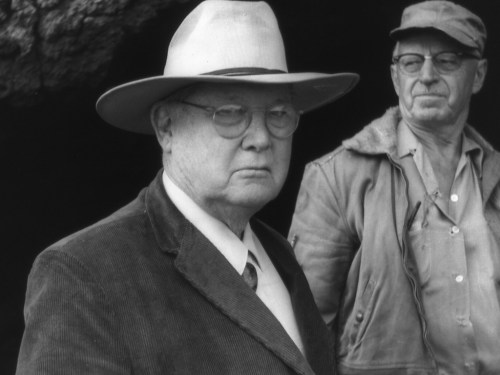
Erle Stanley Gardner, the author of the Perry Mason mysteries and many other books, and Luther Cressman, pioneering archaeologist and ex-husband of Margaret Mead, at Fort Rock Cave in 1966.

Somenos Creek: Update 2

CHEK-TV video clip on the Somenos Creek archaeological situation. Click to play.

Someone passed along this CHEK-TV news item showing George Schmidt of TimberCrest Estates, Ltd., the development company wishing to put houses on top of a major archaeological site in the Cowichan Valley at Somenos Creek, which I’ve written about before: 1, 2.

Listen to the favourable treatment he gets from the newscaster. Loaded language like “In limbo”. “Pony Up”.

Hey, CHEK-TV, since you’re the voice of the people now and all that and also “journalists”, how about you dig around in the zoning history of the land before you just repeat the mantra “government must pay”.  Did the developer buy this land already zoned for residential development?  How much did he pay in 1972?  Does he deserve compensation for having a risk turn out the wrong way for him?  Does he have the right to destroy a cemetery?  Is he, in fact, losing anything that he already had, or is he losing a perceived entitlement?  He took a risk, he has gained mightily, and now he wants a slice of the First Nation’s pie as well.

I’d seriously suggest CHEK-TV also looks into the $500,000 amount he claims to have spent on archaeology at Somenos Creek.  From what little I know of the site, I am very skeptical about that figure.

Truly, there needs to be a mechanism by which true hardship cases of conflict between development and archaeology, or where the impact assessment process has failed, can be resolved.  That, indeed, may mean some government financial input.  But these should be reserved for instances where other options have run out and where there is demonstrable financial hardship.  This case does not pass the smell test – vast profits have assuredly been made and now legal and moral constrains are drawing a line under this development.

I say this company should stop going cap in hand to the government and just give the land up as a heritage park in return for a tax receipt.  Unless I am mistaken, most entrepreneurs are not socialists, and I  am sure the last thing the typical developer would want is to be perceived as a corporate welfare bum.

Haida Gwaii is now just Haida Gwaii

a.k.a., The-Islands-Coming-Out-Of-Concealment.

The thinnest possible news report from the Times-Colonist says that the BC Government will now use “Haida Gwaii” in all official contexts, rather than “The Queen Charlotte Islands”.  Presumably this means it will be changed in the official BC Gazetteer but so far it shows no such change this calendar year.  More from the Globe and Mail:

“The change is a very important symbolic gesture,” said Guujaaw, president of the Haida Nation. (Guujaaw goes by one name.) “That’s the land that gave us our life and culture. It’s the proper name.”

Robert Finch, chief executive officer of the Monarchist League of Canada, said he was surprised and disappointed by the B.C. government’s decision. “They assume that they’re doing a good thing, but they’re erasing a very big part of Canada’s heritage.”

I wonder if Robert Finch has even the faintest idea of how clueless he sounds, how arrogant and absurd and, frankly, irrelevant.  Maybe if he spent more time thinking about the Crown’s broken promises to aboriginal people he would be less likely to spout such verbal tripe.

Anyway, this will simplify journal articles, where it will no longer be necessary to footnote the name “Queen Charlotte Islands” or refer to “locally known as Haida Gwaii and henceforth referred to thusly”.  Meanwhile, enjoy the picture above: coming home through north Juan Perez Sound.