Category Archives: Northwest Coast

Destruction of Kwalate Village

Major landslide scar near Kwalate Village. Source: panoramio user Obslord.

Yesterday’s post about Marianne Nicolson’s powerful pictograph in Kingcome Inlet and the post from a few days ago about the enormous Tsunami in Lituya Bay got me thinking again about recent work in Knight Inlet on the central B.C. Coast (map).

A recent project by a team of geomorphologists and an archaeologist, UVic’s own Duncan McLaren, investigated oral historical accounts about Kwalate Village of the A’wa’etlala and Da’naxda’xw peoples, of the Kwakwaka’wakw First Nations.  The accounts state that a landslide in Knight Inlet triggered a local Tsunami which swept this village away. This account is known anthropologically through a number of sources, including Franz Boas (1910, Kwakiutl Tales):

“About three generations ago, or possibly at an earlier date, a large portion of the mountain opposite Kwalate Point slid into the inlet causing a huge tidal wave which wiped out all of the inhabitants of the village opposite…and the vast slide is noticeable today”.

Of course, the story of the destruction of Kwalate is still told and the dead, unknown in number but perhaps up to one hundred, are still mourned and memorialized in the surrounding communities.  While it is not necessary, or even desirable or possible, for archaeology to confirm oral historical accounts, when that happens it can be of interest to archaeologists and First Nations people alike. Continue reading

Cliff Painting by Marianne Nicolson

Marianne Nicolson is a member of the Dzawada’enuxw Tribe of the Kwakwaka’wakw First Nations.  She is an internationally-known contemporary artist, and a Ph.D. candidate in the Departments of Linguistics and Anthropology at the University of Victoria.  Her work is outstanding and profound and if you get a chance to see her studio pieces, then by all means do so.

One work you will not be seeing in a gallery anytime soon is her massive pictograph, Cliff Painting, near the head of Kingcome Inlet in her traditional territory (map).  The work is over 15 metres high by 10 metres wide, emblazoned on a prominent cliff as you round the final corner heading into Kingcome (video, scroll down).  It formed the focal point of the book by Judith Williams Two Wolves at the Dawn of Time, which is highly recommended.  Painted using scaffolds lowered from above the cliff, the work is a profound statement of power and energy.  The image is of a “copper“, a large shield-shaped symbol of chiefly power, family prestige and spiritual inheritance, among many more nuanced meanings.  Many pictographs on the coast are fading away, rinsed by sun and rain, vandalized even.  This massive pictograph takes a stance for all the past, present, and future powers of the Kwakwaka’wakw First Nation.

Cliff Painting in Progress. Source: The Medicine Project.

Northwest Coast in New Zealand

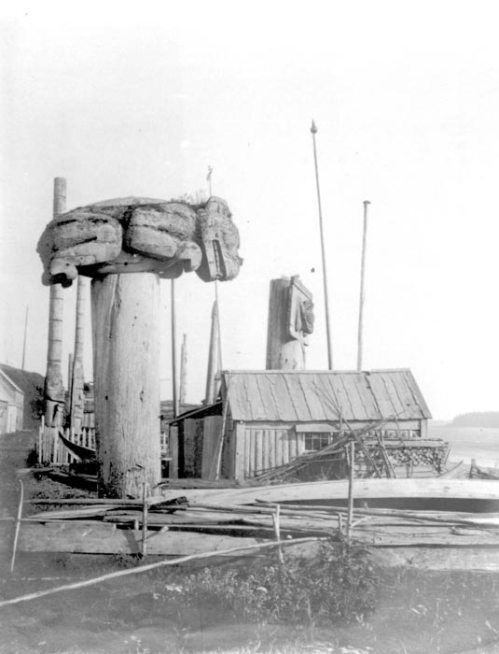
Masset, ca. 1924. Source: University of Canterbury, NZ.

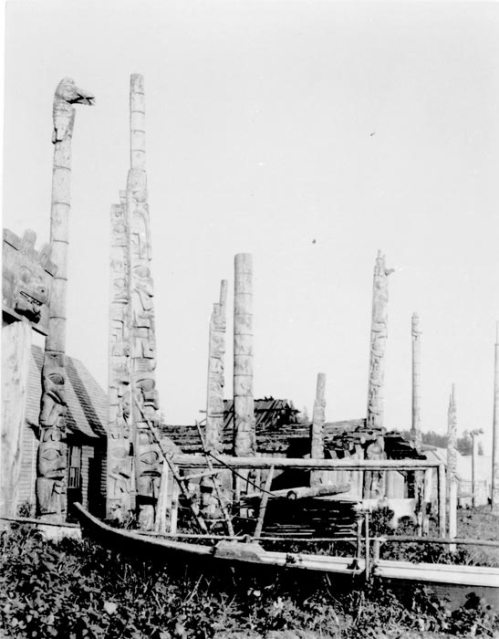
I found myself poking around in a New Zealand archive at the University of Canterbury the other day and found some nice historic pictures from the NW Coast.  These are assigned to the collection of John Macmillan Brown, an early New Zealand academic and, in retirement, an amateur anthropologist.  I am guessing these pictures were taken by him in retirement.  Most are undated; one carries a date of 1924.  The subjects are familiar yet the views are new – the more we can catalogue the world’s pictures of the NW Coast, the better we can understand the processes of transformation which continue to unfold.

Update: fixed links, sort of.  Note to web types: you should always provide stable URLs, none of this “your search has expired” junk.  If you want your collections used, and you do, because you put them on the web, you need to make it so the results can be bookmarked and shared.  Gosh.

Skidegate ca. 1924. Are those oarlocks on that canoe? Source: University of Canterbury.

La Perouse at Port des Francais (Lituya Bay)

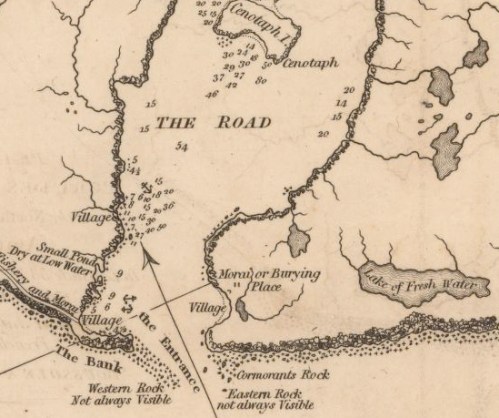
Detail of entrance of Port des Francais. Source: Brown University. Click for zoom version.

Most readers will be very familiar with Captains Vancouver and Cook and some of the other early European explorers of the Northwest Coast.  Less familiar is Jean-François de Galaup, Comte de La Pérouse, (1741-1788), who embarked on a world journey of exploration in 1785:

The French decided to mount a scientific and exploration voyage to rival that of Captain James Cook. Two ships, the Boussole and the Astrolabe, under La Perouse’s command left France in August 1785. They spent the summer of 1786 off the coasts of Alaska looking for a northwest passage then sailed down the west coast of North America in August and September 1786.

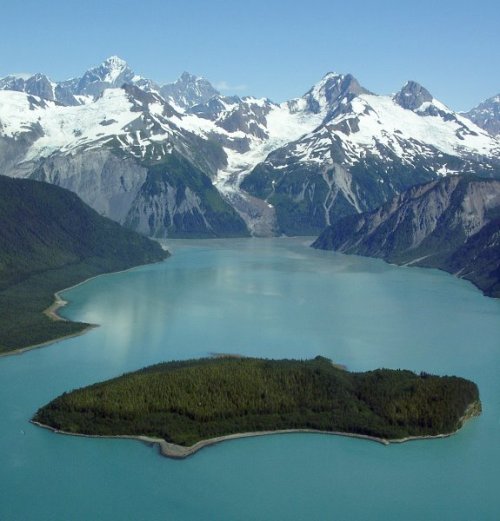
One of their most memorable and tragic periods was the time they spent in Lituya Bay, Alaska, which they called Port des Francais (map).

Lituya Bay, with Cenotaph Island in the foreground. Source; Panoramio user footsnviews.

Their mapping and illustration of Tlingit life are not unknown but also not that easy to find.  I recently came across an interesting site which has the best web presentation of these materials (actually reproduced from a 1798 British edition) I have seen: the images are highly zoomable, and the zoom is fast and crisp and smooth.  Linking to specific images is possible and the links don’t break.  With a little bit of effort, you can download the images (hint: “view source” of the page and search for ‘Size4″).  So zoom right in and see the details of pictures such as this one of a fish camp (are those halibut drying, or Pacific cod?), or this one of both a fine Tlingit dugout, and the construction of a skin vessel, with its seal skin hull removed and placed to one side.  The chart made by La Perouse is here and full of detail (again, these are English re-engravings of the originals).

While spending  time in Lituya Bay, tragedy befell the expedition. From here, an account of La Perouse’s time in Port des Francais:

1786 July Port des Francais / Lituya Bay

The next day, the narrow entrance to an inlet was located to the east of Cape Fairweather. De Pierrevert, from the Boussole, and Flassan, from the Astrolabe, were dispatched in small boats to investigate the inlet. Their favourable reports encouraged a somewhat reluctant La Pérouse to take the ships in. Their first approach was unsuccessful and they tacked offshore through the night before the tide carried them in the next morning. Even then, it was a precarious passage and the ships both nearly were driven onto rocks. They anchored just inside the entrance but La Pérouse was not happy with this spot, it having a shallow, rocky bottom. He sent men off to a find safer anchorage. D’Escures found a better location behind the large island in the inlet and the two ships transferred there. It was 3 July 1786.

Continue reading

Major expansion at the Royal B.C. Museum?

Proposed changes to the RBCM: the clear white structure to the back left is the new curatorial tower & archives; to the right is a new entrance and multi-functional area. Source: Times-Colonist.

The Victoria Times-Colonist had a story Saturday that the Royal B.C. Museum is proposing a major expansion, in which theirs quare footage would more than double, from 379,000 to 895,000 square feet.  The curatorial tower and the low-rise archives building on the NW side of the block would be demolished, replaced by a new multi-function complex which would also form the entrance to the museum.  The collections and curatorial facilities, and the archives, would move to a new 14 story building to the south of the current museum.  The RBCM C.E.O, Pauline Rafferty (an archaeologist by training) notes that ““We are now at a crossroads.  We have outgrown our on-site storage facilities and significant artifacts are stored below sea level.”  The article estimates the cost will be in the hundreds of millions of dollars which is easy to believe. The Times-Colonist weighs in with a strong editorial of support, citing the collapse of the Cologne archives last year with irreparable damage to the history of that City.  So: no-brainer, right?

Continue reading

Samuel Hancock witnesses smallpox among the Makah, 1852-53

Front page of Samuel Hancock's memoirs.

Samuel Hancock’s reminiscences were published in 1927 as a very small print run, and contain one of very few contemporary eyewitness accounts of the effects of smallpox on a Northwest Coast people, in this case the Makah Tribe of the Olympic Peninsula. So far as I know, these memoirs are not available anywhere online and are hard to find in libraries.  My brother Al Mackie (I told you only my family reads this thing) sent me a scan of parts of Hancock’s narrative relating to the smallpox epidemic, and so this is in essence his guest contribution.

The  excerpt  is a powerful and distressing account that hints at the social and cultural turmoil which arises from catastrophic depopulation and the witnessing of mass death, as noted elsewhere:

A smallpox epidemic in 1852 decimated the Makah population and caused one of the five ancient villages, Biheda, to be abandoned. This loss was not the only problem. The extreme number of fatalities further disrupted the line of authority in most families. In addition, knowledge of the critical components of some ceremonies and rituals were suddenly lost. People also died without transmitting ceremonial rights or privileges through a potlatch. The complicated social and ritual life that had existed for thousands of years began to fall apart.

The part of Hancock’s book quoted below is on pages 181-183 (PDF).  Such stories must have been passed down in Makah circles as well, much like the smallpox account of Skidegate Haida elder Solomon Wilson.  More detail on the author and source is given below the excerpt.

“Soon after this, a brig commanded by Capt. Fouber arrived here from San Francisco, having on board two natives who lived here, and also a white man with smallpox; the two natives left the brig, and went on shore among their friends, but in a few days were prostrate with the same disease, contracted on the vessel; one soon died and the other recovered, but the disease spread among the natives, proving very disastrous, for in a majority of instances it was fatal. After resorting to every means in their power to arrest its progress and fatality in vain, for their friends were dying in vast numbers daily, those who had escaped became almost frantic with grief and fear, and conceived the idea of crossing the Strait and going to the Nitanat tribe living on Vancouver’s Island. They crossed over to this place, carrying the infection with them, and soon nearly all those who fled from Neaah Bay, besides a great many of the native tribe, became victims to the epidemic.

“It was truly shocking to witness the ravages of this disease here at Neaah Bay. The natives after a time became so much alarmed that when any of their friends were attacked, all of the other occupants who lived in the house would at once leave it and the sick person with a piece of dried salmon and some water, laying all their personal effects by the sick persons, not intending to ever approach them again; sometimes the retreating ones would lie down anywhere on the beach till they died. I have, in walking along, encountered them lying in this situation when they would beg in the most supplicating manner for medicine or something to relieve them, promising to serve me as slaves all their lives should they recover, if I would contribute in some way to their recovery, while I did not have it in my power to do anything to ameliorate the sufferings of the poor creatures other than by furnishing them food or water if needed. Continue reading

Lasqueti Island Archaeology

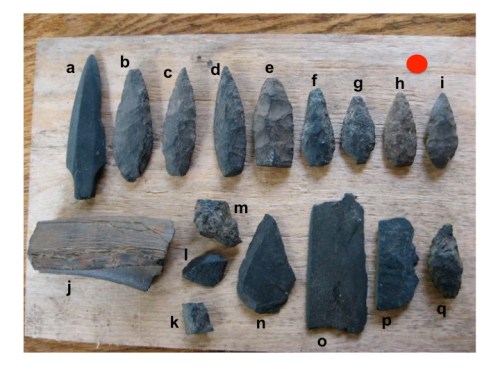
Projectile points and other artifacts from Lasqueti Island.

So many of the Gulf Island of the BC Coast are essentially unknown to archaeologists.  This goes for the larger ones as well as the small: I’d count Lasqueti, Hornby, Texada, Saturna, and Prevost Islands among those, while even major islands like Mayne Island and Quadra Island are often known only from one site, dug long ago.

This doesn’t mean there hasn’t been any work, or that there aren’t interesting and revealing collections of archaeological material already in existence.  So it is great to see that Dana Lepofsky of SFU has put together a small web site on the archaeology of Lasqueti Island.  She deftly combines some ethnographic and traditional practice information with a series of photographs of private collections of artifacts.  Among these are projectile points apparently assignable to the Charles Phase, which dates around 5400 to 3600 years ago.  Also note the beautiful ground stone adze or chisel in this picture: the luminous green nephrite (B.C. “jade”) would have been imported from the Central Fraser River, probably no closer than the Hope area.  This flaked and ground sandstone club is an unusual find, probably used in hunting or fishing, but perhaps also in warfare.

If you click the photographs, then a window will open; if you click the “image details” link on the pop-up window then you will be taken to more information about that photo, if available.  There are also two PDFs linked, one to the role of herring in traditional subsistence, and another on mapping a fishtrap.  These stem from Lepofsky’s ongoing work (and excellent website) in Tla’amin territory on the Sunshine Coast (previously), where she will be running an archaeological fieldschool again this summer.  While this only scratches the surface of Lasqueti Archaeology, it does point to the usefulness of looking at what citizens have picked up over the years as a guide to some of the time depth and activities of an area.

Sadly, of course, some of the artifacts picked up may have resulted from, or even caused, unnecessary disturbances to the archaeological record.  Lepofsky provides a helpful “call before you dig” article as well – specific to Lasqueti yet applicable elsewhere.  In typical Dana fashion, as a Lasquetian herself, the number to call is her own!

Lasqueti Island intertidal fishtrap. Photo: Dana Lepofsky.

Hoko River pictures are back

Hoko River project director Dale Croes, apparently wearing chaps, at the site in 1977.

(Edit 2018 October: look here for current location of these pictures)

Some time ago I pointed readers to the vast repository of Hoko River wet site excavation pictures put online by Dale Croes.  Unfortunately, those links broke but now, via  blog reader APM, I hear that the Hoko photo gallery is back online.  I will definitely be mining this repository for lots of posts.  Not only is this one of the most interesting sites ever excavated on the Northwest Coast, the pictures are a superb combination of excavation, artifact, and camp life – the latter a visual record of local archaeology as social practice in the 1970s. Also, as I mentioned previously, the lush, rich colour of the old Kodachrome slide film is stunning – you just don’t see that in modern digital cameras or even print film, despite the undeniable advantages of digital.

From the main page, many of the most interesting pictures are found under the “camp life” link.  There you will be confronted with an awkward frames-based link layout.  Not all links work still, but I’d say 90% do.  You can browse easily by clicking on the pictures that open on the right-hand frame to get the next picture.  This is easier than keeping the mouse centred on the picture number to the left.  Right click on the picture to bring it up in its own window or tab.  Some pages are organized as thumbnails, such as the wet site stratigraphy series. Because of the slightly awkward interface, I’ll aim to create a series of posts here which point to what I think are interesting aspects of this wonderful site.

Richard Daugherty and survey crew evaluate potential of Hoko Site in 1967 in WSU research vessel.

Boundary Maintenance

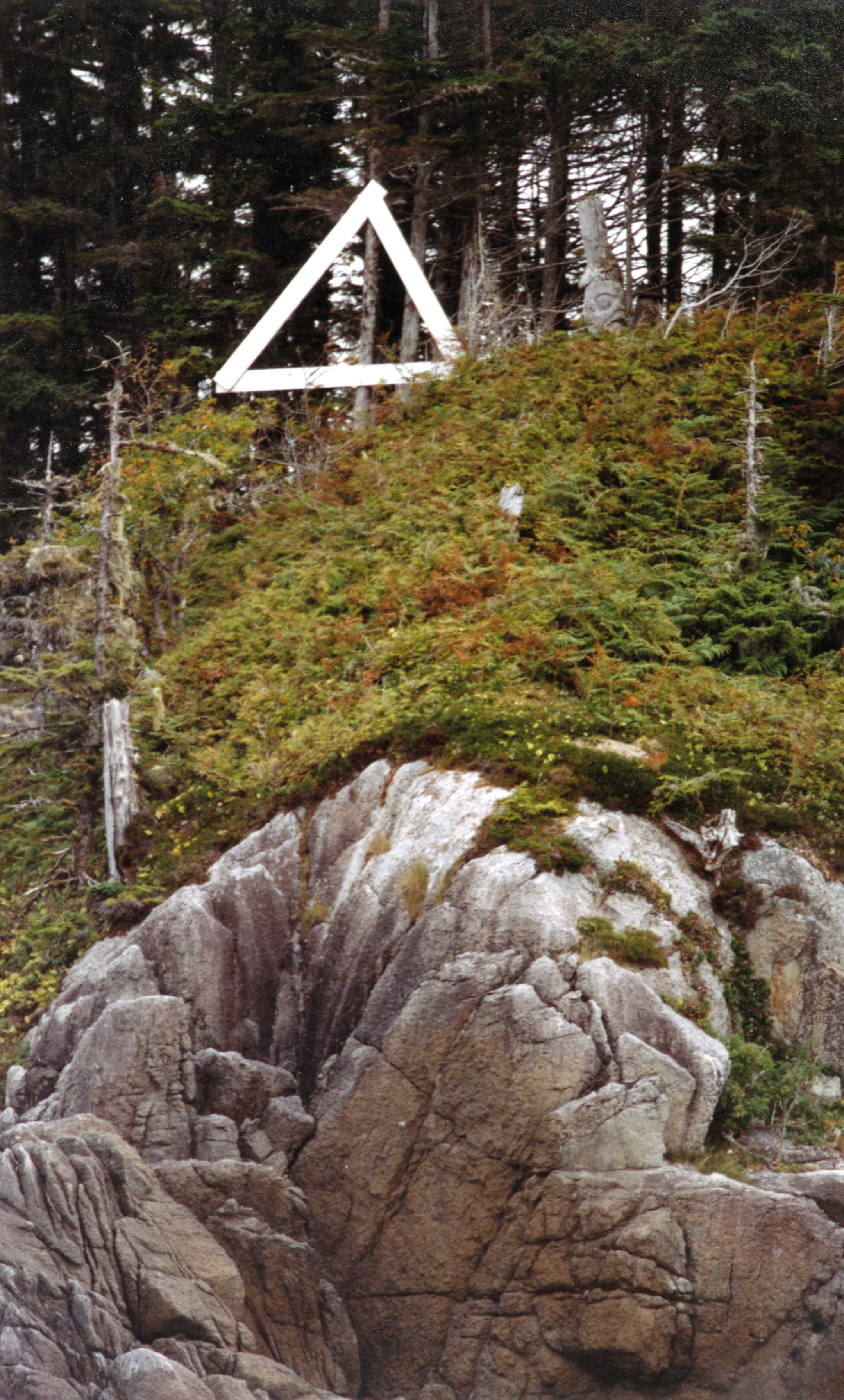
Headland with wooden markers. Click to zoom.

This is one of my favourite pictures of B.C. Archaeology, even though  it doesn’t look like much.  It’s a bit fuzzy: I took it with a zoom lens in about 1985 , rounding a headland in a small boat  on the Central Coast.  In fact, you might think it doesn’t look all that archaeological.  Look closer: sticking up to the right of the white triangle you can see the carved head of a pole.

The white triangle is a standard device used by Fisheries to demarcate the different fishing zones on the coast, for management purposes.  On one side of the triangle there might be different catch limits or closures or seasons of harvest enforced than on the other.

I don’t know much about the pole, but its location on such a prominent headland, facing the open Pacific, next stop Japan, is suggestive it marked a change of territory, a boundary shift, a movement from the control of one lineage or house to another. You don’t often see such a pole away from a village site.

Both wooden markers may ultimately serve the same purpose: boundary maintenance between zones of control; advertisements for power; watchful symbols of formal rights; the means of resource management.  It is intriguing and almost poetic to see them standing, side by side, on the same headland, guarding the same water.

Detail of wooden markers.

Ancient Basketry from the Biderbost Site

2,000 year old basketry from the Biderbost Site, Seattle. Source: Burke Museum.

The Biderbost site is on the Snoqualmie River near Seattle.   Since 1960, a series of excavations have revealed a remarkable set of artifacts made from organic materials, preserved because of the water-saturated, anaerobic conditions of deposition.  The Biderbost site was the first site of its kind to be excavated in the Northwest, at least to a professional standard.  The Burke Museum has an excellent page on this site, including a page of basket photos (reasonable resolution, yay), weaving techniques, and conservation of these delicate artifacts.  There are also three informative (if not exciting) videos on YouTube about:

These artifacts, which include a large number of basketry pieces, date about 2,000 years ago.  Since most archaeological sites in the Northwest preserve stone, shell and bone fairly well but not wood, bark or root, these sites (which also includes Ozette, Hoko River (pics now broken fixed), Pitt Polder, Qwu?gwes, Kilgii Gwaay, and others) offer remarkable insight into the organic technology.  Ordinarily, we don’t see this stuff at all archaeologically and yet it may be the majority of the traditional technology; it may be stylistically distinctive and different compared to stone and bone tools; and it may be disproportionately representative of the lives of women.

Why there aren’t more archaeologists focusing research questions on these sites is unclear to me: yes, they are awkward sites and expensive and time consuming, but then so are shell middens.  I suspect it boils down to the unfortunate fact that the key NW wet-site researchers in the last thirty years (Dale Croes and Kathryn Bernick) were never in the kind of academic position where they routinely supervised graduate students and hence they were never able to harness the energy and intellect of that backbone of NW Coast Archaeology: the Master’s student and their diverse and often excellent theses.

I would be remiss in not mentioning that the Burke Museum has a Biderbost “Adopt a Basket” program to help with long term conservation of this remarkable suite of artifacts.

Basket rim and body fragment from Biderbost. Note the mud embedded in the weave. Source: Burke Museum.

Fishing weight wrapped in basketry with sticks attached. At a normal site this would appear to be an unmodified pebble. Source: Burke Museum.