Category Archives: Northwest Coast

Convictions in Yakima Looting Case, with comments on B.C.

Looting at Wakemap Mound, 1957.

A news snippet from Washington State: from the Yakima Herald-Republic, via the excellent Washington Department of Archaeology and Heritage Preservation Blog.

“Yakima, Wash. — Two Goldendale residents found guilty of looting American Indian artifacts from a Yakama Nation cultural site have been sentenced to pay $6,690 in damages and placed on two years probation. The pair have also been sentenced to 150 hours each of community service.Devin Prouty, 27 and Tiffany E. Larson, 24, both pleaded guilty in U.S. District Court to unlawfully removing artifacts, including rocks, rock flakes made by indigenous people and arrowheads from Spearfish Park near the Columbia River in Klickitat County…”

Looting is a serious problem in Washington and Oregon States but is it one in British Columbia as well?

Continue reading

ASBC Victoria: May Public Lecture Tuesday 18th

Quartz Crystal projectile point with Stave Watershed in background.

Seven Thousand Years of Occupation at the Ruskin Dam Site, Stave River Watershed

Duncan McLaren, Ph.D. and Brendan Gray, M.A.

This month’s Archaeological Society of B.C. (Victoria Chapter) free public lecture will be about a fascinating site recently excavated by Cordillera Archaeology in the Stave River watershed, near Vancouver:

Excavations of the Ruskin Dam Site, located on the north side of the Fraser Valley, were conducted over four months in 2009 as part of a salvage project.  Our talk will discuss the significance of the major discoveries at the site including: the house features, quartz crystal tools, biface styles, woodworking technology, objects of personal adornment, and faunal remains which contain a high proportion of sturgeon bones.  Combined, the artifacts, radiocarbon dates, and site stratigraphy provide a unique opportunity for gaining a perspective on the long-term occupation of this strategically located archaeological site.

I expect this talk will also indirectly exemplify the leading role B.C. Hydro is playing in enlightened Cultural Resource Management in this province.

This talk is free and open to any member of the public.

Tuesday May 18 at 7.30 P.M.

Pacific Forestry Centre, 506 West Burnside Road.

For information,  e-mail asbcvictoria@gmail.com , or leave a comment/question below.

Capilano University Field School Blog

"At each logging camp a familiar discovery was a wood burning stove or oven. The one pictured {above} had stumped some former students of Muckle's in the past because the student who helped recover the stove had read an engraving on the side saying "To Jake". After pondering upon this curious inscription, it was realized that the "J" had incorrectly been read, and the whole etching had actually said "To Bake", commonly found on ovens." Source: http://archaeologyfieldschool.blogspot.com/

I noticed that the Capilano University Archaeology Field School, which just started a few days ago near Vancouver, has a blog.  So far there are three days worth of entries and it looks like it will be a lot of fun to follow along with the students who, under the direction of  Bob Muckle, will be continuing to work on the archaeology of historic logging in the Seymour River Watershed, which flows into Burrard Inlet.  Much of the logging was conducted by Japanese immigrants, making for a nice overlay of ethnicity and capitalism and material culture.

Continue reading

More on Comox Harbour Fishtraps

Fishtrap stakes delineating chevron patterns in the intertidal zone of Comox Harbour. Photo credit: Greene 2010.

I posted once before some time ago on the incredible fishtrap complexes in Comox Harbour on eastern Vancouver Island, highlighting Megan Caldwell’s M.A. thesis (downloadable) on the topic, and mentioning in passing that primacy of investigation should perhaps go to Nancy Greene, who has been mapping and dating these features for about a decade.  I was glad to find the other day that Nancy Greene has a 2010 downloadable poster on the topic (link starts a 4 meg PDF)  from an academic conference: WARP, the Wetland Archaeological Research Project, which itself has a nifty new website.

These Comox Harbour fishtraps are one of the wonders of B.C. Archaeology and it is highly welcome to see some more of Greene’s reconstructions and mapping.

Continue reading

Russian Plastic Tlingit Warrior Models. And more!

Model of a Tlingit warrior. Source: http://www.modelsculpt.org, click for original page.

Well, there’s another headline I never thought I’d write!  Don’t ask me how I found it but these Russian guys have a passion for modelling human figures and one of their subjects is a Tlingit warrior.  It’s actually pretty impressive, with slat armour faithfully rendered, a wooden helmet and the circular gorget or throat protector. Scroll around on that forum for more images of the model.  We’ve looked at Tlingit slat armour on this site once before, as well.  The narrow slit between the helmet and the gorget or collar might seem exaggerated, but it agrees with this picture (also perhaps exaggerated) and this drawing, both apparently from Russian sources.

But there was an ancillary benefit to looking through this Russian-language forum: one of the participants has scanned some amazing pages of Tlingit art and artifacts from a Russian book, stuff I had never seen before that perhaps has its origins in colonial Russian Alaska.

Continue reading

How to Make a Petroglyph

Replica sandstone petroglyph made by Christine Stathers. Photo credit: Stathers.

I’ve often said the graduate student work is the backbone of the archaeological discipline in British Columbia.  Today I get to report on more student work – but this time its a fascinating study done by an undergraduate student at Camosun College here in Victoria.  The student, Christine Stathers, did an experimental archaeology project for her Anthropology 240 course, and she kindly agreed that I could post some of the results here.  The results are highly informative for our interpretation of petroglyphs, I think.

Continue reading

UVIC Archaeology Field School

I hear through the grapevine that the 2010 University of Victoria Field School in Archaeology still has a couple of spaces available.  The project, in conjunction with Parks Canada and with the Hul’qumi’num Treaty Group, will run July 5 to August 13 or so in the southern Gulf Islands.  Students will take Anthropology 343 and 344 at UVIC and there will be a camp fee, to cover the costs of running the project and a camp on a Gulf Island for four weeks – one of the unferried ones: Portland Island.  There is more information about the course at the University of Victoria Anthropology Web site, including a PDF application form you can download.  The course will be taught by Dr. Duncan McLaren, who can be reached at dsmclaren {{at}} gmail dot com for more information.  Other UVIC faculty* and Parks Canada archaeologists will be taking part as well, as well as First Nations apprentices.  This particular course will be focused on skills needed in Cultural Resource Management jobs, as well as the cultural history of the Salish Sea and other related topics.  If you know someone who might be interested, or have students looking for a pretty good  fieldschool, consider circulating this information soon, as I hear the field school needs to finalize its numbers soon and there will be a second look at applications received.

*since this is my personal web site and is not affiliated with my day job, you’ll have to click the links to find out who that might be.

More on the Sea-to-Sky Cultural Journey

Sign at the Horsehoe bay kiosk. Source: tad McIlwraith flickr.com account.

A month or two ago I commented on the Squamish and Lil’wat Cultural Journey website, which explores oral history and place names in the traditional territory of these two southwestern British Columbia First Nations.  I was really happy to see that Douglas College Anthropologist (and occasional commenter here) Dr. Tad McIlwraith has carried the review much further.  He’s even taken it into the field, so to speak, by documenting and discussing the actual cultural centre itself, and also the roadside kiosks which bring Squamish and Lil’wat histories to the travelling public.

Tad’s review has two parts.

Continue reading

William Alexander’s Watercolours of Vancouver’s Voyage

Village of the Friendly Indians near Bute's Canal. Watercolour by William Alexander. Source: University of Illinois.

Yesterday I posted an engraved  view of  a village near the entrance to Bute Inlet, the view seen in 1792 during the voyage of Captain Vancouver.  Much as with the earlier posts on John Webber (1, 2, 3), there are multiple versions of these scenes.  The above shows a watercolour rendering made by William Alexander, a well known artist and draughtsman of the late 18th century.  It seems his series of works on the NW Coast was not done from life but was a commissioned finalization of the drawings of William Daniell, who was actually on Vancouver’s voyages, and perhaps other artists/oficer’s sketches.  At least that is the story I’ve been able to winkle out, starting from a position of sheer ignorance.  Nicely, though, Alexander’s watercolours from the Vancouver Voyage series, covering Alaska, the Northwest Coast and some views of California and Chile, are all available online through the Newberry Library at the University of Illinois.  These renderings were not familiar to me and perhaps not to you, either.

Continue reading

Houses on Stilts

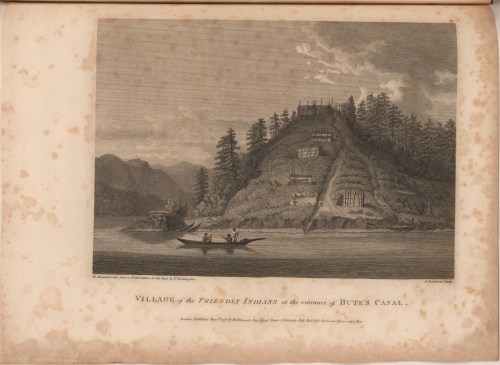
"Village of the Friendly Indians at the Entrance of Bute's Canal", 1792. Click for zoomable version.

The above image shows a seemingly improbable Kwiakah Kwakwaka’wakw Village (EDIT: probably Homathko Coast Salish Village) at the entrance to Bute Inlet, as drawn in 1792 by a member of Captain Vancouver’s expedition.  With the houses scattered up a steep hillside, the top one apparently partially cantilevered out, it does not fit the average archaeologist’s mental model of a typical Northwest Coast village.  The setting would undoubtedly have some defensive advantages, at least for those at the top.  I know of another image of a steeply-tiered village site which is apparently not strictly a defensive site.  Hard to live on the side of such a steep hill, you might think.  Wouldn’t it be nice to have photographs of such a village?  Aha.

Continue reading