Category Archives: Northwest Coast

Salmon species now knowable from vertebrae

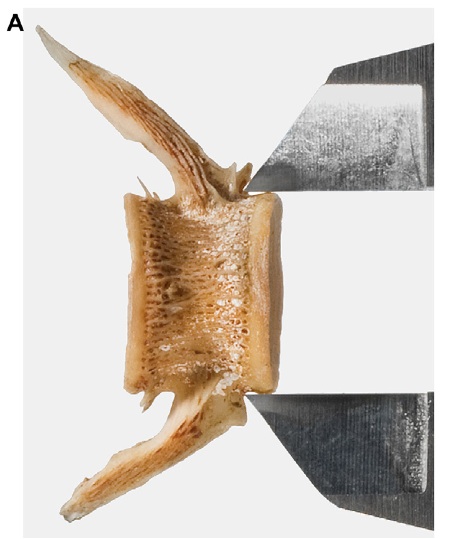
Measurement of vertebral height. Source: Huber et al. 2011

Salmon are a crucial cultural keystone species across most of the Northwest,  of very high importance to many coastal and interior cultural groups for thousands of years.  Many archaeological sites are chock full of salmon bones, and the oldest of these are around 10,000 years old.  As a cultural story, the importance of salmon is obvious.  Increasingly though, the archaeological data are also invoked to tell the history of salmon themselves.  The very long-term view of the archaeological record provides  knowledge of their ranges, their relative abundance, their life histories, etc.  These data can then be harnessed as part of conservation and fisheries management of these threatened species of fish.

Each species offers different things to people: some run early, some late; some are more fatty, some leaner; some run in huge compact numbers, others tend to dribble by; some can be caught in large numbers in the open ocean, others can only be caught efficiently in streams.  There’s just one problem with using salmon bones in archaeology: until recently, you really couldn’t tell one species of salmon from another based only on their bones.
Continue reading

Oregon Earthquakes and Tsunamis

Source: Byram 2007.

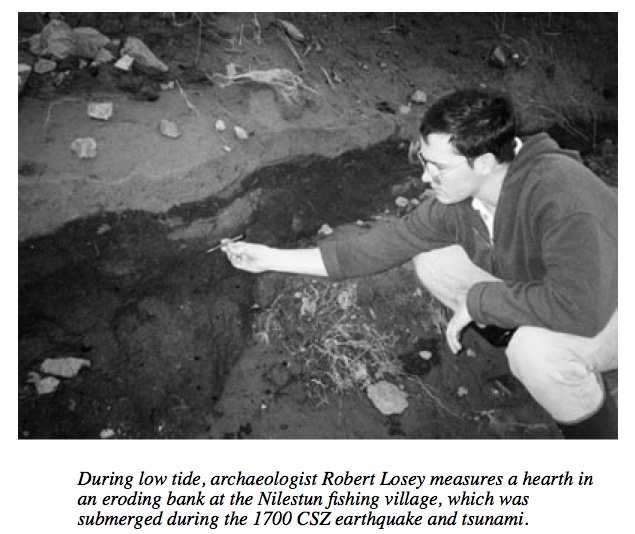
Every few centuries, on average, the Northwest Coast gets shocked by a massive mega-thrust earthquake, on the order of 8 to 9 on the Richter scale.  On occasion, these produce a devastating tsunami wave.  It wouldn’t be surprising then if such disruptive events featured in aboriginal oral histories and also in the archaeological record itself.  There is a growing body of research on this topic which I am not planning on reviewing at this time, but a nicely focused starting point is a series of papers in the Oregon Historical Quarterly, available online.

Continue reading

The Skagit River Atlatl

The Skagit River Atlatl. Image © UBC Museum of Anthropology, Photographed by Derek Tan. CC Licenced.

An atlatl, or spear thrower, is a device used to increase the velocity, and hence range or striking power, of a projectile.  These are usually made of wood or other organic material, and hence they seldom survive in the archaeological record.  Some years ago though, one was dragged up in a fishing net from waterlogged conditions in the Skagit River estuary in northern Washington State near Anacortes.  As the UBC Museum of Anthropology describes:

Made of yew, a hard yet flexible wood, the weapon survived 1,700 years buried in alluvium in the Skagit estuary until it was dredged from these silts by a seine fisher’s net in 1939 in the Lower Skagit between Townhead Island and Bald Head Island. It is believed that it hung in a fish shed, perhaps to dry slowly thus preventing some deterioration, until archaeologists became aware of it in the 1950’s.

Rather incongruously, the Southwest Archaeology blog Gambler’s House has had two in-depth posts about this artifact, here and here.  It’s worth reading both as they give excellent background and tons of links.

Continue reading

Revisiting the Salt Spring Island Archives

Part of the Charles Sampson collection from Salt Spring Island. Source: saltspringarchives.com

Salt Spring Island is a large island in the Salish Sea, close to Vancouver Island’s southeast corner (map).  Quite a while ago I highlighted the photographs of the “Bob Akerman” museum, which comes via the comprehensive Salt Spring Island archives.  There are a few other photo records of archaeological collections there which I thought were worth a quick look.  For example, the picture above from the Charles Sampson Collection shows some fairly spectacular ground slate points to the left, and what may be a Charles phase (ca. 4,000 year old)  contracting stem point to the bottom right.  It’s not just archaeological collections that the archives has going for it, though. Continue reading

Mossback nails it . . .

Mossback's column at Crosscut.com

Some time ago I mentioned Seattle’s reporter on the “Heritage Beat”, Knute Berger, who posts by the name Mossback. Over the summer, while I was gone, mossback produced a really to-the-point column on heritage preservation: Help wanted: A ‘Sierra Club’ for historic preservation to fight development.  Unusually for heritage conservation advocates, Mossback cares as much about indigenous archaeology as about historic buildings, and he does a terrific job writing about both.  Take for example, the following quote, from the above article, which speaks to many of the same issues currently plaguing the Glenrose Cannery site (it’s long, so you’ll have to click below):

Continue reading

The Bill Reid Centre For Northwest Coast Art Studies

Gwayasdums house under construction 1899. Source: SFU.

The Bill Reid Centre for Northwest Coast Art Studies is part of the Department of Archaeology and First Nation Studies at Simon Fraser University, although it is physically located in downtown Vancouver. It  currently shares space with the Bill Reid Gallery on Hornby St., near SFU’s Harbour Centre Campus. They have a website that looks to be growing fast with some good content – and despite the name of the centre, it is not only about Haida Art, or even just about Art:

A major activity of the Centre is to visually document through photographs, drawings and other works, the depth and richness of Northwest Coast Art in the hundreds of communities in which monumental architecture and sculpture were recorded.

I’ll point out a few highlights and make some comments “after the jump”

Continue reading

Glenrose Cannery Under Threat?

Anthropomorphic and zoomorphic sculpture from Glenrose and St Mungo Cannery sites. Source: Delta heritage passport

The Glenrose Cannery site, which lies on the Fraser River near the Alex Fraser bridge, is one of the mose significant archaeological sites in BC.  The human figure on the left, above, dates to the ‘St Mungo” phase, putting it at between 3500 and 5000 years old.  It might be the oldest known representation of a human being in British Columbia – well, to my knowledge, it is.  Yet, you can already see elements of the formline art appearing – look at the eyebrows, for example.  More importantly, look at the beard.  Look at the hair, pulled into a bun.  This is a portrait of an individual.  The artifact, which is probably a small handle for a chisel, is a masterpiece of Canadian art. The site in which it was found shows continuous occupation from the present to about 9,000 years ago and spans up to eight metres of vertical deposits.

So it is disturbing to think that Glenrose might be further affected by development, in this case, road building associated with the “Gateway Project”, a transportation infrastructure megathrust to get stuff to and from the Ports of Vancouver faster. There is a short article in The Province yesterday (archive) in which UBC Professor Emeritus RG Matson, one of the key figures in BC Archaeology, visits the site.   We can’t preserve everything from the past, clearly, or all cultures at all times would have been glued to the footprints of their forebears.  But a site of such demonstrated significance as Glenrose should probably be completely off limits.

Continue reading

BC Archaeology Forum 2010

I got the news yesterday that the annual B.C. Archaeology Forum has been scheduled.  The event will be co-hosted by the Musqueam First Nation and the UBC Laboratory of Archaeology and held November 5-7.  You can download a registration form here (MS-Word document)

Continue reading

Oregon’s weird weirs

Dense fish trap / weir in an Oregon estuary. Source: Byram pdf @ WARP website

(edit: I completely stupidly mixed up who did the poster under discussion. Apologies all around, fixed the text below)

I mentioned the Wetland Archaeology Research Project (WARP) and their revamped website once before in reference to Nancy Greene’s pioneering fishtrap work at Comox.  I’m glad to see they have another interesting conference-style poster available for download, this one by Robert Losey (now at the University of Alberta) Scott Byram on the topic of Oregon fish weirs in unusual settings (PDF).

If a cow patch strikes you as an unusual setting, of course.

Continue reading

Newsflash: Facebook is Good for Something

Lolota, the son of Zickchuse, - Snoqualmie - 1890

I’m a bit of a reluctant user of “facebook”, mostly because of their user-hostile and byzantine privacy policies.  However, increasingly people are using its easy interface to create really useful web pages, many of which you don’t need to be a member of facebook or logged in to enjoy.  There are some quite specific archaeology ones relevant to the Northwest Coast which I will review some other time.  Today, I want to focus on a remarkable compendium of historic photos of North American indigenous people.  There are almost 200 separate galleries, many with more than fifty pictures in them (do the math), under the auspices of the group administrator Jonathan Holmes, who takes an active role in the discussions and comments.  This is an enormous investment of time and effort, especially as many of the pictures have notes (hover your mouse over the picture) and in a remarkable number the identity of the subject is named and contextualized.  This is not a mere link dump for pictures – the over 20,000 comments reflect many positive reviews from Tribal and First Nations members (e.g., Tahltan) and members of the general public, (as well as some cranky comments from six year olds and racists). Continue reading