Category Archives: history

The Wreck of the Kad’yak

Cannon from the Kadyak on the seafloor near Kodiak Island. Source: Archaeology Magazine.

Off Alaska’s Kodiak Island lie the remains of the Russian-American Company ship Kad’yak, which sank in 1860.  The wreck of this Barque was rediscovered in 2003, as this first-hand account documents.  (It is full of the usual intrigue between divers and dirters and is rich with interesting links about the discovery).  Almost immediately, an underwater archaeological research project was formed, participants included people from the Kodiak Maritime Museum, the Baranov Museum, the Alutiiq Museum, the State of Alaska Department of Natural Resources, NOAA National Marine Fisheries Service in Kodiak, and East Carolina University.  This was the first underwater archaeology project in Alaska, and it is ably documented by the Alaska Office of History and Archaeology.

Continue reading

Sealaska Heritage Institute Blog

Stone artifact recently donated to the Sealaska Heritage Institute Special Collections. Source: SHI.

Sealaska Heritage Institute (SHI) is a regional Native nonprofit organization founded for the Tlingit, Haida and Tsimshian people of Southeast Alaska. SHI was established in 1981 by Sealaska Corp., a for-profit company formed under the Alaska Native Claims Settlement Act (ANCSA). SHI, formerly Sealaska Heritage Foundation, administers Sealaska Corp.’s cultural and educational programs.

I know this because I got linked the other day by SHI’s Special Collections Research Center Blog, which I hadn’t seen before.  While not updated as frequently as this corner of the internavel is, it contains a lot of great posts going back to 2007 – you can see links to their archives down on the lower right hand side of their front page.

The most recent post concerns the artifact shown above.  It looks to my eye like a, possibly unfinished, hand maul. They seem a little uncertain about the function though, so someone should go over to their site and give some opinions – they take comments.  People with dirty minds are excluded from this request.

Continue reading

Historic Maps and Dioramas of Victoria and Environs

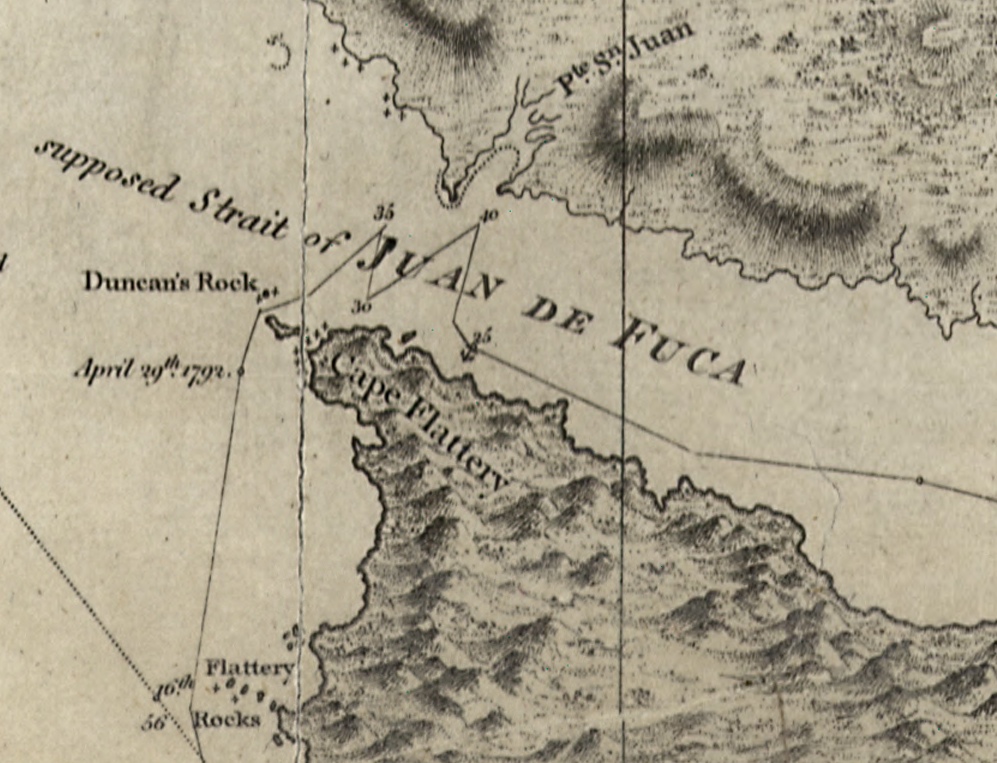
Detail of Capt. Vancouver's 1792 chart showing the "supposed strait of Juan de Fuca". Source: viHistory

vihistory is a web site designed to aid in historical research of Vancouver Island, at which it succeeds admirably.  You should poke around and have fun with their census data and the other worthy, if dreary, pursuits it affords the serious scholar.

One feature which is not immediately clear on first glance, perhaps deliberately as has entertainment potential, is a large selection of very high-resolution maps and images which you can download from this page. The file sizes are large, of course, but increasingly that is less of an obstacle in the past.  The maps are mostly of historic Victoria, but there are some regional maps such as telegraph and lighthouse maps of British Columbia, and a couple of maps of Nanaimo.  As usual, I have surfed through the maps so you don’t have to – and some of them are remarkably fun, and informative.

Continue reading

Peabody Museum Ethnographic Collection

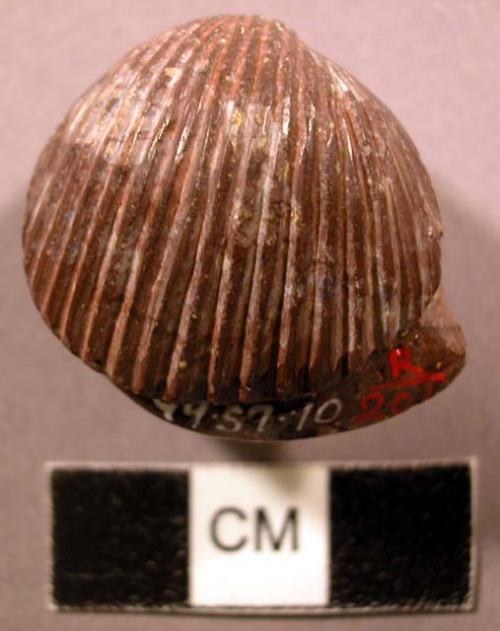
Haida carved cockle. Source: Peabody.

The Peabody Museum at Harvard has a predictably great collection from the Northwest Coast.  I’m more drawn to the archaeological-type artifacts vs. the masks and baskets and argillite, but fill your eyes with the charming Haida carving of a cockle, above, collected in “Massett Bay”.

One nice thing about this collection is the accession ledger is also scanned in and made available.  For example, if you go the the page for the cockle above here, you can click on the cockle picture for a higher resolution, on the first ledger page for the left hand side of the ledger book, and on the second for the right hand side.  It is possible in this way to do some ad hoc fact checking of their descriptions to finding additional information. For example, the cockle’s second page contains the notation “taken from the interior of R/200”.  Accession number R/200 turns out to be this unusual ?argillite carved box with inlaid shell.

Some of the other objects are equally unusual – I’d say there are more “wow – never seen one of those before” moments in this collection than any other I have seen.

Continue reading

BBC: History of the World in 100 Objects

Detail of a Clovis point from British Museum. Source: BBC.

The BBC is producing a series of 100 “podcasts” which explores the history of the world through the lens of 100 different objects.  Each episode is about 15 minutes long, and while you can subscribe to the series for your iPod or on iTunes, you can also listen to each episode individually on the web: thirty of the planned one hundred episodes are now available.

One interesting episode focuses on the Clovis Point.  They mainly give weight to a Clovis First model of the first peopling of the Americas (including a bizarre quote from Gary Haynes to the effect that yes, there is older material than Clovis but nonetheless Clovis is first), but they do also offer an indigenous perspective which is unusual.

Continue reading

Sally Binford

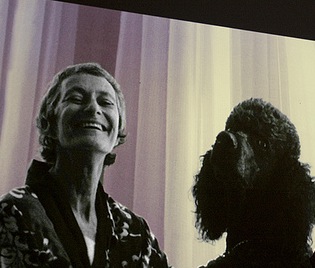
Sally Binford with her poodle, Jake. Photo credit: Honey Lee Cottrell, source: SFMOMA (click); cropped from original.

There is not much question that Lewis Binford was one of the most influential archaeologists of the 20th century – if not the founder, then the loudest exponent of “The New Archaeology“.  Like a lot of archaeologists not of a certain age, nor of a certain geography, I had never really focused on the co-editor of one of his more influential books, New Perspectives in Archaeology: Sally Binford.  Insofar as I had thought of her, I imagined some sort of academic liaison followed by her giving up her career, this being the 1960s and all – a not uncommon pattern.  Who was this other Binford, this flash in the pan?  I can’t be the only one who has wondered that, and not being plugged into the grandest social circles of the discipline, I’m turning to the internet.

Turns out she was superbly interesting in her own right.  I just came across a blog post recounting an interview excerpted from this book, which she gave not long before her death in 1994 (a death by her own hand on a date she had set 20 years ahead – one day before her 70th birthday.  She took her poodle, Jake, with her).  I  found the whole thing from A Very Remote Time Indeed.

I don’t endorse the interview in any particular way, clearly it is her perspective, but since Lewis Binford is a well known blowhard it can’t hurt to hear something from the other side of those days – especially as it also implicates the academic culture of Anthropology in the 1960s as including strong anti-semitic and racist undertones.  So, it is rather voyeuristically fascinating for me to read the lengthy interview,  but I warn it is a somewhat not-safe-for-work link.  There are some nude bodies and so forth, reflecting her post-archaeology career as a sex educator and sexual liberationist of some note.  Scroll down about halfway for the meetup with Lewis.  I’m pasting in some excerpts “below the fold”.

This whole thing is only tangentially related to the Northwest Coast and may be much too “inside baseball” for many readers, but the entire interview is quite compelling as a portrait of a cutting edge feminist and free thinker who intersected briefly, yet, brightly, with archaeology.

Continue reading

D’Suq’Wub: Old Man House – a Poster

Old Man House: computer reconstruction of one end. Source: Suquamish Tribe.

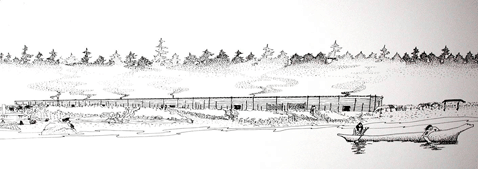
“Old Man House” is on the Kitsap Peninsula just north of Bainbridge island, across Puget Sound from modern downtown Seattle.  The “house” was the subject of one of the earlier excavations on the NW Coast by Warren Snyder and team from the University of Washington.  The house formed the locus of a major village of the Suquamish Tribe, and its most famous historic resident was Chief Sealth, also known as Chief Seattle.  The Suquamish Tribe has a very nice poster on the history and archaeology of Old Man House which can be downloaded from their website – clicking here will start a moderately sized JPG file. (Edit 2018: archived copy here)

Interpretive sketch of Old Man House. Source: Suquamish Tribe.

It is a bit of misnomer to call this structure a “house” though.

Continue reading

The Schieffelin Brothers Yukon River Prospecting Trip of 1882

Tanana woman returning from the hunt, 1882. Source: AKDC

Browsing in the Alaska Digital Archives I found an interesting photo album documenting a prospecting trip up the Yukon River by the Schieffelin Brothers, Ed and Al, who just a few years earlier had founded the famous desert mining town of Tombstone, Arizona.  Two pictures from this album struck me as particularly interesting, though the whole thing is worth browsing.

The first of these is the remarkable picture above, showing a Tanana woman with a long-gun, powder horn, and a couple of large rabbits.  While anthropologists and archaeologists have grudgingly revised their “Man the Hunter” stereotypes in recent years, it is nonetheless rare to see such a frank portrait of a competent woman with her prey.  I’ll be using this one in class, starting next week.

Continue reading

Photos of Victoria and Esquimalt, 1859

Victoria 1859. Source: LOC

In 1846, the Oregon Treaty established the boundary between British and American territory west of the Rockies (and unintentionally established the benchmark date for whether archaeological sites are automatically protected under the Heritage Conservation Act, but that’s another story).  Vancouver Island was to remain in British hands in its entirety, but otherwise the 49th parallel was to be the boundary on land.  The ocean boundary through the Salish Sea was resolved later, after the armed standoff on San Juan Island known as the “Pig War“.   An International Boundary Commission was struck, with the mandate of surveying the 49th parallel and one of its base camp headquarters in 1858 and 1859 was Esquimalt.  At this time, a series of photographs of the young Fort Victoria and surrounding buildings were taken, some of the earliest photographs from British Columbia I know of – including some remarkable pictures of First Nations people.

Continue reading

Vanishing Eulachon

Eulachon. Source: Sitnews.net

I often use eulachon (Thaleichthys pacificus, a small, anadramous smelt) as an example of “archaeologically-invisible” food. They are also known as “candlefish”, on account of being so oily that a wick jammed down their throat will burn like a candle.

These small fish run by the millions up rivers to spawn, where they could be intercepted.   Traditionally, many or most eulachon would be processed into eulachon oil, or grease: a highly nutritious, calorie-dense substance that preserved very well and could also be used to preserve other foods such as berries.  The means of processing was to put them into a large container, perhaps an old canoe, known colloquially as a “stink box”, let them “rest” there for a week, and then heat them up, enabling the oil to rise and then be skimmed off, or pressed out.  The residue (bones, guts, brains, etc.) would then be returned to the river and few or no bones would make it away from the processing site.  In this way, eulachon provided a staple food, a nutritional supplement, a means of preservation, and an extremely valuable trade item – when Alexander Mackenzie arrived near Bella Coola in 1793, “Over Land, From Canada”, he did so on one of the well-worn grease trails that linked coast to interior. Since the fish arrive in the early Spring, they were hailed as starvation busters in lean years.  Nonetheless, archaeologically they are almost invisible, relative to their importance.
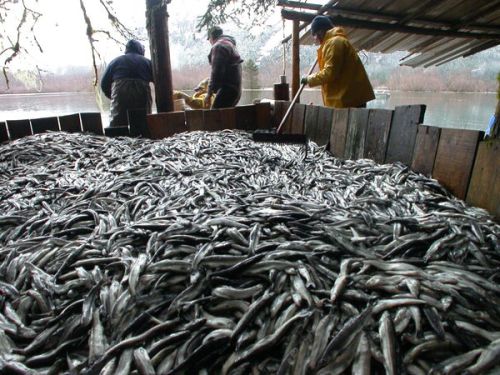
Haisla eulachon catch from the Kemano River. Source: living landscapes.

It is therefore sobering to read that U.S. President Obama has listed the Columbia River eulachon as an endangered species: eulachon are becoming almost invisible relative to the real world now, it seems.

Continue reading