Category Archives: history

Raven-Walking & Geological Transformation

Haida History starts at least 14,500 years ago. (Image credit: Daryl Fedje).

Three things we know about Haida Gwaii:

1.  About 14,500 calendar years ago it was a temperate tundra environment, with no trees.  The first trees, pine, appear about 14,000 years ago and there is progressive forest infilling thereafter, with the modern species mixture in place by about 3,000 years ago.

2. It has an impoverished suite of large land mammals – historically, these were limited to black bear, caribou, marten, ermine, a vole and a shrew.  We know that 13,000 years ago there were also deer and brown bear on the islands, and quite likely other species as well.

3.  It used to be much larger than in the present.  With lower sea levels at the end of the last ice age, Hecate Strait was largely dry land, exposing a large, unglaciated, coastal plain that became rapidly flooded.

It seems to me that we can add a fourth thing we know:

Continue reading

Chief Thunder Voice

Bing Crosby being invested as Squamish Chief Thunder Voice.

In 1948, Bing Crosby, then a first-rank international star, visited Vancouver – and ended up being invested as Squamish Chief Thunder Voice, among other civic performances.  The Vancouver City Archives has the video (1.00 minute in).

By the way, what is up with coastal First Nations adopting feather war bonnets?  Is this a kind of weird double reverse emulation: trying to look more stereotypically Chiefly in the eyes of the majority population?  Is it intra-aboriginal cultural appropriation?  Or do they just look freakin’ awesome?  Note the tomahawk as well in the picture above.  Someone should write a paper on “Plains Paraphernalia as  Signifiers of Rank on the Historic Northwest Coast”.  Or maybe they have, already.  I’d read it.

Peavies, pickaroons, hookaroons and skid tongs

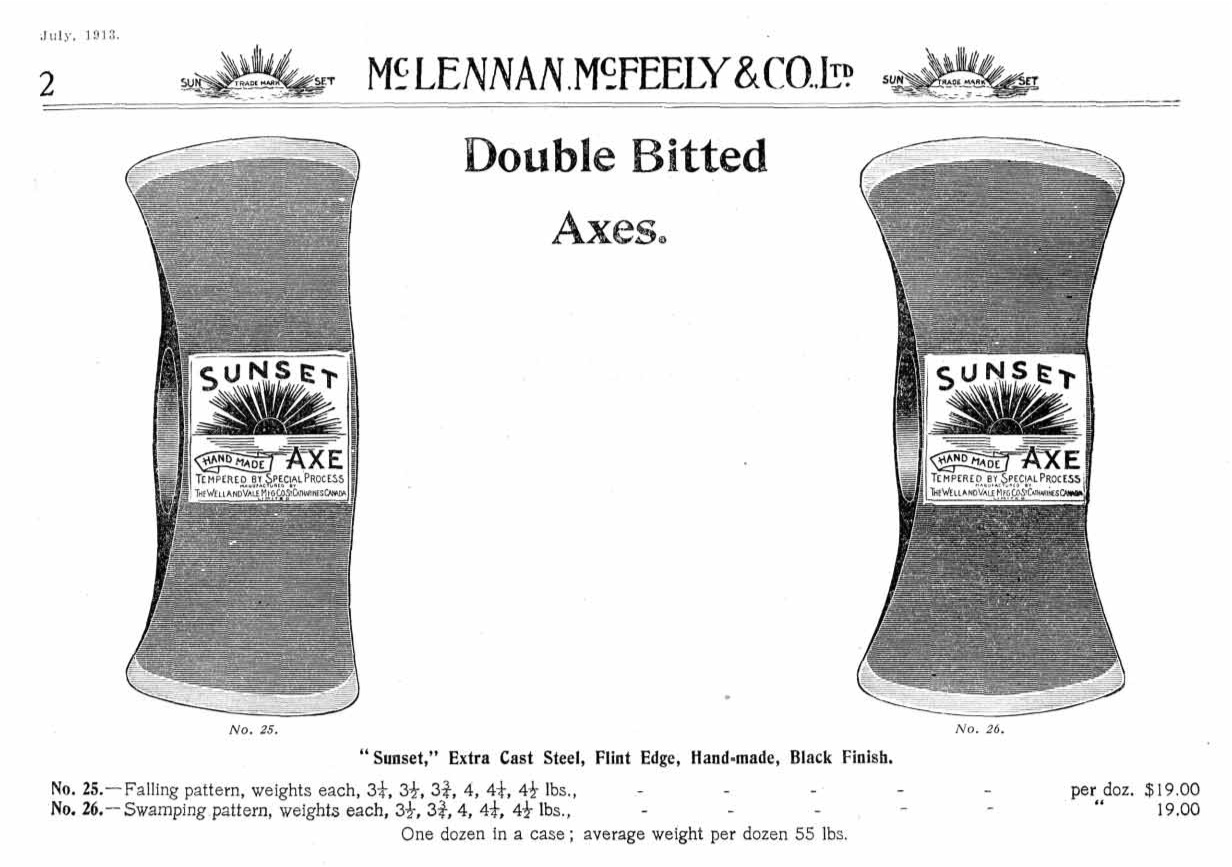
Double-bitted axes, available by the case.

It’s pretty common to run into historic industrial equipment when doing archaeological work in BC, especially logging equipment.  The Vancouver City archives has put the entire McLennan, McFeely & Co. Ltd Catalogue 1908-14 online, albeit in a somewhat awkward format (hey guys, why not just post a single PDF as well?) (edit: see comments below).  This catalogue would have been the ordering bible for many remote logging, mining and cannery outfits up and down the coast, the remains of which are often lying atop shell middens or strewn in the intertidal zone.  Altogether, the Vancouver City Archives and the Burnaby Village Museum have put  more than 1,500 pages of historic merchandise, as well as ordering and shipping information and price lists. Click on an image and it brings up a legible PDF of that single page.

Continue reading

Pitt Rivers Museum Haida Collection on flickr.com

Any idea what activity is being represented on this Haida argillite carving?

The Pitt Rivers Museum in Oxford is one of the world’s great ethnological museums.  Indeed, it is largely presented as a “museum of a museum”, with artifacts and curios displayed in glass cases in juxtapositions that made sense to anthropologists.  Now I see they are putting some of their collection online – one of many interesting innovations going on at that museum.  The Haida Collection which Cara Krmpotich has worked on consists of 200 really well composed and lit photos on the flickr.com website.  Cara notes that she hopes making this material available in this manner will facilitate its use by Haida people and I expect they will (indeed one person with a Haida name has been commenting on some of the photos).  Coincidentally, I see there has recently been a Haida delegation to the Pitt-Rivers museum.

In any case, the flickr set is a fantastic set of images of Haida art and technology. It would be nice to have the full catalogue information or other information associated with these, or at least a statement that such information is lacking.  While there are visually spectacular items throughout the set, also check these plain spoons from SGang’gwaay, Tanu’uu and Masset,  this bird bone whistle, and this tidy little loop of twine.

Haida wooden labret at Pitt Rivers museum.

Argillite Beaver

Haida argillite pipe representing the SS Beaver. Photo: University of Aberdeen.

The SS Beaver was a prominent early side-wheel trading ship on the NW Coast.  Nice to see it memorialized by Haida argillite pipe in the Marischal Museum collection of the University of Aberdeen, along with some other exceptional Haida pipes.  Apparently donated to the museum by the former Captain of the SS Beaver, William Mitchell, this pipe sports a rotating side wheel carved from whale bone, a beaver figurehead, and someone peeking out of the cabin windows, perhaps Capt. Mitchell himself who probably commissioned this carving.  Some other close ups (in an awkward zoomable interface) are  available on the Scots and Aboriginal People in the Fur Trade site.  More on the SS Beaver here.

A figure looking out the window of the SS Beaver pipe.

Songhees claim for Cadboro Bay land compensation: update

There is a fairly progressive editorial in the Times-Colonist on the Cadboro Bay land compensation issue.  The editorial cites John Lutz’s excellent book Makuk:A New History of Aboriginal-White Relations, to boot.

Lawyer Rory Morahan, acting on behalf of the Songhees, says the Chekonein village sites and fields were never surveyed, reserved or protected as required by the treaty. “The colony, or the province, appropriated the lands and issued title to the lands to other parties — that is, non-aboriginal colonists,” he says. The statement of claim says the Crown never paid compensation for taking the treaty land between 1851 and 1871.

The case will be complicated, given the variety of historical documents that will be presented to the court. Some basic facts are not in dispute, since even Roderick Finlayson, an early chief factor for the Bay, mentioned the Cadboro Bay village in his memoirs.

Beyond what is written in the treaties, the court might need to consider whether the Lekwungen actually understood what they were agreeing to. Lutz’s research has raised questions about the communication gap between the aboriginals and the whites.

Douglas signed nine treaties with aboriginals on southern Vancouver Island and, as Morahan says, this lawsuit could set a precedent if successful.

The decision could have ramifications elsewhere in the province. The Lekwungen were the first aboriginals in British Columbia to be dispossessed by settlers, but similar actions — land grants given, then taken without compensation — occurred for decades.

If it is proven in court that an injustice has occurred, the governments should act quickly to make things right. After a century and a half, it’s time.

This isn’t the first time I’ve noticed a fairly progressive editorial slant down at the TC – good for them, as the comments on their pieces show, there is a lot of resistance to the notion of fair compensation.

Songhees claim to Cadboro Bay

Songhees claim to Cadboro Bay lands promised by Douglas. Source: TImes-Colonist.

The Douglas Treaties have stood up well in court but the fact remains that the rights to hunt and fish are severely compromised by urban developments.  Further, it is a widespread shameful pattern that the government went out of its way to reduce the sizes of the few, small reserves that were established and to eliminate some altogether.  It is very welcome to see the strong assertion of the Songhees Nation that they have the rights to 200 acres surrounding Cadboro Bay.

Lawyer Rory Morahan said the band is not trying to reclaim the land promised to it in one of the Douglas Treaties, but is asking for compensation and a declaration that it is Songhees land.

A statement of claim was filed in B.C. Supreme Court yesterday, but it is likely to be at least a year before the case is heard.

The key to launching the lawsuit was finding historical documents, Morahan said. “There’s oral tradition about the village site, but in the courts you need more than oral tradition. We have been working on this for about a year, getting the details down,” he said.

The treaty with the Chekonein people, ancestors of the Songhees Nation, specifies that they would have 200 acres (80 hectares) around their Cadboro Bay village site, adjacent to the beach, and about 40 acres (16 hectares) of camas and potato fields.

“Under the treaty, the Songhees ancestors were promised that their village sites and fields would be protected for their use and the use of future generations, and that their villages and fields would be properly surveyed,” Morahan said.

Clearly, the Songhees are not asking for the land to be returned, but for compensation for its unlawful and duplicitous preemption.  The were successful in obtaining compensation a couple of years ago for the land under the legislative assembly, ironically enough and I imagine they have a good chance of success with this case as well. There is certainly an inarguable case for the archaeological significance of Cadboro Bay.

The comments in the Times-Colonist article are some of the most pathetic, racist, ignorant drivel I have ever seen, though.

Stephen Hume kicking ass (but whose?)

Desecrated spiritual site: the Big Rock at Campbell River

Stephen Hume has written some great columns on BC archaeology and history over the years and he comes out swinging in this recent piece:

Beside Highway 3 near Keremeos, a large glacial boulder has myths attached that extend far into B.C.’s past. It’s our own Stonehenge but it’s defaced with graffiti. Not far away, somebody jackhammered out of a cliff face one of the most significant ancient rock paintings in North America. Near Campbell River, another cultural site of great significance to first nations — the Big Rock — is also covered with graffiti. On Saltspring Island, effluent filters through a grave site with government approval. Near Qualicum, the bones of persons of great importance were mixed into paving material for a parking lot.

We pay lip service to first nations culture; we trot it out when we’re on the world stage — at the Olympics, for example — but our actions betray our venal hypocrisy. When conflicts arise between private commercial gain and public protection of our now-shared ancient heritage, money seems to trump culture almost every time.

I use the term “our” to describe this heritage because we are all citizens of B.C. together, first nations and settler society, fused by our braided history. We have one shared narrative in this province. It is composed of many stories. They begin not with the recent arrival of European adventurers or Asian monks but in a far more ancient past.

When we permit the desecration of important first nations sites, it’s our shared history that we abuse and our children’s legacies that we steal.

I am not convinced that the private member’s bill to which he is refers is the answer, and in any case it died on the vine – more on that later.  And the BC Archaeology Branch is kept on a short leash through the expedient of under-funding.  But I certainly appreciate Hume’s  take-no-prisoners attitude – we need a few vocal bulldogs on the case.  Incidentally, in a parallel universe to this blog, Hume’s brother is in a UVIC archaeology class right now, so maybe another bulldog can be raised – it seems to run in the family.

Notably,  it looks like there is a move afoot to designate the Big Rock, spearheaded by Frank Assu of Cape Mudge.  Let’s hope this succeeds, and maybe we won’t see it get dressed up again as a pumpkin.

Vandalized Pictograph Boulder near Keremeos.

NW Coast Objects in Madrid

Tlingit adze with quillwork and copper insets in the Museo de América, Madrid.

Tlingit adze with quillwork and copper insets in the Museo de América, Madrid.

Even though the Spanish were among the first outsiders to eplore the NW Coast, you don’t hear much about collections they may have made while out here.  So it is welcome to see this (now, 10 year old) writeup on NW Coast items in Madrid’s Museo de América.  The article suggests that many such objects were collected but not retained in Royal Collections, perhaps because they were considered inferior to, say, Aztec and Inka pieces.  Either way, there are some spectacular objects illustrated in the article, though the photographs are not very sharp at all.

Going to the Museo de América’s website shows they have a search function and some online thumbnails.  This link should take you to their 52 pieces labelled as NW Coast, while this takes you to six pieces listed as from BC.   Most of the illustrations are extremely low resolution, though I found one or two which aren’t such as the outstanding Haida waterfowl, below.  Look how fluid the form-line rendering is in this 18th century piece.  Click the images on the Museo site for slightly higher resolution or go to the records page by clicking on “Ficha Completa” and then on “Ampliar Imagen”, where you can zoom in slightly using the magnifying glass.  Also worth checking out, this Tlingit clap-board style “rattle”, this foreshaft and point, and this rather spectacular hat.  Anyway, something to poke more: online catalogues in Spanish Museums.

EDIT:  I see their search function makes links to search results expire after a short time so I crossed them out, above.  Pretty lame, but there you go.  Get into the system via the generic system and then browse around, if you want.

18th Century Haida Waterfowl.

18th Century Haida waterfowl, listed as made from"Ivory".

Akerman Collection – Salt Spring Island

Stone Bowl from Akerman Museum

Stone Bowl from Akerman Museum

Salt Spring Island has a pretty active museum and archival society, by the looks of it – at least, they are putting a lot of pictures and documents online.  One thing which caught my eye was their photos of the Akerman Museum – which I take to be the private collection at the home of Bob Akerman.  This is a striking carved object (of which I wish there were more photographs) described as: Black stone that they claim had healing power. Shamans used it when they were visiting the sick. Though elsewhere, they show another object with a similar description which appears not to be worked much, if at all.  There’s no real documentation which is too bad — the stone tools in this picture, for example, strike me as more of a neolithic thing than a northwest coast one.  I hope they have the information somewhere.  This is an impressive metal celt, and it looks like he has a good collection of nephrite ones as well, though the picture is exceptionally poor.  (NB – bandwidth is not nearly so much of a concern these days, so don’t shrink your pictures so much!) There are lots of slightly unusual artifacts, like this collection of handstones. All around, it looks like Akerman has a great collection — I don’t want to think too much about where the archaeological material came from, or how he came to have it, and I’d like to think there is a shoebox full of notes somewhere — but all the same it is interesting to peruse and I’m glad the Salt Spring Archives have at least some documentation of it.

Another highlight of the site is Chris Arnett’s short, but lively and informative history of First Nations of Saltspring Island.