Category Archives: history

Haida Argillite Pipe: High Resolution Pictures

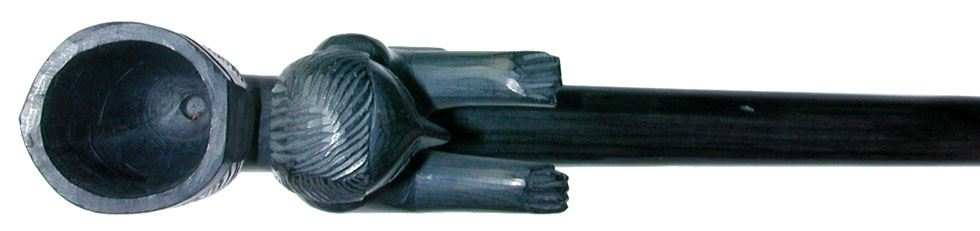
Detail: Haida Argillite Pipe ca. 1880. http://www.antiquearms.co.uk

I occasionally complain about the lousy pictures that professional organizations put on the web.  I guess I should know that when you have something to sell, you put it’s best face forward; when you don’t, you might not care as much.  Check out the high resolution pictures of this Haida argillite pipe for sale (4,800 GBP).  Multiple angles of the pipe, each one sharp and crisp: you can see each stroke of the knife and the grain of the slate.  Yes there is some glare but the images are much better than most museums make available on the web.  Amazing stuff.

Described as:

19thC. HAIDA ARGILLITE EFFIGY PIPE. #4213 #4213

a bowl carved in the form of a European sailor’s head with large rounded eyes and long straight nose, a figure seated astride the stem also with large rounded eyes and long straight nose and with arms extended wearing European costume with a stripe incised along the sides of the tunic arms and the trousers. Overall 20cm. From the tribes of the Pacific Northwest Coast of North America, principily Northern Columbia and Queen Charlotte Island. 20cm

This pipe was brought back and formed part of the collection of John Madden (1837-1902) of Hilton Park Clones Co, Monaghan Ireland, he left the Irish family estate at the age of 24 to travel by horse across the eastern states of America as far as the Great Lakes just before the start of the Civil War. During his later travels between 1870-1890 he is known to have reached British Columbia where he bought this pipe, it stayed in the family home until the collection was sold at an auction of part of the contents of Hilton Park on the 8th July 1985 where this item was aquired.

For the record, here are the seven views offered by the dealer: 1, 2, 3, 4, 5, 6, 7.

Haida Pipe: detail as if looking down the stem to the bowl.
Capital Regional District Report

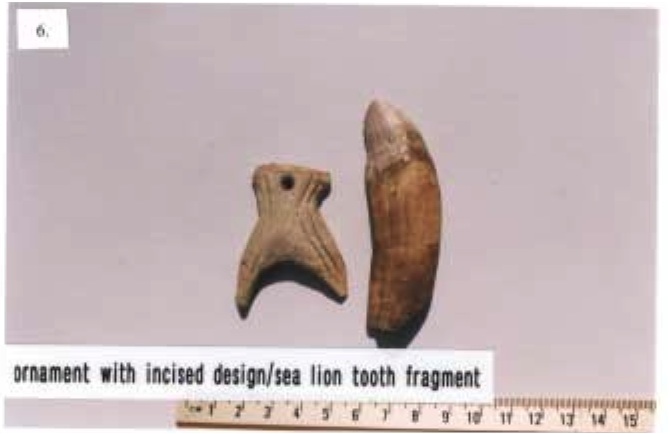
Decorated antler?, and a worked sea lion tooth from the Elchuk collection, Mill Hill.

I just came across this interesting document from 1999 by Liz Crocker (PDF) which is a cultural history of three CRD Parks: Mill Hill, Francis/King and Thetis Lake.  While I wouldn’t put a lot of stock in the archaeological component of this report, there are at least two notations of considerable interest.

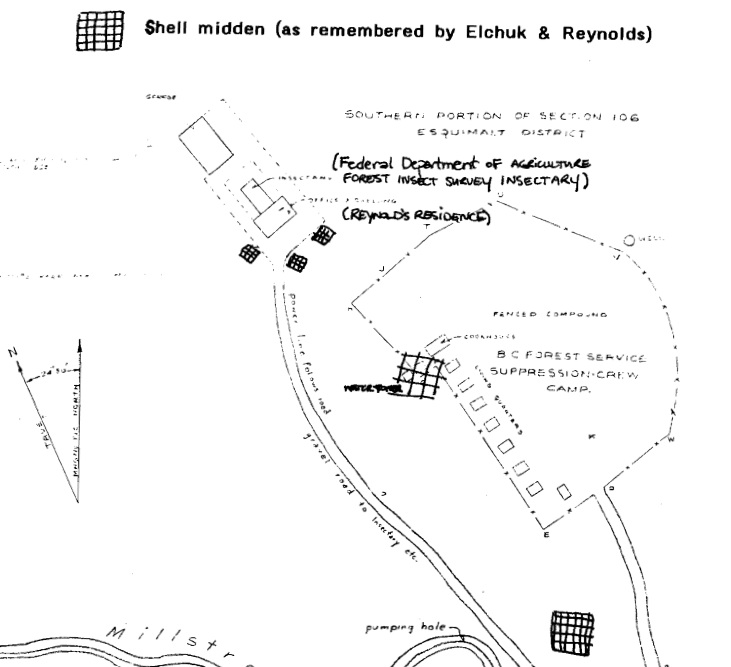
The first is the documentation of an unrecorded shell midden at Mill Hill, not DcRu-70 but another site, including a sketch map of the location which is about 2 to 3 kilometres inland.  There are also reports of unrecorded inland shell middens at Thetis Lake Park. Since such sites are rare and poorly know,  then this is something worth following up.  Indeed, I wish the CRD took their stewardship role seriously enough to commission an intensive, comprehensive, and professional inventory of the archaeological heritage of all their Parks.  This kind of baseline information is so essential that I honestly don’t understand how they think they can discharge their duties without it.

The other point of interest in Crocker’s report is the documentation of a fairly large private collection, also from Mill Hill and also well inland.  Included in this collection are Locarno-style artifacts as well as more recent ones such as a flat-topped handmaul.  Appendix 2 of the linked report includes some snapshots  of this collection.  Despite the poor quality, it is great to see private collections being documented.  The small decorative piece shown above is interesting and unusual, and the abundance of organic remains suggests again that these were collected from or near a shell midden.  Again, something to follow up. If only there were a Ph.D. student at UVIC, say, who was interested in inland shell middens…..

Sketch map of reported but unrecorded inland shell midden patches at Mill Hill.

State Underwater Archaeology Overviews

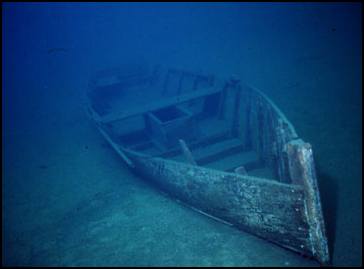
Part of a sunken fleet of recreational dories, Emerald Bay, California.

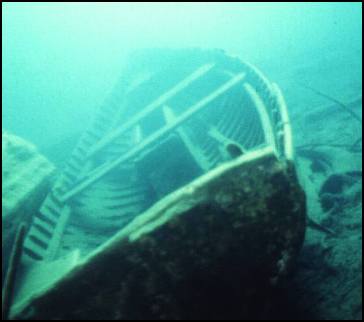
The US National Parks Service has a useful page summarizing policies and laws regarding “submerged resources” – which includes underwater archaeological sites.  The sections most of interest to the six readers of this blog are probably the pages on Washington State, Alaska, Oregon and California — though the fact that Idaho has a page is, at least, surprising until you remember the importance of paddle-wheelers in the earlier interior historical period all over the west.

Another Emerald Bay dory. Source: http://www.parks.ca.gov/default.asp?page_id=22707

Haida, Argillite, and the Pig War

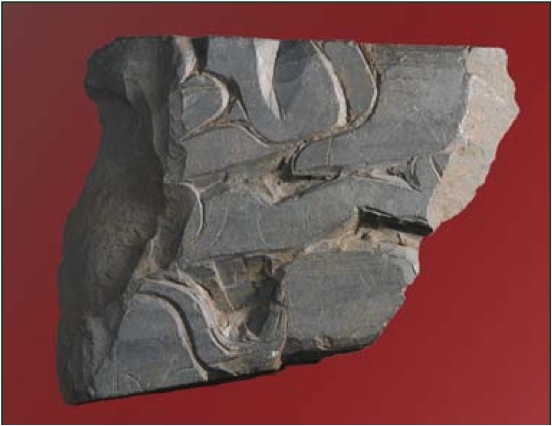
Carved argillite from Belle Vue Sheep Farm, San Juan Island. Source: NPS.

I don’t know as much about the 1859 Pig War as you might think, having spent an awful lot of time on San Juan Island. This “war”, which was more of an armed standoff between British and American troops, was a key event in the various mid-19th century boundary disputes.  One key location was Belle Vue Sheep Farm, near the southern tip of San Juan Island, where there has recently been some interesting historical archaeological work by the U.S. National Parks Service.

One interesting find at this dig is a piece of carved argillite, shown above, which most likely stems from Haida Gwaii (see page 7 of this PDF report, browse other NW NPS reports here).  Around this time there were plenty of Haida and other North Coast Nations around the Victoria area, and so it is not surprising, really, to see this piece.  And yet, it is also a stroke of massive good fortune to have such a distinctive piece of the turbulent 19th century history of First Nations.

Intriguingly, a key figure on the American side of the Pig War was George Pickett, who later achieved substantial fame for leading Pickett’s Charge at the Battle of Gettysburg in the American Civil War,

Ironically for someone who later fought for the racist Confederacy, Pickett was once married to a Haida woman by the name of Sâkis Tiigang.   (More often known as “Morning Mist”, this site gives her Haida name as beSakkis Tiigang while the Pickett Society in a detailed article gives her the slightly more authoritative-seeming name Sâkis Tiigang, meaning “Mist Lying Down”).  They had a son together, the artist James Tilton Pickett who, without wanting to generalize overly, certainly looks like a Haida man.  Shortly after the birth of young James in 1857, Sâkis Tiigang passed away.

Probably there is no tangible connection between Morning Mist/Sâkis Tiigang and this carved piece of her homeland, but surely there is a poetic one.

James Tilton Pickett, son of Sâkis Tiigang and George Pickett/ 1857-1889. Source: Pickett Society.

Duff and Kew: 1957 article on SGang Gwaay Town

Map of SGang Gwaay Town. Duff and Kew, 1957

As promised, I am linking to a copy of the 1957 report (PDF) by Wilson Duff and Michael Kew on the Kunghit Haida town of  SGang Gwaay, which has also been known erroneously as Ninstints. Little mention is made of the pole recovery aspect which was the subject of previous posts, though if you scroll all the way down in Duff and Kew’s article I append Duff’s report from that same issue of the “Report of the Provincial Museum of Natural History and Anthropology”.  In that report, the personnel involved are noted and there is also a discussion of  the activity of the  “B.C. Totem Pole Restoration Committee.”

Anyway, Duff and Kew describe in full the environment and setting of Anthony Island, the town site and associated archaeological sites, and also gives a full account of the early period conflict between Haida and trading ships.  In particular, vivid detail is given of the rise and fall of Chief Koyah and the serial raids he led on trading ships.  As Duff notes, this escalation in violence may well have been the resulted of an ill-advised power-play by Captain Kendrick who temporarily held Koyah hostage, a mortal insult in Haida society:

What Kendrick regarded as a simple” lesson” must to Koyah have been a monstrous and shattering indignity. No Coast Indian chief could endure even the slightest insult without taking steps immediately to restore his damaged prestige. To be taken captive, even by a white man, was like being made a slave, and that stigma could be removed only by the greatest feats of revenge or distributions of wealth. This humiliating violation of Koyah’s person must have been shattering to his prestige in the tribe. The Indian account of the incident told to Captain Gray a year later (but before Gray had heard Kendrick’s version) states this very clearly.

“On Coyah the chief’s being asked for, we were informed by several of the natives . . . that Captain Kendrick was here some time ago . . . that he took Coyah, tied a rope around his neck, whipped him, painted his face, cut off his hair, took away from him a great many skins, and then turned him ashore. Coyah was now no longer a chief, but an ‘AWiko,’ or one of the lower class. They have now no head chief, but many inferior chiefs. . . .” (Hoskins, in Howay, 1941, p. 200).

Kendrick had hurt Koyah more than he knew.  On Koyah’s part, if we understand the motivations of a Haida chief correctly, only bloody revenge or a great distribution of wealth would restore his lost prestige. To capture and destroy Kendrick’s ship, for example, and then distribute the loot, would fill the bill nicely. Koyah watched for his chance, and John Kendrick’s carelessness soon gave it to him.

Continue reading

Speaking of Wilson Duff and Bill Reid

Roy Jones of Skidegate climbs a pole at SGang Gwaay. Source: CBC.

Yesterday I noted the upcoming musical about the Bill Reid-Wilson Duff expedition to “rescue” carved poles at the Haida Village of SGang Gwaay (Ninstints).  I’ve just found that the CBC has posted online a short documentary, (2013:edit, use this link)  first broadcast in 1959 and narrated by Bill Reid, showing the removal of these poles to the Museum of Anthropology at UVIC.  The expedition also included Wayne Suttles and Michael Kew, as well as Wilson Duff of course.  The Haida crew consisted of Roy Jones, Clarence Jones and Frank Jones of Skidegate. Some aspects of the trip are recounted in the BC Provincial Museum Annual Report of 1957, which I will scan and post some other day.

The spoken component of the documentary is a fascinating account by Reid, at that time just beginning his carving career, but the real jaw-dropping element is the depiction of the use of axes and saws and climbing spikes to log this forest of poles.  Necessary, of course, but jarring nonetheless.

Broadcast Date: May 21, 1959

A small boat ferrying Bill Reid and a team of anthropologists approaches the southern tip of the Queen Charlotte Islands. Reid documents the rescue mission to salvage and relocate the last of the crumbling Haida totems as revealed in this CBC documentary. With a sense of excited urgency, Reid describes and catalogues the enormous poles on the approaching shore. As they are gently felled, the majestic cultural landmarks will creak and groan before they are prepared for transport.

It’s low resolution and grainy, but the general impression is a very powerful one.

Felling a tree, surely, not a pole at SGang Gwaay. Source: CBC.

Upcoming musical about Wilson Duff (!)

John Mann of Spirit of the West in "Beyond Eden"

I can hardly believe this, but the Vancouver Playhouse is mounting a new musical based on an event familiar to to all students of archaeology and anthropology n BC.  The musical stars John Mann from the band Spirit of the West.  From Tom Hawthorn’s blog:

Written by Bruce Ruddell with musical direction by Bill Henderson, formerly of Chilliwack, the musical premieres on Jan. 16 at the Vancouver Playhouse. The musical is based on a 1957 expedition to the Queen Charlotte Islands by the archeologist Wilson Duff and his Haida friend, the artist Bill Reid.

Mr. Mann portrays a character based on the archaeologist, a man who travelled to Haida Gwaii to preserve totem poles, which he bought for $50 each. These can now be seen at the Royal B.C. Museum in Victoria and the Museum of Anthropology in Vancouver.

“Off the top he believes his job is to keep those poles alive because you can learn from them,” Mr. Mann said. “If they rot, they’re lost, they’re gone forever. No one will be able to study them.

“In the course of those three days, his mind is changed. Then all hell breaks loose.”

This is remarkable and interesting on a number of levels.   I’d love to see it.

Wilson Duff was one of the first modern Anthropologists and Archaeologists to work in British Columbia and it seems he had just got started when he died by his own hand in 1976, at the age of 51.

McLennan & McFeely 1908-1914 Catalogue (update)

Railroad wheelbarrows from McLennan and McFeely catalogue.

I posted previously about this excellent resource which the City of Vancouver Archives has put online: the McLennan and McFeely catalogue of industrial, farm and fishing equipment, 1908-1914.  In that post, I moaned a little about how nice it would be to be able to download a single PDF of all 1400+ pages.  To my delight and happiness (and surprise, I must admit, because it can have been no trivial task) Sue Bigelow of the  Archives has posted a note indicating that they have now made such a document available for download (link in upper right hand corner of this page).  It is 270 megs, but I have it now and what an amazing resource.  Thanks so much to Sue and to the City of Vancouver Archives – as I said, this is potentially a huge aid for historical archaeologists and indeed any archaeologist who encounters historical debris.

Mangles!

Archaeology in Action: a flickr.com photo pool

Archaeologists? No -- "Pothunters" destroying a site on the Columbia River, ca. 1966. Source: flickr user gbaku.

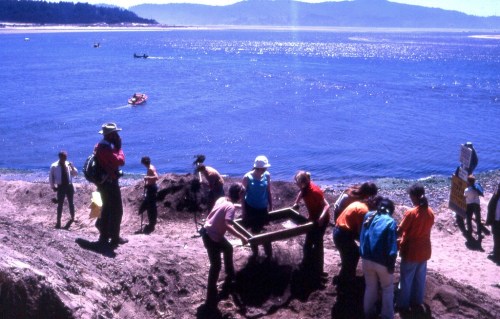
Archaeology in Action is a large set of pictures of archaeologists doing archaeology on the photo sharing website flickr.com.  Not too much Northwest Stuff there that I could find with the notable exception of many pictures put up by a former University of Oregon professor under the name of gbaku (you can find his real name easily enough).  His pictures are a wonderful tour of Oregon and Alaskan archaeology of the 1960s and 1970s – these are not sets of pictures of stratigraphy, or backdirt (interesting though those things are) but are predominately of, well, archaeologists in action.  It would be fun to see more NW Coast pictures up here — I know Grant has a large collection of pictures of archaeologists going about their business and I am sure we all have some pictures of people in with the endless pictures of yet another bone.

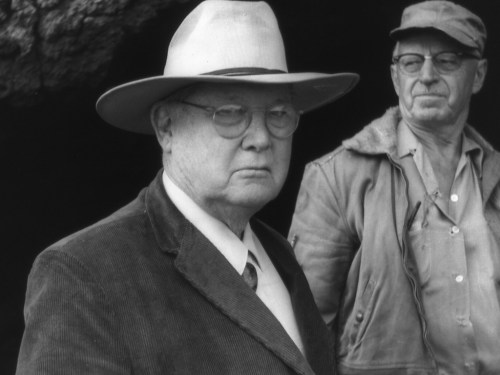
Erle Stanley Gardner, the author of the Perry Mason mysteries and many other books, and Luther Cressman, pioneering archaeologist and ex-husband of Margaret Mead, at Fort Rock Cave in 1966.

Haida Gwaii is now just Haida Gwaii

a.k.a., The-Islands-Coming-Out-Of-Concealment.

The thinnest possible news report from the Times-Colonist says that the BC Government will now use “Haida Gwaii” in all official contexts, rather than “The Queen Charlotte Islands”.  Presumably this means it will be changed in the official BC Gazetteer but so far it shows no such change this calendar year.  More from the Globe and Mail:

“The change is a very important symbolic gesture,” said Guujaaw, president of the Haida Nation. (Guujaaw goes by one name.) “That’s the land that gave us our life and culture. It’s the proper name.”

Robert Finch, chief executive officer of the Monarchist League of Canada, said he was surprised and disappointed by the B.C. government’s decision. “They assume that they’re doing a good thing, but they’re erasing a very big part of Canada’s heritage.”

I wonder if Robert Finch has even the faintest idea of how clueless he sounds, how arrogant and absurd and, frankly, irrelevant.  Maybe if he spent more time thinking about the Crown’s broken promises to aboriginal people he would be less likely to spout such verbal tripe.

Anyway, this will simplify journal articles, where it will no longer be necessary to footnote the name “Queen Charlotte Islands” or refer to “locally known as Haida Gwaii and henceforth referred to thusly”.  Meanwhile, enjoy the picture above: coming home through north Juan Perez Sound.