Tag Archives: history

Adawkhl Gitsegulka

Gitsegulka ca. 1909. Source: Adawhkl Gitsegulka.

Yesterday, while posting CanadaGood’s flickr set of “totem poles” I found a really interesting document at the web site of the Gitsegulka community of the Gitxsan First Nation on the Skeena River.  Called Adawkhl Gitsegulka, it is a history of the settlement written in 1979, by band members via consultation with hereditary chiefs.  So often we only see these historical pamphlets for settler communities; it is quite fun and interesting and a little bit sad to read through this one written by First Nations themselves.  For example, note how (page 7) the Indian Agent in 1909 respects the hierarchies of the hereditary chiefs, apparently only in order to establish himself as the highest ranking of the lot.  Scroll down to page 35 for a discussion of the motives and means of carving poles.

There is an interesting theme which runs through the whole document: the uneasy relationship between the deeply felt Christianity of many Gitsegulka Gitxsan, and the old ways and practices.  In its informal way, through consultation with numerous elders, with charming illustrations, the Adawkhl Gitsegulka is an intriguing source of information on how the community saw itself in the transformative years of the late 1970s, when land and title claims were once again rising.  Five years on, they were in court claiming rights and title to their territory, and not much more than 10 years later, the landmark, borderline racist, “McEachern decision” of the BC Supreme Court would be handed down (the Gitxsan-Wet’suwet’en case: Delgamuukw vs. the Queen, round 1) which started a transformation of aboriginal rights in Canada.  Delgamuukw 3  in 1997 eventually set the frame for the modern treaty process when the Supreme Court ordered a new trial.  The trial has never happened but the new Supreme Court terms and definitions structure our modern understanding that Aboriginal rights and title were never extinguished and must be reconciled.  The Adawkhl Gitsegulka is an indigenous perspective on a small community about to have its voice heard right across Canada.

The document ends with the slogan of the [then] Gitksan-Carrier Tribal Council:  “Walk on, walk on, on the breath of our grandfathers”.
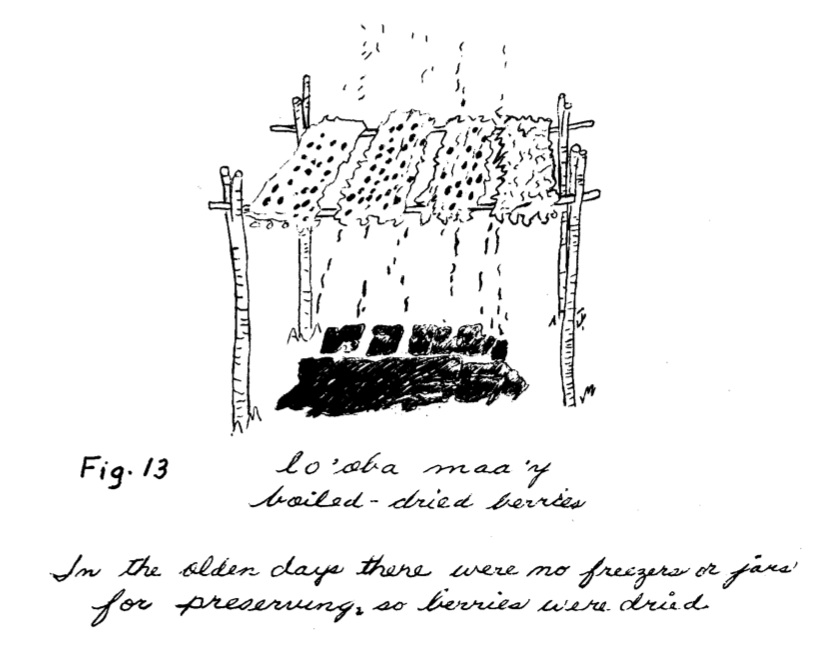
Drying Berries. Source: Adawhkl Gitsegulka.

Interior layout of a house. Source: Adawkhl Gitsegulka.

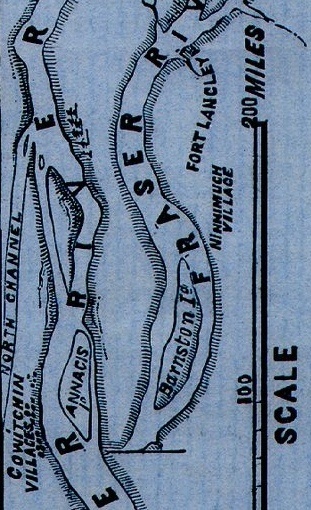
“Correct Map of the Gold Diggings”: May 20th, 1858

Detail of 1858 Map of Fraser Gold Diggings. Click for full image.

From UBC, this interesting 1858 San Francisco broadsheet “The Pictorial Newsletter of California” (large JPG file).  Most of the text is mundane births and deaths, but the map above from it is a lot of fun.  It’s especially interesting to see the “Cowitchin” Village at New Westminster.  Now, “Cowitchin” was often used as a generic term for many Coast Salish people in the early historic period.  But note too, just upriver at Fort Langley, a “Ninnimuch” Village, presumably Snuneymuxw First Nation, also known historically as the “Nanaimo” people, whose core territory would be on east Central Vancouver Island.  There are lots of reports of Vancouver Island nations paddling up and down past Fort Langley so its not that much of a surprise, but rather a nice testament to the extensive regional trade and, perhaps, permeable social networks in place across the greater Gulf of Georgia. It also makes me think the “Cowitchin Village” might indeed really be Cowichan. It’s notable the “Pinkslitsa River” (Harrison River) is the only lower tributary mapped, probably because it was an important route in and out of the middle Fraser, bypassing the canyon.  It’s a nice map, it’s early, and I’d never seen it before, so thanks to UBC and their Early BC Newspapers page.

Detail of 1858 map showing "Cowitchin" and "Ninnimuch" Villages on Lower Fraser.

From the UBC notes:  Pictorial News Letter of California: for the Steamer John L. Stephens San Francisco: Hutchings & Rosenfield; Charles F. Robbins, Printer, 1858

“Issued exactly one month after the first steamer left San Francisco headed for the Fraser (Bancroft p. 359), this appears to be the first separate publication relating to the Fraser River Gold Rush, and the first map published to illustrate the area for potential gold-seekers.”

You can also download a short PowerPoint file here, and there is an overview essay here.

Even more on the Wilson Duff – SGang Gwaay Musical

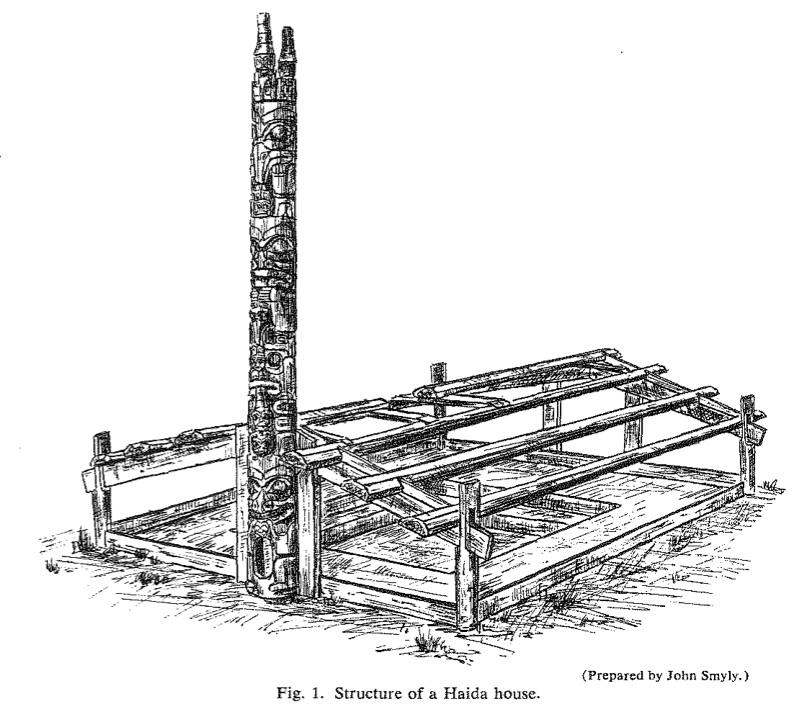
Haida House and pole. Source: Duff and Kew, 1957.

A month or two ago I made several posts (1 , 2, 3) about a forthcoming musical called Beyond Eden, which tells the story of the 1957 expedition to ‘rescue’ poles from the Haida Town of SGang Gwaay (PDF).

I notice The Tyee has a very good overview of this musical (which opens tonight) including some comments from Roy Jones Sr. of Skidegate, last seen on this blog as a young man climbing poles in 1957 CBC archival footage.  Says The Tyee:

Now in his mid-80s, he is reflective about the experience, having enjoyed the physical work and the company of members of the crew — but about cutting the poles? “It didn’t feel right,” he said. However, the Skidegate Band Council had approved the work and many felt it was the right thing to do. Further to that, Jones was on a recent trip to The Chicago Field Museum and saw one of the poles taken from Skedans (an expedition he was also on). “If they hadn’t taken it at that time, it would have been ruined, I think,” he said.

It is good to see some Haida perspective on both the events of 1957 and on this musical.  I also didn’t realize Nathalie at the Qay museum was a student of Wilson Duff’s — I’ll have to buy her a coffee and pump her for stories next time I am up on the islands. It’s a good article — The Tyee is doing some of the best journalism in BC right now.

Poster for "Beyond Eden" musical. Click to buy tickets; scroll down for title song.

Decaying resource towns of the BC coast.

Inside the school library at Ocean Falls.

Inside the school library at Ocean Falls.

Photographer Christopher Grabowski has a beautiful photo-essay at Geist magazine on the subject of decaying resource towns of the British Columbian coast, with emphasis on Alert Bay and  Ocean Falls.  You can read the essay alone, or as the multi-page photo essay, and also read an interview with Grabowski here.  A fuller set of his Ocean Falls photographs can be seen here. (2018 edit: here)

It is striking how Europeans and other settlers were so active on the coast.  Hundreds of communities have come and gone, and settlers are now concentrated in only a few major towns.  Meanwhile, the First Nations remain on their land – in the long term, perhaps, European presence on the remote coastal lands will come to resemble a blip more than an occupation.

In the meantime, these fantastic photos remind us of the wasteful ways of the culture with perhaps the shortest attention span on earth: Canada.

The inscribed fireplace in the ballroom at Ocean Falls: Archie Martin … Ocean Falls community is a monument to his memory. Indeed.

Shipwrecks of Vancouver Island

The three-masted ship Carelmapu with decks awash, dragging her anchors into Schooner Cove, near Tofino, in 1915

The ‘Virtual Museum of Canada”  has been responsible for some nice online exhibits, although a lot of these are now fairly dated.  One with what we could call a “retro web design”, but some good content, is the Shipwrecks of Vancouver Island site, apparently put together mainly on the watch of the Maritime Museum of BC with help from the Underwater Archaeological Society of BC.  There are some nice videos of underwater archaeology, and other informative materials.

Site navigation, though, is much easier if you just go to the site map here — the absurdly finicky navigation does weird things like, say, means using the back button always takes you to a splash introduction screen — is a crime against the web.  Especially since museum people are involved: why such disdain for solid future-proof web design values?  This page, for example, has a nifty slider to scroll through an interactive map: but if you don’t pay attention (e.g., if you use your back button) you will always end up on a “loading XML – introduction to the database” overlay screen page which gets tired after about the third time.  The VMC should consider a legacy fund to make sure that the sites which they poured money into for a while can all be kept up to date for both content and also compliance or at least ease of use.  It would not surprise me in the slightest if the VMC had spent over $100,000 on this site — the one site of their I know something about they spent $140,000 and it is no flashier than this thing.  Almost all that money went into design and mounting of content, very little went to the content creators themselves.  If that  applied here, I think we have a right to expect more – is this site design worth $100,000?  It seems to me that, even in 2004, a competent web designer working alone, with content given by others, could have put this together in about a month.

Canadian Navy diver goes overboard in 1959 to examine the 1853 wreck of the Lord Western, near Flores Island.

Captain Vancouver and Camas

Saranne, or lily, harvesting on the Strait of Juan de Fuca in May 1792.

I am sure it is well known to local ethnobotanists, but I don’t recall seeing the above account of plant cultivation reference before.  It is from page 123 of Captain Vancouver’s “Voyage of Discovery …. ” (1801 edition, which you can browse online here).

I didn’t figure out the exact locale of this camp but it is probably very close to Port Discovery, near Port Townsend at the north end of Puget Sound.  The camp is carefully noted as a plant-harvesting camp and also a place where shellfish were being processed. The houses are mere lean-tos.  It is interesting to see that the considerable number of “eighty or a hundred” women, men and children were engaged in turning over the earth here, “like swine” (!).  It gives a vivid impression of a well-orchestrated, community-level harvesting event.  Vancouver comments favourably on the product, a sort of paste or flour.

Vancouver refers to one plant as a species of wild onion, while the other two plants being cultivated are termed as resembling “saranne”.  That being a new term to me, I turned to the OED only to find it not listed, which is quite surprising.  Googling turned up some interesting historical references though, in which it is clearly a term used for members of the Lily family (camas is also a member of this family).  For example, see this 1792 clip from Pennant’s Arctic Zoology Volume 3, on the use of Saranne, or Lilium kamchatschense, by the inhabitants of (yes) Kamchatka (let your eyes skim, gentle reader, over the foregoing section on the use and abuse of hallucinogenic mushrooms). Perhaps this term, Saranne, was in use around the North Pacific at that time but it strikes me as odd it did not find its way into the OED.

Anyway, a few pages down from p. 123 you can also find a nice description of the Coast Salish wool dog, which is described as being much like a Pomeranian.

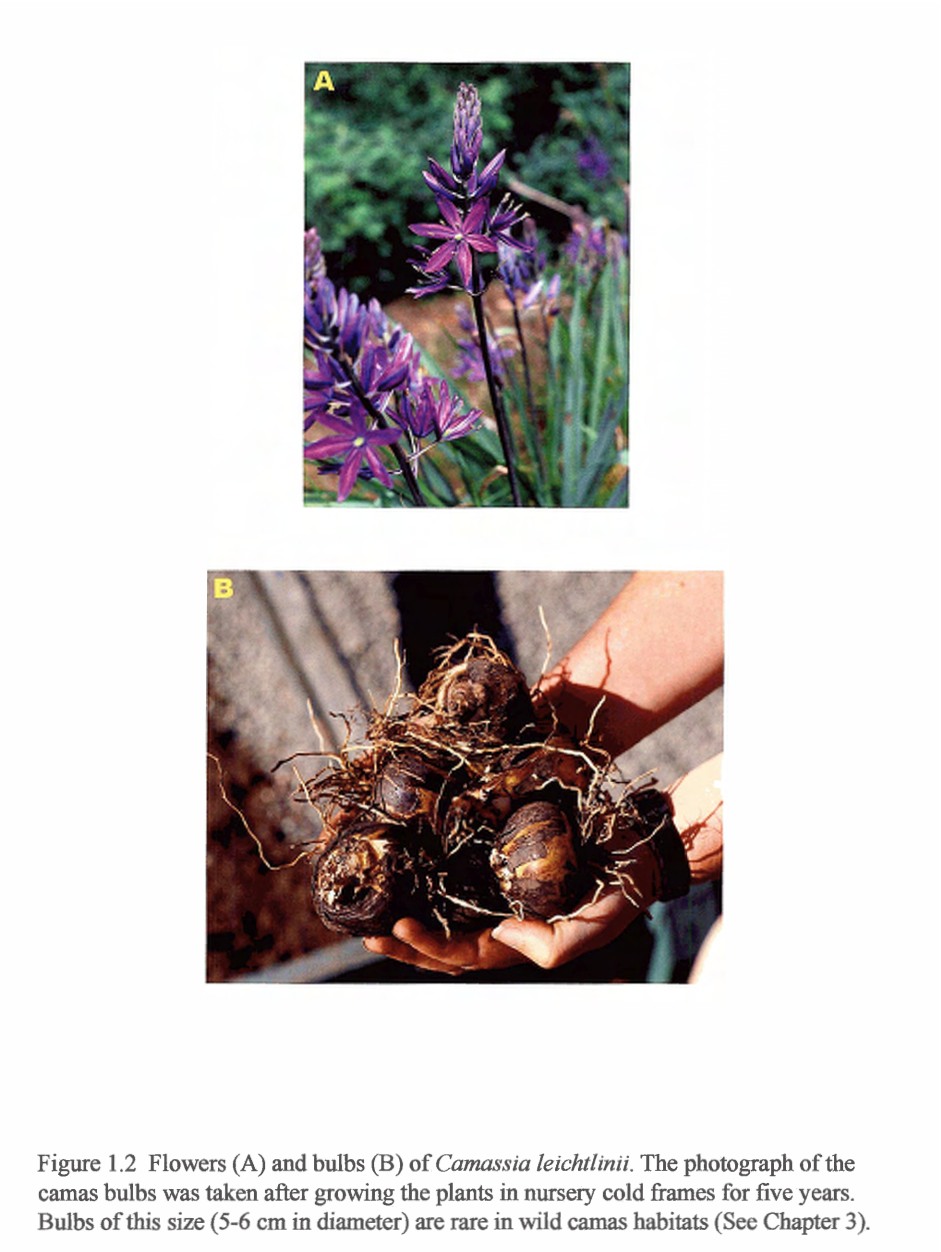
Camas flowers and bulbs. Source: Brenda Beckwith Ph.D. thesis, 2004. http://hdl.handle.net/1828/632

Duff and Kew: 1957 article on SGang Gwaay Town

Map of SGang Gwaay Town. Duff and Kew, 1957

As promised, I am linking to a copy of the 1957 report (PDF) by Wilson Duff and Michael Kew on the Kunghit Haida town of  SGang Gwaay, which has also been known erroneously as Ninstints. Little mention is made of the pole recovery aspect which was the subject of previous posts, though if you scroll all the way down in Duff and Kew’s article I append Duff’s report from that same issue of the “Report of the Provincial Museum of Natural History and Anthropology”.  In that report, the personnel involved are noted and there is also a discussion of  the activity of the  “B.C. Totem Pole Restoration Committee.”

Anyway, Duff and Kew describe in full the environment and setting of Anthony Island, the town site and associated archaeological sites, and also gives a full account of the early period conflict between Haida and trading ships.  In particular, vivid detail is given of the rise and fall of Chief Koyah and the serial raids he led on trading ships.  As Duff notes, this escalation in violence may well have been the resulted of an ill-advised power-play by Captain Kendrick who temporarily held Koyah hostage, a mortal insult in Haida society:

What Kendrick regarded as a simple” lesson” must to Koyah have been a monstrous and shattering indignity. No Coast Indian chief could endure even the slightest insult without taking steps immediately to restore his damaged prestige. To be taken captive, even by a white man, was like being made a slave, and that stigma could be removed only by the greatest feats of revenge or distributions of wealth. This humiliating violation of Koyah’s person must have been shattering to his prestige in the tribe. The Indian account of the incident told to Captain Gray a year later (but before Gray had heard Kendrick’s version) states this very clearly.

“On Coyah the chief’s being asked for, we were informed by several of the natives . . . that Captain Kendrick was here some time ago . . . that he took Coyah, tied a rope around his neck, whipped him, painted his face, cut off his hair, took away from him a great many skins, and then turned him ashore. Coyah was now no longer a chief, but an ‘AWiko,’ or one of the lower class. They have now no head chief, but many inferior chiefs. . . .” (Hoskins, in Howay, 1941, p. 200).

Kendrick had hurt Koyah more than he knew.  On Koyah’s part, if we understand the motivations of a Haida chief correctly, only bloody revenge or a great distribution of wealth would restore his lost prestige. To capture and destroy Kendrick’s ship, for example, and then distribute the loot, would fill the bill nicely. Koyah watched for his chance, and John Kendrick’s carelessness soon gave it to him.

Continue reading

Speaking of Wilson Duff and Bill Reid

Roy Jones of Skidegate climbs a pole at SGang Gwaay. Source: CBC.

Yesterday I noted the upcoming musical about the Bill Reid-Wilson Duff expedition to “rescue” carved poles at the Haida Village of SGang Gwaay (Ninstints).  I’ve just found that the CBC has posted online a short documentary, (2013:edit, use this link)  first broadcast in 1959 and narrated by Bill Reid, showing the removal of these poles to the Museum of Anthropology at UVIC.  The expedition also included Wayne Suttles and Michael Kew, as well as Wilson Duff of course.  The Haida crew consisted of Roy Jones, Clarence Jones and Frank Jones of Skidegate. Some aspects of the trip are recounted in the BC Provincial Museum Annual Report of 1957, which I will scan and post some other day.

The spoken component of the documentary is a fascinating account by Reid, at that time just beginning his carving career, but the real jaw-dropping element is the depiction of the use of axes and saws and climbing spikes to log this forest of poles.  Necessary, of course, but jarring nonetheless.

Broadcast Date: May 21, 1959

A small boat ferrying Bill Reid and a team of anthropologists approaches the southern tip of the Queen Charlotte Islands. Reid documents the rescue mission to salvage and relocate the last of the crumbling Haida totems as revealed in this CBC documentary. With a sense of excited urgency, Reid describes and catalogues the enormous poles on the approaching shore. As they are gently felled, the majestic cultural landmarks will creak and groan before they are prepared for transport.

It’s low resolution and grainy, but the general impression is a very powerful one.

Felling a tree, surely, not a pole at SGang Gwaay. Source: CBC.

Upcoming musical about Wilson Duff (!)

John Mann of Spirit of the West in "Beyond Eden"

I can hardly believe this, but the Vancouver Playhouse is mounting a new musical based on an event familiar to to all students of archaeology and anthropology n BC.  The musical stars John Mann from the band Spirit of the West.  From Tom Hawthorn’s blog:

Written by Bruce Ruddell with musical direction by Bill Henderson, formerly of Chilliwack, the musical premieres on Jan. 16 at the Vancouver Playhouse. The musical is based on a 1957 expedition to the Queen Charlotte Islands by the archeologist Wilson Duff and his Haida friend, the artist Bill Reid.

Mr. Mann portrays a character based on the archaeologist, a man who travelled to Haida Gwaii to preserve totem poles, which he bought for $50 each. These can now be seen at the Royal B.C. Museum in Victoria and the Museum of Anthropology in Vancouver.

“Off the top he believes his job is to keep those poles alive because you can learn from them,” Mr. Mann said. “If they rot, they’re lost, they’re gone forever. No one will be able to study them.

“In the course of those three days, his mind is changed. Then all hell breaks loose.”

This is remarkable and interesting on a number of levels.   I’d love to see it.

Wilson Duff was one of the first modern Anthropologists and Archaeologists to work in British Columbia and it seems he had just got started when he died by his own hand in 1976, at the age of 51.

McLennan & McFeely 1908-1914 Catalogue (update)

Railroad wheelbarrows from McLennan and McFeely catalogue.

I posted previously about this excellent resource which the City of Vancouver Archives has put online: the McLennan and McFeely catalogue of industrial, farm and fishing equipment, 1908-1914.  In that post, I moaned a little about how nice it would be to be able to download a single PDF of all 1400+ pages.  To my delight and happiness (and surprise, I must admit, because it can have been no trivial task) Sue Bigelow of the  Archives has posted a note indicating that they have now made such a document available for download (link in upper right hand corner of this page).  It is 270 megs, but I have it now and what an amazing resource.  Thanks so much to Sue and to the City of Vancouver Archives – as I said, this is potentially a huge aid for historical archaeologists and indeed any archaeologist who encounters historical debris.

Mangles!