Tag Archives: british columbia

Happy “Birthday”, Vancouver

Unidentified Musqueam Chief as portrayed by Cardero in 1792. Source: Vancouver Sun.

The City of Vancouver had its 125th anniversary yesterday, and the local press was full of reflective pieces on civic leaders, famous visitors, notable crimes and, of course, sports.  Well, it would be churlish not to wish Vancouver Happy Birthday!  Well done, Vancouverites.  But in all the coverage of this momentous event, I only see one single article which acknowledges that people might have lived at the mouth of the Fraser River for a tad longer than 125 years.  And a curious article (PDF)  it is: Ancient history of Vancouver’s first peoples: The city’s history predates its 1886 founding, with a native midden dating back 9,000 years

Continue reading

Historic Newspaper Archive on Google

Sooke Freight! Vancouver Daily Post, 1865.

Via the Northwest History blog, I recently found that Google has been quietly archiving a large number of  historical newspapers, including many defunct ones from the west.  Old newspapers are a rich source of social history and can fill in some details of everyday life in the early historical period.  For example, it still costs me about 2 & 1/2 cents per pound to get my sorry self from Victoria to Leech River.  Or, see the table below from 1864 recounting the travel time and cost by stage or foot from New Westminster to the Columbia River. That’s better history than some dumb vote of useless politicians.

As Larry Cebula at Northwest History points out, Google has buried this feature somewhat.  There is a master list of all newspapers here, though, and you can work your way through that.  Many of the newspaper names are cryptic, though, and since I usually do the grunt work for you, here are some of the historic, often defunct, newspapers of particular interest to readers of this blog:

Continue reading

Victoria’s history through cartoons

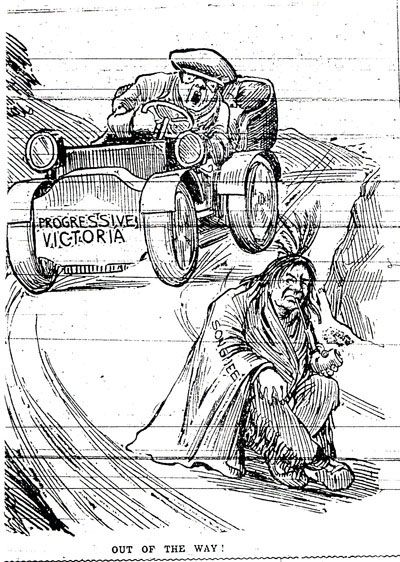
"Progressive Victoria" about to run over the Songhees. Was there ever a Songhees man with feathers in his hair, fringed buckskin, and a peace pipe? Source: Vincent's Victoria.

I mentioned it in a comment the other day so you may have seen it already, but there are a couple of great posts at the blog “Vincent’s Victoria“.  The first post is the already-mentioned review of John Lutz’s talk “Getting the Indians Out of Town: Race and Space in Victoria’s History” – Victoria, British Columbia, that is, better known as World Headquarters to this blog.   In Vincent’s post we find out about the slow process by which First Nations had their presence in the city core steadily reduced, mainly by moving the reserves, but through other means too.  The post then discusses the “Signs of Lekwungen” project which I posted on before. it’s really a shame I didn’t hear about John’s talk until after he had given it – there are other talks in the series but his would have been the most interesting to regular readers here.

The second post is extremely interesting, as it uses editorial cartoons from the Victoria Daily Times newspaper to tell the story of the movement of the Songhees reserve in 1910.

Continue reading

Heritage Dinosaurs?


Closeup of the skull and teeth of Vancouver Island's Puntledge River elasmosaur. Source: BCfossils.ca

Only occasionally does this space turn its eye to fossils, but there’s been quite a bit of press this last week about the perceived lack of protection of fossil sites in British Columbia, some of which are alleged to be ground up for “kitty litter” (archive, etc).  In that CBC report the Minister of Agriculture and Lands lists a whole variety of ways that fossil sites are, indeed, protected, in response to the general position of the paleontologists that there was no such legal protection. I believe this page summarizes the government’s position (which does indeed explicitly allow commercial exploitation in principle, though they are not currently taking kitty litter applications.  The page is a virtual museum of weasel words and contradictory information and frankly, makes almost no coherent sense).

Anyhow,  the most direct and obvious way that such sites are, in my opinion, already protected, or the way they could be: by the Heritage Conservation Act (HCA).

Continue reading

Glenrose Cannery Under Threat?

Anthropomorphic and zoomorphic sculpture from Glenrose and St Mungo Cannery sites. Source: Delta heritage passport

The Glenrose Cannery site, which lies on the Fraser River near the Alex Fraser bridge, is one of the mose significant archaeological sites in BC.  The human figure on the left, above, dates to the ‘St Mungo” phase, putting it at between 3500 and 5000 years old.  It might be the oldest known representation of a human being in British Columbia – well, to my knowledge, it is.  Yet, you can already see elements of the formline art appearing – look at the eyebrows, for example.  More importantly, look at the beard.  Look at the hair, pulled into a bun.  This is a portrait of an individual.  The artifact, which is probably a small handle for a chisel, is a masterpiece of Canadian art. The site in which it was found shows continuous occupation from the present to about 9,000 years ago and spans up to eight metres of vertical deposits.

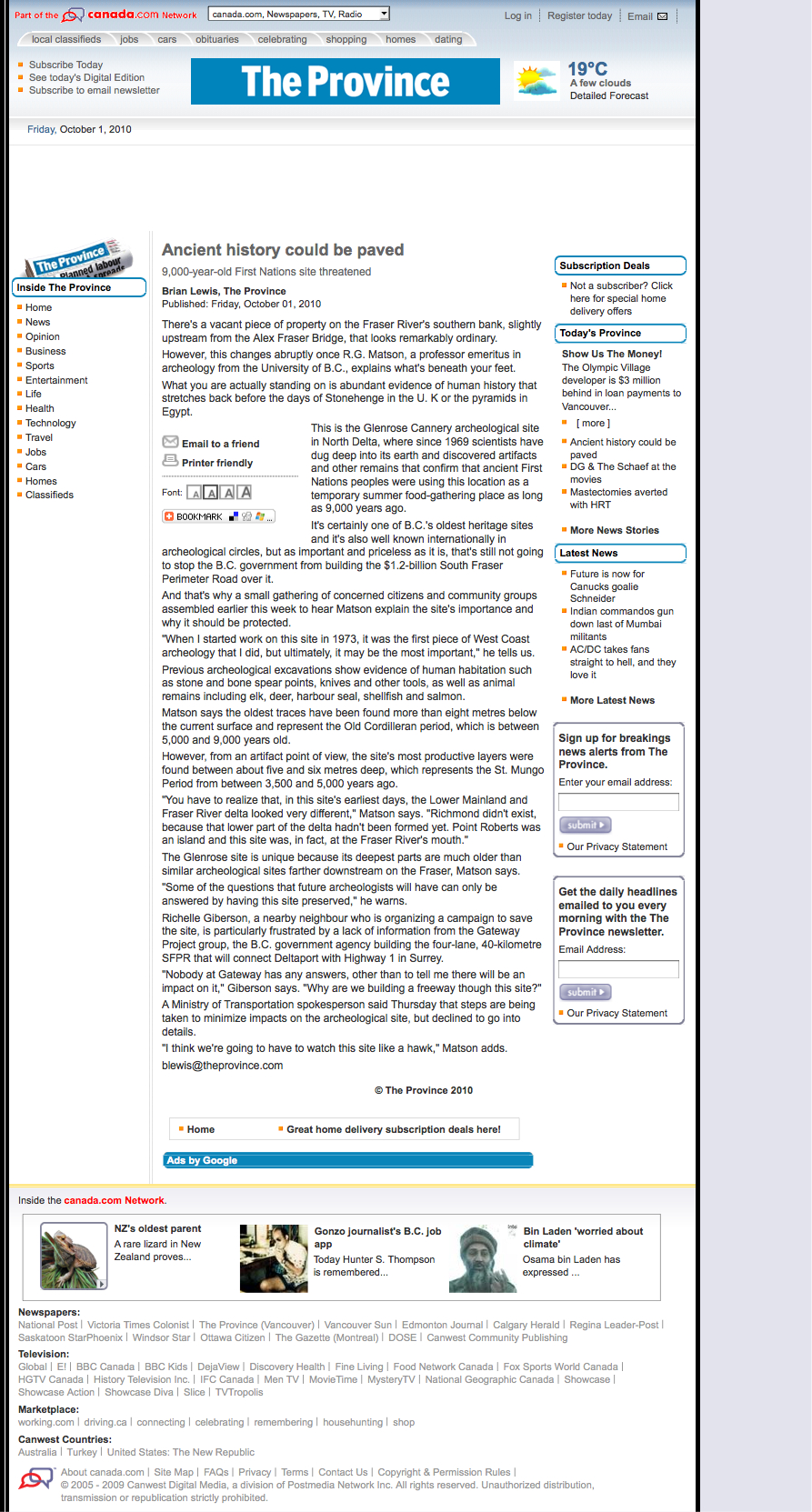
So it is disturbing to think that Glenrose might be further affected by development, in this case, road building associated with the “Gateway Project”, a transportation infrastructure megathrust to get stuff to and from the Ports of Vancouver faster. There is a short article in The Province yesterday (archive) in which UBC Professor Emeritus RG Matson, one of the key figures in BC Archaeology, visits the site.   We can’t preserve everything from the past, clearly, or all cultures at all times would have been glued to the footprints of their forebears.  But a site of such demonstrated significance as Glenrose should probably be completely off limits.

Continue reading

BC Archaeology Forum 2010

I got the news yesterday that the annual B.C. Archaeology Forum has been scheduled.  The event will be co-hosted by the Musqueam First Nation and the UBC Laboratory of Archaeology and held November 5-7.  You can download a registration form here (MS-Word document)

Continue reading

Bella Coola Lichen

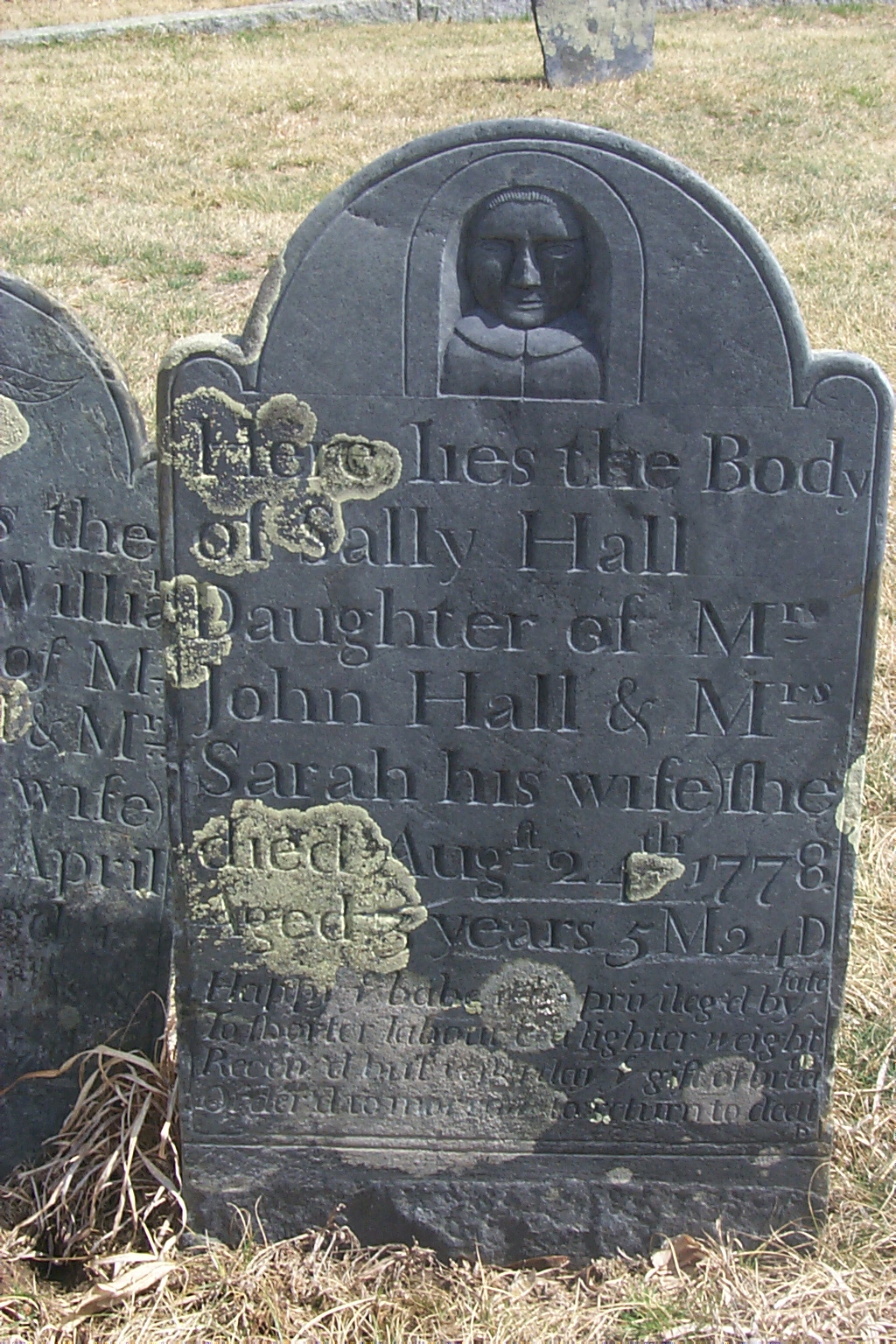
A gravestone with lichen growth. Source: designscience.com

I was reading the charming Bella Coola Blog the other day and came across an interesting post discussing how lichen had been used to date glacial features in the area.  So-called lichenometry is a well-established dating technique which relies on the principle that lichen grows in roughly circular patterns, and that there is a linear relationship between the diameter of the circle and the age of the lichen patch.  Now, such patches can be many hundreds of years old.  So for an event where rock is newly exposed and then lichen grows on it, the lichen will give a minimum date on when the bare rock was first available as a lichen environment.  Anytime you have a bare rock and a dating technique for when the rock became bare, the archaeology antennae rise.

Continue reading

VicNews: Rebirth through Reburial

Burial cairn on Race Rocks. Source: RaceRocks.com

While I was away over the summer the local free paper, the Victoria News, did a (to my mind)   high quality series on reburial and respect in Songhees and Esquimalt communities (cache). The three articles by Lisa Weighton include comments from numerous aboriginal spiritual and political leaders, and sensitively describes how Straits Salish faith asserts that the dead are always with the living.  The dead do not conveniently depart to some other place, but continue in a world alongside and intersecting the world of the living.

Hence ancestral remains are not something belonging to a past which can be “gotten over” but are very much part of the present world.  Laying a person to rest, or back to rest after disturbance, requires food, clothing and prayer.  I don’t pretend to understand the concept well, but I have been to some such ceremonies and the power of the moment is impossible to deny.  In my limited experience the article fairly represents the spiritual and emotional needs that must be met under the sad circumstance of disturbing the dead.  It is incumbent on archaeologists and all citizens to not only work to minimize disturbance of the dead but to respect traditional practices.  It has been impressed on me that such practices are meant to protect us, the living, First Nations or not, as well as to give comfort and respect to the dead.  This should now be considered absolutely part of mainstream archaeology.

Continue reading

“From the Islander” blog

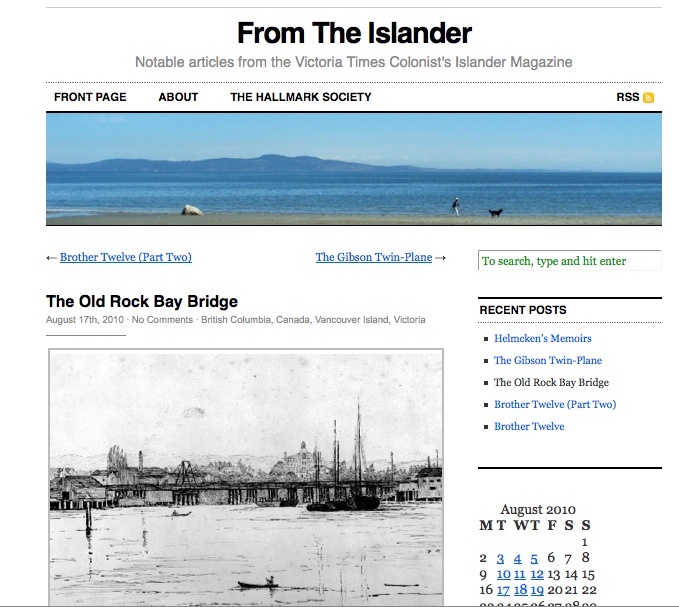
Screenshot of "From the Islander" blog

The Hallmark Society sponsored a nice blog called “From the Islander” through the summer of 2010.  This is a retrospective set of commentaries about excerpts from the weekend newspaper insert “The Islander”, which used to be published in the Victoria Daily Colonist and the Victoria Times-Colonist.  There’s not any archaeology that I have seen, and surprisingly (or not) there is no coverage of First Nations, but all the same it is an interesting read if you have a shine for Vancouver Island history, and a well-done, informative blog.  Apparently the Hallmark Society (or the blogger, who goes by wpbradley and was their summer student intern) has digitized a fair bit of The Islander and indexed it here – though full text is not available for the most part.

Convictions in Yakima Looting Case, with comments on B.C.

Looting at Wakemap Mound, 1957.

A news snippet from Washington State: from the Yakima Herald-Republic, via the excellent Washington Department of Archaeology and Heritage Preservation Blog.

“Yakima, Wash. — Two Goldendale residents found guilty of looting American Indian artifacts from a Yakama Nation cultural site have been sentenced to pay $6,690 in damages and placed on two years probation. The pair have also been sentenced to 150 hours each of community service.Devin Prouty, 27 and Tiffany E. Larson, 24, both pleaded guilty in U.S. District Court to unlawfully removing artifacts, including rocks, rock flakes made by indigenous people and arrowheads from Spearfish Park near the Columbia River in Klickitat County…”

Looting is a serious problem in Washington and Oregon States but is it one in British Columbia as well?

Continue reading