Category Archives: Northwest Coast

Visit to the UNBC Fieldschool on Calvert Island

Deep unit at ElTa-4, Calvert Island.

Deep unit at Luxvbalis, EjTa-4, Calvert Island.

This blog’s world headquarters has temporarily moved out to the central coast, where yours truly is tagging along with Dr. Duncan McLaren and his team working on the early period archaeology and landscape history of the Hakai area.  The project is sponsored in very generous style by the Hakai Beach Institute, which also funds and facilitates a variety of research on the cultural and natural history of this beautiful and sensitive area. One of the other Hakai projects is an archaeological fieldschool directed by Dr. Farid Rahemtulla of the University of Northern BC.  I wrote about this fieldschool once before and you can get some background on this site (EjTa-4, Luxvbalis) at that link. The site is in the traditional territory of the Heiltsuk and Wuikinuxv First Nations.  Yesterday I had the chance to visit the site, get shown around by Farid, and hang out at the screens with his great students – and to be the annoying guy with a camera.

So it’s a really deep site.  Above you can see Kira Cari in this years main excavation unit.  They are expanding a unit from last year which went down 4.7 metres or so without bottoming out. As of yesterday, they are about 2.4 units down.  Basal dates so far are in the 6-7,000 year old range but this might get older since the bottom is not yet reached and there may be older cultural deposits intact in the intertidal zone as well. Continue reading

ASBC Victoria Talk Thursday April 17: Hein Bjerck on Colonizing Scandinavian Seascapes

Lateglacial shoreline at Vega, northern Norway, 96m asl today. The first settlers (9500–9000 BC) had to cross 20km of open sea from the mainland (in the background) to reach the island, a strong indication that seaworthy vessels were at their disposal (photograph H.M. Breivik).

Late glacial shoreline at Vega, northern Norway, +96m asl today. The first settlers (9500–9000 BC) had to cross 20km of open sea from the mainland (in the background) to reach the island, a strong indication that seaworthy vessels were at their disposal (photograph H.M. Breivik).

The Colonization of Scandinavian Seascapes in the Pleistocene/Holocene transition.

Dr. Hein B. Bjerck

ASBC talk Thursday April 17th
7.30
UVIC, Cornett B129
All welcome.

In common with the Northwest Coast, coastal Norway was heavily glaciated into a rugged landscape of fjords and islands.  As the glaciers retreated, people moved in. This talk gives us a chance to do a compare and contrast between our setting and the very distant, yet parallel, setting of post-glacial Scandinavia.

Hein B. Bjerck, is Professor in Archaeology at Norwegian University of Science and Technology (NTNU), The University Museum, Trondheim, Norway.  He is Project leader, “Marine Ventures – Comparative perspectives on the dynamics of early human approaches to the seascapes of Tierra del Fuego and Norway”.  You can also view a project gallery and writeup at the Antiquity journal website.

Dr. Bjerck is in British Columbia at the invitation of the archaeological projects of UVic’s own Daryl Fedje and Duncan McLaren, who are generously funded by the Tula Foundation. The thrust of these projects, at Quadra Island and the Central Coast respectively, is to look at the Pleistocene-Holocene transition and the first occupation of the Northwest Coast.

Incidentally, if you are a graduate student, there is an excellent short field course in archaeology and ecology starting soon at Hakai.  It’s non-credit but you might be able to wrap it into a directed studies with your supervisor. Strongly recommended.

Memorial Tributes for Dr. Richard “Doc” Daugherty

Richard Daugherty with the famous "whaling trophy" from the Ozette Site.  Source: Washington State University.

Richard Daugherty with the famous “whaling trophy” from the Ozette Site. Source: Washington State University.

Dale Croes sends along the following information: two tribute events for the late Dr. Richard Daugherty, who passed away February 22 at the age of 91. Daugherty was Professor of Archaeology at Washington State University, and is best known for two remarkable projects: the Marmes Rockshelter dig and the long-term Ozette wet site project, the latter being commonly referred to as the “Pompeii of North America” on the grounds of its incredible preservation of organic Makah material culture.

I only met Dr. Daugherty once a long time ago when I was privileged to speak about the Kilgii Gwaay wet site in Seattle, but there is an entire generation of NW Archaeologists who were his students, or were otherwise inspired or mentored by him. If you’re one of them (and count me amongst the inspired), then feel free to leave a comment below, and this can serve as an online repository of good memories and funny stories perhaps. It’s the NW Anthropology meetings starting tonight in Bellingham and I am sure there will be plenty of beer glasses clinked in his memory.  If you click “continue reading” then I’ve gathered together some of the obituaries and also the poster which Dale sent with details of the two tributes, the first of which is this coming Monday in Olympia.

Continue reading

Two talks in Victoria next seven days

Burial cairn on Race Rocks.  Source: RaceRocks.com

Burial cairn on Race Rocks. Source: RaceRocks.com

Two very cool talks in Victoria over the next few days.  The first is a unique opportunity to hear from Cowichan (Coast Salish) “gravedigger” Harold C. Joe, who for more than 30 years has worked with archaeologists and anthropologists to care for the disturbed ancestral dead, among his other responsibilities.

The second talk is the monthly ASBC event which features Dr. Andreas Fuls of the Berlin Institute of Technology, who will address a topic in Mayan astronomy and the Mayan collapse.

If you’re not in Victoria you can probably stop reading, but if you click below then you’ll find  more details, including abstracts and the where and when.

Continue reading

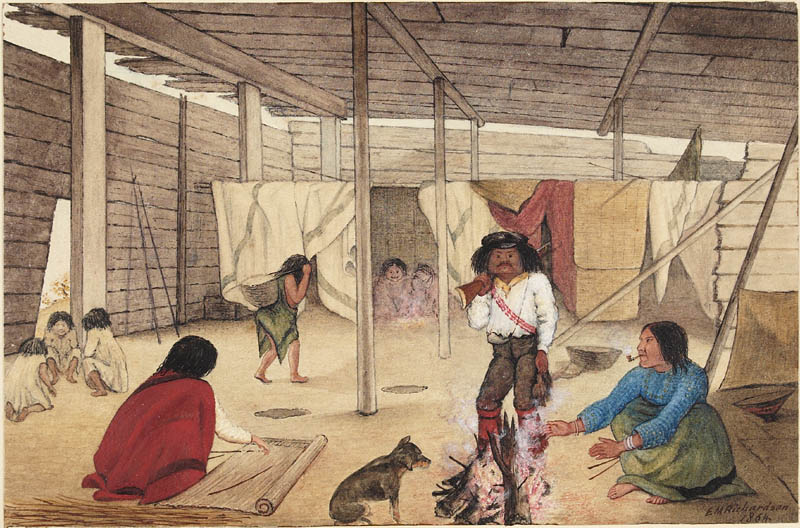
Interior of a Coast Salish Longhouse, 1864

Interior of a Salish Longhouse, 1864. Watercolour by Edward Mallott Richardson.  Locale uknown. Source: Canadian Archives.  Click to enlarge.

Interior of a Salish Longhouse, 1864. Watercolour by Edward Mallott Richardson. Locale uknown. Source: Canadian Archives. Click to enlarge.

Following on from the post about the Salish mausoleum, here is a companion painting by Edward Mallott Richardson from the same year, depicting the interior of a house.  It’s a curious painting, seemingly devoid of close detail.  Where are all the drying fish?!  But at the same time it shows some features of interest which may be worth discussing.  Note the fellow with the gun has a powderhorn, for example, and the basket behind him looks like one of those rectangular coiled ones, only with a tumpline, as shown by the woman entering on the left.  On the far right is a semi-conical object that might be a hat, sitting on a platform within a small compartment.

Continue reading

A Coast Salish Mausoleum, 1864

A Salish Grave, 1864. Watercolour by Edward M. Richardson. No specific locale given. Source: CollectionsCanada.gc.ca

A Salish Grave, 1864. Watercolour by Edward M. Richardson. No specific locale given. Source: CollectionsCanada.gc.ca  Click to enlarge slightly.

“Grave House” is one of those archaeological terms which render slightly creepy a feature that is more or less an everyday experience: the mausoleum, a house for the dead, filled with coffins.

This is a fascinating image I hadn’t come across before: a very early image of a Coast Salish mausoleum.  It highlights the artistry and vividness of these features better than the few sketches or early photographs do. The accompanying text at the Canadian Archives is:

Subject depicts grave boxes in a grave house with guardian figures. The grave house is covered with a roof of wooden planks but has no walls. At the front of the house stands six guardian figures. There are flags to the left and right of the house. On the left hand side of the house a tent is set up and clothes are hanging. A shotgun hangs from the front beam of the house. Item was up for auction in the September 28, 1970 Christie’s sale in Calgary. Lot 31.

The image isn’t very high-resolution but there are still some things to talk about – and there is another Richardson painting I’ll link to in a day or two. (edit: here) Continue reading

Tagging along with Archaeologists in Quatsino Sound

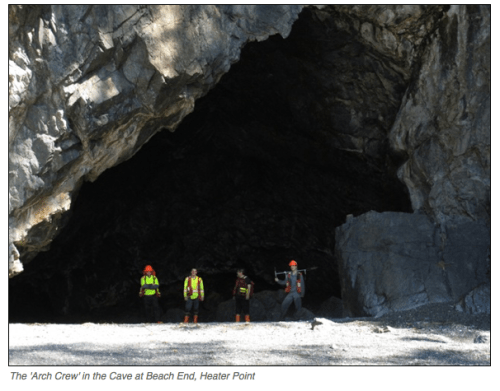
Quatsino - Cave at Heater Point. Source: bcmarinetrails.org

Archaeology Crew at Quatsino: Cave at Heater Point. Source: bcmarinetrails.org

How does the general public perceive archaeologists?  There’s a lot of ways to get at this question, not least the comments section of any newspaper article!  But a positive and slightly unusual perspective is found in this article by Stephanie Meinke at the BC Marine Trails website.  In the course of establishing some new marine trails in the Quatsino Sound area of NW Vancouver Island (map), concern arose that there might be archaeological sites at some of the campsites. Kayakers generally having solid ethics about leaving no trace, but all the same there might be some unintentional impacts.  So an archaeological consulting team (Kennedy Richard and Morgan Bartlett) was hired to assess these spots with potential impact. They were guided by Stephanie and by Janis Leach of Recreation Sites and Trails BC, as well as by two field assistants from the Quatsino First Nation: Mark Wallas and Mark Hunt.

The article gives something of a participant-observation view of the archaeological consulting business in its coastal survey guise, as well as some nice pictures of gorgeous scenery.

Continue reading

Tlingit War Helmet Rediscovered after 100 years

Tlingit war helmet recently rediscovred in Springfield Science Museum.  Source: SSM.

Tlingit war helmet recently rediscovered in Springfield Science Museum. Source: SSM.

This is the kind of cool story that makes me want to poke around in all the community museums I see.  A fantastic Tlingit war helmet has been recently rediscovered in the backroom of a museum in Springfield, Massachussests.  The helmet was accessioned in 1899 as an “Aleutian hat” and the designation was never questioned until now.  The news article about it suggests only 95 of these helmets are known, with the largest collections found in Russia.  They are part of an elaborate system of armour known from the contact and early historic period in Tlingit territory (Southeast Alaska – Alaska Panhandle).

Continue reading

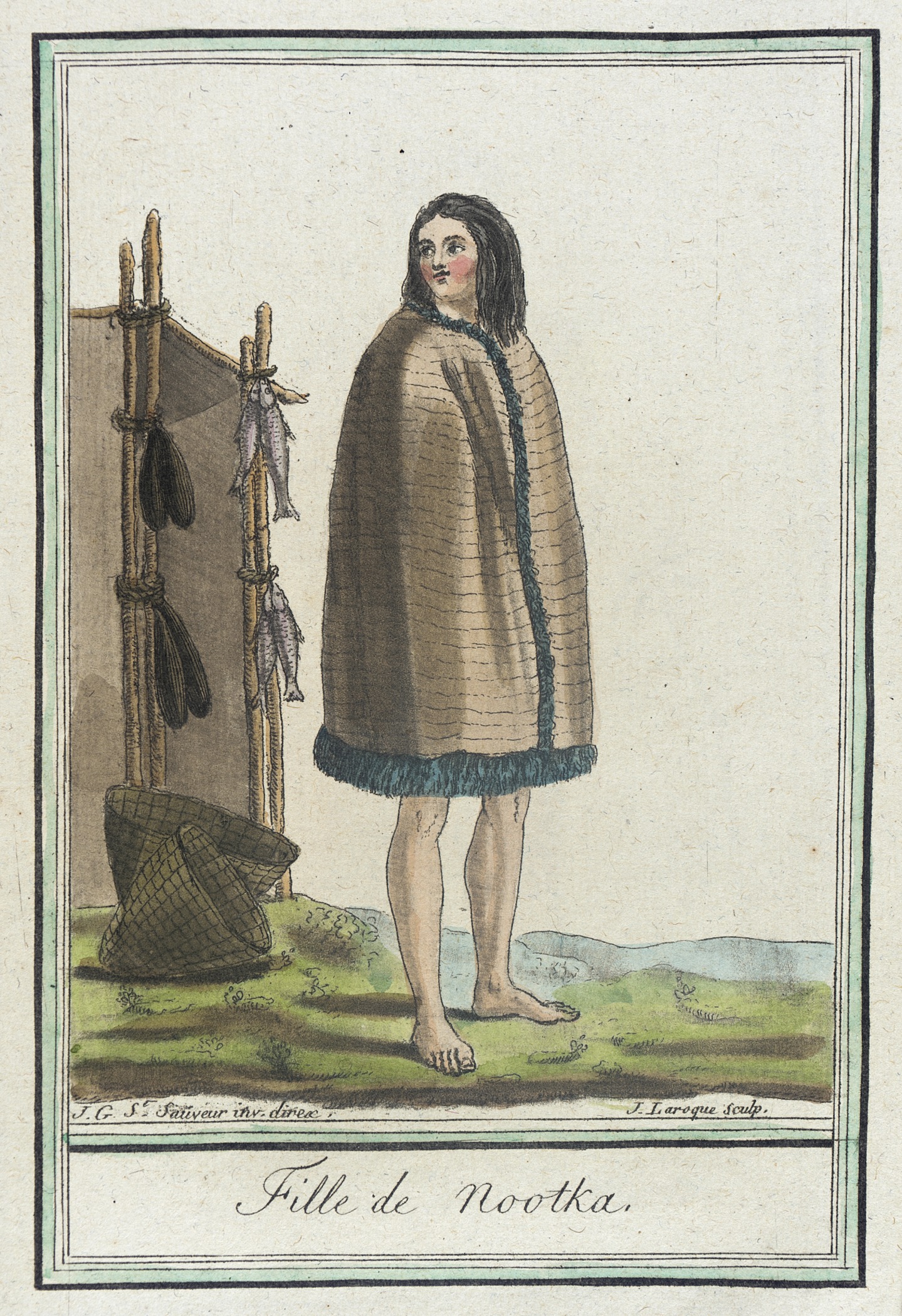
Images of Nootka Island People, 1787

Nootka Sound girl, 1787.  by de Saint-Sauveur, source: LACMA.

Nootka island girl, 1787. by de Saint-Sauveur, source: LACMA.

I found some interesting images at the Los Angeles County Museum of Art. These come from a book published in 1787: Costumes civils actuels de tous les peuples, volume 4: Americas by Jacques Grasset de Saint-Sauveur (1757-1810).  Needless to say, it’s one of the earliest publications with NW Coast content, comprising four plates and 14 pages of “customs” of Nootka Island (Nuu-chah-nulth territory). I’m not entirely sure where Grasset de Saint-Sauveur would have got his inspiration from – Cook’s journals most likely?  You can see all the plates from the four volumes at the LACMA (great images from around the world), or you can read and download the entire book here.  But why bother, when I extract the information for you below.

Continue reading

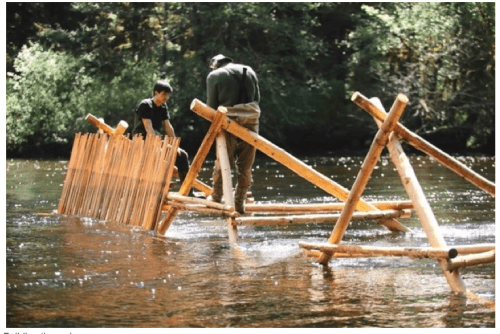
Weir on the River Koeye

Building Koeye Weir. Photo by Grant Callegari via indiegogo.

Building Koeye Weir. Photo by Grant Callegari via indiegogo.

There’s a pretty amazing new construction on the  on the Koeye River (pronounced roughly “kwaay”) on the central coast of B.C. (map).  A team has built a traditional style wooden-weir across the river, and are using it for fishery management – trapping, counting, measuring, and gently releasing salmon at the end (and start) of their life cycle. The construction has been documented at the willatlas.com blog, including some amazing photos, and there are posts on the Hakai Beach Institute blog as well. Even better, there is a short documentary.  This is actually is a teaser for a longer documentary, which is in the fund-raising stage, and I don’t mind using this blog as a platform to bring this really great project to people’s attention.  You can see their fundraising page here.

Continue reading