Category Archives: Miscellaneous

The Cup is So Mine

Take that, Sami Salo.

Well I am going into the field on Sunday so this blog will be taking a break soon.  Before that happens I might as well strut and prance around a bit and let my eleventeen readers know that (apparently) this blog was awarded the  Canadian Archaeological Association‘s annual award for Public Communication (Professional/Institutional Division):

Since 1985, the Canadian Archaeological Association (CAA) has presented annual awards to acknowledge outstanding contributions in communication that further insight and appreciation of Canadian Archaeology. These awards recognise contributions by journalists, film producers, professional archaeologists and institutions and are adjudicated by a committee composed of a regional representation of CAA members.

I say “apparently” because I haven’t heard from them yet (unless they naively left a voice-mail:  I check that once a year, whether anyone has left a message or not) but several people have told me it was announced at the recent annual conference in Calgary.  So I’ll risk a Dewey beats Truman moment – it might be the only one I get!

Continue reading

How to Make a Petroglyph

Replica sandstone petroglyph made by Christine Stathers. Photo credit: Stathers.

I’ve often said the graduate student work is the backbone of the archaeological discipline in British Columbia.  Today I get to report on more student work – but this time its a fascinating study done by an undergraduate student at Camosun College here in Victoria.  The student, Christine Stathers, did an experimental archaeology project for her Anthropology 240 course, and she kindly agreed that I could post some of the results here.  The results are highly informative for our interpretation of petroglyphs, I think.

Continue reading

Mystery Pipe

Mystery panel pipe. 12 inches long by 4 inches high.

I got contacted the other day by someone who was handling the estate of an elderly art collector.  The entire collection is African with one exception, the panel pipe shown above, and with more pictures below.  The person is looking for some basic information about these pipes and I suppose they will be charged with its disposition.  They contacted me thinking I might know something about them because I have posted about such pipes before, but of course I am just an archaeologist and  make posts about a lot of things of which I am largely ignorant.

Mystery panel pipe, detail.

I’ve given them contact information for someone who actually does know but in the meantime they said it would be ok to post these pictures here and see what the readers have to say.

Continue reading

Bird bones at the RBCM

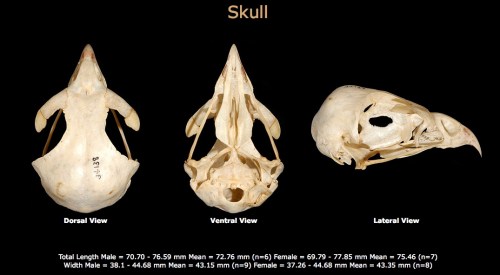
Swainson's Hawk skull. Three views from RBCM Avian Osteology site.

I made a post the other day on a cool M.A. thesis about how to tell deer, bear and human wrist and ankle bones apart.  Identification of bones is one of the essential specialist activities in archaeology: the bones don’t come out of the ground labelled, and yet they are a key way to understand past diet, behaviour and environmental change.  Being able to identify a bone from the ground to the species it comes from requires a collection of bones of known species – a comparative collection – and these do not grow on trees.  They are laborious to produce and finicky to curate.  The one at the University of Victoria, for example, contains over 1,500 skeletons and is in constant use by archaeologists and biologists, not to mention the awesomely talented people at Pacific IDentifications. Mind you, the UVIC collection is one of the best anywhere in North America, but most archaeology departments and even many consulting archaeologists attempt to have a basic comparative collection on hand.  This is a burdensome chore!

While looking at pictures will never be a substitute for a three-dimensional bone for comparison, it can nonetheless be better than nothing.  It is therefore nice to see a really useful, if preliminary, set of web pages at the Royal B.C. Museum on Avian osteology.

Continue reading

ASBC Victoria April Meeting: Tuesday 20th

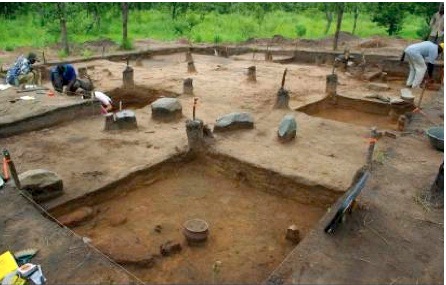
Excavations at Banda, Ghana.

This month’s Archaeological Society of B.C. public lecture is coming up soon, on Tuesday April 20th, in Victoria.  Everyone is welcome to attend these free talks.  The details are as follows:

Ann Stahl

Professor and Chair of Anthropology, University of Victoria

Ritual & Metallurgy: Genealogies of Practice in Banda, Ghana.

The goal of the Banda Research Project has been to investigate the dynamism of African village life in relation to shifting global connections ranging from the imposition of colonial rule at the end of the 19th century and extending to the early first millennium AD when Banda villagers participated in the Saharan trade. Our 2008 and 2009 field seasons at Ngre Kataa revealed extensive primary metal- working contexts dating to the period cal AD 1200-1400 where the site’s inhabitants produced copper alloy and iron objects. These metal-working features and deposits co-occur with a series of apparent shrine deposits. The evening’s presentation will explore the nature of these deposits, and share preliminary insights into the implications of our findings for our understanding of craft specialization and the genealogies of metallurgical practice in the Banda area.

Time: 7.30 p.m.

Place: Pacific Forestry Centre, 506 West Burnside Road.

For information,  e-mail asbcvictoria@gmail.com

A poster for this talk can be downloaded here (PDF)

No Guts No Glory

Chuckchu women inflating walrus intestines, 1917. Source: ADA

I’ve linked before to Tim Rast’s excellent blog ‘Elfshot’, which chronicles his work in Newfoundland, making replications and experimental archaeology for love, and money. Or, as he puts it, “Making a living as a 21st Century Flintknapper.” You can buy some of his superb work here and also browse part of his impressive back-catalogue of reproductions here.

Recently Tim has been going beyond the call of duty with a fantastic series of detailed, superbly illustrated (for the strong of stomach – photos and videos) on preparing the hide of a hooded seal, and the associated fun of processing its intestines for technological projects.  I urge you to go read them in their entirety over at his blog.

Seal intestines were, of course useful for any number of tasks.

Continue reading

Historic Maps and Dioramas of Victoria and Environs

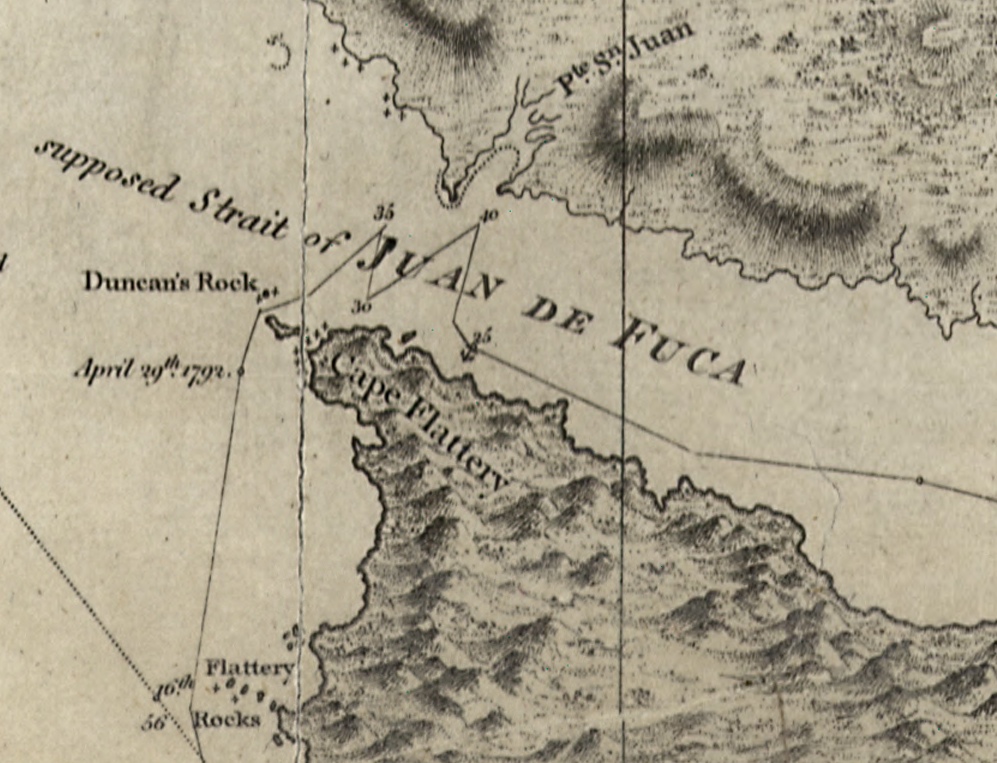
Detail of Capt. Vancouver's 1792 chart showing the "supposed strait of Juan de Fuca". Source: viHistory

vihistory is a web site designed to aid in historical research of Vancouver Island, at which it succeeds admirably.  You should poke around and have fun with their census data and the other worthy, if dreary, pursuits it affords the serious scholar.

One feature which is not immediately clear on first glance, perhaps deliberately as has entertainment potential, is a large selection of very high-resolution maps and images which you can download from this page. The file sizes are large, of course, but increasingly that is less of an obstacle in the past.  The maps are mostly of historic Victoria, but there are some regional maps such as telegraph and lighthouse maps of British Columbia, and a couple of maps of Nanaimo.  As usual, I have surfed through the maps so you don’t have to – and some of them are remarkably fun, and informative.

Continue reading

BBC: History of the World in 100 Objects

Detail of a Clovis point from British Museum. Source: BBC.

The BBC is producing a series of 100 “podcasts” which explores the history of the world through the lens of 100 different objects.  Each episode is about 15 minutes long, and while you can subscribe to the series for your iPod or on iTunes, you can also listen to each episode individually on the web: thirty of the planned one hundred episodes are now available.

One interesting episode focuses on the Clovis Point.  They mainly give weight to a Clovis First model of the first peopling of the Americas (including a bizarre quote from Gary Haynes to the effect that yes, there is older material than Clovis but nonetheless Clovis is first), but they do also offer an indigenous perspective which is unusual.

Continue reading

Intertidal Footprints

6,000 year old human footprint from intertidal sediments near Liverpool. Source: http://www.eyes-and-ears.co.uk

I know of three sites in the world where human footprints more than 5,000 years old are preserved in the intertidal zone: one in Northwestern England, and two in Southeastern Argentina.   These are exceptionally fragile sites – the English ones are often only visible for a single tide cycle.  All three sites find humans co-occurring with other species – Aurochs, canids, birds in England, and a large variety of fauna in Argentina, including extinct megafauna such as giant ground sloths (in both bipedal and quadruped mode) and glyptodonts (a sort of giant armadillo) among other species.  The prints range from single impressions to the trails of individuals walking or running, to clusters of several hundred distinct prints of all ages, to the distinctive prints of playful, gambolling children.

Continue reading

Sally Binford

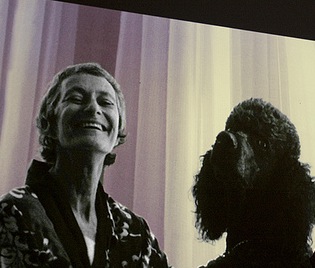
Sally Binford with her poodle, Jake. Photo credit: Honey Lee Cottrell, source: SFMOMA (click); cropped from original.

There is not much question that Lewis Binford was one of the most influential archaeologists of the 20th century – if not the founder, then the loudest exponent of “The New Archaeology“.  Like a lot of archaeologists not of a certain age, nor of a certain geography, I had never really focused on the co-editor of one of his more influential books, New Perspectives in Archaeology: Sally Binford.  Insofar as I had thought of her, I imagined some sort of academic liaison followed by her giving up her career, this being the 1960s and all – a not uncommon pattern.  Who was this other Binford, this flash in the pan?  I can’t be the only one who has wondered that, and not being plugged into the grandest social circles of the discipline, I’m turning to the internet.

Turns out she was superbly interesting in her own right.  I just came across a blog post recounting an interview excerpted from this book, which she gave not long before her death in 1994 (a death by her own hand on a date she had set 20 years ahead – one day before her 70th birthday.  She took her poodle, Jake, with her).  I  found the whole thing from A Very Remote Time Indeed.

I don’t endorse the interview in any particular way, clearly it is her perspective, but since Lewis Binford is a well known blowhard it can’t hurt to hear something from the other side of those days – especially as it also implicates the academic culture of Anthropology in the 1960s as including strong anti-semitic and racist undertones.  So, it is rather voyeuristically fascinating for me to read the lengthy interview,  but I warn it is a somewhat not-safe-for-work link.  There are some nude bodies and so forth, reflecting her post-archaeology career as a sex educator and sexual liberationist of some note.  Scroll down about halfway for the meetup with Lewis.  I’m pasting in some excerpts “below the fold”.

This whole thing is only tangentially related to the Northwest Coast and may be much too “inside baseball” for many readers, but the entire interview is quite compelling as a portrait of a cutting edge feminist and free thinker who intersected briefly, yet, brightly, with archaeology.

Continue reading