Category Archives: history

dSpace: Dentalia Shells on the Northwest Coast

Dentalia Source "mu7is" in Hesquaht Harbour.  From Barton M.A. p. 116

Dentalia Source "mu7is" in Hesquiat Harbour. From Barton M.A. p. 116

Andrew Barton did an excellent job reviewing the biology of the Scaphopoda, the archaeological record of dentalia use and trade, and the technology available to harvest these small creatures with tusk-shaped shells.  Overall, he brought a lot of nuance to a topic that had been somewhat over-simplified.  For example, there is no real evidence that these shells were only available at depth from the NW corner of Vancouver Island.  Barton reports on attempts to replicate ethnographic dentalia “spears” (more like a rake, or a pasta fork).  You should be able to download a copy of Fishing for Ivory Worms : a review of ethnographic and historically recorded Dentalium source locations from SFU dSpace.

Dentalia necklace by Josephine Ingraham, Clatsop/Chinook Tribes

Dentalia necklace by Josephine Ingraham, Clatsop/Chinook Tribes

Skidegate Haida Model Village

Model of Skidegate (hlgaagilda 'llnagaay) as installed at Chicago Exhibition, 1893.

Model of Skidegate (hlgaagilda 'llnagaay) as installed at Chicago Exhibition, 1893.

The Burke Museum in Seattle is doing excellent work.  I just found the project which they are spearheading, together with the Haida Museum at Kaay’llnagaay and the Field Museum in Chicago, to reassemble the famous model village of Skidegate (hlgaagilda ‘llnagaay) created for the 1893  Chicago World Fair.  This exhibition was organized by Putnam, implemented by Boas, who hired James Deans (a well known Victoria antiquarian) to collect some NW Coast stuff.  Deans outdid himself by arranging for the carving of a complete model of Skidegate Village  – amounting to some 27 model houses (most with frontal poles), 2 model mortuary houses, and 17 free standing model poles.  (Deans also apparently collected three boxcars of other material including an entire house, canoe and other material, but that’s another story).

The Burke Museum now allows you to view an interactive panorama of the model village.

The website is designed both to showcase these model houses and also to help find the 13 houses and poles which have gone missing.   The intention is to return the model village to Kaay in 2011.  Replacement poles and houses will be commisioned for those that cannot be found.   A highlight are the videos of Skidegate residents such as Captain Gold, Niis Wes, Percy Williams, Kii7iljuus, and Kwiaahwah Jones talking about the model village, about family, and above all about being Haida yesterday, today and tomorrow.

House of Contentment, model carved by George Dickson

House of Contentment, model carved by George Dickson

Tla’amin Archaeology

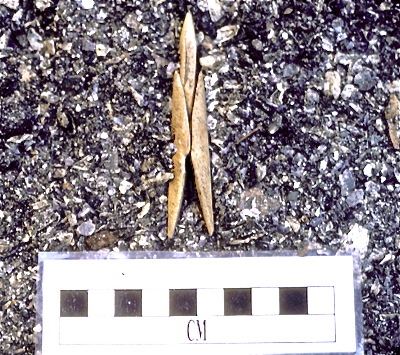
Toggling Composite Harpoon head, articulated in situ.

Toggling Composite Harpoon head, articulated in situ.

The Tla’amin (Sliammon)  First Nation on the Sunshine Coast (map) have been engaged in a wonderful community-based archaeology project with Dana Lepofsky at SFU and her team.  It’s not surprising when you think of what a great person Dana is – brilliant, yet nice, warm, generous. (Hi Dana!)

The website for this project is well worth browsing to see what meaningful partnerships with First Nations looks like.  I think it is a model for the future of BC Archaeology to work together – for then the project becomes not all about the past, but all about the present.  As they say – the past is over; it only exists in the present. Old things exist, but they exist now.   So how can we, as archaeologists, use our particular skills to help communities and the public appreciate the past as a meaningful part of the present, and hence of the future?  This impressive web site shows many great ways how.

Check out this page on Kleh Kwa Num – Scuttle Bay, for example, whih deftly points to the parallel stories of oral history, ethnohistory, and archaeology.  Or, this video of “what happens when an archaeological site is logged?”  As Elsie Paul, a Tl’amin elder says, their ancestral land was hammered for a century and what did aboriginal people get from it?  “Nothing”.  And as Dana says, it became very difficult to find intact archaeological sites around Powell River and the industrial areas, in particular.

These downloadable posters are also really well done, as is their prospectus/report (PDF) – very accessible stuff.   I do wish they didn’t use the silly flash interface for their pictures, though they do allow access to them otherwise – this project is really turning archaeology on its head!

Upside Down Archaeology in Tla'amin Territory.

Upside Down Archaeology in Tla'amin Territory.

Erik the Lost

Erik the Lost

More berzerkness up-island

This site contains an inspired argument that Viking Vinland, Markland and Helluland were on the NW Coast. It’s thought-through to a scary degree, in the way that magnificent obsessions often are.  Though as I always say, if something isn’t worth doing, it isn’t worth doing well. And based on my acquaintance with NW Coast Archaeology, I have to say that the theory falls down at a few key junctures.  Worse, it is part of a long-running narrative in which aboriginal people of the Americas have their finest cultural achievements taken and assigned as the work of Europeans.  See, for example, the Vikings in Minnesota theories, which argue that the great mounds of Mississippian Culture were the construction of White Men from the North.   Do the Minnesota proponents have academic arguments with the Vancouver Island proponents?  Were Vikings everywhere?  Is this a racist narrative?   Too bad all this energy is not put into something worthwhile, there is so much serious work to do.

Vancouver [Native] Art in the Sixties

GOOGA!

GOOGA!

This 1962 picture of Haida artist Robert Davidson at age 13 caught my eye, not least because he looks a lot like his nephew, Haida archaeologist and great guy Allan “Googa Boy Lefty ClamBone Monica Sunshine” Davidson. Here’s Allan tending to his espresso pot at Richardson Island.  Very shareable.  I am pretty sure this was before I accidentally tossed a grub into his cup.

Maps and Charts at the RBCM

1849 Indian Fort at Cadboro Bay

Indian Fort at Cadboro Bay, 1849

The Royal BC Museum was ahead of the curve in putting significant parts of its collection.  One thing I like is their small but relevant collection of maps and charts.  The 1849 chart inset to the left shows an “Indian Fort” in Cadboro Bay, for example.  There is a good selection of Admiralty Charts from the mid 19th Century, Pemberton’s 1861 map of Victoria (the “Bay” in this section is the real “James Bay”, now landfill under the Empress Hotel , where the bridge shows is now the causeway), and a 1911 map showing the Economic geography of Haida Gwaii (which interestingly includes Sea Otter as part of the fauna “on the west coast” since that species is thought to have been extirpated much earlier).  It is always surprising and sobering to see just how quickly remote areas were divided up and labelled according to their perceived economic value in a way that borders on propaganda, but there is realism too check out the instructions to family men.  Now the bad news: the price of being first is often not being very good.  I suspect when these went online bandwidth was a realy problem.  Each chart is split up into 100kb segments and it is not possible to download the entire thing at once.  The full size images must exist, so how about a quick project at the RBCM to make them downloadable in their entirety?  Same goes for the picture archives.

Meanwhile in Dinosaur Land

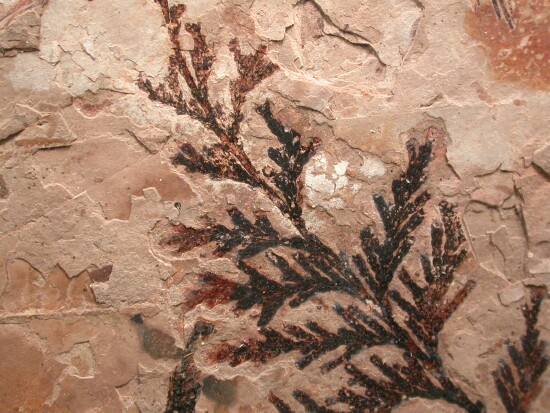
White Cedar fossil from McAbee Fossil Beds.

White Cedar fossil from McAbee Fossil Beds.

It’s not just petroglyphs that have a hard time getting protected in this province.  PalaeoBlog raises the issue of the unusual, exceptionally rich, 50 million year old McAbee Eocene fossil beds near Cache Creek, in the BC interior.  It seems the BC Government has reneged on a deal to help protect and manage these beds, which are exposed in a highway cut.  This deal involved the B.C. Paleontological Society, the RBCM, and Thompson Rivers University.  The Kamloops News has the story.  Once again, the Powers that Be are shown to be Philistines in shark’s clothing.  Maybe if someone told them that Adam and Eve lived in those ancient meadows, frolicking with dinosaurs, they would have a little more interest.  The Fossil Museum has a nice page which makes the importance of the McAbee beds quite clear.

Pickford on Excavation of “Indian Middens”

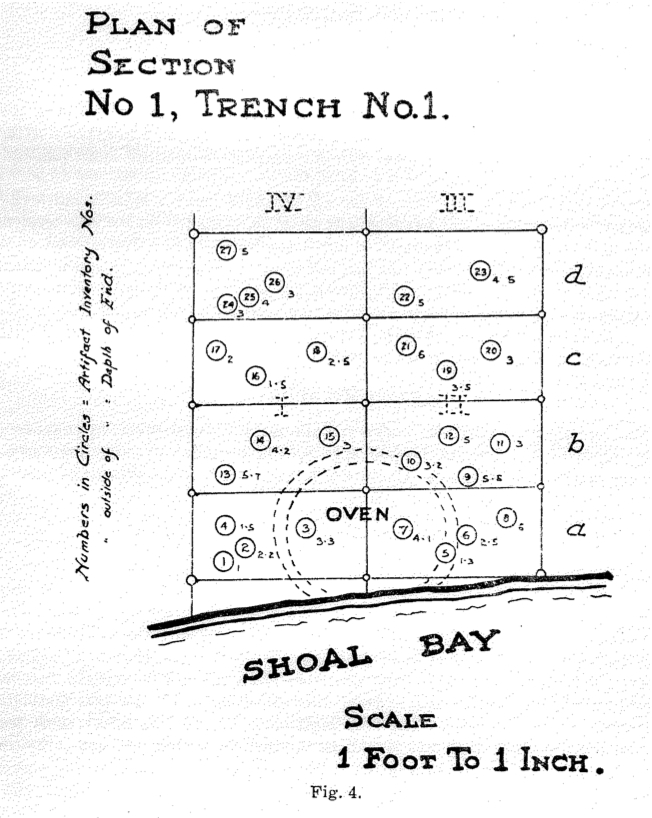
A.E. Pickford's ideal plan of an earth oven.

A.E. Pickford's ideal plan of an earth oven.

A.E. Pickford was the Assistant in Anthropology at the Royal BC Museum, when it was still known by its proper name of the Provincial Museum of Natural History and Anthropology.  Here I link to his indispensible 1947 article, “Archaeological Excavation of Indian Middens” – the examination of such middens by means of sampling.

The rationale for the publication is interesting:  “In case of private ownership, if a person is unable to restrain the impulse to dig on his own land, we urge that he shall adhere to some such principles as those which follow, then he will have the satisfaction of knowing that his work is well done and, when brought into focus with similar undertakings, will help to build up that sound formation of knowledge, without which the correct story of the early population of this country cannot be written.”

After encouraging the study of lofty topics such as racial and cultural origins, foods, housing …. etc., Pickford busts out his inner schoolmarm: “He who digs for relics alone may be likened to the child who tears a book apart in order to secure the coloured plates which it contains, being the while all unaware that in scattering the printed pages to the wind he is losing forever a valuable source of information about those same plates and the life which they represent”.

Reference: Report for the Year 1947.  Victoria: Provincial Museum of Natural History and Anthropology, Province of British Columbia, Department of Education.  [yes, education].

University of Washington Digital Collections

Makah codfish spear (or, more accurately, harpoon)

Makah codfish spear (or, more accurately, harpoon)

The University of Washington has a superb digital collection online, transcending all kinds of different historical, archaeological and popular culture niches.  Searching on “artifact” brings up some 583 images (some of which are links to text etc).  These are downloadable and have stable URLs to which one can link. The resolution could be higher, but the pictures are sharp and clean, at least for those ones they have apparently taken themselves, and they don’t plaster watermarks all over them.  Good work.  The amount of metadata is impressive, and the fact that is is clickable renders this site a fantabulous timewaster of the highest order.  To the left, I was just having a discussion with a student about harpooning fish.  I am under the impression that harpoons were used on large lingcod – after the lingcod were lured to the surface using a cunning little shuttlecock-shaped rising float.  This picture is labelled “Makah codfish spear” though it is self-evidently a harpoon and lanyard.  More (vindication) coming from this excellent site as time goes by.

Aboriginal history a la mode.

Being a mere archaeologist and not a sophisticated type, I like to reduce complex topics to simplistic graphs.  I showed this one to the first class of my new course on the Archaeology of BC.     The numbers for this are based on the emerging 13,000+ (calibrated) year old archaeological finds in Haida Gwaii,  so I expect the red slice to keep on growing.

If I were a paranoid type, I’d liken it to Pac-Man just getting his teeth into a ghost.

Reverse the colours to get the relative number of BC historians vs BC archaeologists in Universities – though I am all for historical archaeology as well, not to mention history, and BC history in particular.   All really good things.  But it is striking nonetheless to consider how weighted we are institutionally towards  the green slice.  As I said to the students, hearing the BC government natter on obsessively on the radio and in newspaper ads last year about the “150th Anniversary of British Columbia” just made my blood boil every time.  Seriously, Premier, do you want a new relationship with First Nations?  How about acknowledging the red slice of pie?  How about a celebration of 130 centuries of BC history?  Call off the government lawyers and other PR flacks who seem to think the world began 150 years ago.

While we are on the topic of letting the facts speak in the tongue of numbers,  where I work, the ratio of BC archaeology faculty members to all regular faculty members = 1:800.  As the kids say, Hello?

PS: Archaeologists are quintessentially “shovel ready” so maybe some stimulus money goes well with pie.  Try it.