Category Archives: First Nations

Weir on the River Koeye

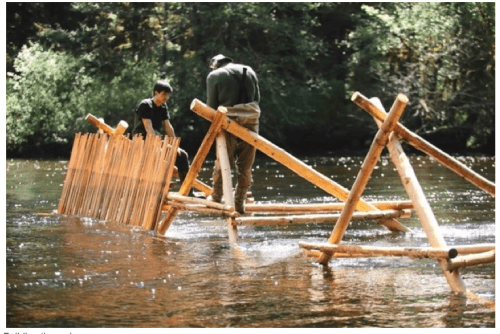
Building Koeye Weir. Photo by Grant Callegari via indiegogo.

Building Koeye Weir. Photo by Grant Callegari via indiegogo.

There’s a pretty amazing new construction on the  on the Koeye River (pronounced roughly “kwaay”) on the central coast of B.C. (map).  A team has built a traditional style wooden-weir across the river, and are using it for fishery management – trapping, counting, measuring, and gently releasing salmon at the end (and start) of their life cycle. The construction has been documented at the willatlas.com blog, including some amazing photos, and there are posts on the Hakai Beach Institute blog as well. Even better, there is a short documentary.  This is actually is a teaser for a longer documentary, which is in the fund-raising stage, and I don’t mind using this blog as a platform to bring this really great project to people’s attention.  You can see their fundraising page here.

Continue reading

‘Namgis Arborglyph

Dawn Cramer inspects an arborglyph deep in the heart of the Nimpkish Valley.  Photo courtesy of the 'Namgis Nation via Jim Stafford

Dawn Cramer inspects an arborglyph deep in the heart of the Nimpkish Valley. Photo courtesy of the ‘Namgis Nation via Jim Stafford

Hard on the heels of my recent post on a newly discovered arborglyph in Klahoose traditional territory, I’ve heard of another one in ‘Namgis territory, in the Nimpkish Valley on Northeastern Vancouver Island.  Local archaeologist and friend of this blog Jim Stafford, who owns the well-regarded Coast Interior Archaeology company (which has a long relationship with the ‘Namgis), sent me the following note and some photographs which are cleared for publication here.  There is also an account of the arborglyph in this PDF document (a newsletter) from the ‘Namgis. Jim writes:

Please find attached images of the arborglyph we found recently in the heart of the Nimpkish Valley.  The photos are provided courtesy of the ‘Namgis Nation and Dawn Cranmer is pictured in two of the photos.  I’ve also included an image of a ‘bark board’ we found nearby with Lee Waddams pictured. Continue reading

Klahoose Arborglyph

Klahoose Arborglyph Ceremony. Source: Klahoose First Nation.

Klahoose Arborglyph Ceremony. Source: Klahoose First Nation.

There has been a mini-flurry of new arborglyphs found in BC – well two of them –  but they are extraordinarily rare.  First up for this blog is the example above, which comes from Klahoose First Nation territory, roughly around Toba Inlet in the extreme NE corner of the Salish Sea (map).  This human face was carved into a tree some time in the 19th century.  It’s in rather stunning condition, setting aside the cut block it finds itself in.  Risk of blowdown is probably why, after appropriate ceremony, it has been moved to the Klahoose offices at T’oq (Squirrel Cove).  As the page describes:

The Klahoose Cultural Leader Norman Harry Sr. and a Tla’amin Cultural Leader Erik Blaney witnessed and performed a ceremony to ensure cultural protocol was observed. The heartfelt moments before the tree was harvested was both moving and surreal on that snowy winter Friday. Needless to say that the emotional event was a historical moment for those who witnessed.

Continue reading

Controversy at Cherry Point site WA, 45WH1

Foreshore near 45WH1.  Source: Re-Sources.

Foreshore near 45WH1. Source: Re-Sources.

I haven’t been following the story at all, but there seems to be quite the controversy going on at Cherry Point, not far north of Bellingham on the coast of Washington State (map).  This large site, in Lummi Nation territory and known to them as Xwe’ chi’ eXen, has seen a lot of archaeological work over the years: about 300 cubic metres was  excavated in a series of WWU fieldschools in the 1970s and 80s under the direction of Garland Grabert. Dating back to at least 3500 years old, has some unusual features, such as being on a wave cut bank over a cobble beach with unusual offshore topography, suggesting proximity to a reef-netting site.

As its site number indicates, it’s the first site recorded by archaeologists in Whatcom County – which usually means it’s a very prominent site.  Indeed, it’s both culturally and scientifically important, and, unfortunately, has seen a lot of impact and is currently threatened. The source of the problem is a major coal port which is being planned. Interestingly enough, when the developer jumped the gun and started core-sampling the site before authorization, they were  taken to court and recently fined 1.6 million dollars.  Which is a lot of dollars. Continue reading

Harpoon Arrows

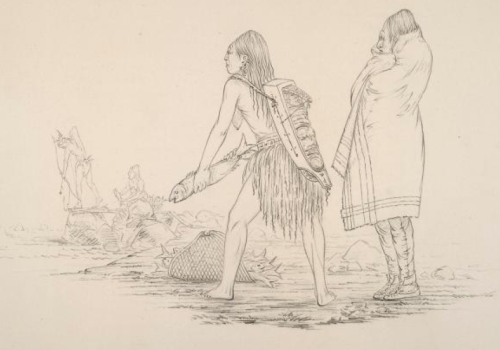
Fishing at the Dalles, 1850, pencil drawing by George Catlin. Source: NYPL.

Fishing at the Dalles, 1850, pencil drawing by George Catlin. Source: NYPL.

I’m probably the last person to get the memo that you can fire a harpoon with a bow and arrow.  In fact,  I only just got my head around firing a harpoon with an atlatl.  Anyway, take a squint at the picture above – the figure in the lower left background is clearly shooting a harpoon-arrow from his bow.  The picture is from about 1850 and is a pencil drawing of a scene at The Dalles, on the Columbia River.  I’ll take a closer look at this picture below. Continue reading

Essay on the CBC – Stone Bowl Auction Controversy

Screenshot of iPINCH website

Screenshot of iPINCH website

I’ve posted a couple of times (1, 2) on the proposed, callous use of a seated human figure bowl as a reality TV show prop.  Well, worse than a prop, since the idea is to auction off this sensitive cultural property in pursuit of TV ratings and the advertizing dollars which follow.  It’s sort of unfathomably insensitive and stupid, doubly maddening since it’s the CBC, a crown corporation and an entity which really should know better.

Anyway, there’s an interesting and insightful essay by Emily Benson on the IPinCH blog which adds a lot of thoughtful commentary and context for this issue:

The example of the seated human figure bowl and media discussions around it, reflect a broader set of questions and issues related to historical and contemporary relations between Indigenous peoples and settlers in Canada. This case reflects the importance of challenging both public and anthropological conceptions regarding the treatment of Indigenous peoples’ cultural heritage.  Explicitly recognizing the relationship of descendant communities to their ancestral /sacred sites and objects, and their rights regarding their cultural heritage, are fundamental to doing so. Key to shifting these perspectives are recognizing the significance of cultural heritage sites and objects to living peoples, and their rights to make decisions regarding their heritage.

It’s part of IPinCH‘s* occasional series “Appropriation of the Month” – most entries are not about the NW Coast but nonetheless many readers here will find a lot of food for thought over there.  I particularly encourage you to go over and leave some comments on the bowl issue!

Archaeological project blog from shíshálh territory

    Archaeologists in shíshálh territory using iPads during excavation. Source: http://shishalharchaeology.wordpress.com/

Archaeologists in shíshálh territory using iPads during excavation. Source: http://shishalharchaeology.wordpress.com/

Last summer we had a good discussion of the vast number of beads coming from some human burials being excavated in shíshálh territory (Sechelt). Tose finds are part of a larger joint research program between the shíshálh Nation, National Museum of Civilization, and the University of Toronto, which has resumed and has a blog.

Continue reading

More on Stone Bowls and Reality Shows

Screenshot from Times-Colonist of Qualicum bowl which may be subjected to reality TV auction by CBC.

Screenshot from Times-Colonist of Qualicum bowl which may be subjected to reality TV auction by CBC.  Click to enlarge.

The Times-Colonist has another article (PDF) on the seated human figure bowl which may go up for auction as part of a crass CBC reality TV show. The new article has some good information about the bowl from Grant Keddie and reactions from the B.C. Archaeology Branch and the CBC.  Thanks to twoeyes for posting this article in comments in the prior post; I thought it needed a new entry of its own.

The bowl was apparently found in Qualicum Beach in 1988, and is known to the Royal BC Museum – it has been photographed by them (see screenshot above).  I’m not sure if there has been any publications about this bowl, if the Qualicum First Nation knew about it before this mini-controversy, or what has been said to the owner about the importance of the item. The Times-Colonist does have some interesting quotes from those involved.

Continue reading

Laser imaging of Sitka poles

Lidar model merged with photograph to document carved pole, Sitka, Alaska.  Source: NPS.

Lidar model merged with photograph to document carved pole, Sitka, Alaska. Source: National Park Service.

This is an interesting application of Lidar technology – creating a durable, highly precise, digital image of a standing pole, which can then be wrapped with high-resolution photographs and used in a “virtual tour” context. It can also be  an archive for conservation.  The project is underway to record a couple of dozen Tlingit poles in an outdoor setting in Sitka, Alaska.

Lidar stands for “light distancing and ranging” and is basically like radar or sonar, only using laser beams.  Thousands of individual laser bursts can measure the three-dimensional surface of something like a totem pole to accuracy of a millimetre or less.  This creates an accurate digital record of the shape of the pole which can then be rendered on-screen in various three-dimensional ways.  Lidar has seen a fair bit of use in archaeological survey (especially its ability to digitally clearcut the trees) and also has seen quite a bit of table-top use to record artifacts in exquisite detail.  The “meso-scale” recording of features like poles is less common though, especially outside of historical and classical archaeology.  There is a lot of potential for recording petroglyphs I think — for example this recent dissertation (which I need to order) apparently shows proof of concept at Writing-On-Stone in southern Alberta.

Continue reading

Seated Human Figure Bowl going up for sale?

Screen shot of human seated figure bowl on boardroom table.  Source: Times Colonist.

Screen shot of human seated figure bowl on boardroom table. Is this a “wild and wacky [sic] object”? Source: Times Colonist.

This short piece (PDF) in the Times Colonist caught my eye, and not in a good way. First, a private citizen apparently owns a large human seated figure bowl, an artifact of immense cultural significance, and is apparently willing to enter a process leading to its sale.  That’s bad news and potentially extremely inflammatory, especially in the context of the CBC reality T.V, show “Four Rooms” (tagline: “four rooms. four buyers. four chances to make a fortune”).

It’s crass and disrespectful to treat these objects like this.  The picture above of one casually manhandled on a boardroom table, apparent scrape marks down its side, is angry-making!  These objects routinely have handling, viewing, and storage restrictions in museums and at cultural centres.

Continue reading