Category Archives: First Nations

D’Suq’Wub: Old Man House – a Poster

Old Man House: computer reconstruction of one end. Source: Suquamish Tribe.

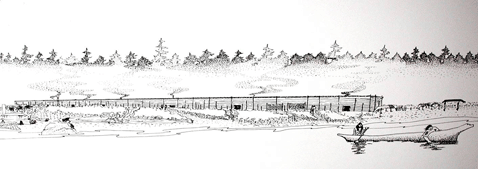
“Old Man House” is on the Kitsap Peninsula just north of Bainbridge island, across Puget Sound from modern downtown Seattle.  The “house” was the subject of one of the earlier excavations on the NW Coast by Warren Snyder and team from the University of Washington.  The house formed the locus of a major village of the Suquamish Tribe, and its most famous historic resident was Chief Sealth, also known as Chief Seattle.  The Suquamish Tribe has a very nice poster on the history and archaeology of Old Man House which can be downloaded from their website – clicking here will start a moderately sized JPG file. (Edit 2018: archived copy here)

Interpretive sketch of Old Man House. Source: Suquamish Tribe.

It is a bit of misnomer to call this structure a “house” though.

Continue reading

The Schieffelin Brothers Yukon River Prospecting Trip of 1882

Tanana woman returning from the hunt, 1882. Source: AKDC

Browsing in the Alaska Digital Archives I found an interesting photo album documenting a prospecting trip up the Yukon River by the Schieffelin Brothers, Ed and Al, who just a few years earlier had founded the famous desert mining town of Tombstone, Arizona.  Two pictures from this album struck me as particularly interesting, though the whole thing is worth browsing.

The first of these is the remarkable picture above, showing a Tanana woman with a long-gun, powder horn, and a couple of large rabbits.  While anthropologists and archaeologists have grudgingly revised their “Man the Hunter” stereotypes in recent years, it is nonetheless rare to see such a frank portrait of a competent woman with her prey.  I’ll be using this one in class, starting next week.

Continue reading

Caribou Metatarsal Hide Scraper

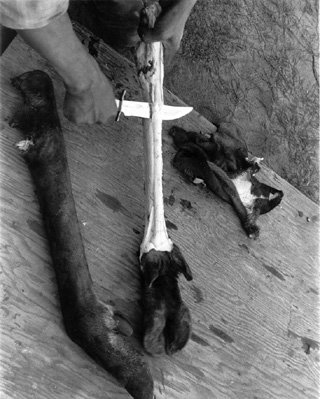
John Shea stripping ligaments from a caribou metatarsal in preparation for making a hide scraper. Source: SFU.ca

I haven’t really mined the SFU Archaeology museum website yet – they seem to have had a bit of a makeover recently, though many of their online resources are achieving “vintage” status.  One such is the photo-essay on making a hide scraper from a caribou metatarsal, or the long, straight bone between the caribou ankle and its hoof – the long bone of the foot (ungulates walk on their tip toes).

The essay is a series of over 20 pictures showing step-by-step the process of making the scraper:

Continue reading

Photos of Victoria and Esquimalt, 1859

Victoria 1859. Source: LOC

In 1846, the Oregon Treaty established the boundary between British and American territory west of the Rockies (and unintentionally established the benchmark date for whether archaeological sites are automatically protected under the Heritage Conservation Act, but that’s another story).  Vancouver Island was to remain in British hands in its entirety, but otherwise the 49th parallel was to be the boundary on land.  The ocean boundary through the Salish Sea was resolved later, after the armed standoff on San Juan Island known as the “Pig War“.   An International Boundary Commission was struck, with the mandate of surveying the 49th parallel and one of its base camp headquarters in 1858 and 1859 was Esquimalt.  At this time, a series of photographs of the young Fort Victoria and surrounding buildings were taken, some of the earliest photographs from British Columbia I know of – including some remarkable pictures of First Nations people.

Continue reading

Vanishing Eulachon

Eulachon. Source: Sitnews.net

I often use eulachon (Thaleichthys pacificus, a small, anadramous smelt) as an example of “archaeologically-invisible” food. They are also known as “candlefish”, on account of being so oily that a wick jammed down their throat will burn like a candle.

These small fish run by the millions up rivers to spawn, where they could be intercepted.   Traditionally, many or most eulachon would be processed into eulachon oil, or grease: a highly nutritious, calorie-dense substance that preserved very well and could also be used to preserve other foods such as berries.  The means of processing was to put them into a large container, perhaps an old canoe, known colloquially as a “stink box”, let them “rest” there for a week, and then heat them up, enabling the oil to rise and then be skimmed off, or pressed out.  The residue (bones, guts, brains, etc.) would then be returned to the river and few or no bones would make it away from the processing site.  In this way, eulachon provided a staple food, a nutritional supplement, a means of preservation, and an extremely valuable trade item – when Alexander Mackenzie arrived near Bella Coola in 1793, “Over Land, From Canada”, he did so on one of the well-worn grease trails that linked coast to interior. Since the fish arrive in the early Spring, they were hailed as starvation busters in lean years.  Nonetheless, archaeologically they are almost invisible, relative to their importance.
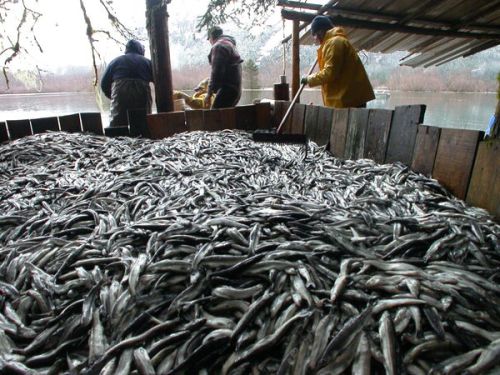
Haisla eulachon catch from the Kemano River. Source: living landscapes.

It is therefore sobering to read that U.S. President Obama has listed the Columbia River eulachon as an endangered species: eulachon are becoming almost invisible relative to the real world now, it seems.

Continue reading

Webber’s Village in Nootka Sound: Original Watercolour

Painting of a village in Nootka Sound, 1778, by John Webber. Source: State Library of New South Wales. Click for larger original.

Yesterday I linked to the original watercolour of a 1778 Nootka Sound house interior by John Webber, which is the basis for the widely reproduced engraving.  Today we can take a look at Webber’s original painting of a Nootka Sound village, presumably Yuquot but not so labelled, as found at the State Library of New South Wales (though yesterday’s post brought forth questions as to whether these are watercolours or coloured engravings – see the comments).  The first and most important point is, see that lumpy, dissected landform in front of the houses?  That, my friends, is what an active shell midden looks like.  No wonder they can be such stratigraphic nightmares.

Continue reading

Webber’s House Interior: Original Watercolour

1778 Watercolour by John Webber of the interior of a house in Nootka Sound. Source: State Library of New South Wales. Click for original.

A few days ago I posted a beautiful watercolour of Nootka Sound by John Webber, artist on Cook’s third voyage.  In the ensuing discussion, it was brought up how nice it would be to see the original watercolours of more of his paintings, which often formed the basis for the  numerous engraved reproductions which are what one normally sees.  The loss of information in moving from the original to the engraving is something of an unknown quantity, and I for one had never seen the watercolours.  Until yesterday!

Continue reading

Historic Pamphlets and Booklets on First Nations Topics

Skeena River pole ca. 1920s: On back: ""Named Waum Gana'o 14' high / erected 1845 / 4 Bottom figure, is of the big hog, upside down." Source: USASK."

The University of Saskatchewan has a comprehensive Indigenous Studies portal, with links to a massive corpus of published and unpublished documents – some of which are available online, free of institutional restriction.  One section which I found interesting was the large collection of pamphlets and booklets.  I know this web site isn’t always 100% archaeological – but you can’t separate the practice of archaeology from the social context in which it occurs. Among these pamphlets are:

  • CBC Radio and Department of Indian Affairs 1939: The Indians Speak to Canada (transcript of a remarkable series of 1939 CBC radio broadcasts in which aboriginal people address the nation; Haida representative Rev. Peter Kelly starts on page 28; White Man’s Burden is found in the closing remarks by the Minister of Mines and Resources)

Continue reading

One more update on the Museum of Vancouver’s Petroglyph.

Interior Petroglyph now at Museum of Vancouver, while still in Stanley Park ca. 1980. Source: DanLeen.org

I have posted several times recently on a superb interior petroglyph boulder languishing in a shady courtyard at the Museum of Vancouver.  Together with Heather Pringle’s posts on this topic, we seem to have caught the attention of the Board of Directors of the Museum.

One of the Directors, Anthropology Professor Bruce Miller of UBC, called me the other day.  He consented to me posting notes from our conversation.   Continue reading

Making a stone tool, 1893

1893 flint-knapping description by Father Morice. Source: Canadiana.org

Father Adrien-Gabriel Morice was a Catholic missionary working in the Skeena and Bulkley River areas of western British Columbia during the later 19th century.  He is perhaps best known for his documentation and writing system for the “Carrier” (Yinka Dene) language, but he also published a major work entitled Notes Archaeological, Industrial and Technological of the Western Denes, with an Ethnographical Sketch of the Same (1893).  The work is a cornucopia of careful observation mixed with some interesting, and occasionally rather religiously judgmental and speculative, commentaries.  One of the most interesting short passages is excerpted above: Morice records how to make stone tools via flaking.  Because metal tools became widely available in the early historical period and had some superior qualities, such accounts of traditional flaked stone (the bread and butter of archaeological sites) are very rare.  The figure above appears accurate in its description of the slightly awkward-seeming way of holding the stone: I have seen this palm grip used by many contemporary flintknappers.  Elsewhere, Morice records a series of Yinka Dene names for different stones, including chalcedony and obsidian.  You can page through his book, but not download it in entirety, here at Canadiana.org. The illustration above is from Page 65 on the drop down menu.  (Why they don’t just make a link to the whole PDF is beyond me).  There are other informative sections, such as about 10 pages describing the operation of fish-traps and weirs.

Fish trap illustrated in Morice 1893. Source: Canadiana.org