Category Archives: Cultural Resource Management

Tse-whit-zen interactive pages and slide show

Whale vertebrae modified into a spindle whorl, from the Tse-whit-zen site. Source: Seattle Times

I mentioned the Tse-whit-zen site a few days ago, in reference to the recent discovery of a small whale sculpture found there in 2009.  The Seattle Times had a superb web site on this ancient Klallam village, but unfortunately, many of the links are broken (how does that even happen, anyway?).  But the four part illustrated slide show with extensive audio commentary by Klallam, archaeologists and other people is still available and is well worth watching – in fact its one of the best such slideshows I’ve seen.  The Interactive Village component of the site is still active as well, and also definitely worth checking out.

As with so many of these sad stories of site disturbance through development, there is a silver lining as the dig itself, and the objects found, have contributed to a vitalization of Klallam traditional practices and increased interest in Klallam traditional culture within their younger generation.  At a severe price, though: over three hundred burials were excavated and removed from the site before the project, a massive graving dock, was brought to a halt – a halt which, according to some, cost over 100 million dollars.  I’m posting some of the pictures in case the Times site loses even more functionality.

Comb recovered from Tse-whit-zen site. Source: Seattle Times.

One of the more than 800 remarkable etched stones found at Tse-whit-zen, some in association with human remains. Source: Seattle Times

More than 300 human burials were disturbed by the graving dock project. Here, some await reburial in a warehouse on site. Source: Seattle Times.

Lousy conservation at the Vancouver Museum?

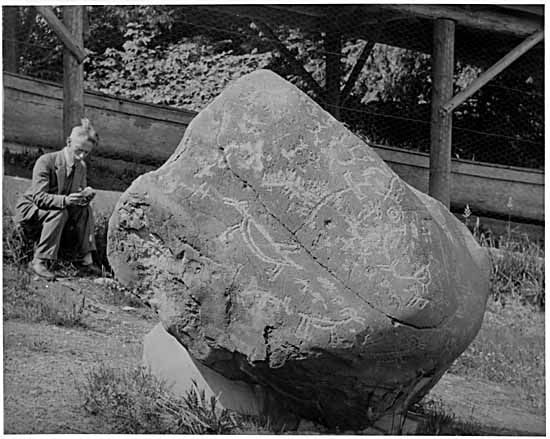
Shoddy conservation of magnificent petroglyph boulder at the Vancouver Museum. Screenshot from VM website.

For some reason mistreatment of rock art just makes me spitting mad.  I posted the other day about a magnificent petroglyph boulder that was removed from its home on the central Fraser River near Lillooet in 1926.  Bad enough that this work of art was ripped from its setting to be a curio in an urban park.  Petroglyphs are not ornaments for your outdoor rock garden any more than they are lifestyle amenities deployed as advertising copy, even if you are a museum.

Now my spies tell me that this petroglyph boulder was moved to the Vancouver Museum in 1992.  Pictures of the boulder on the VM website show it to be in absolutely appalling shape.  It is covered with moss, the designs are visibly eroded and faint, there are signs of exfoliation, and the large crack seen in 1926 seems to be getting larger.   The Vancouver Museum appears to be keeping this treasure in a damp, shady, spot in the outdoors (as they say, it is in a “lower level garden courtyard”) and there is no sign of any attention to basic, fundamental conservation responsibilities. They even have the gall to note in their website description “Today archaeologists are reluctant to reveal the locations of petrogylphs, lest they be disturbed.”  Well I am revealing the location of this petroglyph, which is being disturbed by careless curation!

Seriously: this boulder is one of only a few petroglyphs from that part of the province, where pictographs are much more common.  It was in pristine condition in 1926.  Now it is a moss-ridden crumbling mess.  This boulder is a cultural masterpiece.  It is a provincial treasure.  It is a national treasure.  It is of international significance.  And yet it is being absolutely neglected by a leading cultural institution.  Imagine an Emily Carr painting being treated so poorly.  Imagine a Bill Reid sculpture  treated so shabbily.  It would never happen.  Yet this boulder is as important, is MORE important, and is consigned to rot away metres from state of the art curatorial facilities which are being devoted to white leather pant suits (!!).  It is astonishing to me that they put this boulder on the web at all, suggesting that they don’t see a problem and are therefore unworthy to be in possession of it.  They should make arrangements immediately to have it transferred to a suitable institution or have it returned to its original setting, in what I take to be St’at’imc territory

Vancouver Museum, you have a responsibility of professional stewardship.  Are you living up to it?

Note the eroded engravings and extensive moss/algae cover. Source: VM website screenshot.

The boulder in the early 1930s, soon after it was brought to Stanley Park. Note the crispness of the designs and the lack of moss.

Tse-whit-zen whale

Tse-whit-zen whale sculpture.  Source: Peninsula News, Port Angeles.

Whale sculpture from the Tse-whit-zen archaeological site, Port Angeles. Source: Peninsula News.

The Tse-whit-zen site is a former Klallam Tribe village that was discovered by the construction of a graving dock at Port Angeles, Washington State.  The subsequent disturbance and archaeological project led to an astonishing series of events with over 300 human burials recovered, many more disturbed, 65,000 artifacts recovered and after a huge investment the abandonment of the graving dock project at a cost some estimate in excess of 100 million dollars.  This is a story I want to know more about and will probably post on from time to time.

But for today, set aside the sad history and feast your eyes on the above small sculpture of a whale discovered during the summer of 2009 at Tse-whit-zen during mopping up remediation.  The artist has captured the essence of whale!  The article doesn’t say, but there may be a socket on the lower back of the whale just in front of the tail – perhaps this was the handle for a small chisel, or a knife.  I also wonder if it doesn’t go the other way up — the mouth is asymmetric and the arching back of a diving whale would be a more natural posture.  Either way, this is a happy little sculpture, probably dating from about 2,000 years ago.

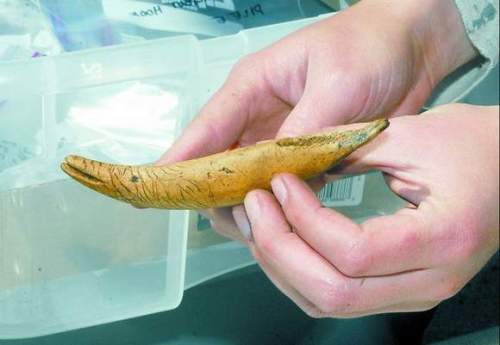
Annotation: Gaadu Din 2

Gaadu Din 2 is an archaeological site in a small limestone cave in Haida Gwaii.  It is a narrow, sinuous cave which probably was used on occasion by denning bears during the Younger Dryas cold period at the end of the Pleistocene:.  Currently it is at about 100 metres above sea level and 500 metres from the shore, but when occupied it was as much as 200 metres above the then-lower sea levels and up to 5 km from the shore.  The logistics of bringing excavation equipment to this mountainside location are significant, as is the care required by Parks Canada’s rigorous standards for the proper treatment and rehabilitation of karst post-project.

Among the interesting features of this cave is its very flat floor and very dry interior.  Thus, while narrow and cramped, it would have also offered some reasonable shelter to humans near the entrance, where there would have been daylight.  Based on this and other hints, we conducted a brief excavation at the entrance and quickly established that there had been – on at least four occasions spanning over 1,000 years — a small campfire built, around which people did a small amount of stone tool repair.  This was between about 10,800 and 13,000 years ago.  Probably this cave was used as a staging post for winter-time bear hunting in the other caves in the area, and bears may have been hunted in this cave itself as well.  You can imagine them, the day of the successful hunt, spending the night at this entrance, warming themselves by the fire, telling stories of the day’s dramatic events, and tweaking their toolkit to be ready for the next.

In any case, it is a remarkable thought that on at least four discrete occasions, separated by centuries, people came to this cave and built a fire in the same place as their ancestors had done.  It was a privilege to sit where they sat and, together with Haida archaeologists descended from these hunters, to recover the clues they left behind, which may well form the oldest known archaeological site in Canada.  There is no space here to relate all we know from these caves but suffice it to say for now that these are heritage sites that reveal not only hunting practices but the spirituality which surrounds those hunting practices and continues to inform and imbue Haida respect for bears to this day.

It is fortunate that these caves lie within Gwaii Haanas National Park Reserve, but many similar caves in BC, with similar materials undoubtedly within them, do not share this protection and are commonly destroyed.  This is because there is both insufficient protection for karst as a special landform with unique ecological attributes, and  a general lack of appreciation within the archaeological community about the potential that such caves hold for archaeological sites of the highest possible significance.

Even more on the Wilson Duff – SGang Gwaay Musical

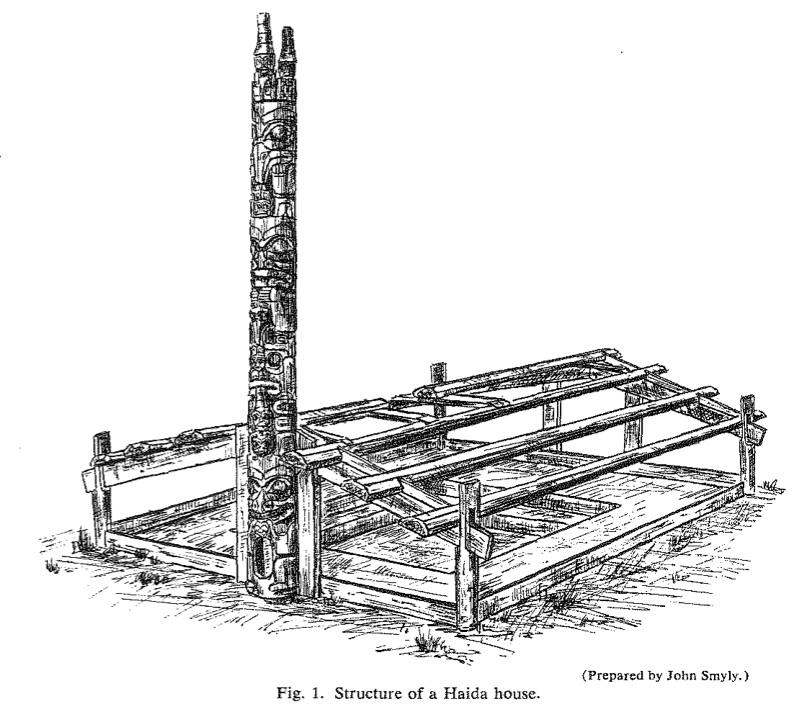
Haida House and pole. Source: Duff and Kew, 1957.

A month or two ago I made several posts (1 , 2, 3) about a forthcoming musical called Beyond Eden, which tells the story of the 1957 expedition to ‘rescue’ poles from the Haida Town of SGang Gwaay (PDF).

I notice The Tyee has a very good overview of this musical (which opens tonight) including some comments from Roy Jones Sr. of Skidegate, last seen on this blog as a young man climbing poles in 1957 CBC archival footage.  Says The Tyee:

Now in his mid-80s, he is reflective about the experience, having enjoyed the physical work and the company of members of the crew — but about cutting the poles? “It didn’t feel right,” he said. However, the Skidegate Band Council had approved the work and many felt it was the right thing to do. Further to that, Jones was on a recent trip to The Chicago Field Museum and saw one of the poles taken from Skedans (an expedition he was also on). “If they hadn’t taken it at that time, it would have been ruined, I think,” he said.

It is good to see some Haida perspective on both the events of 1957 and on this musical.  I also didn’t realize Nathalie at the Qay museum was a student of Wilson Duff’s — I’ll have to buy her a coffee and pump her for stories next time I am up on the islands. It’s a good article — The Tyee is doing some of the best journalism in BC right now.

Poster for "Beyond Eden" musical. Click to buy tickets; scroll down for title song.

ASBC Victoria January Meeting

Haida Gwaii watershed above Sunday Inlet.

The Archaeological Society of British Columbia is a long-established society which promotes knowledge and conservation of BC Archaeology.  The Victoria Chapter is particularly active (though they need to update their website and blog).  They aim for a public lecture every month. There are also chapters in Nanaimo and Vancouver.

This month’s Victoria talk, which is free and open to the public, is:

Watersheds and Coastal Archaeology: A Northwest Coast Perspective.

Jan. 19, 2010, 7:30 pm Pacific Forestry Centre, 506 West Burnside Road.

Rich Hutchings

The watershed or basin has been considered a primary unit of analysis for hydrologists, geologists, ecologists, human geographers, and historians. On the Northwest Coast, the economic significance of riverine settlement has long been a central focus, yet it is only in the last decade that anthropologists have begun to contemplate the social, political and ideological implications of rivers, river edges, and, to a lesser degree, basins. In this lecture, I will explore the concept of watersheds as a unit of analysis for archaeologists working on the Coast. Specifically, I consider the notion of what I call ‘watershed identity’, the issue of territorial boundaries, and the social implications of changing basin landscapes. Finally, these issues are highlighted in relation to the increasing threat of coastal erosion and its impact on maritime heritage, a concern for archaeologists and communities alike in this region.

Biography: Rich Hutchings was born and raised in Seattle, Washington. Having trained and worked as a diver in the marine industry, Rich completed his undergraduate degree at the University of Idaho, Moscow. He then undertook research in the area of alluvial and coastal geoarchaeology on the Nooksack River, earning his Masters degree from Western Washington University, Bellingham in 2004. Rich is currently pursuing Doctoral research at the University of British Columbia, looking at maritime cultural landscapes, coastal erosion, and marine heritage management in the Sechelt area. For information, phone 384-6059 or e-mail asbcvictoria@gmail.com

Capital Regional District Report

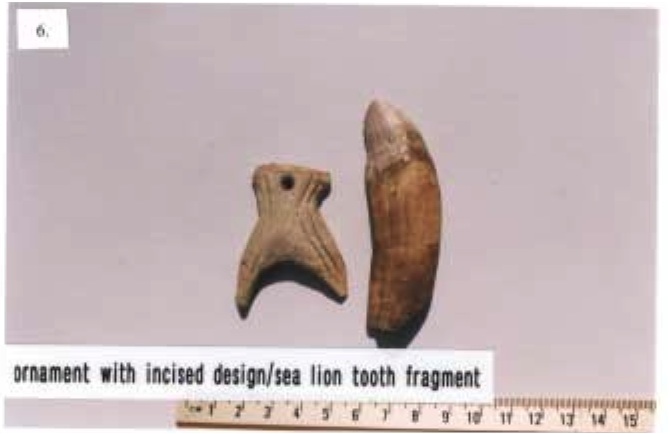
Decorated antler?, and a worked sea lion tooth from the Elchuk collection, Mill Hill.

I just came across this interesting document from 1999 by Liz Crocker (PDF) which is a cultural history of three CRD Parks: Mill Hill, Francis/King and Thetis Lake.  While I wouldn’t put a lot of stock in the archaeological component of this report, there are at least two notations of considerable interest.

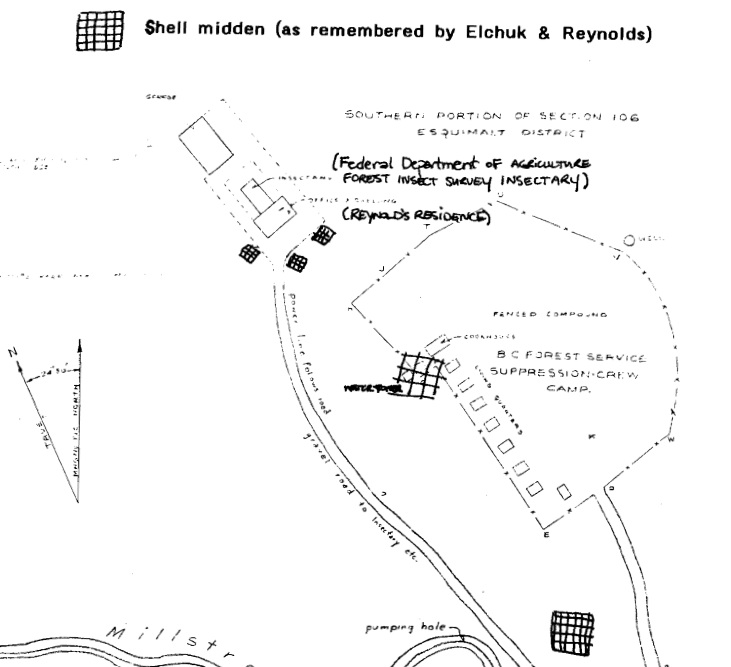
The first is the documentation of an unrecorded shell midden at Mill Hill, not DcRu-70 but another site, including a sketch map of the location which is about 2 to 3 kilometres inland.  There are also reports of unrecorded inland shell middens at Thetis Lake Park. Since such sites are rare and poorly know,  then this is something worth following up.  Indeed, I wish the CRD took their stewardship role seriously enough to commission an intensive, comprehensive, and professional inventory of the archaeological heritage of all their Parks.  This kind of baseline information is so essential that I honestly don’t understand how they think they can discharge their duties without it.

The other point of interest in Crocker’s report is the documentation of a fairly large private collection, also from Mill Hill and also well inland.  Included in this collection are Locarno-style artifacts as well as more recent ones such as a flat-topped handmaul.  Appendix 2 of the linked report includes some snapshots  of this collection.  Despite the poor quality, it is great to see private collections being documented.  The small decorative piece shown above is interesting and unusual, and the abundance of organic remains suggests again that these were collected from or near a shell midden.  Again, something to follow up. If only there were a Ph.D. student at UVIC, say, who was interested in inland shell middens…..

Sketch map of reported but unrecorded inland shell midden patches at Mill Hill.

Victoria-Songhees reburial

Mayor Fortin builds a bridge to the Songhees First Nation. Picture: Johnstonstreetbridge.org

Last summer there was a sad incident with human remains being disturbed in the Dallas Road area of Victoria. The remains, of a young SLENI (woman) were subsequently reburied and since then a burning ceremony has been held.  I’ve been privileged to attend burning and reburial ceremonies and they are powerful and sincere events.  Interesting then to see this news snippet today , focusing on the cost ($9,400) — I can hardly wait for the informed and balanced commentary to ensue.  But kudos to Dean Fortin for doing the right thing – it is no more (or less) than most developers have done over the last decade when human remains were disturbed.  I have to say, though, it is disingenous for Mayor Fortin to note the Songhees reserve is not in the City of Victoria — memo to the Mayor: Victoria is within Songhees territory; the remains are from Songhees territory, the current reserve boundaries are completely irrelevant to this issue.

Victoria News

The cost of being freindly [sic]

By Lisa Weighton – Victoria News

Published: January 11, 2010 3:00 PM

Updated: January 11, 2010 3:34 PM

Mayor Dean Fortin is making First Nations relations a priority.

Last month, the city invested $9,400 in a traditional reburial ceremony after discovering 300-year-old human bones during a sewer retrenching project on Dallas Road, Aug. 27.

“We feel like we have an obligation to work with all other levels of government including our First Nations,” said Fortin.

The cost was a drop in the bucket in the overall $2.4 million-project said Derk Wevers, the city’s sewer and storm water quality technician.

Following consultation with Esquimalt First Nation elder Mary Anne Thomas and Songhees First Nation elder Elmer George, a reburial service was held Dec. 8.

The city also financed a traditional burning ceremony and feast on the Songhees First Nation reserve late last month, which included wages for a city contractor, gifts, food and the gravestone.

Fortin said he was eager to take part despite the reserve not being within Victoria’s boundaries.

Gabriola Petroglyphs at Elaine Seavey’s blog

Anthropomorphic petroglyph on Gabriola Island. Note how the patina of the rock has been disturbed by tracing.

Gabriola Island has some of the most spectacular and important petroglyphs in the world — and unfortunately, they are just as threatened by developers and development pressures, as I have noted before.  Since these sites seem to not always matter as much as I think they should, it is nice to see an awestruck first person account by a person with no vested interest.  Why on earth would those who purport to love and respect Gabriola Island and  Snuneymuxw culture be so intent on diminishing this kind of experience?

Even so, I must comment on the destructive practice of rubbing, not so much through cloth but the scraping of the lines to remove weathering patina and lichen in order to take clearer photographs.  This is a very unfortunate practice which hastens the disintegration of the rock art.

Shipwrecks of Vancouver Island

The three-masted ship Carelmapu with decks awash, dragging her anchors into Schooner Cove, near Tofino, in 1915

The ‘Virtual Museum of Canada”  has been responsible for some nice online exhibits, although a lot of these are now fairly dated.  One with what we could call a “retro web design”, but some good content, is the Shipwrecks of Vancouver Island site, apparently put together mainly on the watch of the Maritime Museum of BC with help from the Underwater Archaeological Society of BC.  There are some nice videos of underwater archaeology, and other informative materials.

Site navigation, though, is much easier if you just go to the site map here — the absurdly finicky navigation does weird things like, say, means using the back button always takes you to a splash introduction screen — is a crime against the web.  Especially since museum people are involved: why such disdain for solid future-proof web design values?  This page, for example, has a nifty slider to scroll through an interactive map: but if you don’t pay attention (e.g., if you use your back button) you will always end up on a “loading XML – introduction to the database” overlay screen page which gets tired after about the third time.  The VMC should consider a legacy fund to make sure that the sites which they poured money into for a while can all be kept up to date for both content and also compliance or at least ease of use.  It would not surprise me in the slightest if the VMC had spent over $100,000 on this site — the one site of their I know something about they spent $140,000 and it is no flashier than this thing.  Almost all that money went into design and mounting of content, very little went to the content creators themselves.  If that  applied here, I think we have a right to expect more – is this site design worth $100,000?  It seems to me that, even in 2004, a competent web designer working alone, with content given by others, could have put this together in about a month.

Canadian Navy diver goes overboard in 1959 to examine the 1853 wreck of the Lord Western, near Flores Island.