Category Archives: Cultural Resource Management

NE BC Archaeology Videos

Click to play video.

Click on the picture above to see a short video of an archaeologist working with Nenan Dane-zaa elders and youth, near Fort St. John.  It’s a nice example of some community archaeology by an unidentified archaeologist who appears to go by the name “Frank”.

Of course the weather in Northeastern B.C. is not always so sunny and warm, and yet (as we discussed a few weeks ago) archaeology continues or even accelerates in the winter months.

Continue reading

More on the Sea-to-Sky Cultural Journey

Sign at the Horsehoe bay kiosk. Source: tad McIlwraith flickr.com account.

A month or two ago I commented on the Squamish and Lil’wat Cultural Journey website, which explores oral history and place names in the traditional territory of these two southwestern British Columbia First Nations.  I was really happy to see that Douglas College Anthropologist (and occasional commenter here) Dr. Tad McIlwraith has carried the review much further.  He’s even taken it into the field, so to speak, by documenting and discussing the actual cultural centre itself, and also the roadside kiosks which bring Squamish and Lil’wat histories to the travelling public.

Tad’s review has two parts.

Continue reading

Basket Conservation at the Langley Centennial Museum

N'laka'pamux Basket undergoing conservation treatment. Source: LangleyMueum.org

I know I occasionally grumble about how regional, publicly funded museums in B.C. are almost devoid of archaeological and aboriginal substance, especially on the web.  A happy exception to this is the Langley Centennial Museum near Vancouver, which has an unusual and interesting virtual exhibit of N’laka’pamux basketry.  The museum is in the possession of a large collection of these baskets, made by an interesting historical figure from the Yale-Lytton area of the Fraser River: one Kathleen Pearson. The exhibit consists of a number of pages, including a short essay (5 pages) which is strangely not clearly linked, based around Boas et al.’s 1928 Bureau of American Ethnology Publication.  The museum goes beyond the historical frame by discussing recent named weavers such as Mary Ann James, and the continuing tradition of N’laka’pamux basket making.

It is really great to see a relatively small museum explicitly recognizing that the world didn’t begin in 1846 and going beyond the story of white settlers as if they were a self contained pod of culture beamed down from Queen Victoria’s forehead.  The other thing  I particularly like about this small web exhibit is that the museum highlights the activities of another group of unsung heroes in the world of heritage conservation: the conservators who restore, stabilize and protect the artifacts entrusted to museums.

Continue reading

CRM problem at Englishman River

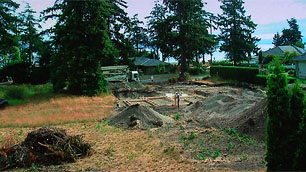
Excavation of house foundations at Englishman River. Source: CBC

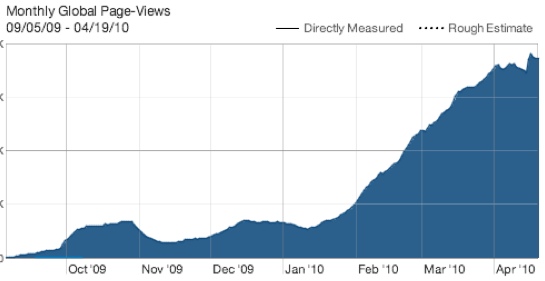
Hmm, I just noticed today is the first anniversary of this blog.  Mind you, it was a slow and intermittent affair at first but with more regular posting has come steady increase in readership.

But you know who else had a birthday on April 20th?

With that in mind, what better way to celebrate than by checking out the firestorm brewing on the Englishman River, where some landowners, perhaps wilfully ignorant, have had an unfortunate series of events transpire regarding an archaeological site on their property. The Archaeology Branch has responded to the story with a terse memo.

A little background to start:

All archaeological sites in B.C. dating to before 1846 A.D. are protected under the Heritage Conservation Act.  This is true whether or not they are known to the Archaeology Branch or unknown and unrecorded.  In some ways, then, it is not relevant that the site under these people’s house was first recorded, I am told, in 1975.  Even if it was first discovered by the application of a backhoe in April 2010, it would be accorded the same protection under the law. The fact that the landowners claim to have not known about the site until recently is an interesting issue that does not really materially affect the facts of this case. And, under the standard procedures in place, they are indeed responsible for paying the costs of the archaeological investigations, in this case reported to be $35,000.  Whether or not they have the money also doesn’t affect the facts of the case – incidentally, these people who self-portray as poor and unemployed are finding archaeology because they are building a new house on their property, which must be costing them several hundred thousand dollars.

So, these facts may not actually alter the legal responsibilities, but they do however very strongly affect the way this issue is seen to be unfolding.

Continue reading

Sealaska Heritage Institute Blog

Stone artifact recently donated to the Sealaska Heritage Institute Special Collections. Source: SHI.

Sealaska Heritage Institute (SHI) is a regional Native nonprofit organization founded for the Tlingit, Haida and Tsimshian people of Southeast Alaska. SHI was established in 1981 by Sealaska Corp., a for-profit company formed under the Alaska Native Claims Settlement Act (ANCSA). SHI, formerly Sealaska Heritage Foundation, administers Sealaska Corp.’s cultural and educational programs.

I know this because I got linked the other day by SHI’s Special Collections Research Center Blog, which I hadn’t seen before.  While not updated as frequently as this corner of the internavel is, it contains a lot of great posts going back to 2007 – you can see links to their archives down on the lower right hand side of their front page.

The most recent post concerns the artifact shown above.  It looks to my eye like a, possibly unfinished, hand maul. They seem a little uncertain about the function though, so someone should go over to their site and give some opinions – they take comments.  People with dirty minds are excluded from this request.

Continue reading

Bears, Humans and Deer: disambiguation at last.

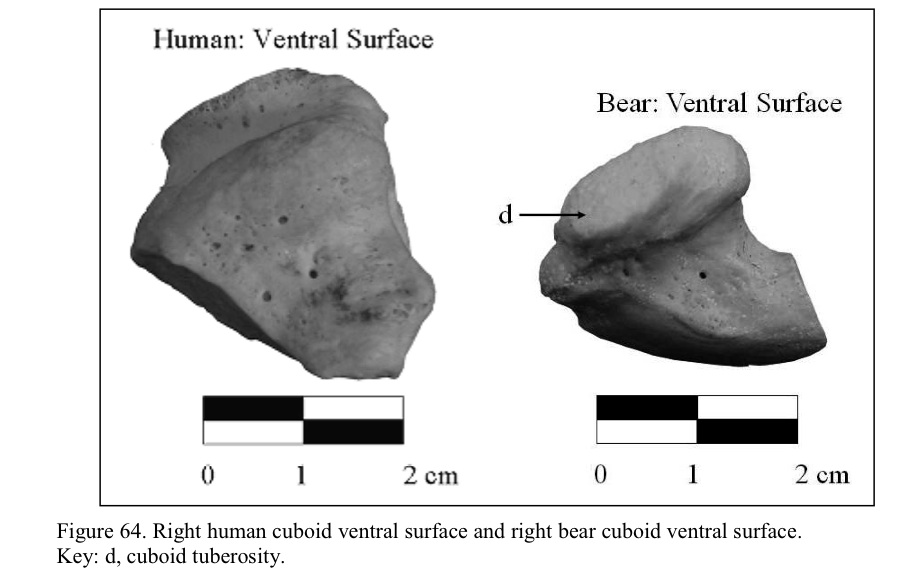
Human and Bear cuboid bones compared. Source: Smart 2009.

Some graduate theses are clearly meant to be both a research excercise and produce a demonstrably useful document.  I’m not saying these are any better than any other kind of thesis, but they do have an aura of public service and virtue about them.  The best example of these which I have seen recently is Tamela Smart’s 2009  Carpals and tarsals of mule deer, black bear and human: an osteology guide for the archaeologist.  If you click here it will start an automatic download of the 3.7 meg PDF from Western Washington University (unfortunately, no way to link to a download page).  (edit: try this link instead)

The premise of this research is that despite obvious differences on the outside, there are surprising similarities between the hand/wrist and ankle/foot bones (carpals and tarsals) of bears, deer, and humans.

Continue reading

Montana Creek Fish Trap, Alaska

Montana Creek Fishtrap being excavated, 1989. Source: Sealaska

In 1989 a nearly complete fish trap was found in Montana Creek, near Juneau Alaska in Aak’w Kwáan Tlingit territory. The cylindrical trap, measuring 3 metres long and 1 metre in diameter, was excavated and found to date to about 600 years ago.  The trap was preliminarily reported in Kathryn Bernick’s 1998 book Hidden Dimensions (UBC Press).  Fishtraps were supported by wood and/or stone weir structures which also  act to direct fish into the trap.  The trap would be removed at the end of each season and stored nearby or at camp.  Of course, being wood, they intrinsically don’t preserve very well except in anaerobic and wet conditions.  They are therefore rather rare since they would need to be left in the creek after use in order to preserve.  So this one is very unusual, and especially so since it was essentially complete (other than being flattened).  All credit to the finder, Paul Kissner, for being alert, recognizing the trap, and reporting it promptly.

But now, the fishtrap has become very much a living object.

Continue reading

Northwest Research Obsidian Studies Lab

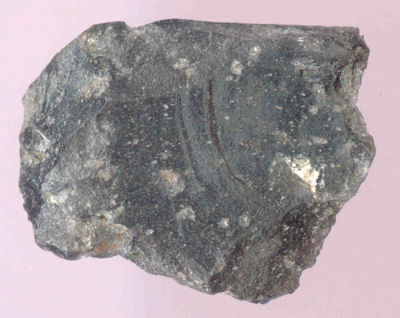
A flake of obsidian from DhRr-18, southern British Columbia. This visually-distinctive glass is from the Mount Garibaldi obsidian source.

Obsidian is a kind of volcanic glass and was highly prized for making certain kinds of stone tools.  Obsidian forms at places of relatively small outflows of magma, or liquid rock.  Small flows can cool quickly, which allows the formation of a glassy crystalline structure ideal for stone tool manufacture.  Small flows also represent a small sample of well-mixed magma, and thus each little patch of obsidian may share a very distinctive chemical signature.  This signature, usually identified by trace elements such as Strontium, Zirconium, Yttrium and Rubidium, then allows for the chemical fingerprinting of each source.  Any obsidian artifact found, whether at a source or not, can also be “fingerprinted” and then compared to a catalogue of known obsidian ources.  Since the artifacts don’t move around on their own but only through the agency of humans, the distribution of obsidian artifacts is a proxy measure for the movement and interaction of people.  When you have hundreds or thousands of such artifacts and a large database of known sources, then you can start to see large scale, long-term social interaction emerge from the silent archaeological record.  Most obsidian isn’t visually distinctive enough to sort out by eye alone, so these geochemical methods are essential.

So far, so Archaeology 101.  I was really happy to find that Oregon’s Northwest Research Obsidian Studies Laboratory has a web site not which not only solicits business, but is a highly educational and informative site about many aspects of obsidian analysis, with a focus on the Northwest. Continue reading

Thoughts on a WSU Archaeological Perspective

Pioneering WSU archaeologist Richard Daugherty instructs students on the beach at Ozette, late 1960s. Source: WSU.

Washington State University (WSU) has one of the oldest and most notable programs in Northwestern North American archaeology, with pioneers such as Richard Daugherty and William Ackerman leading the way.  The WSU magazine has a nice interview with a number of their distinguished alumni and faculty, including William Andrefsky, Dale Croes, Colin Grier, and Gary Wessen.  There are some interesting quotes in it, notably, to my mind – and perhaps yours, if you are a university nerd like me: Continue reading

Alaskan Ice Patches

Barbed bone or antler point with copper tip from Alaskan Ice Patch. Source: Dixon, NPS

All over  Northwestern North America, from Colorado to the NWT, global climate change is rapidly melting glaciers, and their less mobile cousins, permanent patches of ice which accumulate and never completely melt.  Some finds from these ice patches have revealed exceptionally-preserved organic technology dating from recent times to more than 8,000 calendar years ago.  Additionally, of course, there is the remarkable story of Kwädąy Dän Ts’ìnchį, Long-Ago Person Found, a man who died on a glacier in the Tatsenshini area hundreds of years ago.  All of these would make good posts for the future!

For today, though, I found an article online (PDF) about the lesser known Alaskan ice patches, which have been researched primarily by E. James Dixon.  Continue reading