Category Archives: anthropology

Speaking of Wilson Duff and Bill Reid

Roy Jones of Skidegate climbs a pole at SGang Gwaay. Source: CBC.

Yesterday I noted the upcoming musical about the Bill Reid-Wilson Duff expedition to “rescue” carved poles at the Haida Village of SGang Gwaay (Ninstints).  I’ve just found that the CBC has posted online a short documentary, (2013:edit, use this link)  first broadcast in 1959 and narrated by Bill Reid, showing the removal of these poles to the Museum of Anthropology at UVIC.  The expedition also included Wayne Suttles and Michael Kew, as well as Wilson Duff of course.  The Haida crew consisted of Roy Jones, Clarence Jones and Frank Jones of Skidegate. Some aspects of the trip are recounted in the BC Provincial Museum Annual Report of 1957, which I will scan and post some other day.

The spoken component of the documentary is a fascinating account by Reid, at that time just beginning his carving career, but the real jaw-dropping element is the depiction of the use of axes and saws and climbing spikes to log this forest of poles.  Necessary, of course, but jarring nonetheless.

Broadcast Date: May 21, 1959

A small boat ferrying Bill Reid and a team of anthropologists approaches the southern tip of the Queen Charlotte Islands. Reid documents the rescue mission to salvage and relocate the last of the crumbling Haida totems as revealed in this CBC documentary. With a sense of excited urgency, Reid describes and catalogues the enormous poles on the approaching shore. As they are gently felled, the majestic cultural landmarks will creak and groan before they are prepared for transport.

It’s low resolution and grainy, but the general impression is a very powerful one.

Felling a tree, surely, not a pole at SGang Gwaay. Source: CBC.

Upcoming musical about Wilson Duff (!)

John Mann of Spirit of the West in "Beyond Eden"

I can hardly believe this, but the Vancouver Playhouse is mounting a new musical based on an event familiar to to all students of archaeology and anthropology n BC.  The musical stars John Mann from the band Spirit of the West.  From Tom Hawthorn’s blog:

Written by Bruce Ruddell with musical direction by Bill Henderson, formerly of Chilliwack, the musical premieres on Jan. 16 at the Vancouver Playhouse. The musical is based on a 1957 expedition to the Queen Charlotte Islands by the archeologist Wilson Duff and his Haida friend, the artist Bill Reid.

Mr. Mann portrays a character based on the archaeologist, a man who travelled to Haida Gwaii to preserve totem poles, which he bought for $50 each. These can now be seen at the Royal B.C. Museum in Victoria and the Museum of Anthropology in Vancouver.

“Off the top he believes his job is to keep those poles alive because you can learn from them,” Mr. Mann said. “If they rot, they’re lost, they’re gone forever. No one will be able to study them.

“In the course of those three days, his mind is changed. Then all hell breaks loose.”

This is remarkable and interesting on a number of levels.   I’d love to see it.

Wilson Duff was one of the first modern Anthropologists and Archaeologists to work in British Columbia and it seems he had just got started when he died by his own hand in 1976, at the age of 51.

Haida Archaeology at the Virtual Museum of Canada

Rodney Brown at the Cohoe Creek Site, 1998. Source: CHIN.

The Canadian Heritage Information Network (the venerable CHIN) has, via the Virtual Museum of Canada,  a small online exhibit of Haida Gwaii archaeology posted.

I hate to be all grumpy since such initiatives should be supported, but seriously – the problems with this exhibit are manifold.  First, a number of the facts are wrong, despite the content being copyrighted 2009.  They use a figure of 9,000 years for first occupation, not the figure of 12,500 which is more reasonable.  That’s more than a 30% difference.  They state it was a grassland 10,000 years ago, when the better number would be 14,000 or more. It’s written in the first person, so apparently a Haida person wrote it – but really should that be an excuse? Maybe the details don’t really matter.

So, factual errors are unfortunate.  But they also have completely crap illustrations – low resolution, poorly lit images from ethnological collections are used to represent the archaeological record.  This is misleading on a number of levels.  Archaeologists do not usually find beautifully decorated clubs, for example, and it diminishes understanding of the archaeological record and process to imply they do. Indeed, the text of the exhibit lists the following “learning outcomes:

Learning Objectives

The learner will:

  • Describe the history of Haida people revealed by archeology
  • Describe some Haida objects found in archeological excavations

As far as I can tell, not a single object “found in archaeological excavation” is shown and essentially no archaeological facts are given.

Also, all the pages, including “Haida Society since European Contact” are under the header of “Haida Ecology” which is a bit unfortunate.  Put the whole thing under “Haida history”.

It’s also regrettable that the pictures are of such poor quality, like this one of fish hooks.  I mean, this is a national institution, and the year of the web is 2009, not 1995.  People expect more and will tune out if you don’t offer them some substantial eye candy.  I think they have a right to receive it from the Ottawa heritage establishment – after all the NMC is sitting on a superb collection that most of us never get to see.

Finally, the information content is miniscule.  The whole thing can’t add up to more than 500 words and is cluttered with jargon like “Print this Learning Object” and “View the complete asset”.  What kind of robotic geek came up with that sort of bullshit management-speak? And every bit of this information has a copyright notice on it, even pictures from other institutions.  This page has SEVEN separate, identical copyright notices “© 2009, CHIN-Canadian Heritage Information Network. All Rights Reserved.”

Memo to CHIN and the VMC:  no one wants to copy your minimalist, factually incorrect and low-resolution information anyway.  If you can’t do decent eye candy then do decent information.  If you can’t do either, then don’t try to bully me with copyright notices.

C’mon guys, you can do so much better than this, especially if your goal is to educate.  Email me, I’ll send you some pictures and fact-check your page.  No fancy consultancy charge will apply!

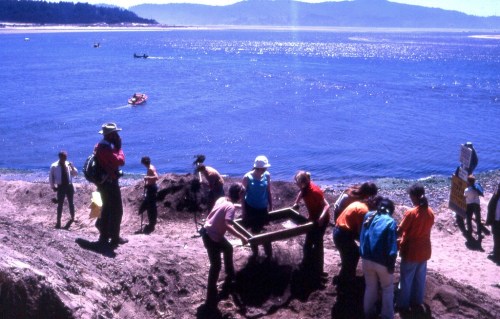
I just noticed this was NW Coast Archaeology blog post #100. To counteract this being so grumpy, here's a nice picture of camp life on Tanu Island.

Videos of Gwaii Haanas Archaeology

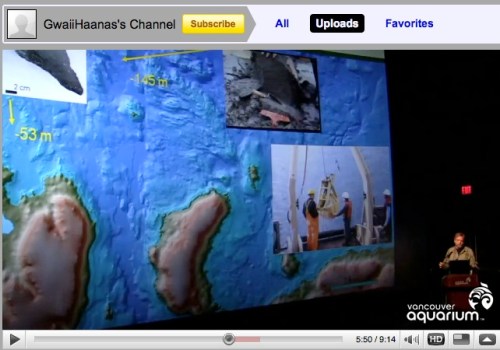
Daryl braves the barrage of bras to set the Vancouver Aquarium straight on the value of dead fish over living fish. Click to play part 1.

Rockwash superstars Nicole and Daryl show off their cool wares in a couple of videos I just found online – I vaguely remember them going off to give this talk at the Vancouver Aquarium.  It’s in two parts: 1 and 2.  Nicole looks fabulous and Daryl has trimmed his beard!  Win-Win.  The projects they describe sure were a lot of fun to take part in.   There are a few other talks up including Lyle Dick and Norm Sloan on Sea Otters on the Gwaii Haanas Youtube Channel.

A sandhill crane is a tough act fo follow but Nicole hammers home the righteous message of dead fish. Click to play part 2.

Archaeology in Action: a flickr.com photo pool

Archaeologists? No -- "Pothunters" destroying a site on the Columbia River, ca. 1966. Source: flickr user gbaku.

Archaeology in Action is a large set of pictures of archaeologists doing archaeology on the photo sharing website flickr.com.  Not too much Northwest Stuff there that I could find with the notable exception of many pictures put up by a former University of Oregon professor under the name of gbaku (you can find his real name easily enough).  His pictures are a wonderful tour of Oregon and Alaskan archaeology of the 1960s and 1970s – these are not sets of pictures of stratigraphy, or backdirt (interesting though those things are) but are predominately of, well, archaeologists in action.  It would be fun to see more NW Coast pictures up here — I know Grant has a large collection of pictures of archaeologists going about their business and I am sure we all have some pictures of people in with the endless pictures of yet another bone.

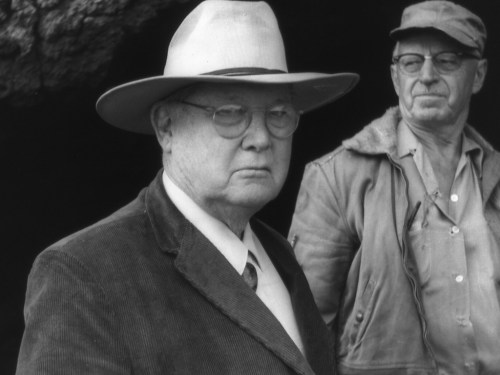
Erle Stanley Gardner, the author of the Perry Mason mysteries and many other books, and Luther Cressman, pioneering archaeologist and ex-husband of Margaret Mead, at Fort Rock Cave in 1966.

Society of Ethnobiology Conference: Coming to Victoria

Top notches in a standing western red cedar tree, the result of extracting one or more planks.

Dana sent me a note that the 33rd annual meeting of the Society of Ethnobiology “The Meeting Place: Integrating Ethnobiological Knowledge”, will be held 5–8 May, 2010, in Victoria.I believe some “rockwashy” types are helping out with the organization.  It sounds like a great conference and a chance to build networks between plant people and rock people and bone people – and we sure do need a lot more archaeology of plants out here on the NW Coast, where bones and stones still rule the day.

This year’s conference theme celebrates the potential of ethnobiology to bridge disciplines, ideas, and communities, and to foster an understanding of the connections between the biological and cultural worlds.

In addition to our usual dazzling line up of papers and sessions, here’s a preview of some of the other special events:

  • Wednesday night welcome reception in the First Nations gallery at the Royal British Columbia Museum
  • Special discussion sessions on: Teaching science through ethnobiology, Ethnobiology and ethics, Communicating environmental knowledge through media, Indigenous people’s food systems, and more!
  • Thursday night poster reception at the just opened First People’s House at the University of Victoria
  • Six! fabulous field trip options
  • A banquet of traditional B.C. First Nation’s food followed by a presentation of the Atla’kima “Spirits of the Forest” dance by Kwakwaka’wakw Longhouse dancers

This year’s meetings will be back-to-back with the International Society of Ethnobiology congress in nearby Tofino, B.C., May 9–14.

Haida Gwaii is now just Haida Gwaii

a.k.a., The-Islands-Coming-Out-Of-Concealment.

The thinnest possible news report from the Times-Colonist says that the BC Government will now use “Haida Gwaii” in all official contexts, rather than “The Queen Charlotte Islands”.  Presumably this means it will be changed in the official BC Gazetteer but so far it shows no such change this calendar year.  More from the Globe and Mail:

“The change is a very important symbolic gesture,” said Guujaaw, president of the Haida Nation. (Guujaaw goes by one name.) “That’s the land that gave us our life and culture. It’s the proper name.”

Robert Finch, chief executive officer of the Monarchist League of Canada, said he was surprised and disappointed by the B.C. government’s decision. “They assume that they’re doing a good thing, but they’re erasing a very big part of Canada’s heritage.”

I wonder if Robert Finch has even the faintest idea of how clueless he sounds, how arrogant and absurd and, frankly, irrelevant.  Maybe if he spent more time thinking about the Crown’s broken promises to aboriginal people he would be less likely to spout such verbal tripe.

Anyway, this will simplify journal articles, where it will no longer be necessary to footnote the name “Queen Charlotte Islands” or refer to “locally known as Haida Gwaii and henceforth referred to thusly”.  Meanwhile, enjoy the picture above: coming home through north Juan Perez Sound.

Raven-Walking & Geological Transformation

Haida History starts at least 14,500 years ago. (Image credit: Daryl Fedje).

Three things we know about Haida Gwaii:

1.  About 14,500 calendar years ago it was a temperate tundra environment, with no trees.  The first trees, pine, appear about 14,000 years ago and there is progressive forest infilling thereafter, with the modern species mixture in place by about 3,000 years ago.

2. It has an impoverished suite of large land mammals – historically, these were limited to black bear, caribou, marten, ermine, a vole and a shrew.  We know that 13,000 years ago there were also deer and brown bear on the islands, and quite likely other species as well.

3.  It used to be much larger than in the present.  With lower sea levels at the end of the last ice age, Hecate Strait was largely dry land, exposing a large, unglaciated, coastal plain that became rapidly flooded.

It seems to me that we can add a fourth thing we know:

Continue reading

Northwest Anthropology Conference: NWAC 2010

The web site for NWAC 2010, to be hosted at Central Washington University March 24 – 27, 2010 in Ellensburg, Washington,  is up and running.  NWAC is a great conference which we were lucky to host in Victoria a couple of years ago.  In case you are wondering where Ellensburg is (no offence), it’s just to the east of the Cascades from Seattle, north of Yakima, about a 350 km drive from Victoria: map.

The theme of this year’s conference is the very welcome “At a Crossroads”:

Anthropology at the Crossroads” is the theme for the Northwest Anthropology Conference (NWAC), Ellensburg, Washington, March 24 – 27, 2010. While all submissions will be considered, this conference will offer opportunities for multiple perspectives on where we are as a discipline, society, and species, with a special emphasis on people and the environment. The “Anthropology at the Crossroads” conference will include symposia and presentations on subjects from archaeology, cultural and linguistic anthropology, paleoanthropology, primatology, medical anthropology, visual anthropology, and others. We invite submitters to use their own preposition in describing their presentation/symposia as “Anthropology at/of/on/etc the Crossroads.” Studying the past, understanding the present, and preparing for the future, makes Anthropology even more relevant today as the discipline continues to assert the importance of an appreciation for culturally diverse modes of interacting with our environment. Thus, this conference is a crossroads where the exchange of ideas better prepares us, our students, and our work to serve the communities we live in as we maintain our commitment to exchanging and transmitting our under-standings of all people, in all places, and at all times. “Anthropology at the Crossroads” also implies interaction among sub-disciplines and communities in an integrated fashion and in this manner encourages self reflection on the relevance of Anthropology today at a moment when we appear to be at several global crossroads.

Chief Thunder Voice

Bing Crosby being invested as Squamish Chief Thunder Voice.

In 1948, Bing Crosby, then a first-rank international star, visited Vancouver – and ended up being invested as Squamish Chief Thunder Voice, among other civic performances.  The Vancouver City Archives has the video (1.00 minute in).

By the way, what is up with coastal First Nations adopting feather war bonnets?  Is this a kind of weird double reverse emulation: trying to look more stereotypically Chiefly in the eyes of the majority population?  Is it intra-aboriginal cultural appropriation?  Or do they just look freakin’ awesome?  Note the tomahawk as well in the picture above.  Someone should write a paper on “Plains Paraphernalia as  Signifiers of Rank on the Historic Northwest Coast”.  Or maybe they have, already.  I’d read it.