Monthly Archives: April 2010

A Stillaguamish River Canoe

Roughly dressed block of cedar in preparation for carving. Source: flickr.com

The Stillaguamish Tribe live along the Stillaguamish River basin (map) of Northwestern Washington State.  They are a tribe which missed out on any reservation land in the 1850s and have struggled somewhat at times to maintain cultural identity as a diaspora.  Regaining Federal Status in 1976 was important to the tribe of about 200 members, as was 2009’s first “First Salmon” ceremonies in a generation.

An interesting and encouraging development seems to be the recent carving of the first Stillaguamish river canoe in a century.  While the larger dugout canoes (still being carved) of the outer coast nations, such as the Haida and Nuu-chah-nulth, are better known emblems of the Northwest Coast as a whole, these river canoes were equally important to the inland waterway and riverine nations of the Fraser Valley and Puget Sound.

According to an informative and well-written article in the Everett HeraldNet, the story starts with an interesting origin of the cedar log itself.

Continue reading

No Guts No Glory

Chuckchu women inflating walrus intestines, 1917. Source: ADA

I’ve linked before to Tim Rast’s excellent blog ‘Elfshot’, which chronicles his work in Newfoundland, making replications and experimental archaeology for love, and money. Or, as he puts it, “Making a living as a 21st Century Flintknapper.” You can buy some of his superb work here and also browse part of his impressive back-catalogue of reproductions here.

Recently Tim has been going beyond the call of duty with a fantastic series of detailed, superbly illustrated (for the strong of stomach – photos and videos) on preparing the hide of a hooded seal, and the associated fun of processing its intestines for technological projects.  I urge you to go read them in their entirety over at his blog.

Seal intestines were, of course useful for any number of tasks.

Continue reading

Aboriginal Bridges of Northwestern B.C.

Bridge at Hagwilget, 1881. Source: B.C. Archives.

I don’t know that much about the “Living Landscapes” program, which includes a series of small web exhibits.  While related to the Royal B.C. Museum in Victoria, and covered by their insane legal language (see below), they seem to have outsourced the actual expertise to non-RBCM people.  Not that surprising, really, since they have hardly any in-house expertise left after decades of cuts!  But all credit to them for their role in the informative series, even if the program is now (2006) finished with nothing for Vancouver Island.

I’ll probably review a few of these pages, but for now the exhibit which caught my eye, mainly because of its cool illustrations, is the one of Aboriginal Bridges of Northwestern B.C. The author, Brenda Guernsey, has put together a great set of images from various public archives to illustrate these amazing features.

Continue reading

Waatch River: a raised beach site on the Olympic Peninsula

View from West up Waatch River Valley to Neah Bay; Vancouver Island in the distance. Source: Panoramio user Sam Beebe.

The Waatch River flows in a low valley that connects Neah Bay across the Olympic Peninsula to Makah Bay.  When sea levels were higher, it would flood with sea water and turn Cape Flattery into an island.  Interesting, then, to see that an old raised beach site has been found on the Waatch River at an elevation of about 13 metres above, and 2 km away from, the modern shoreline.

Continue reading

Historic Maps and Dioramas of Victoria and Environs

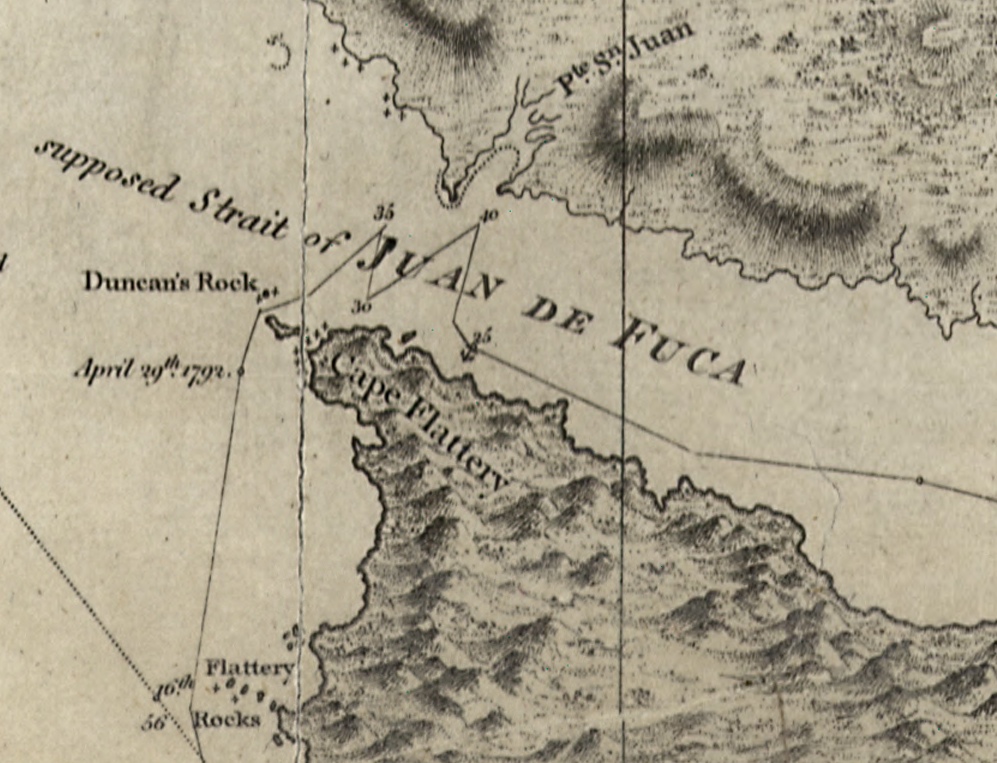
Detail of Capt. Vancouver's 1792 chart showing the "supposed strait of Juan de Fuca". Source: viHistory

vihistory is a web site designed to aid in historical research of Vancouver Island, at which it succeeds admirably.  You should poke around and have fun with their census data and the other worthy, if dreary, pursuits it affords the serious scholar.

One feature which is not immediately clear on first glance, perhaps deliberately as has entertainment potential, is a large selection of very high-resolution maps and images which you can download from this page. The file sizes are large, of course, but increasingly that is less of an obstacle in the past.  The maps are mostly of historic Victoria, but there are some regional maps such as telegraph and lighthouse maps of British Columbia, and a couple of maps of Nanaimo.  As usual, I have surfed through the maps so you don’t have to – and some of them are remarkably fun, and informative.

Continue reading

Bears, Humans and Deer: disambiguation at last.

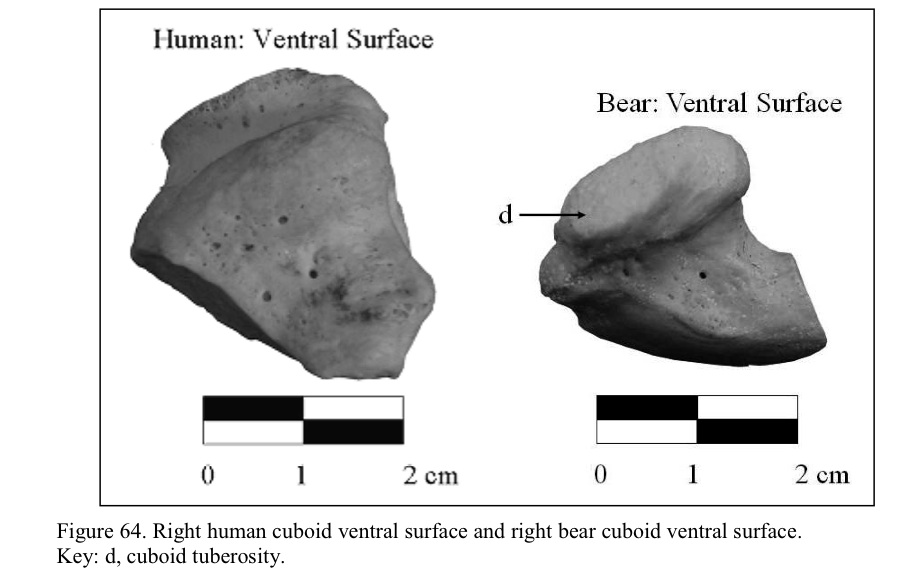
Human and Bear cuboid bones compared. Source: Smart 2009.

Some graduate theses are clearly meant to be both a research excercise and produce a demonstrably useful document.  I’m not saying these are any better than any other kind of thesis, but they do have an aura of public service and virtue about them.  The best example of these which I have seen recently is Tamela Smart’s 2009  Carpals and tarsals of mule deer, black bear and human: an osteology guide for the archaeologist.  If you click here it will start an automatic download of the 3.7 meg PDF from Western Washington University (unfortunately, no way to link to a download page).  (edit: try this link instead)

The premise of this research is that despite obvious differences on the outside, there are surprising similarities between the hand/wrist and ankle/foot bones (carpals and tarsals) of bears, deer, and humans.

Continue reading

Peabody Museum Ethnographic Collection

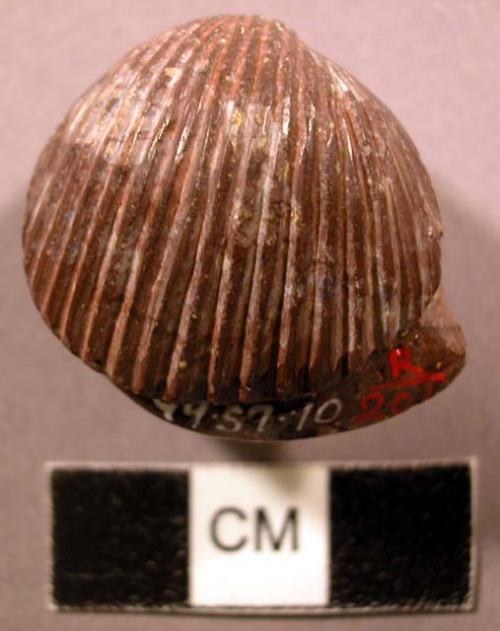
Haida carved cockle. Source: Peabody.

The Peabody Museum at Harvard has a predictably great collection from the Northwest Coast.  I’m more drawn to the archaeological-type artifacts vs. the masks and baskets and argillite, but fill your eyes with the charming Haida carving of a cockle, above, collected in “Massett Bay”.

One nice thing about this collection is the accession ledger is also scanned in and made available.  For example, if you go the the page for the cockle above here, you can click on the cockle picture for a higher resolution, on the first ledger page for the left hand side of the ledger book, and on the second for the right hand side.  It is possible in this way to do some ad hoc fact checking of their descriptions to finding additional information. For example, the cockle’s second page contains the notation “taken from the interior of R/200”.  Accession number R/200 turns out to be this unusual ?argillite carved box with inlaid shell.

Some of the other objects are equally unusual – I’d say there are more “wow – never seen one of those before” moments in this collection than any other I have seen.

Continue reading

BBC: History of the World in 100 Objects

Detail of a Clovis point from British Museum. Source: BBC.

The BBC is producing a series of 100 “podcasts” which explores the history of the world through the lens of 100 different objects.  Each episode is about 15 minutes long, and while you can subscribe to the series for your iPod or on iTunes, you can also listen to each episode individually on the web: thirty of the planned one hundred episodes are now available.

One interesting episode focuses on the Clovis Point.  They mainly give weight to a Clovis First model of the first peopling of the Americas (including a bizarre quote from Gary Haynes to the effect that yes, there is older material than Clovis but nonetheless Clovis is first), but they do also offer an indigenous perspective which is unusual.

Continue reading

Intertidal Footprints

6,000 year old human footprint from intertidal sediments near Liverpool. Source: http://www.eyes-and-ears.co.uk

I know of three sites in the world where human footprints more than 5,000 years old are preserved in the intertidal zone: one in Northwestern England, and two in Southeastern Argentina.   These are exceptionally fragile sites – the English ones are often only visible for a single tide cycle.  All three sites find humans co-occurring with other species – Aurochs, canids, birds in England, and a large variety of fauna in Argentina, including extinct megafauna such as giant ground sloths (in both bipedal and quadruped mode) and glyptodonts (a sort of giant armadillo) among other species.  The prints range from single impressions to the trails of individuals walking or running, to clusters of several hundred distinct prints of all ages, to the distinctive prints of playful, gambolling children.

Continue reading

Yuungnaqpiallerput: Yup’ik Science and Survival

Inflating the stomach of a beluga whale. Source: Yupikscience.org

Yuungnaqpiallerput (The Way We Genuinely Live): Masterworks of Yup’ik Science and Survival” is a fascinating and informative (and large!) website companion to a 2008 exhibition by the same name at the Anchorage MuseumBooks and catalogues are also available and look to be excellent.

I know that Yup’ik territory, on the southern flanks of the Bering Straits, is a long way from the Northwest Coast.  But there are many similarities in the ingenious tricks and tools of the trade needed for a maritime lifestyle, and this exhibition deftly combines historical, archaeological and ethnographic accounts into a compelling vision of people at ease on land and sea.

.

Continue reading