Monthly Archives: February 2010

Hoko River pictures are back

Hoko River project director Dale Croes, apparently wearing chaps, at the site in 1977.

(Edit 2018 October: look here for current location of these pictures)

Some time ago I pointed readers to the vast repository of Hoko River wet site excavation pictures put online by Dale Croes.  Unfortunately, those links broke but now, via  blog reader APM, I hear that the Hoko photo gallery is back online.  I will definitely be mining this repository for lots of posts.  Not only is this one of the most interesting sites ever excavated on the Northwest Coast, the pictures are a superb combination of excavation, artifact, and camp life – the latter a visual record of local archaeology as social practice in the 1970s. Also, as I mentioned previously, the lush, rich colour of the old Kodachrome slide film is stunning – you just don’t see that in modern digital cameras or even print film, despite the undeniable advantages of digital.

From the main page, many of the most interesting pictures are found under the “camp life” link.  There you will be confronted with an awkward frames-based link layout.  Not all links work still, but I’d say 90% do.  You can browse easily by clicking on the pictures that open on the right-hand frame to get the next picture.  This is easier than keeping the mouse centred on the picture number to the left.  Right click on the picture to bring it up in its own window or tab.  Some pages are organized as thumbnails, such as the wet site stratigraphy series. Because of the slightly awkward interface, I’ll aim to create a series of posts here which point to what I think are interesting aspects of this wonderful site.

Richard Daugherty and survey crew evaluate potential of Hoko Site in 1967 in WSU research vessel.
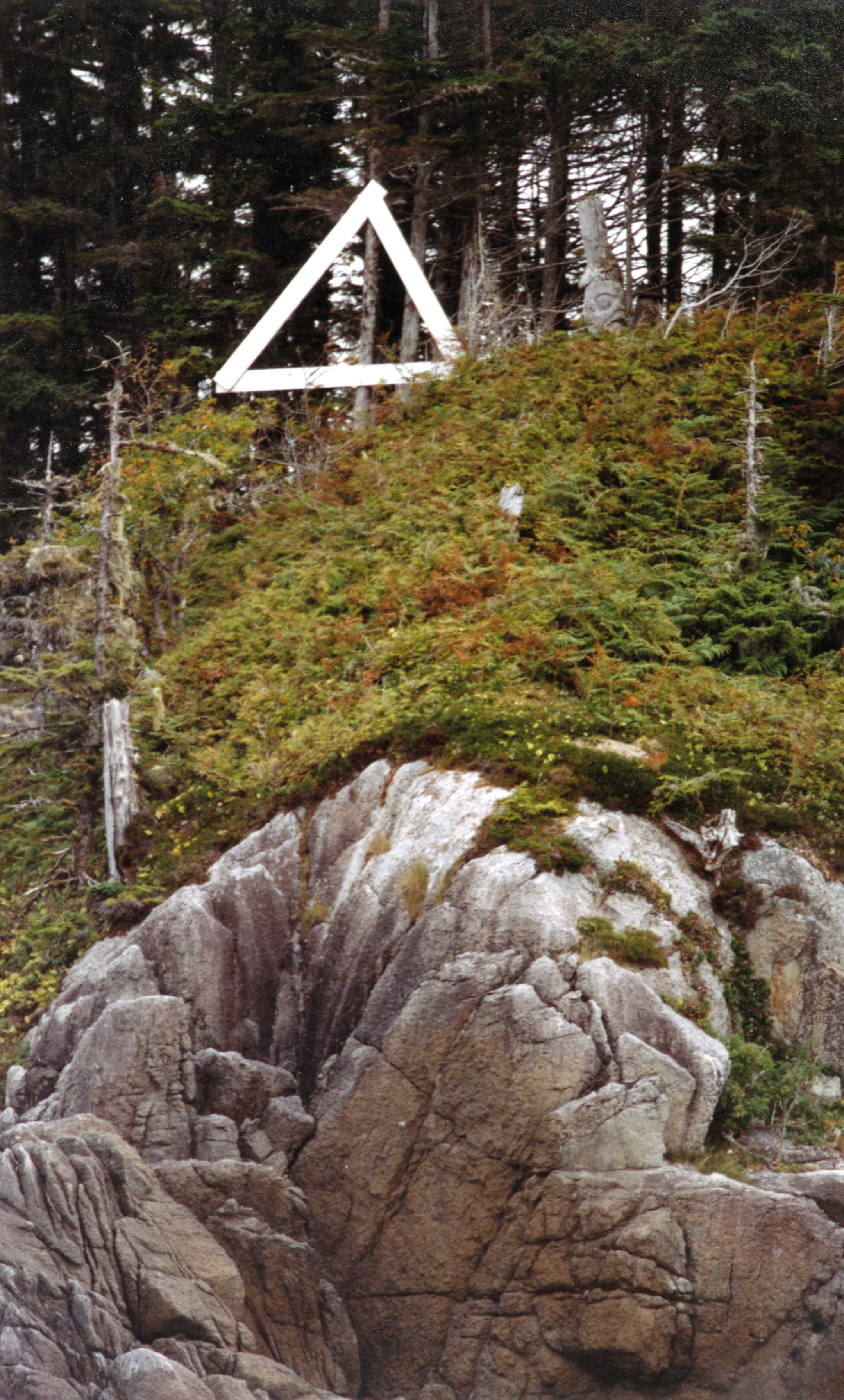
Boundary Maintenance

Headland with wooden markers. Click to zoom.

This is one of my favourite pictures of B.C. Archaeology, even though  it doesn’t look like much.  It’s a bit fuzzy: I took it with a zoom lens in about 1985 , rounding a headland in a small boat  on the Central Coast.  In fact, you might think it doesn’t look all that archaeological.  Look closer: sticking up to the right of the white triangle you can see the carved head of a pole.

The white triangle is a standard device used by Fisheries to demarcate the different fishing zones on the coast, for management purposes.  On one side of the triangle there might be different catch limits or closures or seasons of harvest enforced than on the other.

I don’t know much about the pole, but its location on such a prominent headland, facing the open Pacific, next stop Japan, is suggestive it marked a change of territory, a boundary shift, a movement from the control of one lineage or house to another. You don’t often see such a pole away from a village site.

Both wooden markers may ultimately serve the same purpose: boundary maintenance between zones of control; advertisements for power; watchful symbols of formal rights; the means of resource management.  It is intriguing and almost poetic to see them standing, side by side, on the same headland, guarding the same water.

Detail of wooden markers.

Adawkhl Gitsegulka

Gitsegulka ca. 1909. Source: Adawhkl Gitsegulka.

Yesterday, while posting CanadaGood’s flickr set of “totem poles” I found a really interesting document at the web site of the Gitsegulka community of the Gitxsan First Nation on the Skeena River.  Called Adawkhl Gitsegulka, it is a history of the settlement written in 1979, by band members via consultation with hereditary chiefs.  So often we only see these historical pamphlets for settler communities; it is quite fun and interesting and a little bit sad to read through this one written by First Nations themselves.  For example, note how (page 7) the Indian Agent in 1909 respects the hierarchies of the hereditary chiefs, apparently only in order to establish himself as the highest ranking of the lot.  Scroll down to page 35 for a discussion of the motives and means of carving poles.

There is an interesting theme which runs through the whole document: the uneasy relationship between the deeply felt Christianity of many Gitsegulka Gitxsan, and the old ways and practices.  In its informal way, through consultation with numerous elders, with charming illustrations, the Adawkhl Gitsegulka is an intriguing source of information on how the community saw itself in the transformative years of the late 1970s, when land and title claims were once again rising.  Five years on, they were in court claiming rights and title to their territory, and not much more than 10 years later, the landmark, borderline racist, “McEachern decision” of the BC Supreme Court would be handed down (the Gitxsan-Wet’suwet’en case: Delgamuukw vs. the Queen, round 1) which started a transformation of aboriginal rights in Canada.  Delgamuukw 3  in 1997 eventually set the frame for the modern treaty process when the Supreme Court ordered a new trial.  The trial has never happened but the new Supreme Court terms and definitions structure our modern understanding that Aboriginal rights and title were never extinguished and must be reconciled.  The Adawkhl Gitsegulka is an indigenous perspective on a small community about to have its voice heard right across Canada.

The document ends with the slogan of the [then] Gitksan-Carrier Tribal Council:  “Walk on, walk on, on the breath of our grandfathers”.

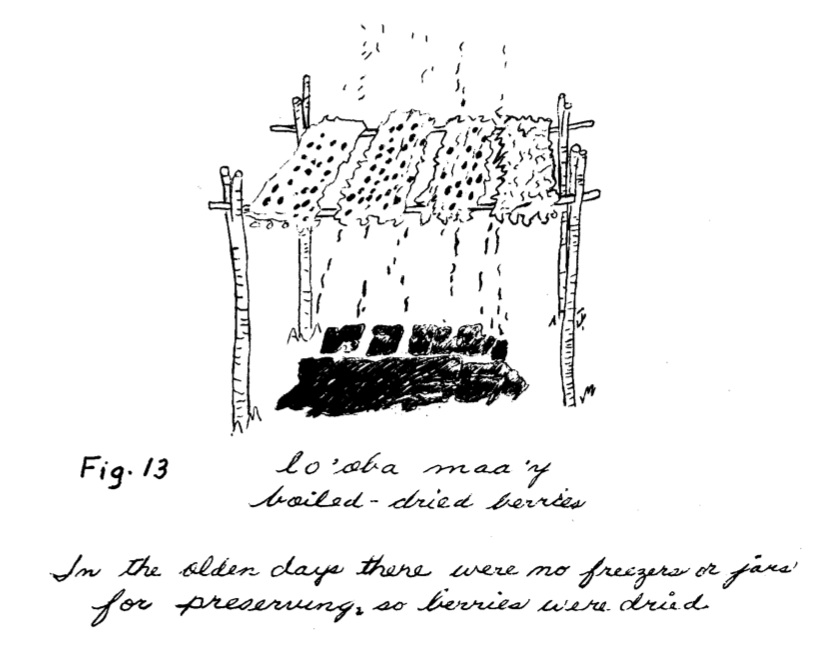
Drying Berries. Source: Adawhkl Gitsegulka.

Interior layout of a house. Source: Adawkhl Gitsegulka.

ASBC Talk: Tuesday, February 16th

Surveyors in the Uplands development, Victoria, using a burial cairn as a surveying aid. Source; BC Archives.

ARCHAEOLOGICAL SOCIETY OF BRITISH COLUMBIA, VICTORIA, February 2010 MEETING

Feb. 16, 2010, 7:30 pm

Pacific Forestry Centre, 506 West Burnside Road, Victoria, B.C.

Darcy Mathews

The Powerful Dead: The Rocky Point Cemetery and Straits Salish Identity.

Burial cairns and mounds are two types of pre-contact burial features in the Strait of Georgia region of south-western British Columbia. More than a millennium ago, the Straits Salish people, an ethno-linguistic group centered on present day Victoria, constructed a cairn cemetery at the Rocky Point site. Located 18 km southwest of present-day Victoria, this cemetery has over 300 cairns which occur in a variety of patterned shapes and sizes. Analysis of cairn construction and the use of space within this cemetery suggests that there was a strategic use of both material culture and landscape in Salish mortuary ritual, simultaneously expressing individual, household and perhaps even village-wide group identity. Underlying these statements of identity is the material expression of relationships between the living and the powerful dead, which were carefully navigated through the process of the funerary ritual, of which building cairns and mounds was but one part of a long-term process; a process that may have an antiquity of several thousand years. Biography Darcy Mathews is a PhD candidate at the University of Victoria. Working with the Scia’New First Nation, his ongoing dissertation research focuses on the identification, preservation, and study of pre-contact burial cairn and mound cemeteries in the Strait of Georgia.

For information, phone 384-6059 or e-mail asbcvictoria@gmail.com

Flickr user CanadaGood’s pictures of poles

Fallen pole at Gitsegulka. Source: flickr.com user CanadaGood.

Someone posting under the username “CanadaGood” at flickr.com has put up an impressive array of over 100 photos of “totem poles”.  What I like about this set is that most of these are not the iconic ones from coffee table books or museums but rather are still standing (or lying) in communities, mostly along the Skeena River.  They aren’t the most technically accomplished photos or anything but they are undeniably atmospheric and they document the process of renewal and decay of poles which was an important part of the carving complex.  Each pole is the material instance of the right to carve and display a set of crests or images, often as a memorial to a dead person of high status, and therefore the “thing” must be set against the intangible, non-material property of rights and titles which it represents.  Proper treatment of the pole might therefore well include letting it return to the earth, replaced by a fresher copy.  I like the matter of fact way this one is set up on stumps and this rotting masterpiece at Gitanyow.  This figure is unusual for being “sculpture in the round”.   Kudos to CanadaGood for putting pictures of these less commonly seen poles on flickr, in high resolution, and under a Creative Commons licence to boot.

Tops of standing poles at Gitsegulka. Source: flickr user CanadaGood.

Ancient Basketry from the Biderbost Site

2,000 year old basketry from the Biderbost Site, Seattle. Source: Burke Museum.

The Biderbost site is on the Snoqualmie River near Seattle.   Since 1960, a series of excavations have revealed a remarkable set of artifacts made from organic materials, preserved because of the water-saturated, anaerobic conditions of deposition.  The Biderbost site was the first site of its kind to be excavated in the Northwest, at least to a professional standard.  The Burke Museum has an excellent page on this site, including a page of basket photos (reasonable resolution, yay), weaving techniques, and conservation of these delicate artifacts.  There are also three informative (if not exciting) videos on YouTube about:

These artifacts, which include a large number of basketry pieces, date about 2,000 years ago.  Since most archaeological sites in the Northwest preserve stone, shell and bone fairly well but not wood, bark or root, these sites (which also includes Ozette, Hoko River (pics now broken fixed), Pitt Polder, Qwu?gwes, Kilgii Gwaay, and others) offer remarkable insight into the organic technology.  Ordinarily, we don’t see this stuff at all archaeologically and yet it may be the majority of the traditional technology; it may be stylistically distinctive and different compared to stone and bone tools; and it may be disproportionately representative of the lives of women.

Why there aren’t more archaeologists focusing research questions on these sites is unclear to me: yes, they are awkward sites and expensive and time consuming, but then so are shell middens.  I suspect it boils down to the unfortunate fact that the key NW wet-site researchers in the last thirty years (Dale Croes and Kathryn Bernick) were never in the kind of academic position where they routinely supervised graduate students and hence they were never able to harness the energy and intellect of that backbone of NW Coast Archaeology: the Master’s student and their diverse and often excellent theses.

I would be remiss in not mentioning that the Burke Museum has a Biderbost “Adopt a Basket” program to help with long term conservation of this remarkable suite of artifacts.

Basket rim and body fragment from Biderbost. Note the mud embedded in the weave. Source: Burke Museum.

Fishing weight wrapped in basketry with sticks attached. At a normal site this would appear to be an unmodified pebble. Source: Burke Museum.

“Correct Map of the Gold Diggings”: May 20th, 1858

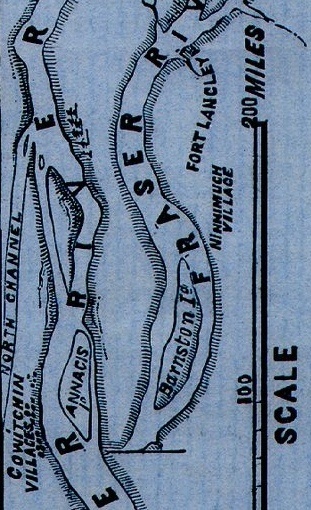
Detail of 1858 Map of Fraser Gold Diggings. Click for full image.

From UBC, this interesting 1858 San Francisco broadsheet “The Pictorial Newsletter of California” (large JPG file).  Most of the text is mundane births and deaths, but the map above from it is a lot of fun.  It’s especially interesting to see the “Cowitchin” Village at New Westminster.  Now, “Cowitchin” was often used as a generic term for many Coast Salish people in the early historic period.  But note too, just upriver at Fort Langley, a “Ninnimuch” Village, presumably Snuneymuxw First Nation, also known historically as the “Nanaimo” people, whose core territory would be on east Central Vancouver Island.  There are lots of reports of Vancouver Island nations paddling up and down past Fort Langley so its not that much of a surprise, but rather a nice testament to the extensive regional trade and, perhaps, permeable social networks in place across the greater Gulf of Georgia. It also makes me think the “Cowitchin Village” might indeed really be Cowichan. It’s notable the “Pinkslitsa River” (Harrison River) is the only lower tributary mapped, probably because it was an important route in and out of the middle Fraser, bypassing the canyon.  It’s a nice map, it’s early, and I’d never seen it before, so thanks to UBC and their Early BC Newspapers page.

Detail of 1858 map showing "Cowitchin" and "Ninnimuch" Villages on Lower Fraser.

From the UBC notes:  Pictorial News Letter of California: for the Steamer John L. Stephens San Francisco: Hutchings & Rosenfield; Charles F. Robbins, Printer, 1858

“Issued exactly one month after the first steamer left San Francisco headed for the Fraser (Bancroft p. 359), this appears to be the first separate publication relating to the Fraser River Gold Rush, and the first map published to illustrate the area for potential gold-seekers.”

You can also download a short PowerPoint file here, and there is an overview essay here.

1973 Aboriginal Perspective on UBC-MOA and SFU archaeology

Excerpt of 1973 Nesika newsletter criticizing MOA and SFU Archaeology. Click to view full page. Scroll down this page for link to plain text.

2018 edit: It looks like Nesika is now available to browse here, and to search here.

This is interesting, from the newsletter Nesika: Voice of B.C. Indians Vol. 2 No. 1 (February 1973), Page 6:

MONEY FOR BOAT: There is money to fund a boat to take archaeology students up and down our coastline to dig up the bones of our grandfathers and sift, sort, and label sacred objects from our burial grounds, but no money for us to treat our heritage with the dignity it. deserves?

This can only refer to the former pride and joy of the SFU department of Archaeology, the motor vessel Sisiutl.

That page from Nesika has two interesting articles.  One argues for the creation of a Cultural Centre at Hesquiat, while the other passionately objects to the millions spent on the UBC Museum of Anthropology and the above-mentioned Sisiutl.  Click on the image above for a legible image of the entire text, or click here for a transcript.  It is chastening to see the eloquence and power of these arguments from almost 40 years ago.  Hesquiat still has no Cultural Centre so far as I know while the Museum of Anthropology just wrapped up a 60+ million dollar renovation and SFU Archaeology has what amounts to their own, brand-new building as well, at what I hear was a cost of about 5 million dollars.

HESQUIAT BAND CULTURAL CENTRE

Lack of funds hit by Chief Rocky Amos

VANCOUVER (Staff) — After Indian Affairs had denied a request for funds for the Hesquiat Cultural Centre due to lack of funds, Band Chief Rocky Amos told the department that “we cannot accept the limitation of funds as valid.” Pointing to the $10 million available to a museum to house Indian artifacts at UBC and to other reports of funds granted for more white people to study Indians, Chief Amos wrote DIA: “It is difficult to follow the line of thinking that makes money available to exhibit our inheritance to city based people and when the rightful heirs to these very artifacts ask for assistance to house their history in an area where it will be meaningful to them, they are denied. “We of the Hesquiat Band are not unique and we have proven we can do it. Now we are made to crawl on our stomachs begging for funds to house our heritage. My pride is aching from begging but my pride also screams in agony when our people are forced into whitemen’s museums to see their inheritance.”

As the second article concludes in terms it is hard to argue with:

If there is money available for museums to store stolen work, then there is money available for museums to be built where that work belongs. With the children and grandchildren of the artists who represented a culture and society which has not, despite all efforts, conveniently died.

First custom built archaeology research vessel in North America: The Sisiutl. Recently scrapped by SFU.  Source: American Antiquity.

PS: kudos to the Union of BC Indian Chiefs for putting so much archival information online.  In related news, I previously linked to the archives of the Native Voice, which is another great resource for understanding First Nations politics and which also contains intriguing aboriginal perspectives on the practice of BC Archaeology.

Museum of Vancouver Web Site (Fail)

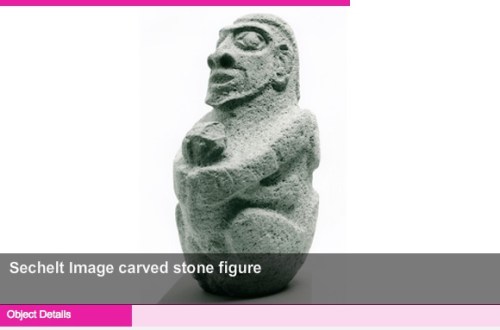
The Sechelt Image. Detail of Screenshot from the Museum of Vancouver. (click for full screen or scroll down)

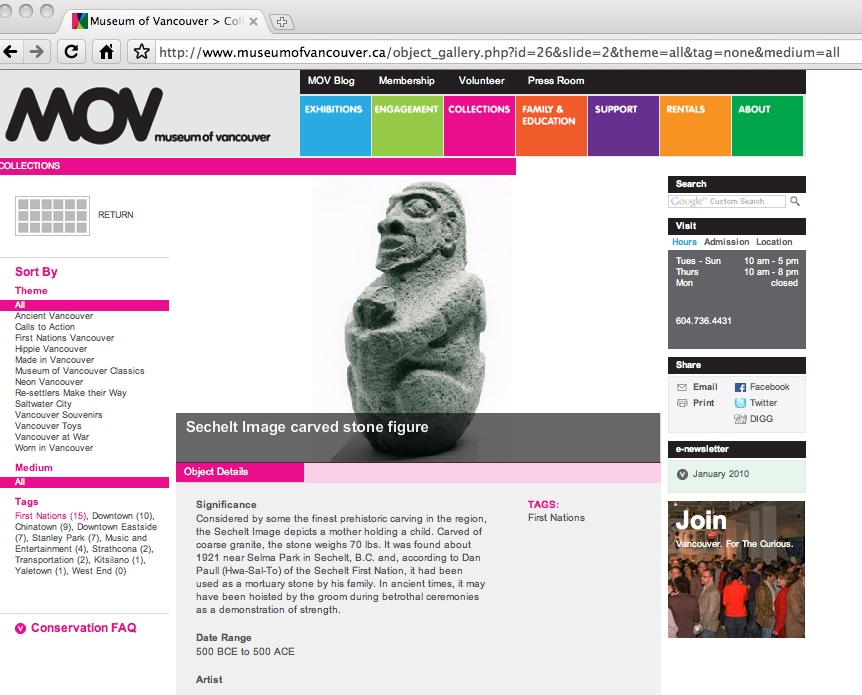
The Museum of Vancouver has a pretty slick and punchy website from a design point of view, very “Web 2.0” with bright colours and links to twitter and facebook and the like.  But in some respects it fails, and fails badly.   Consider the image above: the “Sechelt Image”, a stone sculpture and one of the most famous objects in BC Archaeology.  A single low-resolution picture is offered, a link to which is not possible, and downloads of which are  deliberately made difficult.  And in this protective bubble,  the object can only be seen as a pale, grainy image, surrounded by the Museum’s loud and crass colour scheme. (Update: see full screenshot below: the Vancouver Museum overlays its neon social web over the Sculpture much like Vancouver itself overlays aboriginal culture).

Fine – I am used to that ridiculous phenomenon wherein Public Institutions think they own the images that they are entrusted with – if the image is allowed to be seen by the descendent communities (and in this case I wonder if it really is) then why can it not be seen in high resolution, free from the magenta borders and the exhortations to tweet!?

But the real problem is that the web designers, with their stupid and un-necessary banner reading “Sechelt Image carved stone figure”, obscure an important area of the sculpture, including the all-important vulva which reveals, as noted by Wilson Duff, that this sculpture is powerfully hermaphroditic.  It is not just bad and regressive museology to cover up an important part of an object, but I believe it is deeply disrespectful as well.  By obscuring part of the image and by imprisoning it within their branded frame and obfuscating web design, they, the (hopefully) temporary guardians of this powerful piece of art, are visually co-opting it for what amounts to advertising purposes.  There is no reason to put your label over top of that which you claim to be displaying for its own sake; no reason other than marketing zeal and lack of control over the web designers.

You might think it was just prurience over the frankly sexual image, but below we see another image from their website with no shocking! vulva! to conceal, which has been similarly branded and bounded by the MoV.  Maybe I am just mad at them still because they’re using a petroglyph boulder as a rock garden (note the obscuring “petroglyph” banner) but really: their website is an egregious example of stealth appropriation and blatant disrespect under the disguise of progressive design and social networking.  And I’m just a dumb archaeologist: I’d love to see a Visual Anthropologist dissect the public face they are so eager for the world to see, the face they insist must frame every image on their website.

The Skytte stone bowl. Screenshot from the Museum of Vancouver website. Click for full screen.

The Website sends the Message: "This is Not a Place of Honour. There is No Dignity Here."

Elfshot: experimental and replicative archaeology

Saqqaq Palaeo-Eskimo flaked stone scrapers and knives, hafted with the aid of baleen. Source: Elfshot.

Elfshot is a cool blog chronicling archaeologist Tim Rast’s replicative and experimental work.  Interestingly to us out here on the NW Coast, a lot of  what he studies and replicates is from the comparable areas of the NE Coast, Newfoundland and the eastern Arctic.  That means he is using some marine sources such as baleen as well as materials such as moose sinew.  There is a lot to read at his blog, which is very well illustrated with photographs, videos, and scans from manuscripts.  If you find yourself in his neighbourhood, you can take courses and workshops on ancient technology from him, and I note that some of his beautiful replications are for sale.

Experimental archaeology is a really valuable approach in archaeology. It helps the archaeologist, who more often than not isn’t part of a traditional materials tool-use culture, understand the constraints of certain materials and likely technological sequences that would have been followed to make and use things.  While perhaps no substitute for observation and interviews, the fact is that by the time ethnographers got to most places in the world many traditional technologies had fallen by the wayside, and so there are very few descriptions of such basic technological domains as flaked stone tools.  Much of what we know about these tools and technologies comes from the work of replicators and experimentalists who set the facts of life out to help analyse the material which comes from the ground in archaeological digs.

Anyway, I strongly recommend Elfshot as a knowledgeable blog offering a lot of archaeological insight, especially for coastal contexts.

Use of the "mystery tool type" - piece esquillee - as a wood-splitting wedge. Source: Elfshot.