Tag Archives: history

Videos of Gwaii Haanas Archaeology

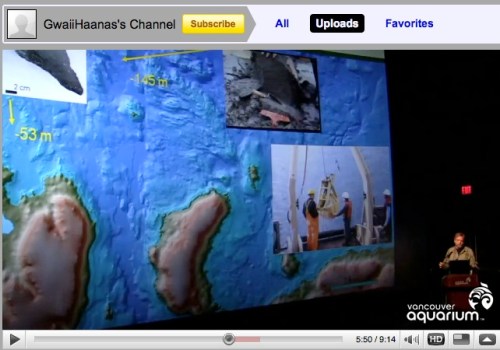
Daryl braves the barrage of bras to set the Vancouver Aquarium straight on the value of dead fish over living fish. Click to play part 1.

Rockwash superstars Nicole and Daryl show off their cool wares in a couple of videos I just found online – I vaguely remember them going off to give this talk at the Vancouver Aquarium.  It’s in two parts: 1 and 2.  Nicole looks fabulous and Daryl has trimmed his beard!  Win-Win.  The projects they describe sure were a lot of fun to take part in.   There are a few other talks up including Lyle Dick and Norm Sloan on Sea Otters on the Gwaii Haanas Youtube Channel.

A sandhill crane is a tough act fo follow but Nicole hammers home the righteous message of dead fish. Click to play part 2.

Raven-Walking & Geological Transformation

Haida History starts at least 14,500 years ago. (Image credit: Daryl Fedje).

Three things we know about Haida Gwaii:

1.  About 14,500 calendar years ago it was a temperate tundra environment, with no trees.  The first trees, pine, appear about 14,000 years ago and there is progressive forest infilling thereafter, with the modern species mixture in place by about 3,000 years ago.

2. It has an impoverished suite of large land mammals – historically, these were limited to black bear, caribou, marten, ermine, a vole and a shrew.  We know that 13,000 years ago there were also deer and brown bear on the islands, and quite likely other species as well.

3.  It used to be much larger than in the present.  With lower sea levels at the end of the last ice age, Hecate Strait was largely dry land, exposing a large, unglaciated, coastal plain that became rapidly flooded.

It seems to me that we can add a fourth thing we know:

Continue reading

Chief Thunder Voice

Bing Crosby being invested as Squamish Chief Thunder Voice.

In 1948, Bing Crosby, then a first-rank international star, visited Vancouver – and ended up being invested as Squamish Chief Thunder Voice, among other civic performances.  The Vancouver City Archives has the video (1.00 minute in).

By the way, what is up with coastal First Nations adopting feather war bonnets?  Is this a kind of weird double reverse emulation: trying to look more stereotypically Chiefly in the eyes of the majority population?  Is it intra-aboriginal cultural appropriation?  Or do they just look freakin’ awesome?  Note the tomahawk as well in the picture above.  Someone should write a paper on “Plains Paraphernalia as  Signifiers of Rank on the Historic Northwest Coast”.  Or maybe they have, already.  I’d read it.

Peavies, pickaroons, hookaroons and skid tongs

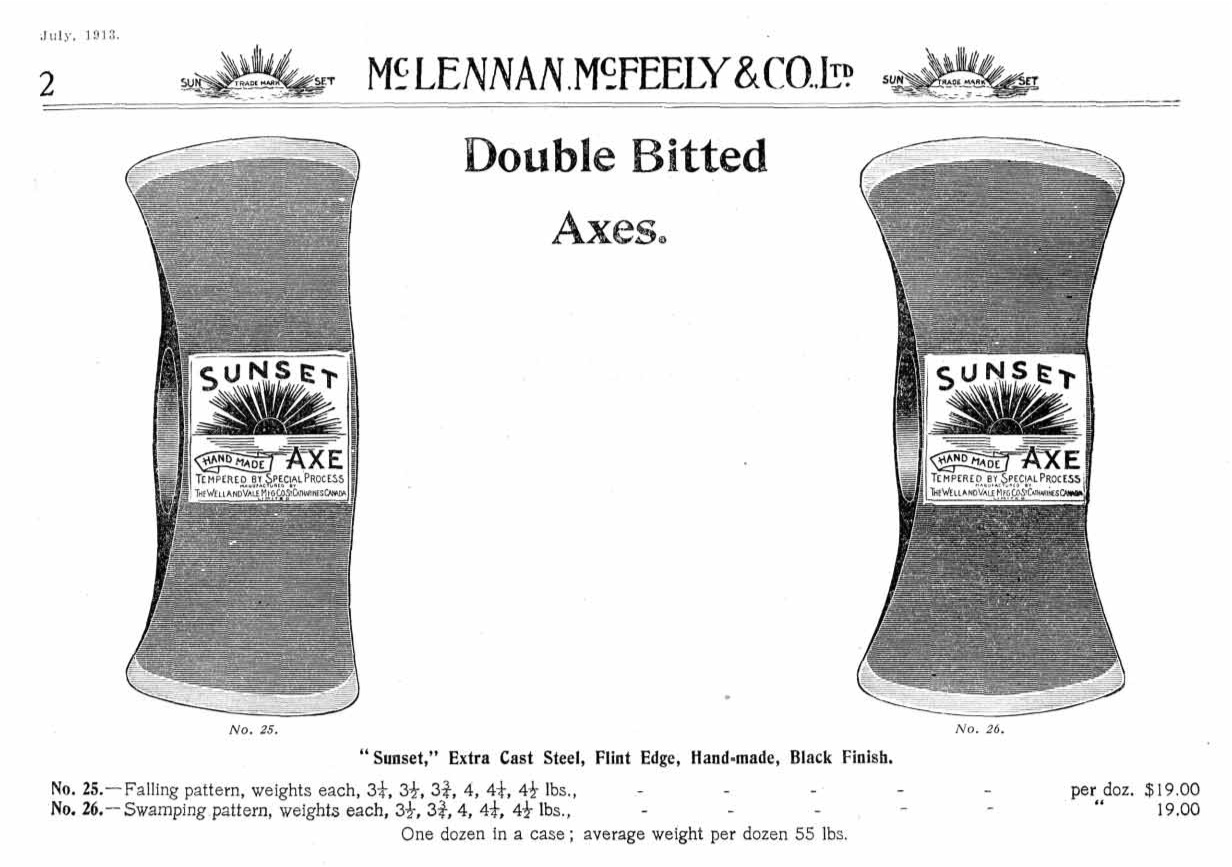
Double-bitted axes, available by the case.

It’s pretty common to run into historic industrial equipment when doing archaeological work in BC, especially logging equipment.  The Vancouver City archives has put the entire McLennan, McFeely & Co. Ltd Catalogue 1908-14 online, albeit in a somewhat awkward format (hey guys, why not just post a single PDF as well?) (edit: see comments below).  This catalogue would have been the ordering bible for many remote logging, mining and cannery outfits up and down the coast, the remains of which are often lying atop shell middens or strewn in the intertidal zone.  Altogether, the Vancouver City Archives and the Burnaby Village Museum have put  more than 1,500 pages of historic merchandise, as well as ordering and shipping information and price lists. Click on an image and it brings up a legible PDF of that single page.

Continue reading

dSpace: The Indian History Film Project

Haida Town of Chaatl. Source: NMC

There is an interesting archive of interview transcripts housed in dSpace at the University of Regina.  Most of the interviews were by CBC Radio’s Imbert Orchard and so share the flaws of Journalism and Anthropology.   The preamble says,

The original intent of The Indian History Film Project was to conduct interviews with First Nations elders across Canada and to produce a television series portraying Canadian history from a First Nations’ perspective.

The Indian History Film Project was an initiative of Direction Films and was conceived and developed by Tony Snowsill. The project leaders were Tony Snowsill and Christine Welsh. The project evolved over time, and eventually it was decided to access libraries and archives across the country to incorporate existing interviews with First Nations elders. All interviews, whether original or archival, were cross indexed by word and theme and housed in the C.P.R.C [Canadian Plains Research Centre].

A number of these interviews are with Haida people, notably Solomon Wilson and Florence Edenshaw, who discussed her arranged marriage, the meaning of Tow Hill, and the artistic tradition of her family, the Edenshaws and Davidsons.  It appears tapes of these are also available through the BC Archives, but not online.

Note: anytime you see (Indian) it means that a Haida word was not transcribed — an eerie effect.  Searching for British Columbia brings up 91 documents.

The following excerpt from an interview with Solomon Wilson of Skidegate sees him relating a tale of smallpox blankets:

Continue reading

Tseycum Repatriation from AMNH

Inside the Tseycum Longhouse.  Click Image for etended video.

Inside the Tseycum Longhouse. Click Image for extended video.

This is old news now that in 2008 the Tseycum First Nation in North Saanich managed to repatriate the remains of 55 of their ancestors who had been removed and sold by Harlan I. Smith.  What I didn’t realize is in addition to the snippet on The National with Wendy Mesley (the file is incongruously called “brown-bones” – WTF CBC?), there is also an extended uncut video of the ceremony in the Tseycum longhouse.   Cora Jacks, who spearheaded the Tseycum repatriation effort and is interviewed here, sadly passed away soon after.

The detailed field notes kept between 1854 and 1910 assisted greatly in tracing the location of the ancestral remains. Museums in the states are required by law to provide information when a nation makes its request. This law called NAGPRA is the Native American Gravesite Protection Repatriation Act and has greatly facilitated the provision of a long list of human remains and sacred objects. (Similar legislation in Canada does not exist.) Historic references show that skulls had been sold for $5 each with similar price tags having been placed on skeletal remains.

Cora had visited New York in 2005 with Vern Jacks Jr. and experienced the deep emotionality of viewing the remains stored in boxes and placed on shelves. The museum had not followed any cultural protocol so that skulls were often separated and Jacks explains the “spiritual restlessness,” which results from this disrespectful treatment. In Chicago Jacks also discovered about 79 sets of remains many of which are probably from this region and most of them were small children who had likely died of smallpox after contact with European settlers. (source).

As the NY Times noted, the Field Museum in Chicago had not yet begun repatriation negotiations with the Tseycum.  While the NAGPRA law in the states is very strong when applicable, it clearly does not apply outside American borders so credit to the AMNH for working in good faith with the Tseycum.

But also: Grant – what the heck – is it really necessary to defend Harlan Smith?  Maybe as a curator of archaeology it is.  I dunno, seems like another relativising moment rather than a chance for an apology or a plain admission that it was wrong, then and now, to steal human remains for profit. But hey, stealing their land was also done in the spirit of the times, so what the heck?  Let’s not forget the RBCM itself is built on top of a village site.

dSpace: Dentalia Shells on the Northwest Coast

Dentalia Source "mu7is" in Hesquaht Harbour.  From Barton M.A. p. 116

Dentalia Source "mu7is" in Hesquiat Harbour. From Barton M.A. p. 116

Andrew Barton did an excellent job reviewing the biology of the Scaphopoda, the archaeological record of dentalia use and trade, and the technology available to harvest these small creatures with tusk-shaped shells.  Overall, he brought a lot of nuance to a topic that had been somewhat over-simplified.  For example, there is no real evidence that these shells were only available at depth from the NW corner of Vancouver Island.  Barton reports on attempts to replicate ethnographic dentalia “spears” (more like a rake, or a pasta fork).  You should be able to download a copy of Fishing for Ivory Worms : a review of ethnographic and historically recorded Dentalium source locations from SFU dSpace.

Dentalia necklace by Josephine Ingraham, Clatsop/Chinook Tribes

Dentalia necklace by Josephine Ingraham, Clatsop/Chinook Tribes

Skidegate Haida Model Village

Model of Skidegate (hlgaagilda 'llnagaay) as installed at Chicago Exhibition, 1893.

Model of Skidegate (hlgaagilda 'llnagaay) as installed at Chicago Exhibition, 1893.

The Burke Museum in Seattle is doing excellent work.  I just found the project which they are spearheading, together with the Haida Museum at Kaay’llnagaay and the Field Museum in Chicago, to reassemble the famous model village of Skidegate (hlgaagilda ‘llnagaay) created for the 1893  Chicago World Fair.  This exhibition was organized by Putnam, implemented by Boas, who hired James Deans (a well known Victoria antiquarian) to collect some NW Coast stuff.  Deans outdid himself by arranging for the carving of a complete model of Skidegate Village  – amounting to some 27 model houses (most with frontal poles), 2 model mortuary houses, and 17 free standing model poles.  (Deans also apparently collected three boxcars of other material including an entire house, canoe and other material, but that’s another story).

The Burke Museum now allows you to view an interactive panorama of the model village.

The website is designed both to showcase these model houses and also to help find the 13 houses and poles which have gone missing.   The intention is to return the model village to Kaay in 2011.  Replacement poles and houses will be commisioned for those that cannot be found.   A highlight are the videos of Skidegate residents such as Captain Gold, Niis Wes, Percy Williams, Kii7iljuus, and Kwiaahwah Jones talking about the model village, about family, and above all about being Haida yesterday, today and tomorrow.

House of Contentment, model carved by George Dickson

House of Contentment, model carved by George Dickson

Erik the Lost

Erik the Lost

More berzerkness up-island

This site contains an inspired argument that Viking Vinland, Markland and Helluland were on the NW Coast. It’s thought-through to a scary degree, in the way that magnificent obsessions often are.  Though as I always say, if something isn’t worth doing, it isn’t worth doing well. And based on my acquaintance with NW Coast Archaeology, I have to say that the theory falls down at a few key junctures.  Worse, it is part of a long-running narrative in which aboriginal people of the Americas have their finest cultural achievements taken and assigned as the work of Europeans.  See, for example, the Vikings in Minnesota theories, which argue that the great mounds of Mississippian Culture were the construction of White Men from the North.   Do the Minnesota proponents have academic arguments with the Vancouver Island proponents?  Were Vikings everywhere?  Is this a racist narrative?   Too bad all this energy is not put into something worthwhile, there is so much serious work to do.

Vancouver [Native] Art in the Sixties

GOOGA!

GOOGA!

This 1962 picture of Haida artist Robert Davidson at age 13 caught my eye, not least because he looks a lot like his nephew, Haida archaeologist and great guy Allan “Googa Boy Lefty ClamBone Monica Sunshine” Davidson. Here’s Allan tending to his espresso pot at Richardson Island.  Very shareable.  I am pretty sure this was before I accidentally tossed a grub into his cup.