Category Archives: Vancouver Island

Public Talks on Quadra Island, Monday June 16

Quadra Clam Gardens.  Source: Groesbeck et al. PLOS-1, 2014.

Quadra Island Clam Gardens. Source: Groesbeck et al. PLOS-1, 2014.

Nuyumbalees Cultural Centre and Discovery Passage SeaLife Society present:

1. Sea Level History of the Discovery Islands.
Daryl Fedje, University of Victoria

2. Quadra Island’s Ancient Clam Gardens.
Dana Lepofsky, Simon Fraser University

Monday, June 16th | 7 pm Quadra Island Community Centre

So I usually limit my announcements of public talks to those happening in the Victoria backyard of Blog World Headquarters but it so happens there is one exceptional one coming up on Quadra Island, where I’ll be spending the next week.  The talk, actually two talks, will focus on two archaeological projects underway up there.  The poster advertising the talks is here, or you can read more below.

Continue reading

ASBC Victoria talk: Tuesday May 20, Michelle Puckett on Quadra Is. Clam Gardens

Gwaii Haanas clam garden.

Clam garden in southern Haida Gwaii.  Note the rock wall forming the flat terrace feature.

Transforming the Beach, Transforming our Thinking: Ancient Clam Gardens of Northern Quadra Island, BC.

Michelle Puckett (presenter) and Amy Groesbeck, Dana Lepofsky, Anne Salomon, Kirsten Rowell, Nicole Smith and Sue Formosa

Tuesday, May 20th, 7:30pm at the University of Victoria, Cornett Building, Room B129.  All welcome, free.

SFU graduate student Michelle Puckett (formerly UVIC’s own) is giving the May ASBC Victoria talk – “clam gardens”.  These intertidal features have taken NW Coast archaeology by storm over the last 15 years or so.  Each one is a deliberate alteration of the beach in order to enhance shellfish productivity.  Hundreds of these are now known, and as archaeologists’ eyes become more tuned to this site type I expect hundreds more to be recorded.  Being, in effect, a kind of mariculture or aquaculture, these are important not only to our understanding of long term histories on the coast (they challenge the anthropological type “hunter-gatherer”) but they will also become important in land claims, I am sure. Click below to read the abstract and bio for this talk.

Continue reading

Two talks in Victoria next seven days

Burial cairn on Race Rocks.  Source: RaceRocks.com

Burial cairn on Race Rocks. Source: RaceRocks.com

Two very cool talks in Victoria over the next few days.  The first is a unique opportunity to hear from Cowichan (Coast Salish) “gravedigger” Harold C. Joe, who for more than 30 years has worked with archaeologists and anthropologists to care for the disturbed ancestral dead, among his other responsibilities.

The second talk is the monthly ASBC event which features Dr. Andreas Fuls of the Berlin Institute of Technology, who will address a topic in Mayan astronomy and the Mayan collapse.

If you’re not in Victoria you can probably stop reading, but if you click below then you’ll find  more details, including abstracts and the where and when.

Continue reading

ASBC Victoria talk: Tue Feb 18, Nicole Westre on Hiikwis Fauna

UVIC Students excavating at Hiikwis Site, Barkley Sound.

UVIC Students excavating at Hiikwis Site, Barkley Sound.

They didn’t do it just for the Halibut: A faunal analysis of the Hiikwis site complex (DfSh-15 & DfSh-16), Barkley Sound.

Nicole Westre

Tuesday, February 18, 2014, 7:30 pm
Cornett Building B129
(North End of Cornett building)
University of Victoria

As always, the ASBC talks are free and open to the public.

Abstract:

The Hiikwis site complex (DfSh-15 and DfSh-16) consists of two village sites in inner Barkley Sound, occupied continuously for nearly 3000 years until the 1900s. Excavated between 2008 and 2010, the site complex has gained attention as the only Barkley Sound village site to contain a significant flaked stone assemblage in late contexts. My talk, however, focuses on sampled vertebrate faunal remains recovered from the site, which are unique among Barkley Sound sites as well. The bird and whale assemblages will be discussed, as will salmon exploitation. In general, Barkley Sound sites suggest that salmon did not become an important resource in the area until only about 800 years ago. This observation challenges the idea that complex Northwest Coast societies emerged as a result of salmon preservation for winter consumption as long as 3500 years ago. Does the Hiikwis site complex follow the typical Barkley Sound pattern, or do the bones tell a different story?

Continue reading

Upcoming archaeology talks in Nanaimo

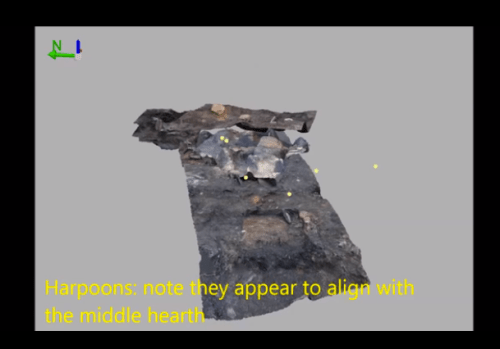
Millennia hearth model screenshot.

Millennia hearth model screenshot from video. Click to go to blog post and view video.

I’ve been asked to post about some upcoming talks in Nanaimo with archaeological interest.  Below I list the talks, which are all co-sponsored to one degree or another between VIU and the Nanaimo ASBC chapter.  The linked posters below give you more information about parking, times, room numbers, abstracts, bios, etc.  All these talks are free and open to the public. For further information then contact mail@asbcnanaimo.ca .

I know many of you are stuck in other lovely places in the world and can’t make it, but for those more local then the details follow.

First up – in just a day or two – is Morley Eldridge of Millennia Research, speaking on his cool uses of digital technology in site recording and excavation.  This is really cool stuff and probably the way of the future for at least some scales of archaeological research. There’s  sneak preview of some of the new methods on the Millennia Blog.

Lecture: A New Methodology for Archaeological Excavation: Mitigative Excavation of GbTo-13 and GbTo-54, Prince Rupert.

Date: Thursday February 6, 2014

Location: VIU Nanaimo campus, Building 356, Lecture Hall 109 (Education/Social Sciences) Time: 11:30 AM – 1:00 PM
ASBC Members, Students and the Public Free! Everyone Welcome.  More instructions on the poster (PDF)

The other talks are by Andrew Martindale (UBC) and Quentin Mackie (UVIC) (no relation).  Details below:

Continue reading

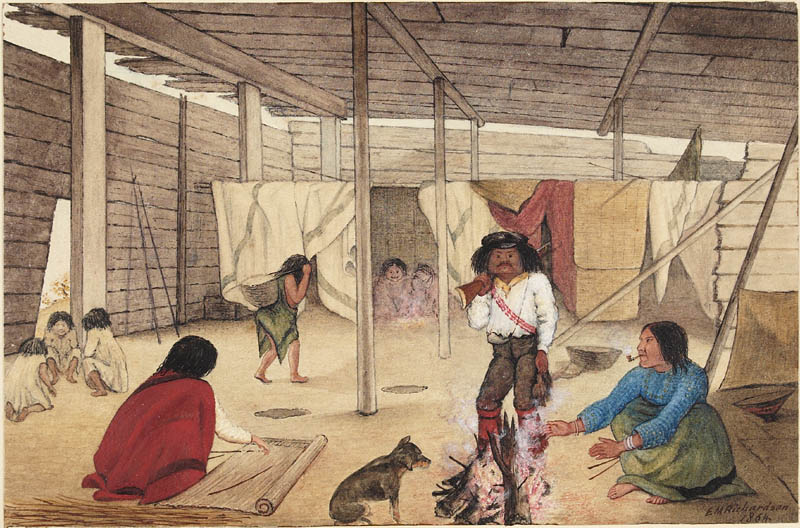
Interior of a Coast Salish Longhouse, 1864

Interior of a Salish Longhouse, 1864. Watercolour by Edward Mallott Richardson.  Locale uknown. Source: Canadian Archives.  Click to enlarge.

Interior of a Salish Longhouse, 1864. Watercolour by Edward Mallott Richardson. Locale uknown. Source: Canadian Archives. Click to enlarge.

Following on from the post about the Salish mausoleum, here is a companion painting by Edward Mallott Richardson from the same year, depicting the interior of a house.  It’s a curious painting, seemingly devoid of close detail.  Where are all the drying fish?!  But at the same time it shows some features of interest which may be worth discussing.  Note the fellow with the gun has a powderhorn, for example, and the basket behind him looks like one of those rectangular coiled ones, only with a tumpline, as shown by the woman entering on the left.  On the far right is a semi-conical object that might be a hat, sitting on a platform within a small compartment.

Continue reading

A Coast Salish Mausoleum, 1864

A Salish Grave, 1864. Watercolour by Edward M. Richardson. No specific locale given. Source: CollectionsCanada.gc.ca

A Salish Grave, 1864. Watercolour by Edward M. Richardson. No specific locale given. Source: CollectionsCanada.gc.ca  Click to enlarge slightly.

“Grave House” is one of those archaeological terms which render slightly creepy a feature that is more or less an everyday experience: the mausoleum, a house for the dead, filled with coffins.

This is a fascinating image I hadn’t come across before: a very early image of a Coast Salish mausoleum.  It highlights the artistry and vividness of these features better than the few sketches or early photographs do. The accompanying text at the Canadian Archives is:

Subject depicts grave boxes in a grave house with guardian figures. The grave house is covered with a roof of wooden planks but has no walls. At the front of the house stands six guardian figures. There are flags to the left and right of the house. On the left hand side of the house a tent is set up and clothes are hanging. A shotgun hangs from the front beam of the house. Item was up for auction in the September 28, 1970 Christie’s sale in Calgary. Lot 31.

The image isn’t very high-resolution but there are still some things to talk about – and there is another Richardson painting I’ll link to in a day or two. (edit: here) Continue reading

Tagging along with Archaeologists in Quatsino Sound

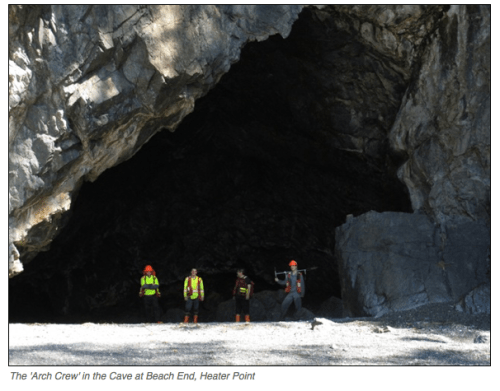
Quatsino - Cave at Heater Point. Source: bcmarinetrails.org

Archaeology Crew at Quatsino: Cave at Heater Point. Source: bcmarinetrails.org

How does the general public perceive archaeologists?  There’s a lot of ways to get at this question, not least the comments section of any newspaper article!  But a positive and slightly unusual perspective is found in this article by Stephanie Meinke at the BC Marine Trails website.  In the course of establishing some new marine trails in the Quatsino Sound area of NW Vancouver Island (map), concern arose that there might be archaeological sites at some of the campsites. Kayakers generally having solid ethics about leaving no trace, but all the same there might be some unintentional impacts.  So an archaeological consulting team (Kennedy Richard and Morgan Bartlett) was hired to assess these spots with potential impact. They were guided by Stephanie and by Janis Leach of Recreation Sites and Trails BC, as well as by two field assistants from the Quatsino First Nation: Mark Wallas and Mark Hunt.

The article gives something of a participant-observation view of the archaeological consulting business in its coastal survey guise, as well as some nice pictures of gorgeous scenery.

Continue reading

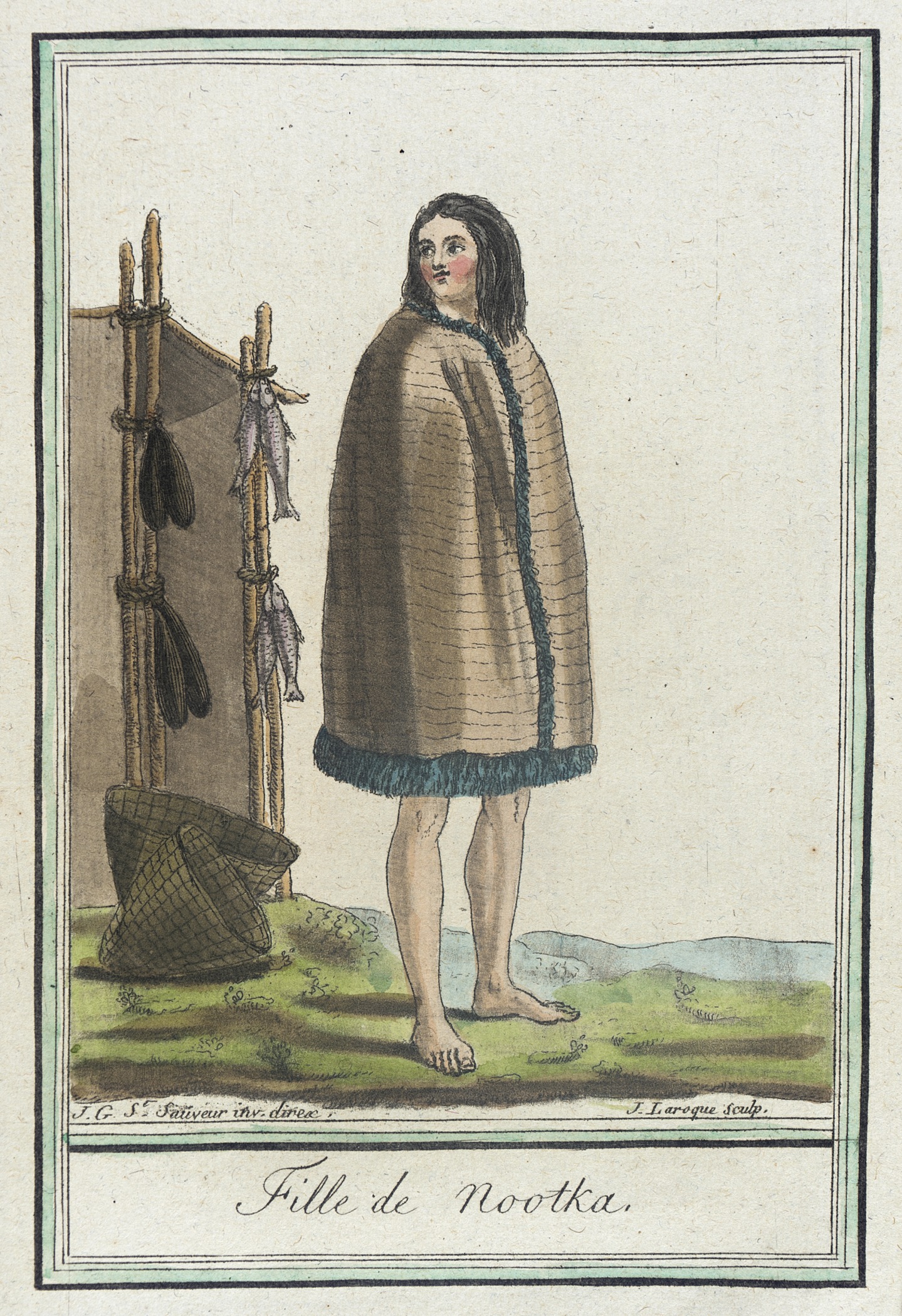
Images of Nootka Island People, 1787

Nootka Sound girl, 1787.  by de Saint-Sauveur, source: LACMA.

Nootka island girl, 1787. by de Saint-Sauveur, source: LACMA.

I found some interesting images at the Los Angeles County Museum of Art. These come from a book published in 1787: Costumes civils actuels de tous les peuples, volume 4: Americas by Jacques Grasset de Saint-Sauveur (1757-1810).  Needless to say, it’s one of the earliest publications with NW Coast content, comprising four plates and 14 pages of “customs” of Nootka Island (Nuu-chah-nulth territory). I’m not entirely sure where Grasset de Saint-Sauveur would have got his inspiration from – Cook’s journals most likely?  You can see all the plates from the four volumes at the LACMA (great images from around the world), or you can read and download the entire book here.  But why bother, when I extract the information for you below.

Continue reading

‘Namgis Arborglyph

Dawn Cramer inspects an arborglyph deep in the heart of the Nimpkish Valley.  Photo courtesy of the 'Namgis Nation via Jim Stafford

Dawn Cramer inspects an arborglyph deep in the heart of the Nimpkish Valley. Photo courtesy of the ‘Namgis Nation via Jim Stafford

Hard on the heels of my recent post on a newly discovered arborglyph in Klahoose traditional territory, I’ve heard of another one in ‘Namgis territory, in the Nimpkish Valley on Northeastern Vancouver Island.  Local archaeologist and friend of this blog Jim Stafford, who owns the well-regarded Coast Interior Archaeology company (which has a long relationship with the ‘Namgis), sent me the following note and some photographs which are cleared for publication here.  There is also an account of the arborglyph in this PDF document (a newsletter) from the ‘Namgis. Jim writes:

Please find attached images of the arborglyph we found recently in the heart of the Nimpkish Valley.  The photos are provided courtesy of the ‘Namgis Nation and Dawn Cranmer is pictured in two of the photos.  I’ve also included an image of a ‘bark board’ we found nearby with Lee Waddams pictured. Continue reading