Category Archives: Technology

Elfshot: experimental and replicative archaeology

Saqqaq Palaeo-Eskimo flaked stone scrapers and knives, hafted with the aid of baleen. Source: Elfshot.

Elfshot is a cool blog chronicling archaeologist Tim Rast’s replicative and experimental work.  Interestingly to us out here on the NW Coast, a lot of  what he studies and replicates is from the comparable areas of the NE Coast, Newfoundland and the eastern Arctic.  That means he is using some marine sources such as baleen as well as materials such as moose sinew.  There is a lot to read at his blog, which is very well illustrated with photographs, videos, and scans from manuscripts.  If you find yourself in his neighbourhood, you can take courses and workshops on ancient technology from him, and I note that some of his beautiful replications are for sale.

Experimental archaeology is a really valuable approach in archaeology. It helps the archaeologist, who more often than not isn’t part of a traditional materials tool-use culture, understand the constraints of certain materials and likely technological sequences that would have been followed to make and use things.  While perhaps no substitute for observation and interviews, the fact is that by the time ethnographers got to most places in the world many traditional technologies had fallen by the wayside, and so there are very few descriptions of such basic technological domains as flaked stone tools.  Much of what we know about these tools and technologies comes from the work of replicators and experimentalists who set the facts of life out to help analyse the material which comes from the ground in archaeological digs.

Anyway, I strongly recommend Elfshot as a knowledgeable blog offering a lot of archaeological insight, especially for coastal contexts.

Use of the "mystery tool type" - piece esquillee - as a wood-splitting wedge. Source: Elfshot.

Makah whaling gear

Parts of a Makah whaling canoe. Source: Waterman, 1920.

I posted a couple of days ago about a historic photo of members of the Quinalt Tribe making canoes in the Queets watershed.  Immediately to the north, the Makah tribe at the tip of the Olympic Peninsula are well known for their succesful whale hunting practices, carried out from canoes similar to those being carved.

As it happens, in 1920 the Anthropologist T.T. Waterman wrote a detailed account of Makah whaling technology, which you can download in full here (PDF).   Above, I illustrate the nomenclature of the Makah whaling canoe – I like how the small bump on the lower bow is called the uvula.  Below, you can see the seating plan when geared up and loaded for whale.  As you might expect for such a dangerous undertaking as killing whales from a canoe, the division of labour is quite precise:  “float-tender”, “harpoon line tender”, “float inflator” .  The “diver” had the task of swimming to the lower jaw of the dead whale, piercing the skin and flesh, and sewing the mouth shut to prevent the whale sinking on the long tow home.  You can see a vivid picture of some of these people further below.  Descriptions of these tasks and the associated gear is given in Waterman, which contains huge insight into traditional Northwest Coast technology and social practice.   I’ll most likely post more snippets from this book in due course.  The Makah have, of course, recently re-asserted their traditional right to hunt whales which I fully support.

Seating positions within a Makah whaling canoe. Source: Waterman, 1920.

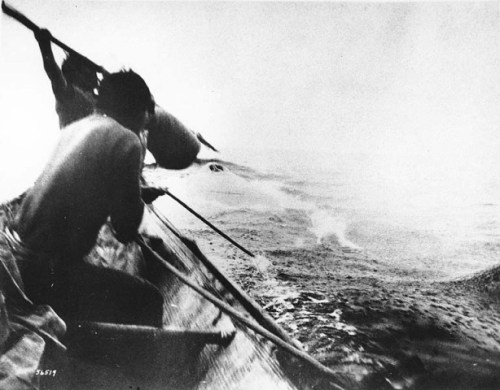
Makah Whaling: the 2nd harpoon strike. Line tender in action behind the harpooner. Source: Makah Tribe.

One Tree, Four Canoes

"Making 4 canoes from one cedar tree, Olympic Loop, Queets, Washington.

Yesterday I posted on canoe steaming.  In the process of preparing that, I ran across an eye-popping photograph, above.  Seriously, I have been working on Northwest Coast Archaeology for over two decades.  I have a pretty good memory.

But I’d never seen this picture before, which shows four dugout canoes being made from a single red cedar felled on the Queets River, Washington State.  Click it for pretty high resolution.  This would presumably be territory of the Queets Tribe, who are now part of the Coast Salish speaking Quinalt Indian Nation.  Imagine the complex and revealing archaeological site left behind: the wood shavings, the planks, the skids, broken tools, coffee cups … years ago I worked on an excavation of a Culturally Modified Tree Site in Clayoquot Sound and we found superbly preserved wooden wedges, woodchips and other evidence of intensive logging and carpentry — evidence which, given the durability of cedar, could easily last for centuries.  Such a contrast to those sites dominated by stone tools: wood was where it was at on the Northwest Coast and yet archaeologically we see much less of it, and think about it less, than we ought to.

I don’t know much more about this picture than the caption.  If you do, then leave a comment!

Makah whaling canoes on the beach at Neah Bay. These are stylistically similar to the ones being made above and to the one being steamed in yesterday's video.

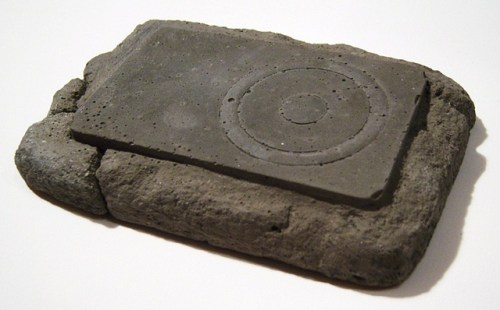
Christopher Locke’s modern fossils.

Egosiliqua malusymphonicus

Christopher Locke is an artist whose work includes a number of fun “modern fossils“, like his palaeofuturistic rendering of an iPod (Egosiliqua malusymphonicus), above, or a Nintendo game controller (Dominaludus sexagentaquad) below.  I take the work to be a slightly sarcastic commentary on the work of palaeontologists and archaeologists as well as on the flukey preservation of ephemera – see his specimen notes alongside each piece at his website.

They are also very reasonably priced — tempting!

Dominaludus sexagentaquad.

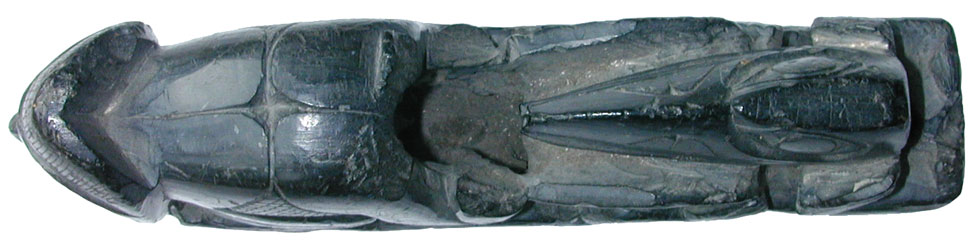
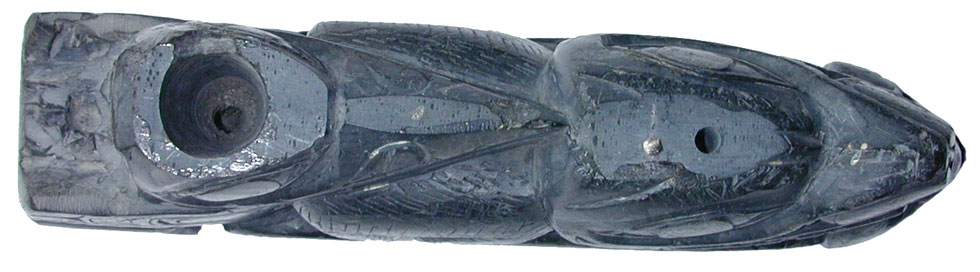
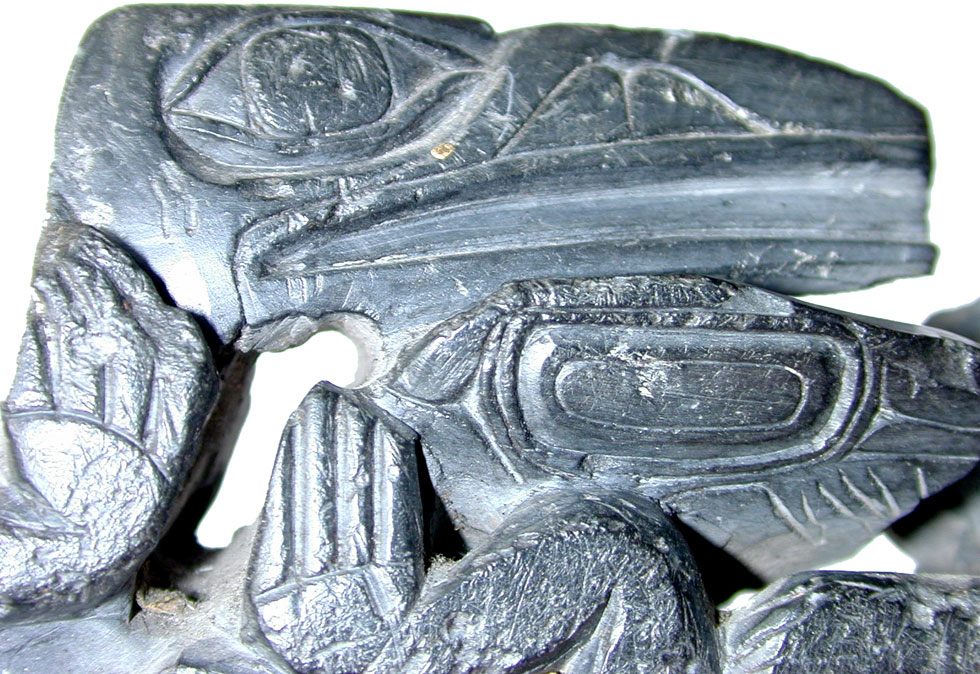
Another Haida Argillite Pipe for Sale

Haida panel pipe, nineteenth century.

A few days ago I featured photographs of a stunning 19th century Haida argillite pipe for sale at a UK web site.  They have a second pipe for sale, a more complex design but in poorer condition.  The photos are similarly revealing of carving strokes and rock grain; even more so in some ways as this piece appears to be unfinished.  The design is complex focusing on Raven and Bear (not the Frog as the description below says, I don’t think), but it is not for me to try to decode the story being told.

The description is given as follows:

19thC. HAIDA ARGILLITE PIPE PANEL. #asc004 #asc004

Probably from the Raven Tribe, the panel carved with various mythological figures including a raven, a man, a frog and the thunder bird, this is possibly part of a larger panel and the top has been slightly filed flat for mounting on a stand, (not photographed). Overall 13.5cm.

From the Haida tribes of the Northwest Pacific Coast of British Columbia and Queen Charlotte Island

£2,500.00

Again, for posterity, here are nine views of this pipe: 1, 2, 3, 4, 5, 6, 7, 8, 9.  As I noted before, while not as sharp as the other set, these photographs surpass most of what one finds on many, many museum sites, where the rule seems to be: offer a single view of an object, offer it at low resolution, do not allow direct hyperlinks to the file, and break the URL as soon as possible.

Front view of panel pipe.

Top view of pipe.

Punchaw Lake Geochemistry

Elongate side-notched points from Punchaw Lake. Source: Montgomery 1978.

Archaeologists are often pretty lousy geologists.  Nowhere is this more apparent in the use of visual cues to classify rock types.  Accurate classification of rock types is an enormous clue to the mobility of past people, to ancient territories, as well as trade and exchange networks.  Even so, very few archaeological studies on the Northwest Coast have looked at geochemical characterization of raw materials, other than for obsidian at least.  The best work done to date is probably Nicole Smith’s M.A. thesis on the Richardson Island site.

It is therefore nice to see some other comparable work being done.  I don’t know much about the Punchaw Lake (near Prince George) project beyond this poster which has been put online  in  the form of a PDF conference poster by Lorenz Bruechert (abstract).  I understand Bruechert did his MA at UNBC on this geochemical study and also there is a much earlier 1978 MA thesis by Patricia Montgomery available online.  It seems Bruechert used the 1970s excavations as a study sample, and the ICP-MS and other work was contracted out to ACME (not that one), a geochemistry consulting company (note: Nicole did the geochem work herself at UVIC so bonus points there).

In any case, Bruechert finds that a sample of the debitage is geochemically sortable into six groups, all of which are closely-related trachydacite or dacite.  There is as much internal differentiation at Punchaw Lake in the geochemistry of this rock type as there is between any two typical sites on the Plateau.  Hence, he suggests three distinct sources with “tens” of kilometres between them.  As the Punchaw Lake site finds itself on the Alexander Mackenzie trail, this is not that surprising to see diversity of raw material (though one could argue there should be even more diversity).  Nonetheless, the point remains that, as the picture below shows, all the material tested by Bruechert would have been classified visually as basalt (lower left on the graph); whereas in fact, none of it is basalt.  It was such findings at Richardson Island which helped allowed Nicole to postulate an “experimental” phase of technological innovation – in her case, a variety of materials including rhyolites, argillites and varvites had all been variously mixed and matched in ways that did not reflect their geochemical origins.

Bruechert Figure 2: rocks called "basalt" (lower left) are actually dacity/trachydacite.

McLennan & McFeely 1908-1914 Catalogue (update)

Railroad wheelbarrows from McLennan and McFeely catalogue.

I posted previously about this excellent resource which the City of Vancouver Archives has put online: the McLennan and McFeely catalogue of industrial, farm and fishing equipment, 1908-1914.  In that post, I moaned a little about how nice it would be to be able to download a single PDF of all 1400+ pages.  To my delight and happiness (and surprise, I must admit, because it can have been no trivial task) Sue Bigelow of the  Archives has posted a note indicating that they have now made such a document available for download (link in upper right hand corner of this page).  It is 270 megs, but I have it now and what an amazing resource.  Thanks so much to Sue and to the City of Vancouver Archives – as I said, this is potentially a huge aid for historical archaeologists and indeed any archaeologist who encounters historical debris.

Mangles!

Tlingit, Dene and Eskimo Metallurgy (1969)

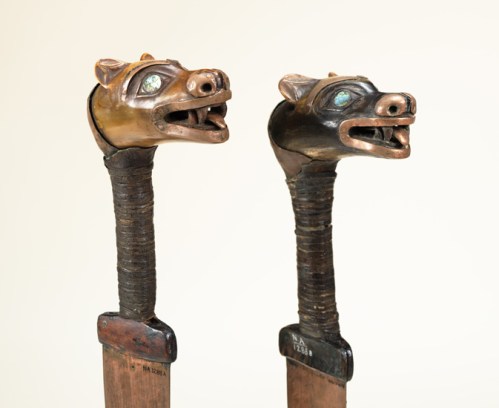
Tlingit dagger hafts, Kluckwan, Alaska. Purchased by George Gordon from Louis Shotridge at the Portland Fair, 1905. Penn Museum Objects NA1288a/b.

From the excellent University of Pennsylvannia Museum website, you can download back issues of their magazine “Expedition”, including this article on aboriginal metallurgy in Northwest North America (PDF).  The caption below is from that article: the two astonishing daggers being described are shown above.  Seriously, this is metalwork of the highest order, reminiscent of, say, Mycenaean pieces.

1969 caption describing the two daggers, above.

Peavies, pickaroons, hookaroons and skid tongs

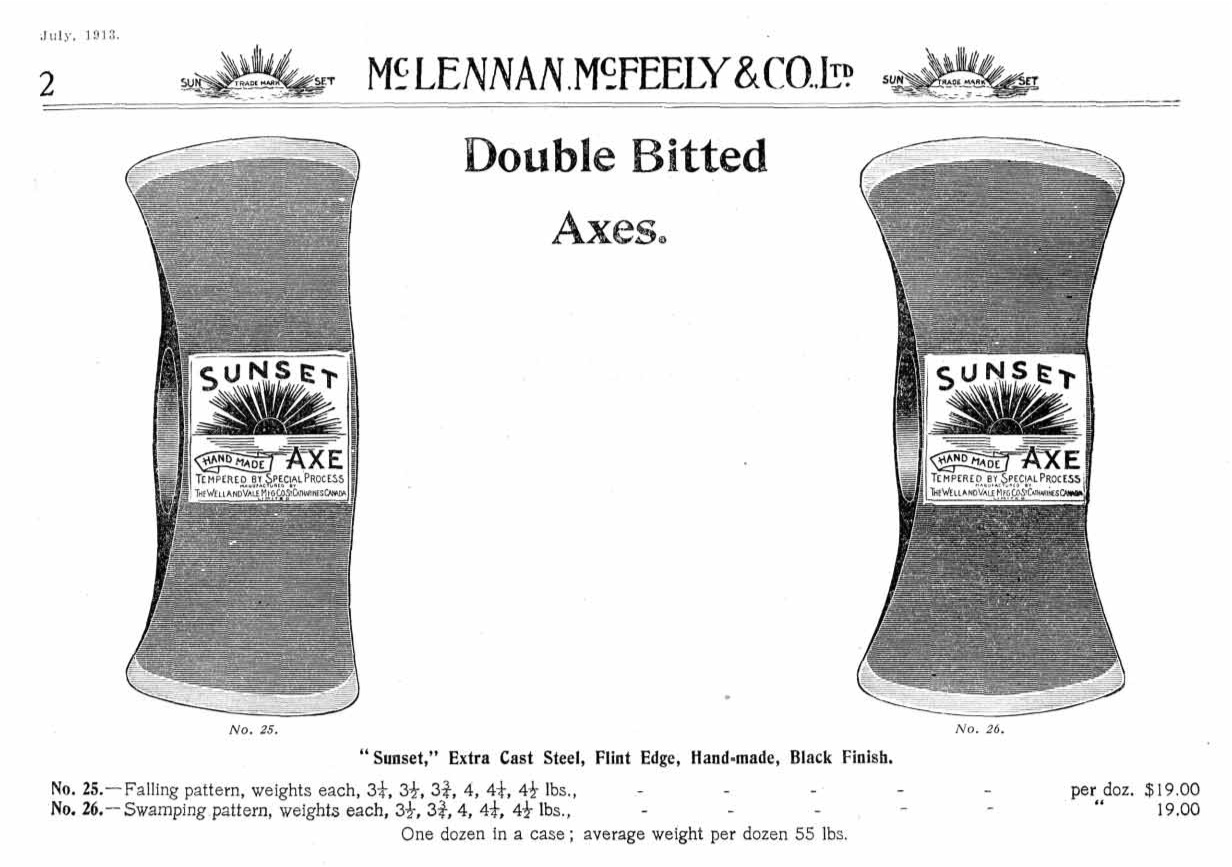
Double-bitted axes, available by the case.

It’s pretty common to run into historic industrial equipment when doing archaeological work in BC, especially logging equipment.  The Vancouver City archives has put the entire McLennan, McFeely & Co. Ltd Catalogue 1908-14 online, albeit in a somewhat awkward format (hey guys, why not just post a single PDF as well?) (edit: see comments below).  This catalogue would have been the ordering bible for many remote logging, mining and cannery outfits up and down the coast, the remains of which are often lying atop shell middens or strewn in the intertidal zone.  Altogether, the Vancouver City Archives and the Burnaby Village Museum have put  more than 1,500 pages of historic merchandise, as well as ordering and shipping information and price lists. Click on an image and it brings up a legible PDF of that single page.

Continue reading

Heather Pringle: Dogs for the Dead

Smell a corpse, not smell like one, Arbuthnot.

B.C.’s own Heather Pringle has a new blog these days, and her recent post on the use of forensic dogs to detect archaeological sites and human remains in particular, in Washington State, is worth a read:

According to the staff at the Institute for Canine Forensics, dogs can smell human remains that are buried as much as nine feet below the surface.  And they can detect remains as old as 2000 years.  ”Human remains have a scent that never,  ever goes away,  especially a bone,  even after it dries out,” one of the institute’s staff members told The Peninsula Daily News.