Category Archives: Northwest Interior

BC Archaeology Forum 2015 is October 16 – 18 at Musqueam

Just reusing the 2010 Archaeology Forum graphic here.

Just reusing the 2010 Archaeology Forum graphic here.

I think it was the day after the last Musqueam – Lab or Anthropology Archaeology Forum that I had to post this, so time flies, and not always exactly like a banana. In more recent dismal events, my laptop got disturbed, which, even though a quality it now shares with me, has disrupted this blog of the last week or two, not to mention my day job.  Anyway, I wanted to get out this announcment which twoeyes kindly forwarded a week or so ago: the 2015 BC Archy Forum is being co-hosted by the Musqueam Indian Band and the Laboratory of Archaeology at UBC, and runs from Friday October 16 to Sunday October 18.  So, soon.  What follows is the text of their announcement email within UBC circles.

Continue reading

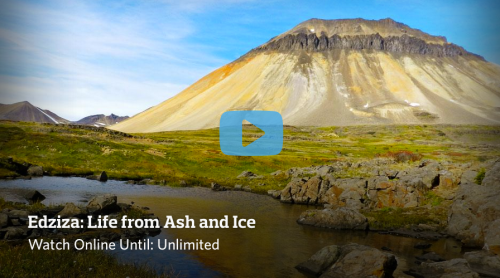
Life from Ash and Ice: A documentary film about Mt. Edziza

Screenshot of Knowledge Network video about Mt. Edziza.

Screenshot of Knowledge Network video about Mt. Edziza. Click to go to site.

For various reasons I’ve been off work for a while and that has meant being off blogging as well. If you’ve commented on posts recently then thanks; if you’ve emailed my gmail account and still would like a reply then maybe try again.

Anyway, what better way to resume making the occasional post here than a film about the place where I did some of my first ever fieldwork: assessing the then-proposed Site Z dam site on the Stikine River in Tahltan territory, far Northwestern British Columbia, in the shadow of Mt. Edziza.  Edziza is well known to Northwest Archaeologists as one of the region’s most important sources of obsidian, a volcanic glass highly suitable for making certain kinds of stone tools.

The video, Edziza: Life from Ash and Ice, can be watched in full on the B.C. Knowledge Network’s web site.  (NB: I had to change the resolution from a default of “lousy”).  Obviously the geology of the Edziza Complex is pretty cool (and is covered in the first half of the video, which features John Clague among others), but there’s quite a bit of more direct archaeological interest in the second half.

Continue reading

Reburial at Hagwilget: A Video

Click to Play Video

Click to play Sacred Ground video.

Archaeological encounters with human remains bring into sharp relief the competing values surrounding cultural heritage.  It doesn’t always go well – powerful emotions are uncovered alongside the burials.  So it’s refreshing and informative to come across a short video, Sacred Ground: In honour and in memory of our ancestors, made by Crossroads Cultural Resource Management, which follows the aftermath of the accidental disturbance of human remains at Hagwilget, on the Skeena Bulkley River.

Continue reading

Alaskan Fish Weir Photos

Screen shot from video of men building a fish weir near Atka, ca. 1946.  Click to see video.  Source: http://vilda.alaska.edu/cdm/singleitem/collection/cdmg11/id/37038/rec/36

Screen shot from video of men building a fish weir near Atka, ca. 1946. Click to see video. Source: http://vilda.alaska.edu/cdm/singleitem/collection/cdmg11/id/37038/rec/36

So, still rustling around the weird world of weirs.  The online Alaskan archives have quite a few interesting examples – and, kind of remarkably, a video showing the construction of a weir near Atka, which is on the Aleutian Islands.   The trap in the video is pretty similar to a couple of other Aleutian ones in the collection, which I’ll talk about below. It’s really cool to not only see a more-or-less traditional trap being built (look at the rocks being casually dropped down by the wooden fence!) but the photos also show weirs actually in use. There’s probably a lot to learn from these pictures – as any introductory textbook in archaeology will tell you, the more we know about the behavioural context of a given site type, the more we can reliably infer the cultural context when presented only with the archaeological remains.

Continue reading

BC Archaeology Forum is in Nanaimo, Saturday October 18th

Petroglyph from Petroglyph Park, Nanaimo. Source: danielleen.org

Panel from Petroglyph Park, Nanaimo. Source: danielleen.org

I’m about to disappear off the grid for a couple of weeks (fieldwork in Gwaii Haanas) but before I do, I want to give some publicity for the Annual BC Archaeology Forum.  It’s great to have some advance notice of this and as you can see below it is co-hosted by VIU and the Snuneymuxw First Nation.

edit: they now have a website including the program.

British Columbia Archaeology Forum

Saturday, October 18th, 2014

Nanaimo, BC

We are pleased to announce that the 2014 British Columbia Archaeology Forum will be hosted by Vancouver Island University in the territory of the Snuneymuxw First Nation in Nanaimo, BC this coming October.

A reception will be held on the evening of Friday, October 17th, with Saturday the 18th reserved for a full day of speakers and presentations followed by an evening event, and optional Sunday excursions in the local area.

We are currently consulting with downtown hotels about the event and securing discounted rooms for forum participants; more information on this will be provided asap.

In the meantime, save the date — Saturday, October 18th, 2014 — and we’ll be in touch soon!

For more information, email: archforum2014 (at) gmail.com

Memorial Tributes for Dr. Richard “Doc” Daugherty

Richard Daugherty with the famous "whaling trophy" from the Ozette Site.  Source: Washington State University.

Richard Daugherty with the famous “whaling trophy” from the Ozette Site. Source: Washington State University.

Dale Croes sends along the following information: two tribute events for the late Dr. Richard Daugherty, who passed away February 22 at the age of 91. Daugherty was Professor of Archaeology at Washington State University, and is best known for two remarkable projects: the Marmes Rockshelter dig and the long-term Ozette wet site project, the latter being commonly referred to as the “Pompeii of North America” on the grounds of its incredible preservation of organic Makah material culture.

I only met Dr. Daugherty once a long time ago when I was privileged to speak about the Kilgii Gwaay wet site in Seattle, but there is an entire generation of NW Archaeologists who were his students, or were otherwise inspired or mentored by him. If you’re one of them (and count me amongst the inspired), then feel free to leave a comment below, and this can serve as an online repository of good memories and funny stories perhaps. It’s the NW Anthropology meetings starting tonight in Bellingham and I am sure there will be plenty of beer glasses clinked in his memory.  If you click “continue reading” then I’ve gathered together some of the obituaries and also the poster which Dale sent with details of the two tributes, the first of which is this coming Monday in Olympia.

Continue reading

Yukon College Fieldschool Websites

Remains of the Mud Monster

Remains of the Mud Monster. Source: facebook.

I think it’s just wound down, but the recurring Yukon College fieldschool “methods in subarctic ethnography and archaeology” spawned some good websites and blog entries.  This fieldschool, convened by Norm Easton, has been happening for quite a few years now.  It has inspired a lot of students, including some from these parts, as well as made major contributions to anthropological knowledge in the broad sense of the term.

This year there was an active facebook page on which, among many other things, are posted thousands of photographs.  I checked and I don’t think you need to be on facebook to read these pages.  Four students also started blogs to track their experiences.  Of these, Yankee in the Yukon never really got off the ground with only two fairly short pieces.  Yukon Adventures also only had two posts, but these are well written, longer reflections of the leadup to the project. Archaeology Adventures had more posts, but is primarily a photo blog – evocative photos but with relatively little context – the surface finds of the blogging world!  It’s great to see students putting their thoughts and pictures out there beyond their own facebook udpdates – each of which is a bit of a walled garden relative to the rest of the internet.

The most sustained blog, one that is successful by any standard, is Yukonic.

Excavations at Little John Site.  source: facebook.

Excavations at Little John Site. source: facebook.

Here you will find dozens of well-written and reflective entries from “Kalista”, a student from rural Alberta,  who tracks the highs and lows, the trivia and depth, the raw and the cooked of the fieldschool experience.  Consider how she comes to say goodbye:

Because while the Archaeology was cool: hearths, obsidian flakes, a rodent tooth, bone fragments, and a preliminary or perhaps heavily eroded side-notched point in addition to other student’s impressive finds of blades, a complete bison heel bone, a perhaps 13000+ year old game-changer biface, and the admittedly really cool, very old squirrel bones, behind all of those things except perhaps some of the bones, is people. The cultural material only exists because of people. Accordingly, it is the people that made my experience in Beaver Creek. People like Leslie, Chelsea, Tamika, Eddy, Blake, Bessie, Wilfred, Louis and Robert, Eldred, Jessica, Pat, Pat’s wife (whose name unfortunately always evades me), Jolinda, Ryan, Glen, other Glen, Marilyn, DJ, Mike, Tristain, Leon, Tayla, Tom, Forrest, Ian, Martha, Julius, Susie, Selena, Roland, Star, Derrick, Ken, Doug, many more people and names I am forgetting, and of course Ruth and David. A list of names that may be forgotten corresponding to a community of people I intend never to forget.

Luckily, Tamika had the great idea to have hers and Eddy’s birthday celebration before we left so there was a nice gathering that unfortunately ended with goodbyes. The birthday party felt like home: copious amounts of food, the older people eating first, and three types of dessert (because one just isn’t enough).

It felt like home because of the parallel’s to my own family’s celebrations but also due to the welcome we were afforded in our time at the Little John Site: our welcome sign the first day, countless visits, teaching us Upper Tanana and how to make birch bark baskets, shotgun and rifle shooting, ball games, numerous other activities; their way of life. As David said, we are now ambassadors of their culture and if possible, I hope to be able to show some of the character the White River First Nation showed us.

No, I am not good at goodbyes. What do you say? How do you thank enough, wish well enough people who did so much yet you may never see again? Consequently of these thoughts, I am a most awkward person at goodbyes and perhaps do not look like I feel much, but as I put this goodbye on paper, I could cry.

It’s strongly to the credit of the fieldschool leaders (Norm especially, no doubt, but I am sure he has cultivated a cast of characters….) that the experience is more about people than about things.  Archaeology is always, or should always, be about people, not things, and if you can’t see the people in the present then what hope for finding them in the past?
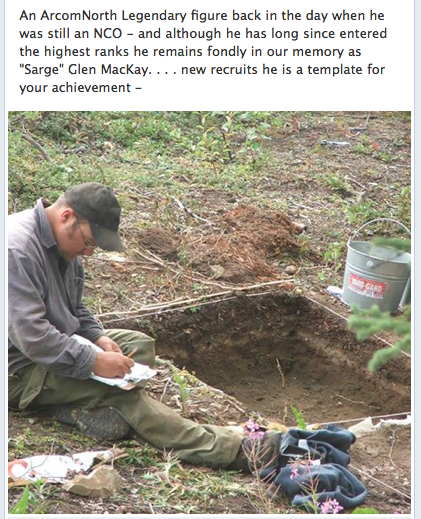
The inimitable Glen  showing off his chops.

Speaking of “people”: the inimitable Glen showing off his chops.

New finds from the Skeena River near Gitwangak

Unusual serrated stone tool from Gitwangak area site, perhaps used for cedar processing.  Source: CBC

Unusual serrated stone tool from Gitwangak area site, perhaps used for cedar processing. Source: CBC

There’s a nice audio interview and slide show from the CBC with Jenny Lewis of Kleanza Consulting archaeologists about a dig going on along the Skeena River near Gitwangak (Kitwanga) in Gitxan Territory.  The project is apparently a CN Rail siding repair and there have been many, many stone tools found, including some in stratified setting with carbon dates associated.

Remarkably, Lewis asserts that they have material dating to around 9,000 years ago, in addition to the more recent finds.  This would certainly make it amongst the oldest, if not the oldest, archaeological material known from the Skeena River area, although it is not specified how the earliest date estimates were arrived at.  The well-known sites in the Kitselas Canyon, for example, are generally all within the last 5,000 years if memory serves me right. Continue reading

Northwest Anthropological Conference 2013 – Portland March 27-30

View of reconstructed Cathlapotle Chinookan Plankhouse relatively close to Portland.

View of reconstructed Cathlapotle Chinookan Plankhouse relatively close to Portland. Click for source.

The 2013 Northwest Anthropology conference is coming up soon at the end of March, but it’s not too late to submit a symposium proposal (deadline January 28th) or contribute a paper (deadline February 8th).

NWAC is always an excellent conference which draws on Anthropology broadly but with a hefty dose of archaeology, sometimes mostly archaeology.  I’ve noticed in the past it also draws a lot of participation from Tribal and First Nations groups, from consulting and government archaeologists, interested laypeople, as well as academics of all levels from undergrads to retirees.  In that sense it is far more multi-vocal than the “really big conferences” tend to be.  It also has a tradition of very reasonable fees and hotel rates and this year is no exception.  Add on Portland’s status as microbrewery capital of (probably) the entire world and what’s not to like?

The conference is hosted by the excellent Department of Anthropology at Portland State University, with lead organization apparently by occasional blog commenter (and Professor Emeritus) Ken Ames.

The Canadian Archaeological Association conference is also coming up locally in May (at Whistler), so more on that in due course, but just for now, the call for sessions is open until January 31st.

Jobs on Haida Gwaii and at WSU

Archaeological Science on Haida Gwaii.

Archaeological Science on Haida Gwaii.

So I’ve never posted job ads here before and I may never do so again, but there are two ones posted right now with a lot of potential for readers of this blog: one is an archaeological position with the Council of the Haida Nation (PDF), the other a tenure track position  in archaeological sciences at Washington State University.

Continue reading