Category Archives: Lower Mainland

Capilano University Field School Blog

"At each logging camp a familiar discovery was a wood burning stove or oven. The one pictured {above} had stumped some former students of Muckle's in the past because the student who helped recover the stove had read an engraving on the side saying "To Jake". After pondering upon this curious inscription, it was realized that the "J" had incorrectly been read, and the whole etching had actually said "To Bake", commonly found on ovens." Source: http://archaeologyfieldschool.blogspot.com/

I noticed that the Capilano University Archaeology Field School, which just started a few days ago near Vancouver, has a blog.  So far there are three days worth of entries and it looks like it will be a lot of fun to follow along with the students who, under the direction of  Bob Muckle, will be continuing to work on the archaeology of historic logging in the Seymour River Watershed, which flows into Burrard Inlet.  Much of the logging was conducted by Japanese immigrants, making for a nice overlay of ethnicity and capitalism and material culture.

Continue reading

More on the Sea-to-Sky Cultural Journey

Sign at the Horsehoe bay kiosk. Source: tad McIlwraith flickr.com account.

A month or two ago I commented on the Squamish and Lil’wat Cultural Journey website, which explores oral history and place names in the traditional territory of these two southwestern British Columbia First Nations.  I was really happy to see that Douglas College Anthropologist (and occasional commenter here) Dr. Tad McIlwraith has carried the review much further.  He’s even taken it into the field, so to speak, by documenting and discussing the actual cultural centre itself, and also the roadside kiosks which bring Squamish and Lil’wat histories to the travelling public.

Tad’s review has two parts.

Continue reading

Basket Conservation at the Langley Centennial Museum

N'laka'pamux Basket undergoing conservation treatment. Source: LangleyMueum.org

I know I occasionally grumble about how regional, publicly funded museums in B.C. are almost devoid of archaeological and aboriginal substance, especially on the web.  A happy exception to this is the Langley Centennial Museum near Vancouver, which has an unusual and interesting virtual exhibit of N’laka’pamux basketry.  The museum is in the possession of a large collection of these baskets, made by an interesting historical figure from the Yale-Lytton area of the Fraser River: one Kathleen Pearson. The exhibit consists of a number of pages, including a short essay (5 pages) which is strangely not clearly linked, based around Boas et al.’s 1928 Bureau of American Ethnology Publication.  The museum goes beyond the historical frame by discussing recent named weavers such as Mary Ann James, and the continuing tradition of N’laka’pamux basket making.

It is really great to see a relatively small museum explicitly recognizing that the world didn’t begin in 1846 and going beyond the story of white settlers as if they were a self contained pod of culture beamed down from Queen Victoria’s forehead.  The other thing  I particularly like about this small web exhibit is that the museum highlights the activities of another group of unsung heroes in the world of heritage conservation: the conservators who restore, stabilize and protect the artifacts entrusted to museums.

Continue reading

Katzie Artifact Gallery

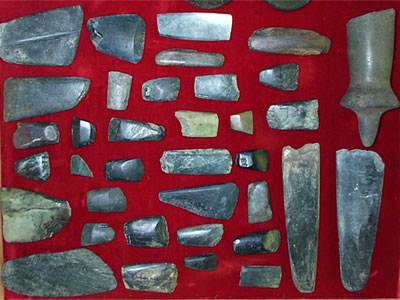
Ground stone celts (adze and chisel blades). Source: Katzie.ca

Hmmm: the pictures are low resolution, there isn’t much annotation, many are of replicas, and the page design HTML is wonky, causing a lot of sideways scrolling.  Yet I really like the Katzie First Nation’s artifact gallery.  And no, its not only because they give ground stone its rightful pride of place.  Though, in the image above, feast your eyes on the uppermost left specimen – an unusual yet definitive example of a broad celt being bisected to form two narrow ones.  In essence, an adze is being turned into two chisels.  Chew on that, Spaulding and Ford. Also check out the specimens in the centre-right, where the sharpened bits differ in colour from the bodies.  These are either patinated specimens subsequently reground and recycled, or speak to a process of heat treating or oiling or similar to enhance the raw material.  You could read all about this in my M.A. thesis if it were online, which it isn’t.  Or wasn’t until five minutes ago.  But I digress.

What I like is the text associated with these images.

Continue reading

Northwest Research Obsidian Studies Lab

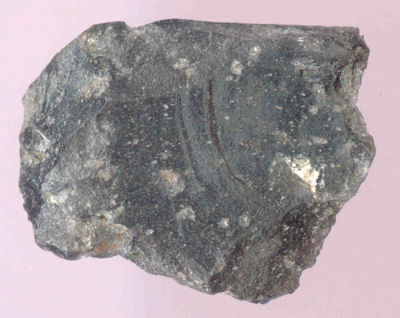
A flake of obsidian from DhRr-18, southern British Columbia. This visually-distinctive glass is from the Mount Garibaldi obsidian source.

Obsidian is a kind of volcanic glass and was highly prized for making certain kinds of stone tools.  Obsidian forms at places of relatively small outflows of magma, or liquid rock.  Small flows can cool quickly, which allows the formation of a glassy crystalline structure ideal for stone tool manufacture.  Small flows also represent a small sample of well-mixed magma, and thus each little patch of obsidian may share a very distinctive chemical signature.  This signature, usually identified by trace elements such as Strontium, Zirconium, Yttrium and Rubidium, then allows for the chemical fingerprinting of each source.  Any obsidian artifact found, whether at a source or not, can also be “fingerprinted” and then compared to a catalogue of known obsidian ources.  Since the artifacts don’t move around on their own but only through the agency of humans, the distribution of obsidian artifacts is a proxy measure for the movement and interaction of people.  When you have hundreds or thousands of such artifacts and a large database of known sources, then you can start to see large scale, long-term social interaction emerge from the silent archaeological record.  Most obsidian isn’t visually distinctive enough to sort out by eye alone, so these geochemical methods are essential.

So far, so Archaeology 101.  I was really happy to find that Oregon’s Northwest Research Obsidian Studies Laboratory has a web site not which not only solicits business, but is a highly educational and informative site about many aspects of obsidian analysis, with a focus on the Northwest. Continue reading

Puget Sound Clovis

In Red: Surface Finds of Clovis Projectile Points. After Croes et al. 2008.

I posted yesterday about the Manis Mastodon site and its possible status as a pre-Clovis site on the Olympic Peninsula.  Clovis projectile points are so distinctive that most archaeologists have no problem assigning even an isolated find of such a point, lacking in any kind of stratigraphic context or any associated dates, to the Clovis archaeological culture.  We know from sites elsewhere in North America that Clovis dates to a pretty narrow window, perhaps only 13,200 to 12,800 calendar years ago.  It has always been very closely associated with the ice-free corridor route for the First Peopling of the Americas and is predominantly known from classic sites in places like Colorado, New Mexico and Texas. So it may come as a surprise to some that Clovis is pretty well represented in Puget Sound and north to Bellingham Bay, although only from surface or other finds without provenience.

Continue reading

Forthcoming Vancouver Archaeology Talks

Once in a while I yawn, stretch, and look across the Moat of Georgia and notice something interesting happening in Vancouver.  This time I see there are two forthcoming events for those within striking distance of the Velvet Rut.

First, UBC is holding its annual Archaeology Day this weekend, Sunday March 21st.  The program, which looks great, can be viewed here.  The event is free and open to the public and is held in the Anthropology and Sociology Building on the UBC Campus.

Second, the Vancouver Chapter of the Archaeological Society of BC is holding a public lecture featuring SFU professor Eldon Yellowhorn.  His topic is “Encountering Modernity: the Piikani Historical Archaeology Project.  The poster is below, click for a legible version.  The talk is Wednesday March 24th at 7.00 at the Museum of Vancouver (who don’t seem to have it listed on their calendar), and it is free and open to the public.

Memo to the ASBC-Vancouver: update your web site if you want people to come to your talks.

Click to enlarge

One more update on the Museum of Vancouver’s Petroglyph.

Interior Petroglyph now at Museum of Vancouver, while still in Stanley Park ca. 1980. Source: DanLeen.org

I have posted several times recently on a superb interior petroglyph boulder languishing in a shady courtyard at the Museum of Vancouver.  Together with Heather Pringle’s posts on this topic, we seem to have caught the attention of the Board of Directors of the Museum.

One of the Directors, Anthropology Professor Bruce Miller of UBC, called me the other day.  He consented to me posting notes from our conversation.   Continue reading

More views of the Museum of Vancouver petroglyph problem

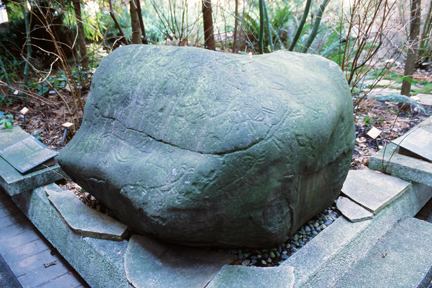
Petroglyph from Lone Creek Cabin, Stl’atl’imx Territory, now in an outdoor courtyard at the Museum of Vancouver. Source: Squamish-Lil'wat Centre.

I’ve posted before on the large petroglyph boulder from the central Fraser River that is being kept in a sub-standard context at the Museum of Vancouver.  I found some more pictures of it, from the website of the Squamish-Lil’wat Cultural Centre (which is excellent).  These additional pictures confirm there is a serious conservation issue at the Museum of Vancouver.  I don’t want to beat a dead horse but I am still mad about this situation. Continue reading

“Correct Map of the Gold Diggings”: May 20th, 1858

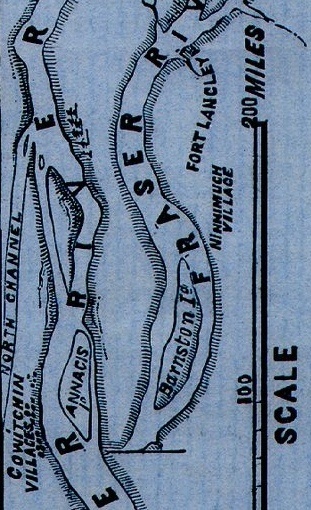
Detail of 1858 Map of Fraser Gold Diggings. Click for full image.

From UBC, this interesting 1858 San Francisco broadsheet “The Pictorial Newsletter of California” (large JPG file).  Most of the text is mundane births and deaths, but the map above from it is a lot of fun.  It’s especially interesting to see the “Cowitchin” Village at New Westminster.  Now, “Cowitchin” was often used as a generic term for many Coast Salish people in the early historic period.  But note too, just upriver at Fort Langley, a “Ninnimuch” Village, presumably Snuneymuxw First Nation, also known historically as the “Nanaimo” people, whose core territory would be on east Central Vancouver Island.  There are lots of reports of Vancouver Island nations paddling up and down past Fort Langley so its not that much of a surprise, but rather a nice testament to the extensive regional trade and, perhaps, permeable social networks in place across the greater Gulf of Georgia. It also makes me think the “Cowitchin Village” might indeed really be Cowichan. It’s notable the “Pinkslitsa River” (Harrison River) is the only lower tributary mapped, probably because it was an important route in and out of the middle Fraser, bypassing the canyon.  It’s a nice map, it’s early, and I’d never seen it before, so thanks to UBC and their Early BC Newspapers page.

Detail of 1858 map showing "Cowitchin" and "Ninnimuch" Villages on Lower Fraser.

From the UBC notes:  Pictorial News Letter of California: for the Steamer John L. Stephens San Francisco: Hutchings & Rosenfield; Charles F. Robbins, Printer, 1858

“Issued exactly one month after the first steamer left San Francisco headed for the Fraser (Bancroft p. 359), this appears to be the first separate publication relating to the Fraser River Gold Rush, and the first map published to illustrate the area for potential gold-seekers.”

You can also download a short PowerPoint file here, and there is an overview essay here.