Category Archives: history

Adawkhl Gitsegulka

Gitsegulka ca. 1909. Source: Adawhkl Gitsegulka.

Yesterday, while posting CanadaGood’s flickr set of “totem poles” I found a really interesting document at the web site of the Gitsegulka community of the Gitxsan First Nation on the Skeena River.  Called Adawkhl Gitsegulka, it is a history of the settlement written in 1979, by band members via consultation with hereditary chiefs.  So often we only see these historical pamphlets for settler communities; it is quite fun and interesting and a little bit sad to read through this one written by First Nations themselves.  For example, note how (page 7) the Indian Agent in 1909 respects the hierarchies of the hereditary chiefs, apparently only in order to establish himself as the highest ranking of the lot.  Scroll down to page 35 for a discussion of the motives and means of carving poles.

There is an interesting theme which runs through the whole document: the uneasy relationship between the deeply felt Christianity of many Gitsegulka Gitxsan, and the old ways and practices.  In its informal way, through consultation with numerous elders, with charming illustrations, the Adawkhl Gitsegulka is an intriguing source of information on how the community saw itself in the transformative years of the late 1970s, when land and title claims were once again rising.  Five years on, they were in court claiming rights and title to their territory, and not much more than 10 years later, the landmark, borderline racist, “McEachern decision” of the BC Supreme Court would be handed down (the Gitxsan-Wet’suwet’en case: Delgamuukw vs. the Queen, round 1) which started a transformation of aboriginal rights in Canada.  Delgamuukw 3  in 1997 eventually set the frame for the modern treaty process when the Supreme Court ordered a new trial.  The trial has never happened but the new Supreme Court terms and definitions structure our modern understanding that Aboriginal rights and title were never extinguished and must be reconciled.  The Adawkhl Gitsegulka is an indigenous perspective on a small community about to have its voice heard right across Canada.

The document ends with the slogan of the [then] Gitksan-Carrier Tribal Council:  “Walk on, walk on, on the breath of our grandfathers”.
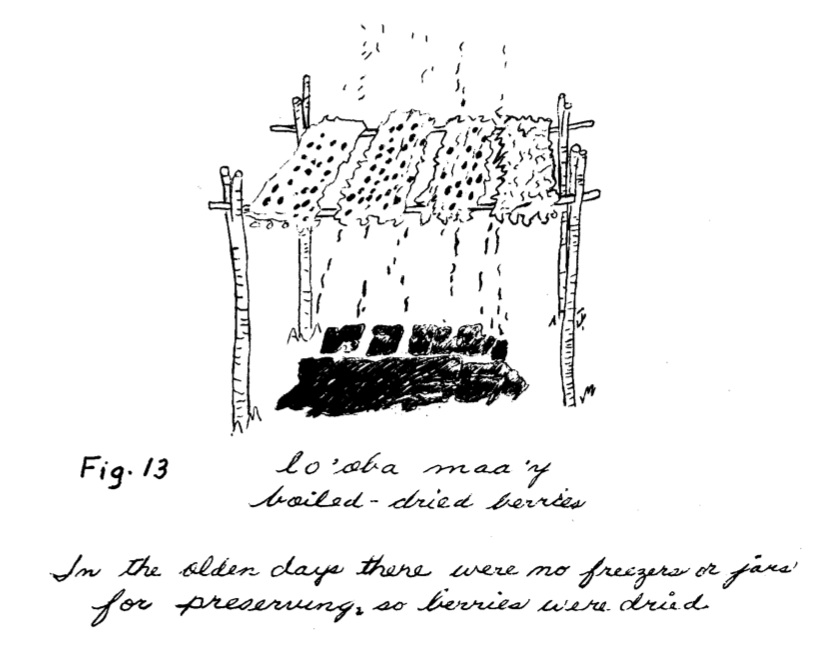
Drying Berries. Source: Adawhkl Gitsegulka.

Interior layout of a house. Source: Adawkhl Gitsegulka.

Flickr user CanadaGood’s pictures of poles

Fallen pole at Gitsegulka. Source: flickr.com user CanadaGood.

Someone posting under the username “CanadaGood” at flickr.com has put up an impressive array of over 100 photos of “totem poles”.  What I like about this set is that most of these are not the iconic ones from coffee table books or museums but rather are still standing (or lying) in communities, mostly along the Skeena River.  They aren’t the most technically accomplished photos or anything but they are undeniably atmospheric and they document the process of renewal and decay of poles which was an important part of the carving complex.  Each pole is the material instance of the right to carve and display a set of crests or images, often as a memorial to a dead person of high status, and therefore the “thing” must be set against the intangible, non-material property of rights and titles which it represents.  Proper treatment of the pole might therefore well include letting it return to the earth, replaced by a fresher copy.  I like the matter of fact way this one is set up on stumps and this rotting masterpiece at Gitanyow.  This figure is unusual for being “sculpture in the round”.   Kudos to CanadaGood for putting pictures of these less commonly seen poles on flickr, in high resolution, and under a Creative Commons licence to boot.

Tops of standing poles at Gitsegulka. Source: flickr user CanadaGood.

“Correct Map of the Gold Diggings”: May 20th, 1858

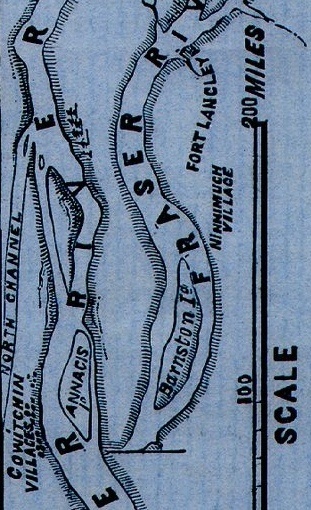
Detail of 1858 Map of Fraser Gold Diggings. Click for full image.

From UBC, this interesting 1858 San Francisco broadsheet “The Pictorial Newsletter of California” (large JPG file).  Most of the text is mundane births and deaths, but the map above from it is a lot of fun.  It’s especially interesting to see the “Cowitchin” Village at New Westminster.  Now, “Cowitchin” was often used as a generic term for many Coast Salish people in the early historic period.  But note too, just upriver at Fort Langley, a “Ninnimuch” Village, presumably Snuneymuxw First Nation, also known historically as the “Nanaimo” people, whose core territory would be on east Central Vancouver Island.  There are lots of reports of Vancouver Island nations paddling up and down past Fort Langley so its not that much of a surprise, but rather a nice testament to the extensive regional trade and, perhaps, permeable social networks in place across the greater Gulf of Georgia. It also makes me think the “Cowitchin Village” might indeed really be Cowichan. It’s notable the “Pinkslitsa River” (Harrison River) is the only lower tributary mapped, probably because it was an important route in and out of the middle Fraser, bypassing the canyon.  It’s a nice map, it’s early, and I’d never seen it before, so thanks to UBC and their Early BC Newspapers page.

Detail of 1858 map showing "Cowitchin" and "Ninnimuch" Villages on Lower Fraser.

From the UBC notes:  Pictorial News Letter of California: for the Steamer John L. Stephens San Francisco: Hutchings & Rosenfield; Charles F. Robbins, Printer, 1858

“Issued exactly one month after the first steamer left San Francisco headed for the Fraser (Bancroft p. 359), this appears to be the first separate publication relating to the Fraser River Gold Rush, and the first map published to illustrate the area for potential gold-seekers.”

You can also download a short PowerPoint file here, and there is an overview essay here.

1973 Aboriginal Perspective on UBC-MOA and SFU archaeology

Excerpt of 1973 Nesika newsletter criticizing MOA and SFU Archaeology. Click to view full page. Scroll down this page for link to plain text.

2018 edit: It looks like Nesika is now available to browse here, and to search here.

This is interesting, from the newsletter Nesika: Voice of B.C. Indians Vol. 2 No. 1 (February 1973), Page 6:

MONEY FOR BOAT: There is money to fund a boat to take archaeology students up and down our coastline to dig up the bones of our grandfathers and sift, sort, and label sacred objects from our burial grounds, but no money for us to treat our heritage with the dignity it. deserves?

This can only refer to the former pride and joy of the SFU department of Archaeology, the motor vessel Sisiutl.

That page from Nesika has two interesting articles.  One argues for the creation of a Cultural Centre at Hesquiat, while the other passionately objects to the millions spent on the UBC Museum of Anthropology and the above-mentioned Sisiutl.  Click on the image above for a legible image of the entire text, or click here for a transcript.  It is chastening to see the eloquence and power of these arguments from almost 40 years ago.  Hesquiat still has no Cultural Centre so far as I know while the Museum of Anthropology just wrapped up a 60+ million dollar renovation and SFU Archaeology has what amounts to their own, brand-new building as well, at what I hear was a cost of about 5 million dollars.

HESQUIAT BAND CULTURAL CENTRE

Lack of funds hit by Chief Rocky Amos

VANCOUVER (Staff) — After Indian Affairs had denied a request for funds for the Hesquiat Cultural Centre due to lack of funds, Band Chief Rocky Amos told the department that “we cannot accept the limitation of funds as valid.” Pointing to the $10 million available to a museum to house Indian artifacts at UBC and to other reports of funds granted for more white people to study Indians, Chief Amos wrote DIA: “It is difficult to follow the line of thinking that makes money available to exhibit our inheritance to city based people and when the rightful heirs to these very artifacts ask for assistance to house their history in an area where it will be meaningful to them, they are denied. “We of the Hesquiat Band are not unique and we have proven we can do it. Now we are made to crawl on our stomachs begging for funds to house our heritage. My pride is aching from begging but my pride also screams in agony when our people are forced into whitemen’s museums to see their inheritance.”

As the second article concludes in terms it is hard to argue with:

If there is money available for museums to store stolen work, then there is money available for museums to be built where that work belongs. With the children and grandchildren of the artists who represented a culture and society which has not, despite all efforts, conveniently died.

First custom built archaeology research vessel in North America: The Sisiutl. Recently scrapped by SFU.  Source: American Antiquity.

PS: kudos to the Union of BC Indian Chiefs for putting so much archival information online.  In related news, I previously linked to the archives of the Native Voice, which is another great resource for understanding First Nations politics and which also contains intriguing aboriginal perspectives on the practice of BC Archaeology.

Ha’ina: supernatural Nuu-chah-nulth crystal?

Crystal artifact said to be used to summon guests to feasts. Source: British Museum

Hmmm, coincidences.  Two or three days ago I was having a beer with a recently graduated student of mine, who was telling me about a number of quartz crystal artifacts he had found in an excavation in the Fraser Valley.  Now, artifacts made of quartz crystal are well known in the Gulf of Georgia — the nature of the rock makes it highly suitable for flaked stone tool production, especially microblades.  Ethnographic accounts suggest they could also be used for sawing very tough rock types such as nephrite.  However, the artifacts being described to me the other night included complete crystals with grooves around the bases — pendant-like, perhaps, or specialized abraders, or, well, or what?

Well,  in a stunning display of “coincidence”, or a happy intervention from a raven, today I ran across just such a shiny little thing at the British Museum website.  From their text, (which I cannot vouch for, having never heard of such a thing before):

The Nuu-chah-nulth believed that these crystals, or ha’ina, grew on the top of mountains and were endowed with magical qualities for bringing wealth and good fortune, for example, when hunting sea otter.

This ha’ina was collected by Captain George Dixon, who had accompanied Captain Cook on his Third Voyage (1776-80) to Vancouver Island. In 1785-88 Dixon made a trading voyage on the King George and Queen Charlotte which was promoted by the King George’s Sound Company (King George’s Sound was Captain Cook’s short-lived name for Nootka Sound on Vancouver Island, where this crystal was collected, probably from the Mowachaht people.)

The Nuu-chah-nulth used the ha’ina to invite people to potlatches, the great feasts given to celebrate life-cycle events at which hereditary rights were displayed. The invitation to a potlatch would take place at a gathering a year or two before the potlatch, when the crystal would be, metaphorically speaking, sent out to the prospective guests. They may have ‘sent’ this example to Dixon. Dixon was supported by Sir Joseph Banks in his work, and through Banks gave this ‘piece of rock crystal’ to the British Museum on 22 May 1789.

It would be sad and ironic (though not surprising) if this artifact was indeed an invitation never acknowledged, an unfulfilled RSVP, and if the gormless British had managed to interpret an invitation as a commodity and not as a request for honour, attendance and respect.  It would be wrong on a number of levels to draw conclusions about the Fraser Valley examples, but it does show the potentially fuzzy boundaries between symbolic and functional material culture.

Memories of Ozette

Makah whaler Wilson Parker posing as a MAKAH WHALER for Edward Curtis, ca.1915

The magazine of Washington State University has a nice article on the archaeological project at Ozette, the UNESCO World Heritage Site on the west side of the Olympic Peninsula.  This Makah village site was covered by a landslide about three hundred years ago (animation), which created preservation conditions highly favourable to preservation of wooden artifacts.  The story begins

THERE’S A WELL-KNOWN PHOTOGRAPH taken by Native American chronicler Edward Curtis in 1915 of a Makah whaler. Dressed in an animal skin, the man is longhaired and wild. He had indeed been a whaler, as had generations of his people. But still, the photograph is a memory of a time already past. Curtis provided Wilson Parker with a hide and a wig to replace the European clothes the Makahs had adopted long before. In spite of Curtis’s fiction, however, there is much to be learned from Wilson Parker, the man in the photograph. As is always the case with a good myth, there is a deeper truth that lies beneath the surface story.

Parker is Sharon Kanichy’s great-great-grandfather, she tells me as we talk in the Makah cultural center in Neah Bay. Kanichy ’01 was born in February 1970. That same month, a powerful storm blew in off the Pacific, eroding the bank above the beach at Cape Alava, on the Olympic Coast, revealing something remarkable.

“All we knew was there was a burial site,” says Ed Claplanhoo of the buried longhouses revealed by that February storm. Claplanhoo ’56 was Makah tribal chairman in 1970, so it was he who got a phone call the first Saturday in February, from a hippie schoolteacher, as Claplanhoo describes him. A dubious character, says Claplanhoo, which is why he didn’t take the fellow seriously when he tried to warn Claplanhoo that “people” were getting in the “house” and taking “artifacts.” Claplanhoo knew everyone in Neah Bay and knew everyone who owned artifacts. He’d heard of no problems.

But the fellow persisted. The next Sunday, the same phone call. “Mr. Claplanhoo, they’re still taking artifacts out of the house.”

“So I said okay,” says Claplanhoo, “I’ll tell you what, you come to my house at seven o’clock tonight and we’ll talk about it.”

From there, the article recounts the story of the Ozette excavations from the point of view of both Makah and the archaeologist Richard Daugherty, who led the decade long excavation of “North America’s Pompeii.”  It nicely captures the importance of the site as well as the nature of the dig and the social relations formed which endure to this day.

Don’t miss the slideshow from the excavations — it’s an awkward interface but some very atmospheric pictures of life on a remote archaeological dig in the 1960s – as well as a few shots of the US Marines who helped airlift supplies in and treasures out.

Digging at the Ozette Site - the hoses were used to gently free the wooden artifacts, such as the house planks shown, from the mudflow which buried them. Source: WASU Magazine.

Rock Art on Gabriola Island in 1792

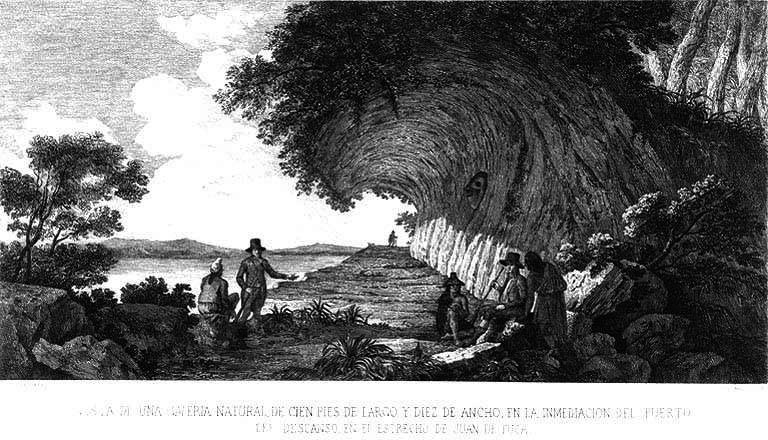
Descanso Bay Rock Art, 1792. Source: U. Washington

From the University of Washington, an unexpected image of a large Gabriola Island rockshelter containing rock art, entititled:

Northwest Coast carvings on cliff near Descanso Bay, Gabriola Island, British Columbia, in engraving made 1792.

Cardero, Jose, b. 1767 or 8

Notes: Photograph of engraving of explorers and indians viewing a carved head and other petroglyphs on the side of a cliff. The caption says it is a view of a natural gallery, one hundred feet long, and ten feet wide near Descanso Bay.

Caption on image: Vista de una galeria natural, ce cien pies de largo y diez de ancho, en la inmediacion del puerto del Descanso, en el estrecho de Juan de Fuca Image from Alessandro Malaspina’s Viaje politico-cientifico alrededor del mundo, 1885, f.p. 200

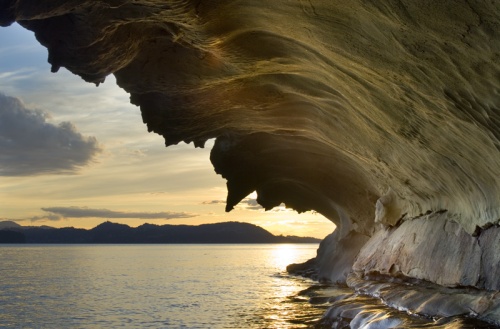
I presume this is the “Malaspina Galleries” near the ferry terminal – I didn’t know there was rock art there though and maybe there isn’t, anymore.  Perhaps this place, or this one? Or, perhaps the unusual pitted and pocked natural sandstone fooled the Spanish, though it sure looks like there is a large image in the middle of that engraving.   Quick, Gabriolans, trot down there and check it out.

Malaspina Galleries, Gabriola Island. Photo: Kevin Oke.

Stanley Park’s Wandering Petroglyph

Petroglyph Boulder in Stanley Park. Source: Vancouver Public Library

I was intrigued by this 1930s photo of noted Vancouver photographer Philip Timms perched beside a large petroglyph in Stanley Park, not least because it is obviously not from the coast. The caption indicates as much: “rock was brought to Stanley Park from the Cariboo; at the former totem pole site at Lumberman’s Arch.”

A little digging around suggests this boulder was discovered in 1923 in the Lone Cabin Creek area of the middle Fraser River, just south of the Gang Ranch. It was moved to Stanley Park in 1926. As of 2002 at least, it was still there. If anyone knows for sure where it is, let me know.  The complete absence from flickr, for example, suggests to me that the information below sayng it is stashed out of site at the Vancouver Museum may be accurate.  This site has a number of undated pictures of it (not the apparent deterioration from the picture above – it probably doesn’t do well in the rain) and some history and interpretation which I can’t vouch for:

It is thought that this boulder may have been a marker of a Salmon site. Another theory has the stone important in puberty rites. This boulder is probably about 500 years old. This petroglyph was carved in the vicinity of Lone Cabin Creek, north of Lillooet, on the Fraser River. It first gained Euro-Canadian attention in 1923 upon its discovery by H.S. Brown a cariboo prospector. He brought its existance to the attention of William Shelly, the Vancouver Parks Board commissioner of the era. Shelly proposed moving the six-ton rock from its location on the Fraser to a new home in Stanley Park. Three years alter, the move commenced. The rock was first loaded onto a raft to be floated to the nearest railway station. This awkward plan failed as the weight of the boulder caused the raft to sink immediately after loading. The next, more successful attempt involved a team of ten horses and a sled. In the dead of winter, the “Shelly Stone” was dragged to the closest rail line. This whole procedure took over a month and cost Shelly two thousand dollars which was a lot of money at the time. The Shelly Stone arrived safely at Stanley Park. It was set in a foundation of concrete as it was felt this would prevent the enormous rock from being carried off or destroyed. The rock remained at Brockton Pt mislabeled as an Indian Pictograph until moved to the Vancouver Museum basement in June of 1992. During the years in Stanley Park, human contact and urban polution have worn on the petroglyph like sandpaper. It is hoped that the protected environment of the museum will guard its images from further deterioration. Since it is not part of the regular museum exhibition, it currently does not cost to view it.

This boulder must be of the highest spiritual and cultural significance — shouldn’t it be moved back to the Cariboo where it belongs?

Geist: Memory and the Valley Photo Essay

Sxwòyeqs (The Place that Everyone Died) | Stave Lake. Source: Geist Magazine.

A while ago I linked to a beautiful photo-essay from Geist Magazine on decaying towns on the BC coast.  I see they have another excellent photo essay, this one on the subject of the superposition of Euro-Canadian towns and spaces onto Aboriginal archaeological sites and significant places.  The text by Sandra Shields and David Campion is sensitive and evocative and the photographs are well taken — in some ways they are banal – an overpass, and access road – yet knowing what lies underneath triggers emotional reactions. UVIC’s own Duncan McLaren is featured as well so it must be a good article – Stave Lake (above) has two of the oldest archaeological sites in Canada (each more than 12,000 years old), parts of which miraculously survived the reservoir inundation.

The Geist authors are interviewed here, which is also well worth reading:

Interviewer: it’s not only peo­ple that are miss­ing in “Memory and the Valley”; you touch on the dis­ap­pear­ing salmon, the white pine, the waters drained away. There’s def­i­nitely that tone of loss through­out the whole work.

Campion: That is why we’re hav­ing the exhibit here in the old city hall in Chilliwack, with a wall of the orig­i­nal pio­neers look­ing down on the work. It’s because you strug­gle with these two nar­ra­tives. One says: When Canada started, we came to a land that had no peo­ple in it and we strug­gled really hard and made a won­der­ful life for our­selves and a future for our chil­dren. Whereas, for abo­rig­i­nal peo­ple, it’s a story of huge pain and suf­fer­ing, and a huge loss of peo­ple to dis­ease, even before con­tact. Then res­i­den­tial schools, cul­tural mod­i­fi­ca­tion, and so on.

So you’ve got this prob­lem at the base of Canadian soci­ety. For soci­ety as a whole to move for­ward, we need to find a way to acknowl­edge that loss, not just to have it mean some­thing in that on/off, negative/positive sense. As non-Natives, we need to find a way to absorb the real­i­ties of our com­ing here into our national narrative.

The notion of a “palimpsest” in archaeology is common, borrowed from manuscript studies: parchments would be scraped clean and re-used, yet, the older writing can still be seen and read, a ghostly precursor image.  Writing over writing, material culture over material culture, names over names and the living over the dead.  Every time you walk across the concrete apron in front of the MacPherson Library at UVIC you walk across an archaeological site.  Every time you leave the Elliot Lecture hall you walk across a site.  The Legislature is on a site, the Fraser Arms Hotel, the Willows Beach Tea House, all superimposed, a collective blotting.  Our feet tread the scraped parchment of the dead.

Leq’á:mél | Nicomen Island

Even more on the Wilson Duff – SGang Gwaay Musical

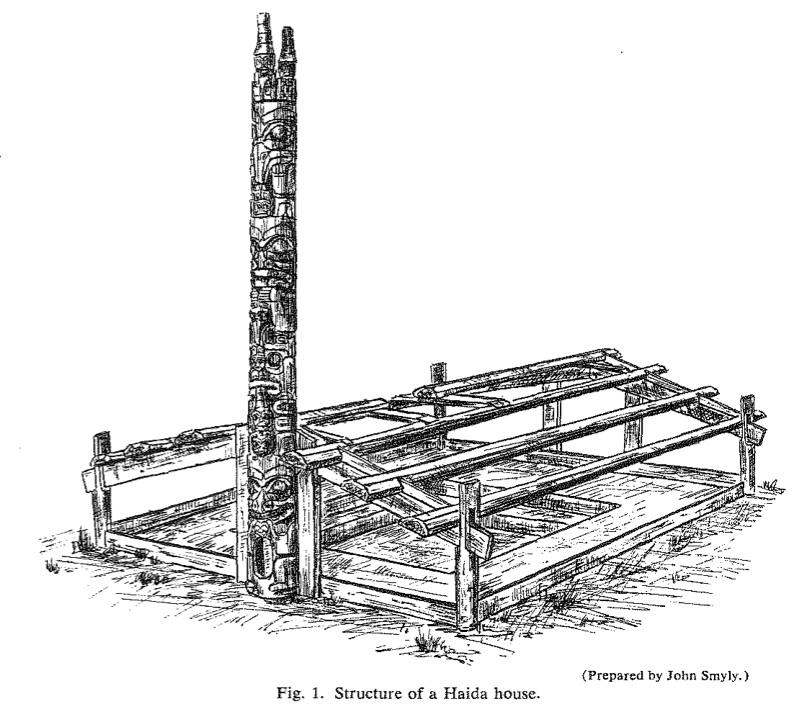
Haida House and pole. Source: Duff and Kew, 1957.

A month or two ago I made several posts (1 , 2, 3) about a forthcoming musical called Beyond Eden, which tells the story of the 1957 expedition to ‘rescue’ poles from the Haida Town of SGang Gwaay (PDF).

I notice The Tyee has a very good overview of this musical (which opens tonight) including some comments from Roy Jones Sr. of Skidegate, last seen on this blog as a young man climbing poles in 1957 CBC archival footage.  Says The Tyee:

Now in his mid-80s, he is reflective about the experience, having enjoyed the physical work and the company of members of the crew — but about cutting the poles? “It didn’t feel right,” he said. However, the Skidegate Band Council had approved the work and many felt it was the right thing to do. Further to that, Jones was on a recent trip to The Chicago Field Museum and saw one of the poles taken from Skedans (an expedition he was also on). “If they hadn’t taken it at that time, it would have been ruined, I think,” he said.

It is good to see some Haida perspective on both the events of 1957 and on this musical.  I also didn’t realize Nathalie at the Qay museum was a student of Wilson Duff’s — I’ll have to buy her a coffee and pump her for stories next time I am up on the islands. It’s a good article — The Tyee is doing some of the best journalism in BC right now.

Poster for "Beyond Eden" musical. Click to buy tickets; scroll down for title song.