Category Archives: history

Victoria’s history through cartoons

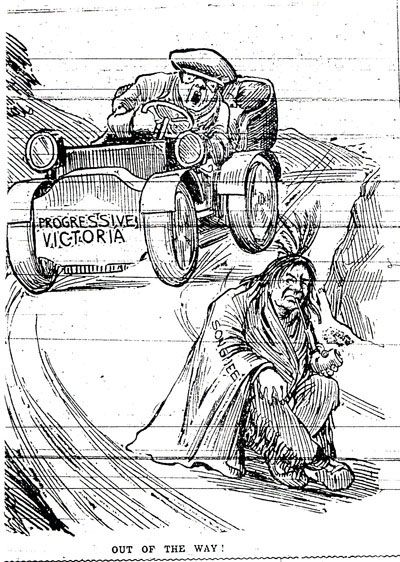
"Progressive Victoria" about to run over the Songhees. Was there ever a Songhees man with feathers in his hair, fringed buckskin, and a peace pipe? Source: Vincent's Victoria.

I mentioned it in a comment the other day so you may have seen it already, but there are a couple of great posts at the blog “Vincent’s Victoria“.  The first post is the already-mentioned review of John Lutz’s talk “Getting the Indians Out of Town: Race and Space in Victoria’s History” – Victoria, British Columbia, that is, better known as World Headquarters to this blog.   In Vincent’s post we find out about the slow process by which First Nations had their presence in the city core steadily reduced, mainly by moving the reserves, but through other means too.  The post then discusses the “Signs of Lekwungen” project which I posted on before. it’s really a shame I didn’t hear about John’s talk until after he had given it – there are other talks in the series but his would have been the most interesting to regular readers here.

The second post is extremely interesting, as it uses editorial cartoons from the Victoria Daily Times newspaper to tell the story of the movement of the Songhees reserve in 1910.

Continue reading

Revisiting the Salt Spring Island Archives

Part of the Charles Sampson collection from Salt Spring Island. Source: saltspringarchives.com

Salt Spring Island is a large island in the Salish Sea, close to Vancouver Island’s southeast corner (map).  Quite a while ago I highlighted the photographs of the “Bob Akerman” museum, which comes via the comprehensive Salt Spring Island archives.  There are a few other photo records of archaeological collections there which I thought were worth a quick look.  For example, the picture above from the Charles Sampson Collection shows some fairly spectacular ground slate points to the left, and what may be a Charles phase (ca. 4,000 year old)  contracting stem point to the bottom right.  It’s not just archaeological collections that the archives has going for it, though. Continue reading

Mossback nails it . . .

Mossback's column at Crosscut.com

Some time ago I mentioned Seattle’s reporter on the “Heritage Beat”, Knute Berger, who posts by the name Mossback. Over the summer, while I was gone, mossback produced a really to-the-point column on heritage preservation: Help wanted: A ‘Sierra Club’ for historic preservation to fight development.  Unusually for heritage conservation advocates, Mossback cares as much about indigenous archaeology as about historic buildings, and he does a terrific job writing about both.  Take for example, the following quote, from the above article, which speaks to many of the same issues currently plaguing the Glenrose Cannery site (it’s long, so you’ll have to click below):

Continue reading

“BC Studies” is now mostly free

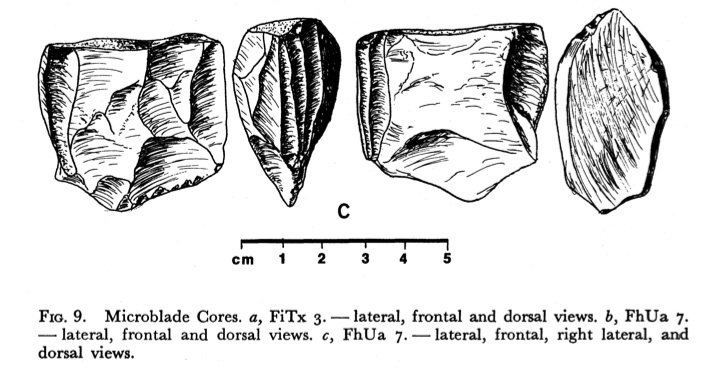
Haida Gwaii microblade cores. Source: Fladmark 1970. BC Studies.

The journal BC Studies is a respected, peer-reviewed publication that focuses on, well, studies of BC, but particularly on historical topics it seems.  It has long been an awkwardly circulated journal, in that it appears in few indexing databases and no PDFs were available, even via subscription or through paywalls such as university databases. These days, going to the library to photocopy is considered a hardship.   It is therefore extremely welcome to see that BC Studies has put almost its entire series of back issues online, open access, free. Wow.  You can download any article from inception in 1969 through the  Summer of 2008.  Interestingly, a number of the articles are also available as mp3 sound files, so you could listen to these on your daily commute.  Naturally you can browse it yourself but you won’t, so let me point out some of the highlights, with an eye on archaeology, ethnohistory and historical geography.

Continue reading

Newsflash: Facebook is Good for Something

Lolota, the son of Zickchuse, - Snoqualmie - 1890

I’m a bit of a reluctant user of “facebook”, mostly because of their user-hostile and byzantine privacy policies.  However, increasingly people are using its easy interface to create really useful web pages, many of which you don’t need to be a member of facebook or logged in to enjoy.  There are some quite specific archaeology ones relevant to the Northwest Coast which I will review some other time.  Today, I want to focus on a remarkable compendium of historic photos of North American indigenous people.  There are almost 200 separate galleries, many with more than fifty pictures in them (do the math), under the auspices of the group administrator Jonathan Holmes, who takes an active role in the discussions and comments.  This is an enormous investment of time and effort, especially as many of the pictures have notes (hover your mouse over the picture) and in a remarkable number the identity of the subject is named and contextualized.  This is not a mere link dump for pictures – the over 20,000 comments reflect many positive reviews from Tribal and First Nations members (e.g., Tahltan) and members of the general public, (as well as some cranky comments from six year olds and racists). Continue reading

Signs of Lekwungen

Signs of Lekwungen "Walk in Two Worlds", near corner of Fort and Wharf Street in Victoria. Source: Flickr.com user ngawangchodron

The city of Victoria in collaboration with the Songhees and Esquimalt First Nations has fairly recently created a series of outdoor art installations which mark culturally-significant places.   As the City’s online brochure explains,

Established in 2008, the Signs of Lekwungen (pronounced Le-KWUNG-en) is an interpretive walkway along the Inner Harbour and surrounding areas that honours the art, history and culture of the Coast Salish people who have resided in the Victoria area for hundreds of years.

The Songhees and Esquimalt Nations are part of the Coast Salish family and are descendants of the Lekwungen family groups. Lekwungen is the original language of this land.

The Signs of Lekwungen consist of seven unique site markers – bronze castings of original cedar carvings, conceptualized and carved by Coast Salish artist, Butch Dick. The markers depict spindle whorls that were traditionally used by Coast Salish women to spin wool. The spindle whorl was considered the foundation of a Coast Salish family.

Continue reading

Spatial History Mapping Project

Emeryville Shell Mound, San Francisco, and sea level change. Source: Spatial History Project.

If you’re at all a map geek – and most archaeologists have that tendency – then you might enjoy flipping around Stanford’s Spatial History Mapping Project. This project is intended to further creative visual analysis and representation of historical events and phenomena.  Luckily for us, they apply their skills to some archaeological problems, such as the relationship between sea level change and shell mound development illustrated above:

Did rising sea levels force native people to raise their shellmounds to stay above the tides? The visualization suggests that no, mound building was unrelated to sea level rise.

You can see that particular page here.

Continue reading

Bella Coola Lichen

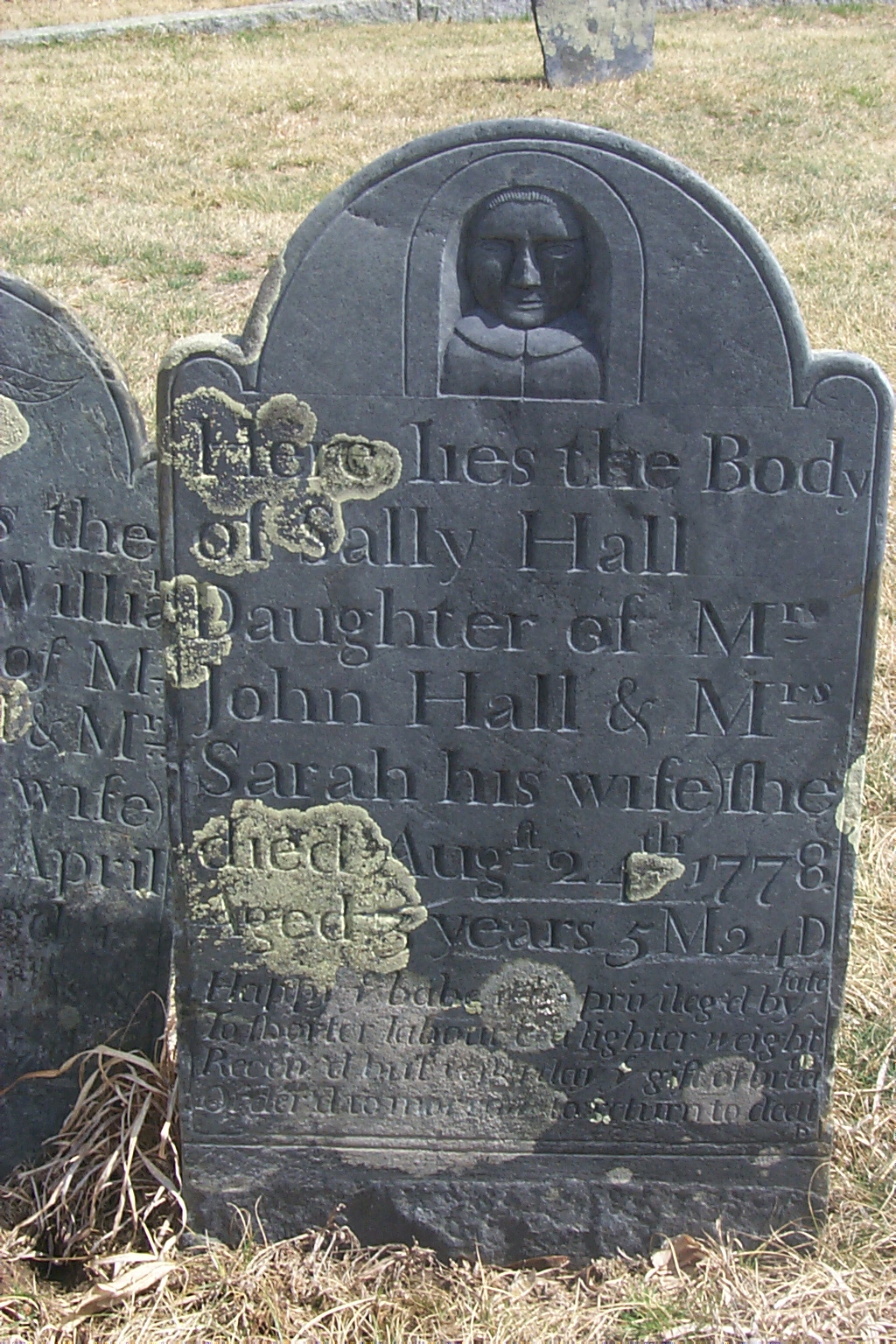
A gravestone with lichen growth. Source: designscience.com

I was reading the charming Bella Coola Blog the other day and came across an interesting post discussing how lichen had been used to date glacial features in the area.  So-called lichenometry is a well-established dating technique which relies on the principle that lichen grows in roughly circular patterns, and that there is a linear relationship between the diameter of the circle and the age of the lichen patch.  Now, such patches can be many hundreds of years old.  So for an event where rock is newly exposed and then lichen grows on it, the lichen will give a minimum date on when the bare rock was first available as a lichen environment.  Anytime you have a bare rock and a dating technique for when the rock became bare, the archaeology antennae rise.

Continue reading

Two upcoming events in Vancouver and Victoria


1936 Field Trip by the Vancouver Natural History Society to Musqueam. Source: Vancouver Public Library. VPL Accession Number: 19483

In Vancouver this Sunday, September 19 at 1.00 there is a guided walk of the Ancient Salmon Stream and Musqueam Village, starting at Jericho Beach (details here) with Victor Guerin, “a cultural/linguistic consultant and historian, a member of the Musqueam First Nation and a speaker of the Musqueam dialect of the Central Coast Salish language Halkomelem. He has been learning about his people’s culture and history his entire life, including some 16 years of consultation and documentation with family elders and 4 years formal training in the Musqueam language with linguistic analysts at UBC.”

This talk/walk is one in a series from the False Creek Watershed Society, most of which look like they hold promise for an interesting conversation between historical ecology, traditional knowledge, and landscape development.  It would be good to see connections built or strengthened between restoration groups and archaeologists, who share many of the same values.  You can see the other talks and walks they sponsor here – two of them are actually today, Saturday September 18th.  OK, go to those as well!

The other upcoming event is the  Archaeology Society of B.C. monthly public lecture in Victoria, which is on Tuesday 21 September.  This month’s speaker is Grant Keddie from the Royal B.C. Museum.

Continue reading

“From the Islander” blog

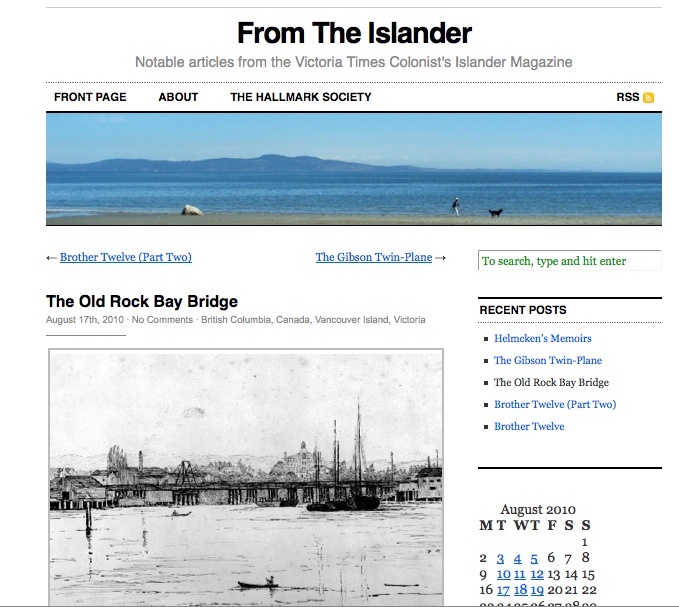
Screenshot of "From the Islander" blog

The Hallmark Society sponsored a nice blog called “From the Islander” through the summer of 2010.  This is a retrospective set of commentaries about excerpts from the weekend newspaper insert “The Islander”, which used to be published in the Victoria Daily Colonist and the Victoria Times-Colonist.  There’s not any archaeology that I have seen, and surprisingly (or not) there is no coverage of First Nations, but all the same it is an interesting read if you have a shine for Vancouver Island history, and a well-done, informative blog.  Apparently the Hallmark Society (or the blogger, who goes by wpbradley and was their summer student intern) has digitized a fair bit of The Islander and indexed it here – though full text is not available for the most part.