Category Archives: history

Tlingit War Helmet Rediscovered after 100 years

Tlingit war helmet recently rediscovred in Springfield Science Museum.  Source: SSM.

Tlingit war helmet recently rediscovered in Springfield Science Museum. Source: SSM.

This is the kind of cool story that makes me want to poke around in all the community museums I see.  A fantastic Tlingit war helmet has been recently rediscovered in the backroom of a museum in Springfield, Massachussests.  The helmet was accessioned in 1899 as an “Aleutian hat” and the designation was never questioned until now.  The news article about it suggests only 95 of these helmets are known, with the largest collections found in Russia.  They are part of an elaborate system of armour known from the contact and early historic period in Tlingit territory (Southeast Alaska – Alaska Panhandle).

Continue reading

Images of Nootka Island People, 1787

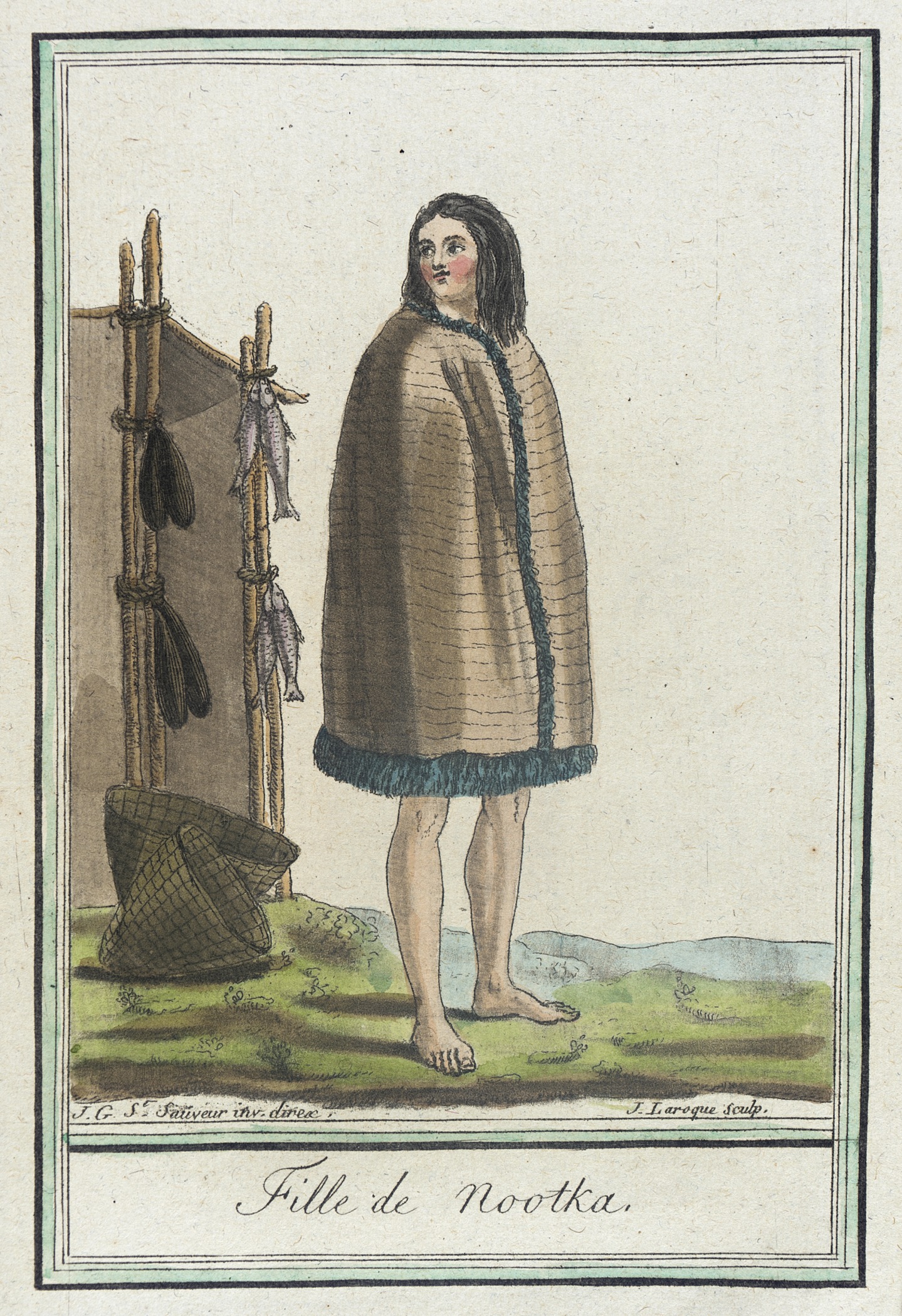
Nootka Sound girl, 1787.  by de Saint-Sauveur, source: LACMA.

Nootka island girl, 1787. by de Saint-Sauveur, source: LACMA.

I found some interesting images at the Los Angeles County Museum of Art. These come from a book published in 1787: Costumes civils actuels de tous les peuples, volume 4: Americas by Jacques Grasset de Saint-Sauveur (1757-1810).  Needless to say, it’s one of the earliest publications with NW Coast content, comprising four plates and 14 pages of “customs” of Nootka Island (Nuu-chah-nulth territory). I’m not entirely sure where Grasset de Saint-Sauveur would have got his inspiration from – Cook’s journals most likely?  You can see all the plates from the four volumes at the LACMA (great images from around the world), or you can read and download the entire book here.  But why bother, when I extract the information for you below.

Continue reading

Klahoose Arborglyph

Klahoose Arborglyph Ceremony. Source: Klahoose First Nation.

Klahoose Arborglyph Ceremony. Source: Klahoose First Nation.

There has been a mini-flurry of new arborglyphs found in BC – well two of them –  but they are extraordinarily rare.  First up for this blog is the example above, which comes from Klahoose First Nation territory, roughly around Toba Inlet in the extreme NE corner of the Salish Sea (map).  This human face was carved into a tree some time in the 19th century.  It’s in rather stunning condition, setting aside the cut block it finds itself in.  Risk of blowdown is probably why, after appropriate ceremony, it has been moved to the Klahoose offices at T’oq (Squirrel Cove).  As the page describes:

The Klahoose Cultural Leader Norman Harry Sr. and a Tla’amin Cultural Leader Erik Blaney witnessed and performed a ceremony to ensure cultural protocol was observed. The heartfelt moments before the tree was harvested was both moving and surreal on that snowy winter Friday. Needless to say that the emotional event was a historical moment for those who witnessed.

Continue reading

Harpoon Arrows

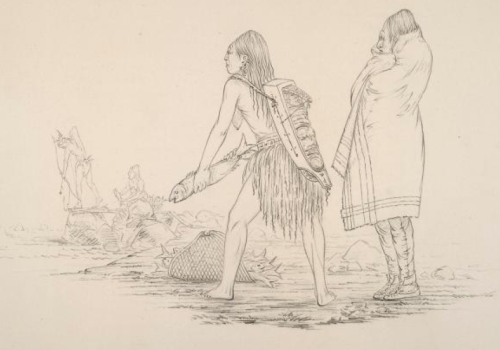
Fishing at the Dalles, 1850, pencil drawing by George Catlin. Source: NYPL.

Fishing at the Dalles, 1850, pencil drawing by George Catlin. Source: NYPL.

I’m probably the last person to get the memo that you can fire a harpoon with a bow and arrow.  In fact,  I only just got my head around firing a harpoon with an atlatl.  Anyway, take a squint at the picture above – the figure in the lower left background is clearly shooting a harpoon-arrow from his bow.  The picture is from about 1850 and is a pencil drawing of a scene at The Dalles, on the Columbia River.  I’ll take a closer look at this picture below. Continue reading

Essay on the CBC – Stone Bowl Auction Controversy

Screenshot of iPINCH website

Screenshot of iPINCH website

I’ve posted a couple of times (1, 2) on the proposed, callous use of a seated human figure bowl as a reality TV show prop.  Well, worse than a prop, since the idea is to auction off this sensitive cultural property in pursuit of TV ratings and the advertizing dollars which follow.  It’s sort of unfathomably insensitive and stupid, doubly maddening since it’s the CBC, a crown corporation and an entity which really should know better.

Anyway, there’s an interesting and insightful essay by Emily Benson on the IPinCH blog which adds a lot of thoughtful commentary and context for this issue:

The example of the seated human figure bowl and media discussions around it, reflect a broader set of questions and issues related to historical and contemporary relations between Indigenous peoples and settlers in Canada. This case reflects the importance of challenging both public and anthropological conceptions regarding the treatment of Indigenous peoples’ cultural heritage.  Explicitly recognizing the relationship of descendant communities to their ancestral /sacred sites and objects, and their rights regarding their cultural heritage, are fundamental to doing so. Key to shifting these perspectives are recognizing the significance of cultural heritage sites and objects to living peoples, and their rights to make decisions regarding their heritage.

It’s part of IPinCH‘s* occasional series “Appropriation of the Month” – most entries are not about the NW Coast but nonetheless many readers here will find a lot of food for thought over there.  I particularly encourage you to go over and leave some comments on the bowl issue!

Buy Your Piece of BC Archaeological History

Sisiutl for Sale

I was browsing to price out some used skiffs, and look what I found – a custom built archaeological research vessel — only $99,000.  (I wonder what she cost to build?) The listing is here, with a PDF backup for posterity here.

I don’t have any memories of the Sisiutl —  never stepped on board — but I know she is close to the hearts of many SFU faculty and former students.

Continue reading

Burnt Embers blog: Oak Bay Cairns Mark Songhees History

Cropped screenshot of detail of cairn marking Sahsima, south Oak Bay. Source: Burnt Embers blog; click to visit.

I recently have started following a wonderful new blog called Burnt Embers.  It’s mostly a photo blog of the author’s surroundings – which appear to be deepest south Oak Bay, which is a municipality adjacent to Victoria, B.C. It’s a wealthy municipality not really known for being sensitive to archaeological concerns or First Nations history: for example, it’s the locale of the rather messy Esplanade controversy I documented last year (1, 2, 3).

Anyway, the blogger at Burnt Embers, one “ehpem”, has recently done a great service by bringing to light a series of attractive cairns, emblazoned with art by Tsartlip artist Charles Elliot (Temoseng), which pay tribute to Songhees and Straits Salish places, history, and names.  As ehpem points out, Oak Bay Council has erected these cairns but provides no other information about them, whether on their website or anywhere else.  They’ve  been sort of bolted onto the Oak Bay landscape.  No matter: ehpem has photographed them beautifully and assembled a great series of pages documenting each one and also created a google map which is really handy for getting around from cairn to cairn. The cairns are, in the order which ehpem documents them:

Sahsima – a transformer stone near the Chinese Cemetery.  Sahsima, meaning “harpoon”, was the original name identified by Songhees elder James Fraser for the point where the Chinese Cemetery is located: Hayls the Transformer, with spirit companions, Raven and Mink, came by in his canoe, frightening away the seal the harpooner had been stalking. The harpooner rebuked them, Hayls turned him to stone as he stood there poised to throw the harpoon, saying “You’ll be the boss for seals … from Sooke to Nanaimo.” Continue reading

Happy “Birthday”, Vancouver

Unidentified Musqueam Chief as portrayed by Cardero in 1792. Source: Vancouver Sun.

The City of Vancouver had its 125th anniversary yesterday, and the local press was full of reflective pieces on civic leaders, famous visitors, notable crimes and, of course, sports.  Well, it would be churlish not to wish Vancouver Happy Birthday!  Well done, Vancouverites.  But in all the coverage of this momentous event, I only see one single article which acknowledges that people might have lived at the mouth of the Fraser River for a tad longer than 125 years.  And a curious article (PDF)  it is: Ancient history of Vancouver’s first peoples: The city’s history predates its 1886 founding, with a native midden dating back 9,000 years

Continue reading

Imaging of Yukon Shipwrecks

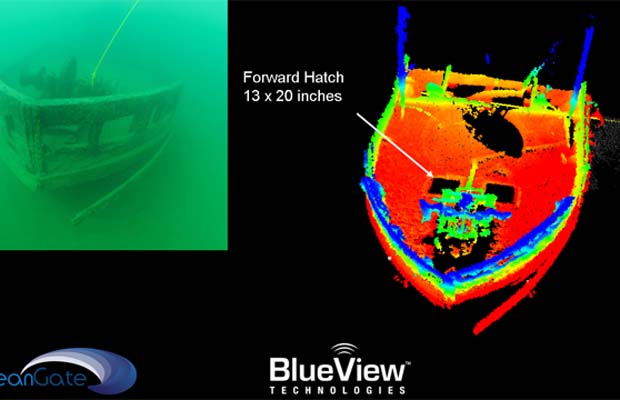
3-D Sonar Scan of A.J. Goddard historic sternwheeler from Yukon. Source: Montreal Gazette.

A year or two ago, the well-preserved wreck of the Klondike-era paddlewheeler A.J. Goddard was found in Lake Lebarge on the Yukon River.  The find (which is now protected) got a lot of attention because of the ghostly images (click on the very high resolution pop-up ones here) as much as the historical significance.  The wreck was recently in the news again because divers had found some vinyl phonograph records which had the potential to be played. Listening to the music of the dead crewmen of a ship evocative of the Cremation of Sam McGee would create close, perhaps emotional, connection with these poor unfortunates.

Being made of stern stuff (heh) what I am more interested in is the intriguing  sonar image (above) that accompanied the mainstream press coverage.  The phonograph is cool, but archaeologically the more significant development are the new technologies being used on wrecks in general and some Yukon wrecks in particular.

I found more images and a very short article at Wired magazine and they are worth a look, as is much of the background info from the Institute of Nautical Archaeology (INA), which includes a photo galleryEdit: you can view a nice video of BluView and OceanGate’s sonar model of the wreck here.

Continue reading

Historic Newspaper Archive on Google

Sooke Freight! Vancouver Daily Post, 1865.

Via the Northwest History blog, I recently found that Google has been quietly archiving a large number of  historical newspapers, including many defunct ones from the west.  Old newspapers are a rich source of social history and can fill in some details of everyday life in the early historical period.  For example, it still costs me about 2 & 1/2 cents per pound to get my sorry self from Victoria to Leech River.  Or, see the table below from 1864 recounting the travel time and cost by stage or foot from New Westminster to the Columbia River. That’s better history than some dumb vote of useless politicians.

As Larry Cebula at Northwest History points out, Google has buried this feature somewhat.  There is a master list of all newspapers here, though, and you can work your way through that.  Many of the newspaper names are cryptic, though, and since I usually do the grunt work for you, here are some of the historic, often defunct, newspapers of particular interest to readers of this blog:

Continue reading