Category Archives: First Nations

Rock Art Talk in Vancouver BC, Wed. April 27

Source: ASBC

With hockey sidelined for a few days, there’s no excuse for Vancouverites not to take in an interesting-looking talk on rock art of the Stein River Valley tonight, sponsored by the Archaeological Society of British Columbia, “Vancouver Chapter”.

The talk, entitled “Rock Art Science in the Stein River Valley, British Columbia”, will be given by Chris Arnett, a UBC graduate student and experienced rock art researcher.  It is open to the public and free of charge, starting at 7.00 p.m. at the Museum of Vancouver, 1100 Chestnut Street in Kitsilano (map).  The link at the ASBC website is borked, so the abstract is here for posterity:

Rock art is found on every continent and is part of the cultural heritage of many peoples but there are few places in the world where direct historical and cultural continuity exists between those who made the art and the contemporary people. In places where this continuity does exist knowledge regarding rock art is controlled and not always accessible to non-indigenous people. When access is made available and information shared there can be prejudice towards indigenous ways of knowledge in favour of fashionable (historically contingent) theories of researchers. Early 21 century research shifts from a hermeneutic rock art research to a rock art science that combines forensic archaeology with Indigenous theory. My presentation will trace the dynamics of rock art research over a 125 year period in a place renowned for its rock art, the Stein River Valley of British Columbia, and suggest that the combined interests of researchers and indigenous people has potential to produce mutually constructed histories.

BC Archaeology Forum Roundup

Musqueam Potlatch Dish, made 1895. Photo by Derek Tan. Source: MoA, CC Licenced.

It was fun to attend the BC Archaeology Forum on the weekend.  First and foremost, the Musqueam First Nation were gracious hosts who provided a warm and thoughtful welcome, and plentiful, delicious meals. Together with the organizing committee from the UBC’s Laboratory of Archaeology, the event was an incredible bargain for 30 bucks, including dinner. I took in most of the talks. The short review is that it was an extremely successful forum, well attended, with interesting papers spanning the province and important issues raised.  The long review has become really long, so you’ll have to continue reading on page 2.

Continue reading

BC Archaeology Forum Program

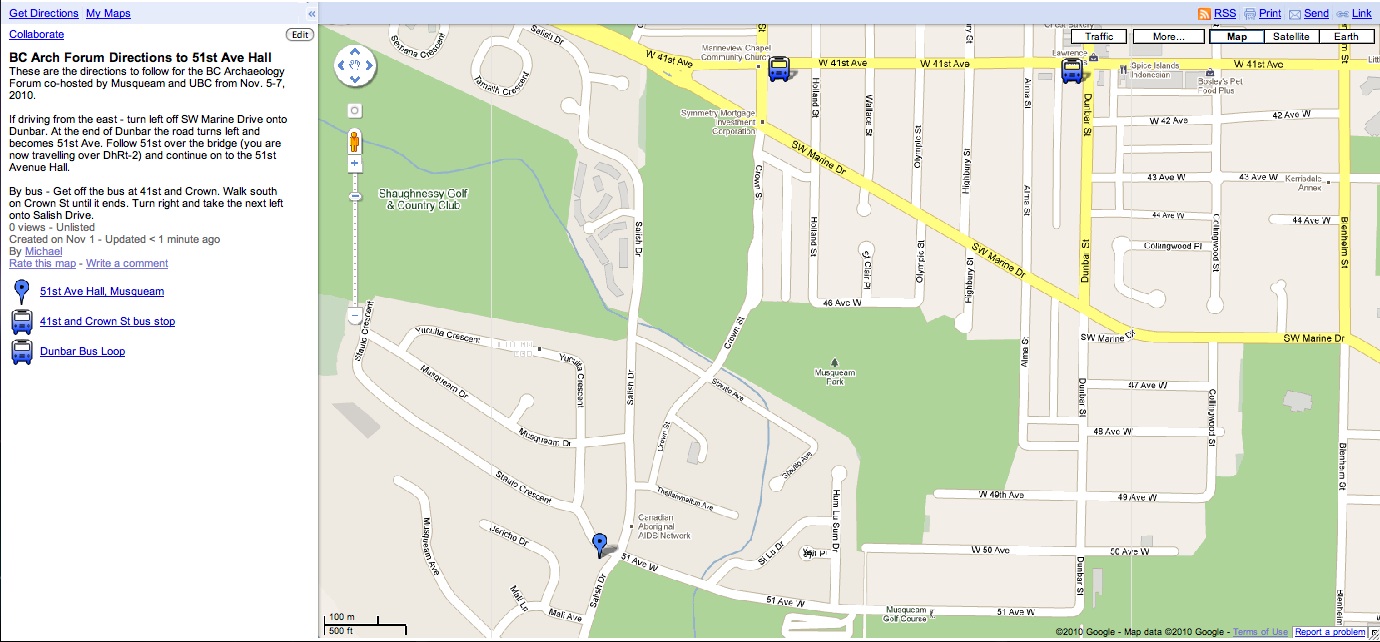
I’m a big supporter of the B.C. Archaeology forum and posted about it a while back.  The forum is an annual gathering of archaeologists, students, First Nations and others with an interest in B.C. Archaeology. It’s a rare chance for all the different stakeholders to get together, catch up, and socialize.  This year the forum is co-hosted by UBC and the Musqueam First Nation, and will be held near SW Marine Drive (i.e., not on the UBC campus: map).  Since I am getting tons of hits from google queries looking for information about it, and since this can also serve as a reminder to get out to the forum this Saturday, November 6th, I am pasting in the program of events below.

Remember, everyone is welcome.  The registration fee is only 20$, and half that for students.  You can walk up to register on Saturday morning.  It would be most welcome to see lots of public and community members there.

The program (PDF) (I refuse to call it an agenda)  is pasted in below with some comments.

Continue reading

Victoria’s history through cartoons

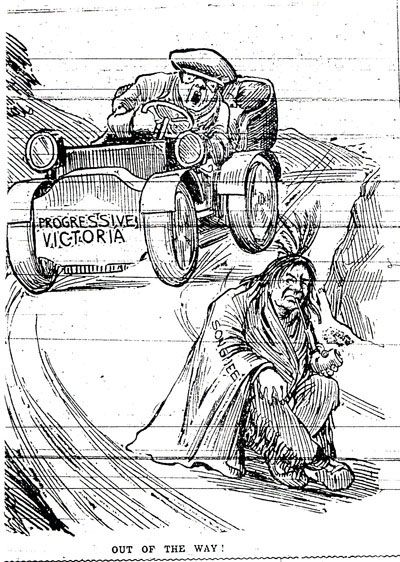
"Progressive Victoria" about to run over the Songhees. Was there ever a Songhees man with feathers in his hair, fringed buckskin, and a peace pipe? Source: Vincent's Victoria.

I mentioned it in a comment the other day so you may have seen it already, but there are a couple of great posts at the blog “Vincent’s Victoria“.  The first post is the already-mentioned review of John Lutz’s talk “Getting the Indians Out of Town: Race and Space in Victoria’s History” – Victoria, British Columbia, that is, better known as World Headquarters to this blog.   In Vincent’s post we find out about the slow process by which First Nations had their presence in the city core steadily reduced, mainly by moving the reserves, but through other means too.  The post then discusses the “Signs of Lekwungen” project which I posted on before. it’s really a shame I didn’t hear about John’s talk until after he had given it – there are other talks in the series but his would have been the most interesting to regular readers here.

The second post is extremely interesting, as it uses editorial cartoons from the Victoria Daily Times newspaper to tell the story of the movement of the Songhees reserve in 1910.

Continue reading

Revisiting the Salt Spring Island Archives

Part of the Charles Sampson collection from Salt Spring Island. Source: saltspringarchives.com

Salt Spring Island is a large island in the Salish Sea, close to Vancouver Island’s southeast corner (map).  Quite a while ago I highlighted the photographs of the “Bob Akerman” museum, which comes via the comprehensive Salt Spring Island archives.  There are a few other photo records of archaeological collections there which I thought were worth a quick look.  For example, the picture above from the Charles Sampson Collection shows some fairly spectacular ground slate points to the left, and what may be a Charles phase (ca. 4,000 year old)  contracting stem point to the bottom right.  It’s not just archaeological collections that the archives has going for it, though. Continue reading

The Bill Reid Centre For Northwest Coast Art Studies

Gwayasdums house under construction 1899. Source: SFU.

The Bill Reid Centre for Northwest Coast Art Studies is part of the Department of Archaeology and First Nation Studies at Simon Fraser University, although it is physically located in downtown Vancouver. It  currently shares space with the Bill Reid Gallery on Hornby St., near SFU’s Harbour Centre Campus. They have a website that looks to be growing fast with some good content – and despite the name of the centre, it is not only about Haida Art, or even just about Art:

A major activity of the Centre is to visually document through photographs, drawings and other works, the depth and richness of Northwest Coast Art in the hundreds of communities in which monumental architecture and sculpture were recorded.

I’ll point out a few highlights and make some comments “after the jump”

Continue reading

“BC Studies” is now mostly free

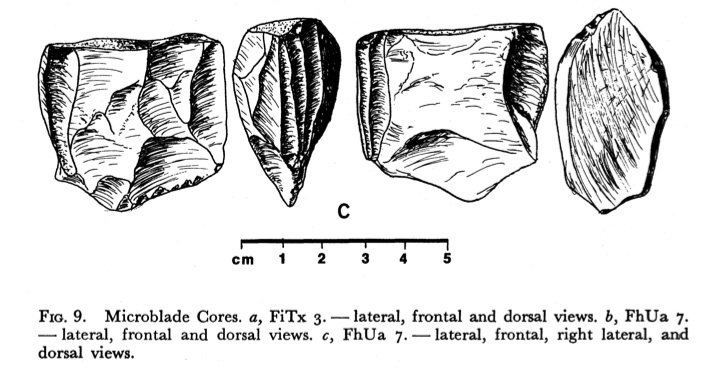
Haida Gwaii microblade cores. Source: Fladmark 1970. BC Studies.

The journal BC Studies is a respected, peer-reviewed publication that focuses on, well, studies of BC, but particularly on historical topics it seems.  It has long been an awkwardly circulated journal, in that it appears in few indexing databases and no PDFs were available, even via subscription or through paywalls such as university databases. These days, going to the library to photocopy is considered a hardship.   It is therefore extremely welcome to see that BC Studies has put almost its entire series of back issues online, open access, free. Wow.  You can download any article from inception in 1969 through the  Summer of 2008.  Interestingly, a number of the articles are also available as mp3 sound files, so you could listen to these on your daily commute.  Naturally you can browse it yourself but you won’t, so let me point out some of the highlights, with an eye on archaeology, ethnohistory and historical geography.

Continue reading

Newsflash: Facebook is Good for Something

Lolota, the son of Zickchuse, - Snoqualmie - 1890

I’m a bit of a reluctant user of “facebook”, mostly because of their user-hostile and byzantine privacy policies.  However, increasingly people are using its easy interface to create really useful web pages, many of which you don’t need to be a member of facebook or logged in to enjoy.  There are some quite specific archaeology ones relevant to the Northwest Coast which I will review some other time.  Today, I want to focus on a remarkable compendium of historic photos of North American indigenous people.  There are almost 200 separate galleries, many with more than fifty pictures in them (do the math), under the auspices of the group administrator Jonathan Holmes, who takes an active role in the discussions and comments.  This is an enormous investment of time and effort, especially as many of the pictures have notes (hover your mouse over the picture) and in a remarkable number the identity of the subject is named and contextualized.  This is not a mere link dump for pictures – the over 20,000 comments reflect many positive reviews from Tribal and First Nations members (e.g., Tahltan) and members of the general public, (as well as some cranky comments from six year olds and racists). Continue reading

Signs of Lekwungen

Signs of Lekwungen "Walk in Two Worlds", near corner of Fort and Wharf Street in Victoria. Source: Flickr.com user ngawangchodron

The city of Victoria in collaboration with the Songhees and Esquimalt First Nations has fairly recently created a series of outdoor art installations which mark culturally-significant places.   As the City’s online brochure explains,

Established in 2008, the Signs of Lekwungen (pronounced Le-KWUNG-en) is an interpretive walkway along the Inner Harbour and surrounding areas that honours the art, history and culture of the Coast Salish people who have resided in the Victoria area for hundreds of years.

The Songhees and Esquimalt Nations are part of the Coast Salish family and are descendants of the Lekwungen family groups. Lekwungen is the original language of this land.

The Signs of Lekwungen consist of seven unique site markers – bronze castings of original cedar carvings, conceptualized and carved by Coast Salish artist, Butch Dick. The markers depict spindle whorls that were traditionally used by Coast Salish women to spin wool. The spindle whorl was considered the foundation of a Coast Salish family.

Continue reading

VicNews: Rebirth through Reburial

Burial cairn on Race Rocks. Source: RaceRocks.com

While I was away over the summer the local free paper, the Victoria News, did a (to my mind)   high quality series on reburial and respect in Songhees and Esquimalt communities (cache). The three articles by Lisa Weighton include comments from numerous aboriginal spiritual and political leaders, and sensitively describes how Straits Salish faith asserts that the dead are always with the living.  The dead do not conveniently depart to some other place, but continue in a world alongside and intersecting the world of the living.

Hence ancestral remains are not something belonging to a past which can be “gotten over” but are very much part of the present world.  Laying a person to rest, or back to rest after disturbance, requires food, clothing and prayer.  I don’t pretend to understand the concept well, but I have been to some such ceremonies and the power of the moment is impossible to deny.  In my limited experience the article fairly represents the spiritual and emotional needs that must be met under the sad circumstance of disturbing the dead.  It is incumbent on archaeologists and all citizens to not only work to minimize disturbance of the dead but to respect traditional practices.  It has been impressed on me that such practices are meant to protect us, the living, First Nations or not, as well as to give comfort and respect to the dead.  This should now be considered absolutely part of mainstream archaeology.

Continue reading