Category Archives: First Nations

Coast Salish Mausolea, Victoria, 1859

 Grave near Victoria on the harbour, 1859, by William Tyrwhitt-Drake.  Source: British Museum. Click for their record and verso.

Grave near Victoria on the harbour, 1859, by William Tyrwhitt-Drake. Source: British Museum. Click for their record and verso.

So, not long ago we had an excellent discussion here centered around Edward Richardson’s 1864 painting of a Coast Salish grave house or mausoleum.  I’ve recently come across another set of images of these places which are so important to First Nations. These images were painted by well-known early Victoria resident (and former mayor and Supreme Court of BC Justice)  Montague Tyrwhitt-Drake.  They’re pretty interesting paintings  from the early colonial period on southern Vancouver Island which I don’t recall seeing before.

The painting above clearly shows a small mausoleum, weighted with rocks on top, in front of which are two carved figures. The one on the right includes fishers or river otters, both of which have important spiritual significance in this area.  Each of these images has notes on the back, which are also reproduced at the British Museum site (click the image to go to the accession record). For this image, the notes aren’t transcribed, though maybe someone with better olde handwritinge fkills would care to have a go  As near as I can make out, the back reads:

This is another eccentric specimen of Indian taste for sculpture, it is equal to the finest specimens of _________  — see the elegant attitude of that man scratching his ?cheek bone, but a _____ ________ _______ would have mastered __________ a flight of ___________ imagination. The other is holding two dogs [sic] of a breed which I am afraid is lost to the present generation. This ______ are carved in wood and _____ ________ near a large grave of the family vault above ground ___________ .

It”s true, both sculptures are lively and naturalistic. In both cases, and the one below, there is apparently a rendering of face paint.  I’m sure those readers more knowledgeable than I will see a lot of interesting detail in these pictures.  Note the open prairie environment – anthropogenic Garry Oak meadow, no doubt.

Continue reading

Alaskan Fish Weir Photos

Screen shot from video of men building a fish weir near Atka, ca. 1946.  Click to see video.  Source: http://vilda.alaska.edu/cdm/singleitem/collection/cdmg11/id/37038/rec/36

Screen shot from video of men building a fish weir near Atka, ca. 1946. Click to see video. Source: http://vilda.alaska.edu/cdm/singleitem/collection/cdmg11/id/37038/rec/36

So, still rustling around the weird world of weirs.  The online Alaskan archives have quite a few interesting examples – and, kind of remarkably, a video showing the construction of a weir near Atka, which is on the Aleutian Islands.   The trap in the video is pretty similar to a couple of other Aleutian ones in the collection, which I’ll talk about below. It’s really cool to not only see a more-or-less traditional trap being built (look at the rocks being casually dropped down by the wooden fence!) but the photos also show weirs actually in use. There’s probably a lot to learn from these pictures – as any introductory textbook in archaeology will tell you, the more we know about the behavioural context of a given site type, the more we can reliably infer the cultural context when presented only with the archaeological remains.

Continue reading

Yelm Jim’s Fish Weir at Puyallup

Yelm Jim's fish weir on the Puyallup River ca. 1885. Click for high resolution.  Source:  http://www.digitalarchives.wa.gov/Record/View/DAA73FC7A57E989D65B6DBEA419FC89E

Yelm Jim’s fish weir on the Puyallup River ca. 1885. Click for high resolution. Source: http://www.digitalarchives.wa.gov/Record/View/DAA73FC7A57E989D65B6DBEA419FC89E

So for one reason or another I’ve been thinking about fish weirs lately.  A picture can be worth a thousand thoughts though, so I was happy to see these two shots of a massive weir photographed ca. 1885 on the Puyallup Indian Reservation (map) near Tacoma, southern Puget Sound, Washington.  I’m sure these are common knowledge images but for some reason I hadn’t come across them before.  If you’re new to weirs I posted something on them before, referencing the monumental reconstruction of one on the Koeye River.  Essentially they are a method for controlling the upstream migration of salmon, allowing for stock assessment and selective harvesting.

Continue reading

BC Archaeology Forum is in Nanaimo, Saturday October 18th

Petroglyph from Petroglyph Park, Nanaimo. Source: danielleen.org

Panel from Petroglyph Park, Nanaimo. Source: danielleen.org

I’m about to disappear off the grid for a couple of weeks (fieldwork in Gwaii Haanas) but before I do, I want to give some publicity for the Annual BC Archaeology Forum.  It’s great to have some advance notice of this and as you can see below it is co-hosted by VIU and the Snuneymuxw First Nation.

edit: they now have a website including the program.

British Columbia Archaeology Forum

Saturday, October 18th, 2014

Nanaimo, BC

We are pleased to announce that the 2014 British Columbia Archaeology Forum will be hosted by Vancouver Island University in the territory of the Snuneymuxw First Nation in Nanaimo, BC this coming October.

A reception will be held on the evening of Friday, October 17th, with Saturday the 18th reserved for a full day of speakers and presentations followed by an evening event, and optional Sunday excursions in the local area.

We are currently consulting with downtown hotels about the event and securing discounted rooms for forum participants; more information on this will be provided asap.

In the meantime, save the date — Saturday, October 18th, 2014 — and we’ll be in touch soon!

For more information, email: archforum2014 (at) gmail.com

R.I.P Hilary Stewart, 1924-2014

Hilary Stewart fish weir

Hilary Stewart drawing of a fish weir. Source: bcheritage.ca

Sad news out of Quadra Island with the news that Northwest Coast archaeological legend Hilary Stewart passed away on June 5th, at the age of 90.  The local newspaper the Discovery Islander has a full obituary (page 2) (PDF) written by her friend, anthropologist Joy Inglis.

Continue reading

Two talks in Victoria next seven days

Burial cairn on Race Rocks.  Source: RaceRocks.com

Burial cairn on Race Rocks. Source: RaceRocks.com

Two very cool talks in Victoria over the next few days.  The first is a unique opportunity to hear from Cowichan (Coast Salish) “gravedigger” Harold C. Joe, who for more than 30 years has worked with archaeologists and anthropologists to care for the disturbed ancestral dead, among his other responsibilities.

The second talk is the monthly ASBC event which features Dr. Andreas Fuls of the Berlin Institute of Technology, who will address a topic in Mayan astronomy and the Mayan collapse.

If you’re not in Victoria you can probably stop reading, but if you click below then you’ll find  more details, including abstracts and the where and when.

Continue reading

Upcoming archaeology talks in Nanaimo

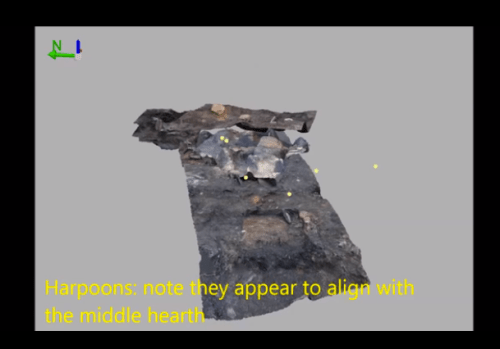
Millennia hearth model screenshot.

Millennia hearth model screenshot from video. Click to go to blog post and view video.

I’ve been asked to post about some upcoming talks in Nanaimo with archaeological interest.  Below I list the talks, which are all co-sponsored to one degree or another between VIU and the Nanaimo ASBC chapter.  The linked posters below give you more information about parking, times, room numbers, abstracts, bios, etc.  All these talks are free and open to the public. For further information then contact mail@asbcnanaimo.ca .

I know many of you are stuck in other lovely places in the world and can’t make it, but for those more local then the details follow.

First up – in just a day or two – is Morley Eldridge of Millennia Research, speaking on his cool uses of digital technology in site recording and excavation.  This is really cool stuff and probably the way of the future for at least some scales of archaeological research. There’s  sneak preview of some of the new methods on the Millennia Blog.

Lecture: A New Methodology for Archaeological Excavation: Mitigative Excavation of GbTo-13 and GbTo-54, Prince Rupert.

Date: Thursday February 6, 2014

Location: VIU Nanaimo campus, Building 356, Lecture Hall 109 (Education/Social Sciences) Time: 11:30 AM – 1:00 PM
ASBC Members, Students and the Public Free! Everyone Welcome.  More instructions on the poster (PDF)

The other talks are by Andrew Martindale (UBC) and Quentin Mackie (UVIC) (no relation).  Details below:

Continue reading

Interior of a Coast Salish Longhouse, 1864

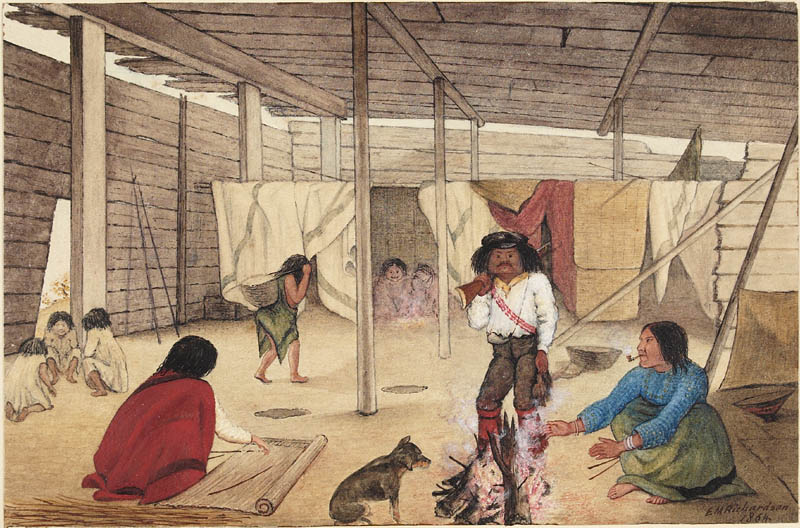
Interior of a Salish Longhouse, 1864. Watercolour by Edward Mallott Richardson.  Locale uknown. Source: Canadian Archives.  Click to enlarge.

Interior of a Salish Longhouse, 1864. Watercolour by Edward Mallott Richardson. Locale uknown. Source: Canadian Archives. Click to enlarge.

Following on from the post about the Salish mausoleum, here is a companion painting by Edward Mallott Richardson from the same year, depicting the interior of a house.  It’s a curious painting, seemingly devoid of close detail.  Where are all the drying fish?!  But at the same time it shows some features of interest which may be worth discussing.  Note the fellow with the gun has a powderhorn, for example, and the basket behind him looks like one of those rectangular coiled ones, only with a tumpline, as shown by the woman entering on the left.  On the far right is a semi-conical object that might be a hat, sitting on a platform within a small compartment.

Continue reading

A Coast Salish Mausoleum, 1864

A Salish Grave, 1864. Watercolour by Edward M. Richardson. No specific locale given. Source: CollectionsCanada.gc.ca

A Salish Grave, 1864. Watercolour by Edward M. Richardson. No specific locale given. Source: CollectionsCanada.gc.ca  Click to enlarge slightly.

“Grave House” is one of those archaeological terms which render slightly creepy a feature that is more or less an everyday experience: the mausoleum, a house for the dead, filled with coffins.

This is a fascinating image I hadn’t come across before: a very early image of a Coast Salish mausoleum.  It highlights the artistry and vividness of these features better than the few sketches or early photographs do. The accompanying text at the Canadian Archives is:

Subject depicts grave boxes in a grave house with guardian figures. The grave house is covered with a roof of wooden planks but has no walls. At the front of the house stands six guardian figures. There are flags to the left and right of the house. On the left hand side of the house a tent is set up and clothes are hanging. A shotgun hangs from the front beam of the house. Item was up for auction in the September 28, 1970 Christie’s sale in Calgary. Lot 31.

The image isn’t very high-resolution but there are still some things to talk about – and there is another Richardson painting I’ll link to in a day or two. (edit: here) Continue reading

Images of Nootka Island People, 1787

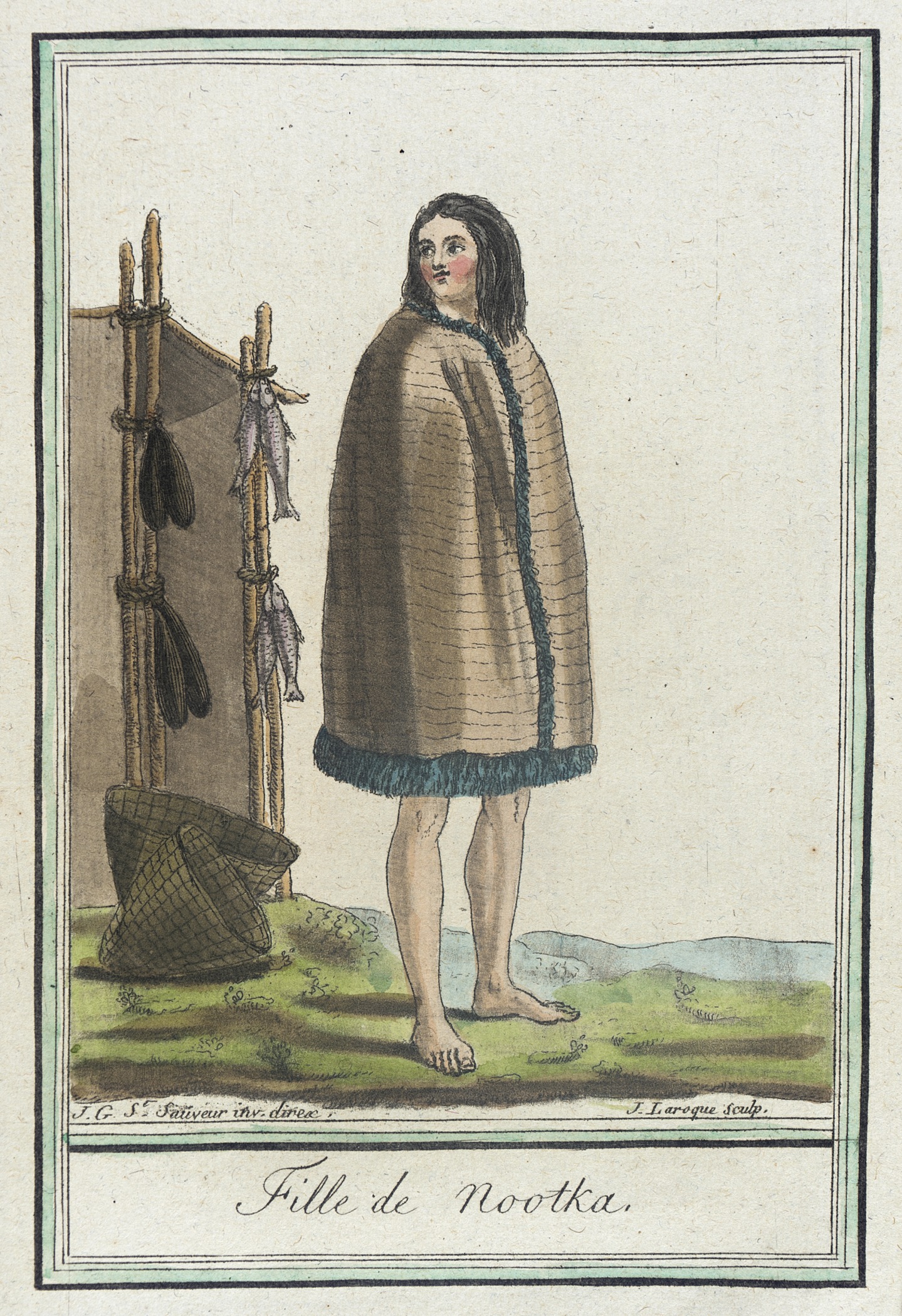
Nootka Sound girl, 1787.  by de Saint-Sauveur, source: LACMA.

Nootka island girl, 1787. by de Saint-Sauveur, source: LACMA.

I found some interesting images at the Los Angeles County Museum of Art. These come from a book published in 1787: Costumes civils actuels de tous les peuples, volume 4: Americas by Jacques Grasset de Saint-Sauveur (1757-1810).  Needless to say, it’s one of the earliest publications with NW Coast content, comprising four plates and 14 pages of “customs” of Nootka Island (Nuu-chah-nulth territory). I’m not entirely sure where Grasset de Saint-Sauveur would have got his inspiration from – Cook’s journals most likely?  You can see all the plates from the four volumes at the LACMA (great images from around the world), or you can read and download the entire book here.  But why bother, when I extract the information for you below.

Continue reading