Category Archives: First Nations

Life from Ash and Ice: A documentary film about Mt. Edziza

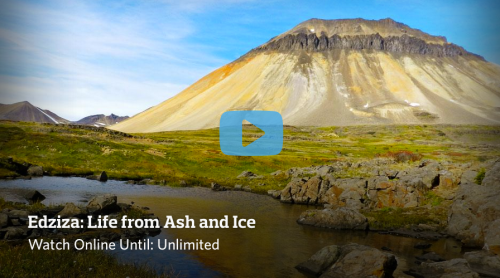
Screenshot of Knowledge Network video about Mt. Edziza.

Screenshot of Knowledge Network video about Mt. Edziza. Click to go to site.

For various reasons I’ve been off work for a while and that has meant being off blogging as well. If you’ve commented on posts recently then thanks; if you’ve emailed my gmail account and still would like a reply then maybe try again.

Anyway, what better way to resume making the occasional post here than a film about the place where I did some of my first ever fieldwork: assessing the then-proposed Site Z dam site on the Stikine River in Tahltan territory, far Northwestern British Columbia, in the shadow of Mt. Edziza.  Edziza is well known to Northwest Archaeologists as one of the region’s most important sources of obsidian, a volcanic glass highly suitable for making certain kinds of stone tools.

The video, Edziza: Life from Ash and Ice, can be watched in full on the B.C. Knowledge Network’s web site.  (NB: I had to change the resolution from a default of “lousy”).  Obviously the geology of the Edziza Complex is pretty cool (and is covered in the first half of the video, which features John Clague among others), but there’s quite a bit of more direct archaeological interest in the second half.

Continue reading

Grace Islet and the Equifinality of Bad Process

Grace Islet human burial cairn intersected by concrete house foundation. The cairn is under the plywood and concrete square structure. Source: Grace Islet on Facebook.

Grace Islet human burial cairn intersected by concrete house foundation. The cairn is said to be under the plywood and concrete square structure. Could there be a more poignant picture of the present day management of archaeological sites in this province? Source: Grace Islet on Facebook, https://www.facebook.com/graceislet

Grace Islet – Shmukw’elu – is a small island (map, pic) in Ganges Harbour, Saltspring Island.  It is a Coast Salish cemetery, and it is a settler construction site.  How do we reconcile these contradictory uses of this island? I’ve been hesitant to post about this case because I know it’s a long and complicated story of how we got to 2014, when we see burial cairns being literally encased into concrete house foundations. I am quite sure that many people of goodwill made many decisions that seemed right to them at the time. I don’t know what all these decisions are, what happened when, exactly, what the consultant said, how the house owner sleeps at night – I just don’t know all these variables and I am schooled in the idea you should know everything before you say anything. It’s clear though that, somehow, the practice of archaeology in this province led to the Grace Islet outcome. Shouldn’t we try to understand the process? That’s fine in principle, but can be silencing in the face of complexity: as Pierre Bourdieu wrote, “the most successful ideological efforts are those which have no need for words, and then ask no more than complicitous silence.” No more silence, then.

Continue reading

Get to Know your (Aboriginal) Neighbours: three events in Victoria

Detail of the Community Mapping event, November 25th, Victoria.

Detail of the Community Mapping event, November 25th, Victoria.

One of the greatest privileges in NW Coast Archaeology is the opportunity to work with First Nations people of all walks of life and to be afforded the chance to tell a small part of their magnificent histories. How many settlers in this area don’t know a single aboriginal person? More than a few, I reckon. Yet how to get that face to face contact so essential for gaining an understanding of the historical circumstances of First Nations if, unlike me, your day job doesn’t have it somewhat built in? If you live in Victoria, you have three  great options coming up – and all three include some archaeological content.  Perhaps archaeology has the potential, not commonly realized, of forming a space of shared interest where conversations can start. Continue reading

“Prehistoric Cairns of Vancouver Island”: notes for a lecture given in 1901

Frank Sylvester Burial Cairns Manuscript, Page One. Source: UVic Special Collections: http://goo.gl/mSxBGe

Frank Sylvester Burial Cairns Manuscript, Page One. Source: UVic Special Collections: http://goo.gl/mSxBGe

There’s an interesting manuscript digitized in the University of Victoria’s special collections library, entitled “Prehistoric Cairns of Vancouver Island.”  The accession notes read:

“Handwritten manuscript, on ruled paper with red-lined margin. Pages hand-numbered 1-20. Signed and dated: Frank Sylvester, Victoria, B.C., June 10, 1901. Appears to be notes for a talk that Frank Sylvester gave, concerning burial cairns on Vancouver Island, his method of excavation of the cairns, and his theories as to the meaning of the cairns and the ancestry of the people buried there.”

It’s a curious document, a mixture of interesting observation, shameless plunder and racial theorizing.  It’s also one of the more complete descriptions I’ve seen of the burial cairn excavation activities of the Victoria Natural History Society.  I don’t recall seeing it cited in the literature, so it’s possible others haven’t come across it either.  In the interests of broad circulation and easy reading,  I’ve transcribed it (PDF), and I also put a version on google docs if anyone cares to improve that transcription.

Continue reading

Clam Garden Event in Sidney, Monday Nov 3rd at 6.30

Clam garden event in Sidney. Source: Parks Canada, click for full poster.

Clam garden event in Sidney. Source: Parks Canada, click for full poster.

This looks like it will be a really cool and interesting event out in Sidney and if you, like blog world headquarters, are on the south island you might want to check it out in person. Snacks included! The great news though is you can register for an online webinar if you can’t make it in person. Kudos to Parks (and their new Clam Garden facilitator and friend of this blog, Sarah R.) for setting that up.  The full details are in this poster, but the short version is: the time is 6.30 and the location is the Shaw Centre on the Sidney waterfront. If you want a quick primer/links on clam gardens, then keep reading.

Continue reading

Kuwoot yas.ein – A video about the discoveries at On-Your-Knees Cave, SE Alaska

Tim Heaton at work in OYK cave.  Screenshot from video.

Tim Heaton at work in OYK cave. Screenshot from video.

On July 4, 1996, paleontologist Tim Heaton was busy at his last day of fieldwork at On-Your-Knees Cave on northern Prince of Wales Island, Southeast Alaska (map).  At this and other caves Heaton had recovered a remarkable array of fauna from both before, during, and after the last glacial maximum, including a variety of black and brown bear bones.  Until this point, he had not found any human remains, but that changed with the discovery of a human mandible and the subsequent discoveries of other scattered, chewed remains.  In due course, an archaeological site was also found at the entrance to the cave, dating to about 10,300 calender years ago, the same as the human remains. Excavation at this site was led by E. James (Jim) Dixon, whose footsteps I often feel like I am stumbling along in. In one layer in the site, they actually found one of the missing teeth from the mandible, showing the extent to which the bones had been scattered, and, sinisterly, chewed, presumably by bears.  The most likely interpretation is that the site represents a bear hunting camp at the entrance to the cave, and that on at least one occasion, the bears got the upper hand.

Anyway, the remains of this young man have revealed important details of the life of early people on the Northwest Coast, and the study also exemplifies how strong relationships, respect, and adherence to protocol can allow for scientific and cultural priorities to unfold together. It’s therefore quite exciting to find a 30 minute video detailing the process of research at On-Your-Knees Cave: “Kuwoot yas.ein: His Spirit is Looking Out from the Cave“.

Continue reading

ASBC Victoria Public Talk: Tue. Oct. 21 – Darcy Mathews on Funerary Petroforms at Rocky Point

Darcy Matthews leading a UVic field trip to burial features in Metchosin.  Photo:qmackie

Darcy Matthews leading a UVic field trip to burial features in Metchosin. Photo:qmackie

ARCHAEOLOGICAL SOCIETY OF BRITISH COLUMBIA, VICTORIA,  OCTOBER MEETING:

Dr. Darcy Mathews

Funerary Ritual and Ancestral Presence at Rocky Point, British Columbia

Tuesday, October 21, 2014, 7:30 pm

UVIC Cornett Building B129 (map)

Free and open to the public

While you might think you’ll have had your fill of cool archaeology at Saturday’s BC Archaeology Forum in Nanaimo, you won’t have seen the latest from Dr.(!!) Darcy Mathews, who will be presenting his recent UVic Ph.D. research to the ASBC next week. Perhaps benefitting from the finest supervision which single-malt can buy, Darcy’s dissertation is Piled Higher and Deeper with carefully chosen nuggets of the finest methods and theories, much like the cairns funerary petroforms it is based on. Seriously, it is a tour de force which absolutely nails its topic in a way seldom seen. No doubt it’ll be coming soon to a prestigious academic press near you.

Anyway, the ASBC provides the abstract: Continue reading

Reburial at Hagwilget: A Video

Click to Play Video

Click to play Sacred Ground video.

Archaeological encounters with human remains bring into sharp relief the competing values surrounding cultural heritage.  It doesn’t always go well – powerful emotions are uncovered alongside the burials.  So it’s refreshing and informative to come across a short video, Sacred Ground: In honour and in memory of our ancestors, made by Crossroads Cultural Resource Management, which follows the aftermath of the accidental disturbance of human remains at Hagwilget, on the Skeena Bulkley River.

Continue reading

A Lummi Reef Net Model

Lummi Reef Netting Model. Source: WhatcomWatch.org

Lummi Reef Netting Model. Source: http://whatcomwatch.org/wpww/?p=348

A while back I found the cool picture above in an online exhibit of the Whatcom Museum showing photographs of Point Roberts and Lummi Island, on Puget Sound just south of the Canadian border.  Reef netting is a peculiarly Straits Salish technology which involved the setting of complex nets, suspended between two canoes, at strategic locations where the natural flow of salmon was constrained. A sort of on-ramp led the fish up to the net by creating a gentle optical illusion of a rising bottom.  When the salmon were milling around in the horizontal net, still free, the canoes would be suddenly swung together, closing the net and trapping the salmon.

Continue reading

The Giant of Happy Valley

The giant of Happy Valley Esquivalt(?) [sic].  Sent to Professor Flower at Nat Hist Mus and returned to the owner Left McCallum. Source: British Museum.

“The giant of Happy Valley Esquivalt(?) [sic]. Sent to Professor Flower at Nat Hist Mus and returned to the owner Left McCallum.” Source: British Museum.

When I was looking for more information about the Coast Salish grave houses I pictured a few days ago, I ran into these images from the British Museum.  They show the torso and head of a large human figure, carved out of wood.  The height of the sculpture is 4 foot 9 inches, meaning the whole sculpture, assuming it once had legs, would have stood well over seven feet tall.  So, a giant indeed.  There is very little information about the sculpture, other than it comes from happy Valley, “Esquivalt” – clearly meaning Esquimalt – a neighbouring municipality to the west of Victoria.  The next municipality to the west is Colwood, and indeed it has a prominent “Happy Valley Road” running through it into Metchosin.  While at the first glance the sculpture doesn’t appear to be a typical NW Coast sculpture, I think there’s reason to at least consider that possibility.

[edit: be sure to see the comment from Pete at the bottom]

Continue reading