Category Archives: First Nations

“Correct Map of the Gold Diggings”: May 20th, 1858

Detail of 1858 Map of Fraser Gold Diggings. Click for full image.

From UBC, this interesting 1858 San Francisco broadsheet “The Pictorial Newsletter of California” (large JPG file).  Most of the text is mundane births and deaths, but the map above from it is a lot of fun.  It’s especially interesting to see the “Cowitchin” Village at New Westminster.  Now, “Cowitchin” was often used as a generic term for many Coast Salish people in the early historic period.  But note too, just upriver at Fort Langley, a “Ninnimuch” Village, presumably Snuneymuxw First Nation, also known historically as the “Nanaimo” people, whose core territory would be on east Central Vancouver Island.  There are lots of reports of Vancouver Island nations paddling up and down past Fort Langley so its not that much of a surprise, but rather a nice testament to the extensive regional trade and, perhaps, permeable social networks in place across the greater Gulf of Georgia. It also makes me think the “Cowitchin Village” might indeed really be Cowichan. It’s notable the “Pinkslitsa River” (Harrison River) is the only lower tributary mapped, probably because it was an important route in and out of the middle Fraser, bypassing the canyon.  It’s a nice map, it’s early, and I’d never seen it before, so thanks to UBC and their Early BC Newspapers page.
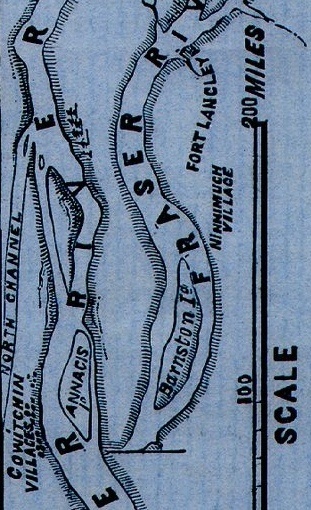
Detail of 1858 map showing "Cowitchin" and "Ninnimuch" Villages on Lower Fraser.

From the UBC notes:  Pictorial News Letter of California: for the Steamer John L. Stephens San Francisco: Hutchings & Rosenfield; Charles F. Robbins, Printer, 1858

“Issued exactly one month after the first steamer left San Francisco headed for the Fraser (Bancroft p. 359), this appears to be the first separate publication relating to the Fraser River Gold Rush, and the first map published to illustrate the area for potential gold-seekers.”

You can also download a short PowerPoint file here, and there is an overview essay here.

1973 Aboriginal Perspective on UBC-MOA and SFU archaeology

Excerpt of 1973 Nesika newsletter criticizing MOA and SFU Archaeology. Click to view full page. Scroll down this page for link to plain text.

2018 edit: It looks like Nesika is now available to browse here, and to search here.

This is interesting, from the newsletter Nesika: Voice of B.C. Indians Vol. 2 No. 1 (February 1973), Page 6:

MONEY FOR BOAT: There is money to fund a boat to take archaeology students up and down our coastline to dig up the bones of our grandfathers and sift, sort, and label sacred objects from our burial grounds, but no money for us to treat our heritage with the dignity it. deserves?

This can only refer to the former pride and joy of the SFU department of Archaeology, the motor vessel Sisiutl.

That page from Nesika has two interesting articles.  One argues for the creation of a Cultural Centre at Hesquiat, while the other passionately objects to the millions spent on the UBC Museum of Anthropology and the above-mentioned Sisiutl.  Click on the image above for a legible image of the entire text, or click here for a transcript.  It is chastening to see the eloquence and power of these arguments from almost 40 years ago.  Hesquiat still has no Cultural Centre so far as I know while the Museum of Anthropology just wrapped up a 60+ million dollar renovation and SFU Archaeology has what amounts to their own, brand-new building as well, at what I hear was a cost of about 5 million dollars.

HESQUIAT BAND CULTURAL CENTRE

Lack of funds hit by Chief Rocky Amos

VANCOUVER (Staff) — After Indian Affairs had denied a request for funds for the Hesquiat Cultural Centre due to lack of funds, Band Chief Rocky Amos told the department that “we cannot accept the limitation of funds as valid.” Pointing to the $10 million available to a museum to house Indian artifacts at UBC and to other reports of funds granted for more white people to study Indians, Chief Amos wrote DIA: “It is difficult to follow the line of thinking that makes money available to exhibit our inheritance to city based people and when the rightful heirs to these very artifacts ask for assistance to house their history in an area where it will be meaningful to them, they are denied. “We of the Hesquiat Band are not unique and we have proven we can do it. Now we are made to crawl on our stomachs begging for funds to house our heritage. My pride is aching from begging but my pride also screams in agony when our people are forced into whitemen’s museums to see their inheritance.”

As the second article concludes in terms it is hard to argue with:

If there is money available for museums to store stolen work, then there is money available for museums to be built where that work belongs. With the children and grandchildren of the artists who represented a culture and society which has not, despite all efforts, conveniently died.

First custom built archaeology research vessel in North America: The Sisiutl. Recently scrapped by SFU.  Source: American Antiquity.

PS: kudos to the Union of BC Indian Chiefs for putting so much archival information online.  In related news, I previously linked to the archives of the Native Voice, which is another great resource for understanding First Nations politics and which also contains intriguing aboriginal perspectives on the practice of BC Archaeology.

Museum of Vancouver Web Site (Fail)

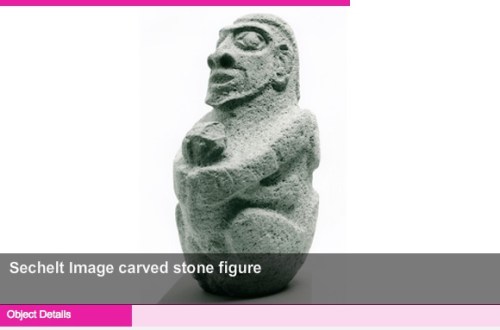
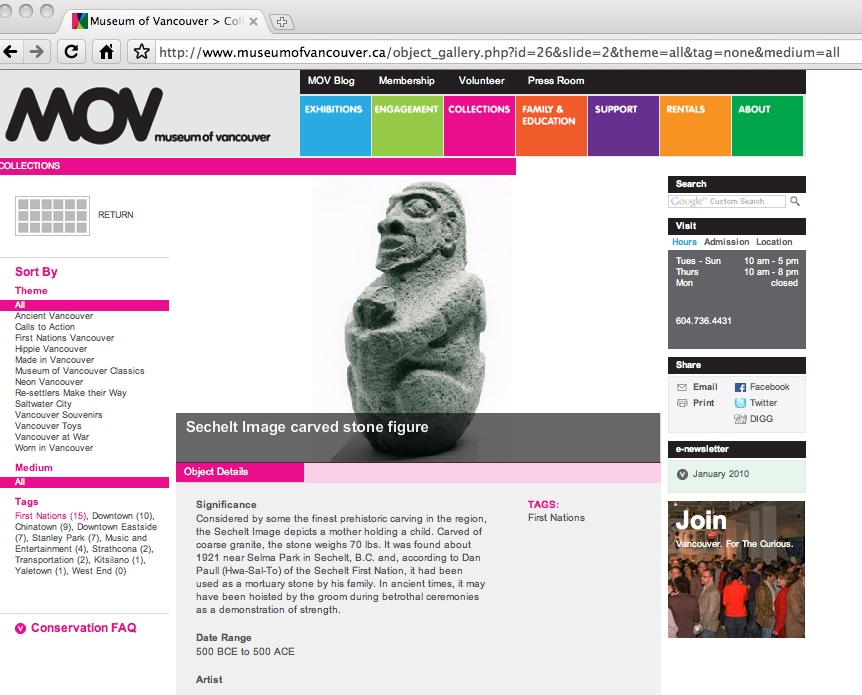
The Sechelt Image. Detail of Screenshot from the Museum of Vancouver. (click for full screen or scroll down)

The Museum of Vancouver has a pretty slick and punchy website from a design point of view, very “Web 2.0” with bright colours and links to twitter and facebook and the like.  But in some respects it fails, and fails badly.   Consider the image above: the “Sechelt Image”, a stone sculpture and one of the most famous objects in BC Archaeology.  A single low-resolution picture is offered, a link to which is not possible, and downloads of which are  deliberately made difficult.  And in this protective bubble,  the object can only be seen as a pale, grainy image, surrounded by the Museum’s loud and crass colour scheme. (Update: see full screenshot below: the Vancouver Museum overlays its neon social web over the Sculpture much like Vancouver itself overlays aboriginal culture).

Fine – I am used to that ridiculous phenomenon wherein Public Institutions think they own the images that they are entrusted with – if the image is allowed to be seen by the descendent communities (and in this case I wonder if it really is) then why can it not be seen in high resolution, free from the magenta borders and the exhortations to tweet!?

But the real problem is that the web designers, with their stupid and un-necessary banner reading “Sechelt Image carved stone figure”, obscure an important area of the sculpture, including the all-important vulva which reveals, as noted by Wilson Duff, that this sculpture is powerfully hermaphroditic.  It is not just bad and regressive museology to cover up an important part of an object, but I believe it is deeply disrespectful as well.  By obscuring part of the image and by imprisoning it within their branded frame and obfuscating web design, they, the (hopefully) temporary guardians of this powerful piece of art, are visually co-opting it for what amounts to advertising purposes.  There is no reason to put your label over top of that which you claim to be displaying for its own sake; no reason other than marketing zeal and lack of control over the web designers.

You might think it was just prurience over the frankly sexual image, but below we see another image from their website with no shocking! vulva! to conceal, which has been similarly branded and bounded by the MoV.  Maybe I am just mad at them still because they’re using a petroglyph boulder as a rock garden (note the obscuring “petroglyph” banner) but really: their website is an egregious example of stealth appropriation and blatant disrespect under the disguise of progressive design and social networking.  And I’m just a dumb archaeologist: I’d love to see a Visual Anthropologist dissect the public face they are so eager for the world to see, the face they insist must frame every image on their website.

The Skytte stone bowl. Screenshot from the Museum of Vancouver website. Click for full screen.

The Website sends the Message: "This is Not a Place of Honour. There is No Dignity Here."

Lu Zil Män Fish Lake: SW Yukon Archaeology and Oral History

Artifacts from the Lu Zil Män Fish Lake site. Source: Yukon government.

The Yukon government has a good web site up about archaeological and oral historical projects in the  Lu Zil Män Fish Lake area of the Kwanlin Dün First Nation’s territory.  The SW Yukon is a fascinating area where inland Tlingit people ranged from the coast, producing entangled relations with the interior speakers of na-Dene languages.

It’s good to see that the site puts the oral testimony of elders first and the archaeology second – what we’d call the “direct historical” approach if we were in a classroom.  This approach puts living people first in archaeology, using their insights to find locales and to interpret the uppermost layers.  Then, as one digs deeper, memory and history become less detailed and environments were different, and increasingly more generalized explanations from archaeology and ethnology come to bear.  The direct historical approach is usually ascribed to early researchers in the American SW, but a leading exponent and innovator was actually Frederica de Laguna, who began work on the Northwest Coast in the late 1920s, and had a 70 year active career.  The direct historical approach fell out of favour in a period where archaeologists tried to be highly scientific and to seek generalizations about people, but recently there has been renewed interest in it, especially in a community-based archaeological idiom.

Anyway, the Lu Zil Män Fish Lake project looks like it was a lot of fun, culturally informed, and well integrated into the community, while the web site is well written for the non-specialist.  My only complaint is the photos are rather washed out seeming and not very crisp or low resolution.

Find sites and excavation units. Source: Yukon government.

Lousy conservation at the Vancouver Museum?

Shoddy conservation of magnificent petroglyph boulder at the Vancouver Museum. Screenshot from VM website.

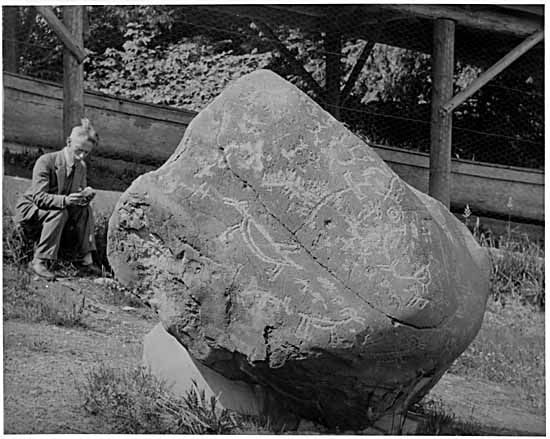
For some reason mistreatment of rock art just makes me spitting mad.  I posted the other day about a magnificent petroglyph boulder that was removed from its home on the central Fraser River near Lillooet in 1926.  Bad enough that this work of art was ripped from its setting to be a curio in an urban park.  Petroglyphs are not ornaments for your outdoor rock garden any more than they are lifestyle amenities deployed as advertising copy, even if you are a museum.

Now my spies tell me that this petroglyph boulder was moved to the Vancouver Museum in 1992.  Pictures of the boulder on the VM website show it to be in absolutely appalling shape.  It is covered with moss, the designs are visibly eroded and faint, there are signs of exfoliation, and the large crack seen in 1926 seems to be getting larger.   The Vancouver Museum appears to be keeping this treasure in a damp, shady, spot in the outdoors (as they say, it is in a “lower level garden courtyard”) and there is no sign of any attention to basic, fundamental conservation responsibilities. They even have the gall to note in their website description “Today archaeologists are reluctant to reveal the locations of petrogylphs, lest they be disturbed.”  Well I am revealing the location of this petroglyph, which is being disturbed by careless curation!

Seriously: this boulder is one of only a few petroglyphs from that part of the province, where pictographs are much more common.  It was in pristine condition in 1926.  Now it is a moss-ridden crumbling mess.  This boulder is a cultural masterpiece.  It is a provincial treasure.  It is a national treasure.  It is of international significance.  And yet it is being absolutely neglected by a leading cultural institution.  Imagine an Emily Carr painting being treated so poorly.  Imagine a Bill Reid sculpture  treated so shabbily.  It would never happen.  Yet this boulder is as important, is MORE important, and is consigned to rot away metres from state of the art curatorial facilities which are being devoted to white leather pant suits (!!).  It is astonishing to me that they put this boulder on the web at all, suggesting that they don’t see a problem and are therefore unworthy to be in possession of it.  They should make arrangements immediately to have it transferred to a suitable institution or have it returned to its original setting, in what I take to be St’at’imc territory

Vancouver Museum, you have a responsibility of professional stewardship.  Are you living up to it?

Note the eroded engravings and extensive moss/algae cover. Source: VM website screenshot.

The boulder in the early 1930s, soon after it was brought to Stanley Park. Note the crispness of the designs and the lack of moss.

Rock Art on Gabriola Island in 1792

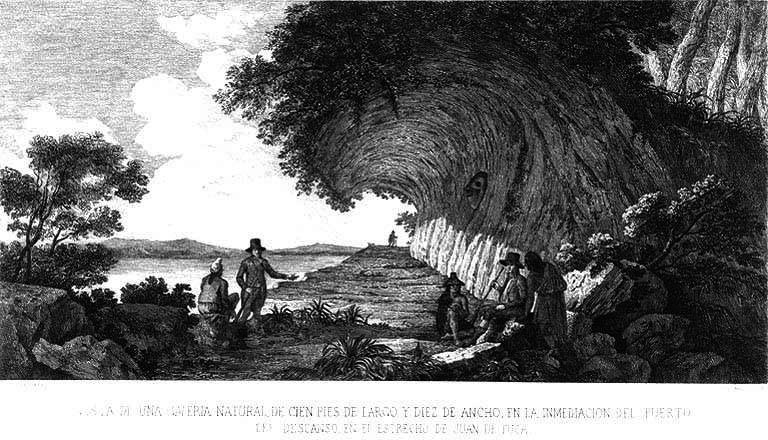
Descanso Bay Rock Art, 1792. Source: U. Washington

From the University of Washington, an unexpected image of a large Gabriola Island rockshelter containing rock art, entititled:

Northwest Coast carvings on cliff near Descanso Bay, Gabriola Island, British Columbia, in engraving made 1792.

Cardero, Jose, b. 1767 or 8

Notes: Photograph of engraving of explorers and indians viewing a carved head and other petroglyphs on the side of a cliff. The caption says it is a view of a natural gallery, one hundred feet long, and ten feet wide near Descanso Bay.

Caption on image: Vista de una galeria natural, ce cien pies de largo y diez de ancho, en la inmediacion del puerto del Descanso, en el estrecho de Juan de Fuca Image from Alessandro Malaspina’s Viaje politico-cientifico alrededor del mundo, 1885, f.p. 200

I presume this is the “Malaspina Galleries” near the ferry terminal – I didn’t know there was rock art there though and maybe there isn’t, anymore.  Perhaps this place, or this one? Or, perhaps the unusual pitted and pocked natural sandstone fooled the Spanish, though it sure looks like there is a large image in the middle of that engraving.   Quick, Gabriolans, trot down there and check it out.

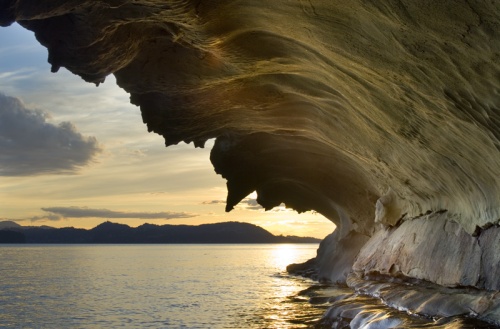
Malaspina Galleries, Gabriola Island. Photo: Kevin Oke.

Makah whaling gear

Parts of a Makah whaling canoe. Source: Waterman, 1920.

I posted a couple of days ago about a historic photo of members of the Quinalt Tribe making canoes in the Queets watershed.  Immediately to the north, the Makah tribe at the tip of the Olympic Peninsula are well known for their succesful whale hunting practices, carried out from canoes similar to those being carved.

As it happens, in 1920 the Anthropologist T.T. Waterman wrote a detailed account of Makah whaling technology, which you can download in full here (PDF).   Above, I illustrate the nomenclature of the Makah whaling canoe – I like how the small bump on the lower bow is called the uvula.  Below, you can see the seating plan when geared up and loaded for whale.  As you might expect for such a dangerous undertaking as killing whales from a canoe, the division of labour is quite precise:  “float-tender”, “harpoon line tender”, “float inflator” .  The “diver” had the task of swimming to the lower jaw of the dead whale, piercing the skin and flesh, and sewing the mouth shut to prevent the whale sinking on the long tow home.  You can see a vivid picture of some of these people further below.  Descriptions of these tasks and the associated gear is given in Waterman, which contains huge insight into traditional Northwest Coast technology and social practice.   I’ll most likely post more snippets from this book in due course.  The Makah have, of course, recently re-asserted their traditional right to hunt whales which I fully support.

Seating positions within a Makah whaling canoe. Source: Waterman, 1920.

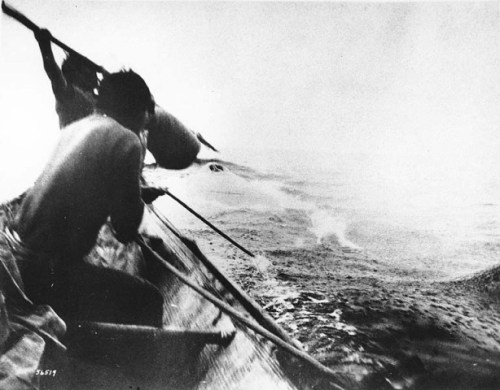
Makah Whaling: the 2nd harpoon strike. Line tender in action behind the harpooner. Source: Makah Tribe.

One Tree, Four Canoes

"Making 4 canoes from one cedar tree, Olympic Loop, Queets, Washington.

Yesterday I posted on canoe steaming.  In the process of preparing that, I ran across an eye-popping photograph, above.  Seriously, I have been working on Northwest Coast Archaeology for over two decades.  I have a pretty good memory.

But I’d never seen this picture before, which shows four dugout canoes being made from a single red cedar felled on the Queets River, Washington State.  Click it for pretty high resolution.  This would presumably be territory of the Queets Tribe, who are now part of the Coast Salish speaking Quinalt Indian Nation.  Imagine the complex and revealing archaeological site left behind: the wood shavings, the planks, the skids, broken tools, coffee cups … years ago I worked on an excavation of a Culturally Modified Tree Site in Clayoquot Sound and we found superbly preserved wooden wedges, woodchips and other evidence of intensive logging and carpentry — evidence which, given the durability of cedar, could easily last for centuries.  Such a contrast to those sites dominated by stone tools: wood was where it was at on the Northwest Coast and yet archaeologically we see much less of it, and think about it less, than we ought to.

I don’t know much more about this picture than the caption.  If you do, then leave a comment!

Makah whaling canoes on the beach at Neah Bay. These are stylistically similar to the ones being made above and to the one being steamed in yesterday's video.

Canoe Steaming

Carl and Joe Martin steam a canoe near Tofino. Click to play video.

The Northwest Coast is rightly famous for the superb dugout canoes made by First Nations, a craft which continues to the present day.  It takes weeks or months to carve  a canoe from a single log of red cedar – imagine then the tension inherent in having a big part of the success or failure “boil down” to a single event the steaming process.  The video above shows master carvers Joe and Carl Martin of the Nuu-chah-nulth nation steaming a canoe at a beach near Tofino, on western Vancouver Island.

Steaming softens the cedar and makes it more flexible, allowing the insertion of carefully-measured, carefully-planned wooden spacers which spread the middle of the canoe into a graceful curve, increasing its buoyancy, resistance to capsizing, and introducing subtle yet beautiful lines, as seen in this enormous example mis-labelled (I think) as Salish.  After the canoe cools and dries, the wood returns to its natural properties. The process means the canoe can in principle be wider than the single piece of cedar from which it is carved.

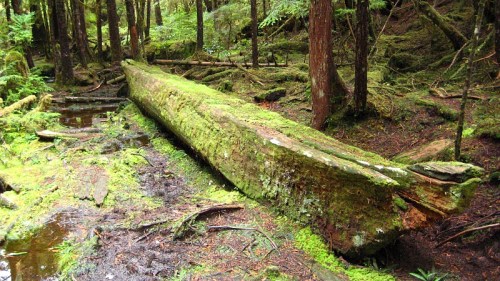
You can click here to see a slide show of the steaming of a Haida canoe carved by the team of Jaalen Edenshaw and his father Guujaw. In the old times, a canoe might be roughed out in the bush then hauled to the beach for finishing.  Sometimes flaws in the wood or other interruptions mean a canoe was never finished.  Such half-finished vessels are a known, but uncommon archaeological site in the woods of coastal British Columbia.

The carving of such canoes is increasingly common.  Nowadays, the canoe log is likely to be hauled to a carving shed.  Sadly, a major constraint  on canoe construction is the difficulty in obtaining prime, straight, clear, old-growth cedar logs.

Partially finished Haida canoe in forest. Photo by Martin Lalune.

Tree Burials at Tsaxis

"Arriving for a tree burial by canoe, in British Columbia, a traditional Indian ceremony", c. 1920. Watercolour by Joanna Simpson Wilson.

One of the most distinctive burial methods on the Northwest Coast was the creation of platforms in trees, on which coffins would be placed.  While the practice is commonly recorded and discussed in the Anthropological literature, photographs of tree “burials” are rare — and even if they were not, then reproduction of these images might well be problematic.

I recently ran across the image above by the little-known Canadian author Joanna Simpson Wilson (1896-1987), which shows numerous bentwood boxes attached to trees as a throng of mourners gathers below.  The platforms are rather insubstantial and the coffins are stacked several-high in places, with red cloth attached — perhaps the remains of blankets.  After a number of years, the boxes would deteriorate and the remains of the body would fall from the tree.  At this time, a secondary burial at a village site cemetery or other place might be performed.  I have seen the remains of several tree burials in the field, with human remains scattered beneath the branches of a large spruce — looking up, there are large branches with ring-like pathologies where the bark grew around rope, and other evidence of cultural modification. Archaeologically, there is a trend over the long term along the coast for inhumation of human remains to give way to sky burials or mortuary houses.

According to this site, the setting of the painting is the Kwakwaka’wakw village of Tsaxis (near Fort Rupert / Port Hardy on Vancouver Island), specifically a place called Storey Beach (more pics).

Boas 1934: Geographical Names of the Kwakiutl Indians. Click to enlarge. Strangely, Tsaxis (#13) is not plotted on the map.