Category Archives: First Nations

Shopping maul

Maul from the Dundas Collection.  Source: Sotheby's

Tsimshian Maul from the Dundas Collection. Source: Sotheby's

The Dundas collection of Tsimshian objects deserves a week of posts – not just for the stunning beauty and resonance of the art but for the profound issues in heritage management, cultural property ownership, and repatriation ethics which it raises or exemplifies.  I’ve been reading up on it a bit, and at one level the isssue is very simple: these Tsimshian treasures should have been repatriated – not to Canada per se, but to Tsimshian Territory.  At another level, there are complex, interwoven threads of (mutual) respect and ownership which make (and made) for no easy solution.   And no easy solution was reached: the collection was broken up, with the majority of the pieces sold to foreign hands (by foreign, here, I mean non-Tsimshian though I am prepared to argue this).

But for today, I was interested to see the Sotheby’s auction catalogue from the 2006 sale of this collection is still online.  The most interesting piece, of course, is the northern-style maul, seen above.  It sold for a surprising USD $1,320.00.  I wonder if it was in use at the time of collection or if it was already an archaeological specimen.  Collection of such materials from archaeological sites and their sale is, of course, now illegal although so far as I know there is a grandfather clause for older collections pre-dating the modern legislation.  I imagine any maul without such prominent provenance would be worth very little indeed.  Despite fetching far more than I would have imagined, it was a mere snip compared to the mask below which sold for a jaw-dropping USD$1,808,000.00.

Tsimshian Mask from the Dundas Collection. Source: Sotheby's.
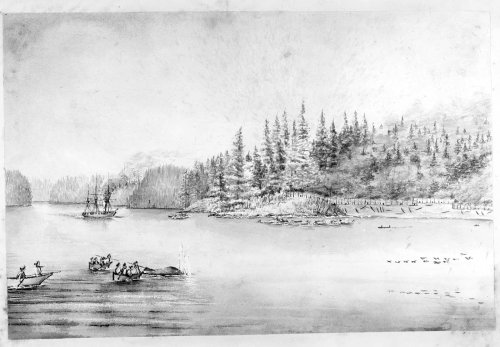
Ucluelet, 1859

"Euclueliat village, Barclay Sound, Vancouver Island, N.W. Coast. H.M.S. Satellite" pen and ink and watercolor drawing 1859 Mar. Source: Yale. Click for original, click through for large size.

The above is a rendering of Ucluelet Inlet on the west coast of Vancouver Island, made in 1859.  You can clearly see the aboriginal village to the right. Artfully, the artist has caught a whale hunt at the exact moment of harpooning in the foreground.   I’ve zoomed in on the village below.

Detail of Ucluelet Inlet village.

Interestingly, the next picture in this folio from Yale University is labelled as a “Songhee” Village (below), yet rather than a Victoria area settlement, it fairly clearly shows what I think is another Ucluelet-area village, with the distinctive saddle-shaped hill to the east side of the inlet.  (The trees are different which makes me think it is a different one than above) Anyway, nothing earth-shaking but I had never seen these historic drawings before.

Songhee? Village. North West Coast Vancouver Island. Barclay Sound. H.M.S. Satellite." pen and ink and watercolor drawing 1859 Mar. Source: Yale. Click for original, then click through for large size.

dSpace: Adams on Gabriola Petroglyphs

Gabriola Petroglyph Design Elements. Source: Adams 2003.

One recent M.A. thesis I was really looking forward to reading is by Amanda Adams entitled Visions cast on stone : a stylistic analysis of the petroglyphs of Gabriola Island, B.C., from UBC Anthropology 2003, and available for free download here.

I was particularly interested to read the instructions she received on proper deportment when visiting the rock art:

Sites were visited in a manner and with a personal code of conduct adhering to Snuneymuxw wishes. Petroglyph sites were not visited at either dawn or dusk. A respectful demeanor was expected as was an “open heart and mind” (Bill Seward, Snuneymuxw elder, personal communication 2002). I was asked to give my full attention to the petroglyphs and their sacredness, not allowing daily distractions to interfere with my concentration on the ancient imagery. These expectations were met to the best of my ability. (18-19)

While many archaeologists are under the impression that there is little to no ethnographic information about petroglyphs, I have long felt that more likely such knowledge is private or highly privileged and not readily shareable.  In this self-serving sense, it was gratifying to see that Adams was able to record some such information:

Snuneymuxw Elder, Bill Seward, asserts that many petroglyphs were made by shamans, hunters and vision seekers (personal communication 2002) while Elder Ellen White maintains that the carvings were places where people both sought and gained power. She explained that “men would be stripped – even in cold weather and laid on top of each petroglyph – learning the spirit world, connecting to the area.” She also noted that the pitted ‘dots’ surrounding several of the carvings were “points of access”, places where one could dip their fingers into pools of “energy” and reservoirs of strength (Archaeology Forum group tour 2002).  (p 13)

Another welcome aspect of Adams’ thesis is her direct comparison to portable art.  Continue reading

Historic Sketchbook of Heywood W. Seton-Karr

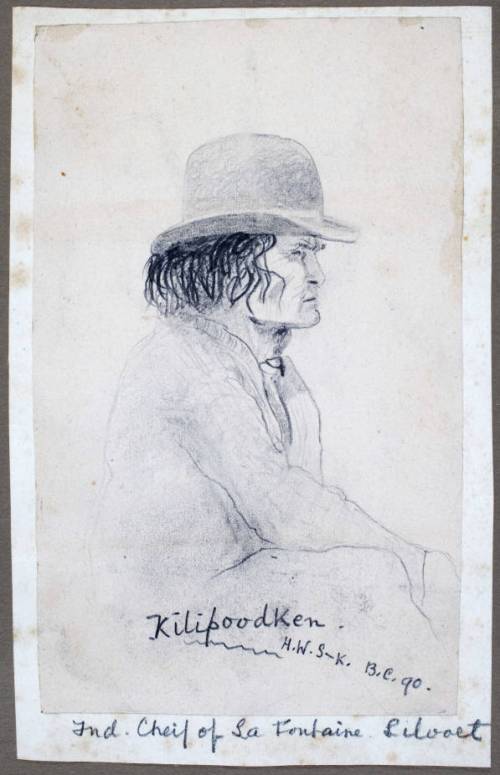
Portrait of Kilipoodken by Heywood Seton-Karr, ca. 1890. Source: Alaska Digital Archives.

I’ve just come across a remarkable sketchbook in the Alaskan digital archives.  It covers the wide-ranging travels of one Heywood W. Seton-Karr, a British Army officer, big game hunter, amateur archaeologist, and talented artist (about whom, more below).  While I could probably fill 10 blog posts from this sketchbook, (and may do so!) a very interesting find is the portrait sketch above.  The caption reads,

Kilipoodken. Ind. [Cheif]  of La Fontaine Libooet. H.W.S-K. B.C.90.

This certainly refers to the Xaxli’p First Nation, also known as the Fountain First Nation, one of the Lillooet (not Libooet!) Tribal Council from the central Fraser River region of British Columbia.  Since googling for “Kilipoodken” only returns the Alaska Digital archives source, it seems to me possible that this mislabelled portrait is unknown to the Xaxli’p Nation, where it is more than likely some of this Chief’s descendants still live.   I hope they find this portrait.

Otherwise, there is much of interest in these sketchbooks. Continue reading

Squamish and Lil’wat Cultural Journey

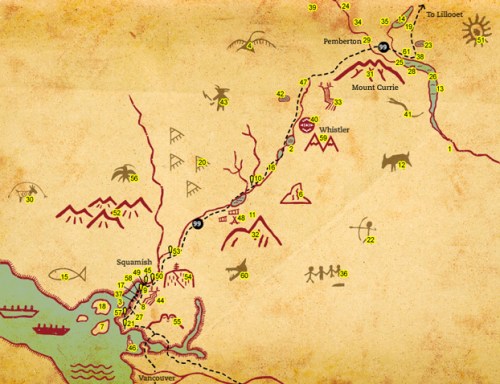
Squamish Lil’wat Cultural Journeys Map. Click to go to the site.

The Squamish and Lil’wat First Nations have jointly produced a really nice website which explores the cultural landscape of their traditional territories, which lie just north of Vancouver. Edit: it looks like their website now sells kitchen products – obviously they did not keep their registration up to date.

The interactive map has dozens of “clickable” elements, taking you to place name information, to the description of rock art motifs, and to landscape features imbued with stories from history and the supernatural.  Some of these include simple but effective animations, and the overall site design is clean and harmonious.

It seems that seven highway pullouts have also been designed with this information: aboriginal cultural tourism out on the land is something I have long thought has enormous potential in B.C.  Looking at a book or a website is one thing, but having the information available, provided by the First Nations, at the place where the story happened or the traditional use occurred, seems like it would be very effective, and popular, way of educating the public about the thousands of years of cultural history on either side of the Olympics.

Supernatural serpent emerging from Ts’zil (Mt. Currie). Screenshot from culturaljourney.ca

Destruction of Kwalate Village

Major landslide scar near Kwalate Village. Source: panoramio user Obslord.

Yesterday’s post about Marianne Nicolson’s powerful pictograph in Kingcome Inlet and the post from a few days ago about the enormous Tsunami in Lituya Bay got me thinking again about recent work in Knight Inlet on the central B.C. Coast (map).

A recent project by a team of geomorphologists and an archaeologist, UVic’s own Duncan McLaren, investigated oral historical accounts about Kwalate Village of the A’wa’etlala and Da’naxda’xw peoples, of the Kwakwaka’wakw First Nations.  The accounts state that a landslide in Knight Inlet triggered a local Tsunami which swept this village away. This account is known anthropologically through a number of sources, including Franz Boas (1910, Kwakiutl Tales):

“About three generations ago, or possibly at an earlier date, a large portion of the mountain opposite Kwalate Point slid into the inlet causing a huge tidal wave which wiped out all of the inhabitants of the village opposite…and the vast slide is noticeable today”.

Of course, the story of the destruction of Kwalate is still told and the dead, unknown in number but perhaps up to one hundred, are still mourned and memorialized in the surrounding communities.  While it is not necessary, or even desirable or possible, for archaeology to confirm oral historical accounts, when that happens it can be of interest to archaeologists and First Nations people alike. Continue reading

Northwest Coast in New Zealand

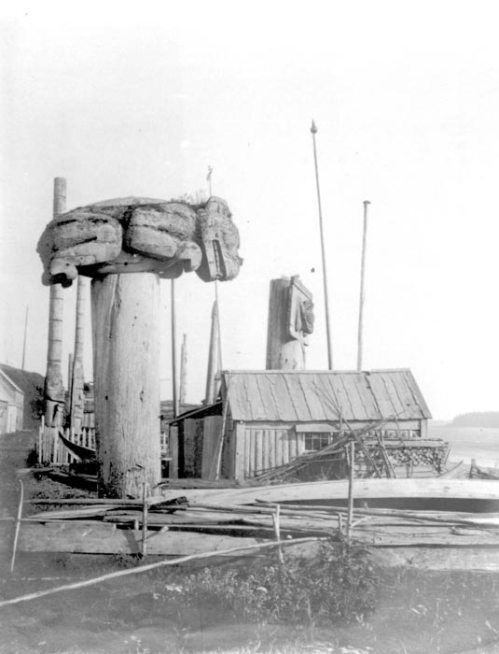
Masset, ca. 1924. Source: University of Canterbury, NZ.

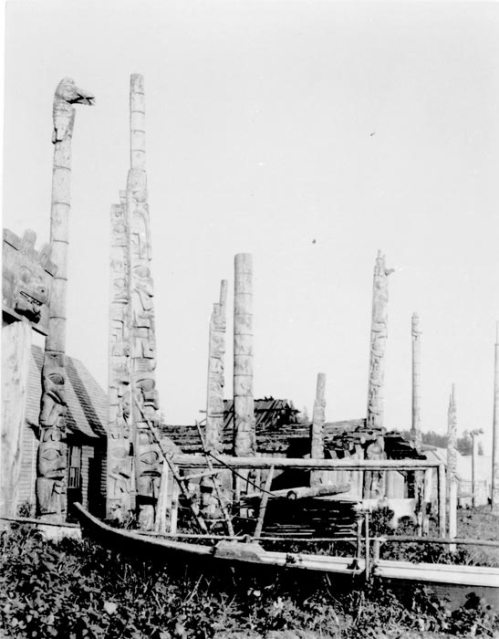
I found myself poking around in a New Zealand archive at the University of Canterbury the other day and found some nice historic pictures from the NW Coast.  These are assigned to the collection of John Macmillan Brown, an early New Zealand academic and, in retirement, an amateur anthropologist.  I am guessing these pictures were taken by him in retirement.  Most are undated; one carries a date of 1924.  The subjects are familiar yet the views are new – the more we can catalogue the world’s pictures of the NW Coast, the better we can understand the processes of transformation which continue to unfold.

Update: fixed links, sort of.  Note to web types: you should always provide stable URLs, none of this “your search has expired” junk.  If you want your collections used, and you do, because you put them on the web, you need to make it so the results can be bookmarked and shared.  Gosh.

Skidegate ca. 1924. Are those oarlocks on that canoe? Source: University of Canterbury.

La Perouse at Port des Francais (Lituya Bay)

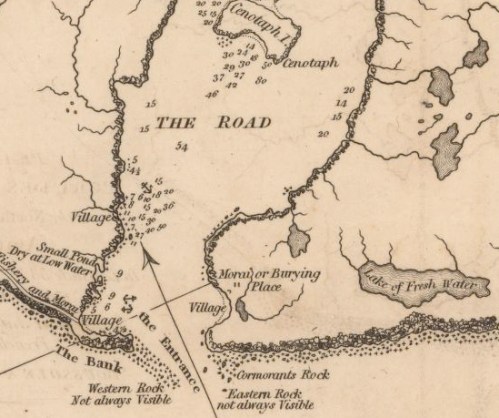
Detail of entrance of Port des Francais. Source: Brown University. Click for zoom version.

Most readers will be very familiar with Captains Vancouver and Cook and some of the other early European explorers of the Northwest Coast.  Less familiar is Jean-François de Galaup, Comte de La Pérouse, (1741-1788), who embarked on a world journey of exploration in 1785:

The French decided to mount a scientific and exploration voyage to rival that of Captain James Cook. Two ships, the Boussole and the Astrolabe, under La Perouse’s command left France in August 1785. They spent the summer of 1786 off the coasts of Alaska looking for a northwest passage then sailed down the west coast of North America in August and September 1786.

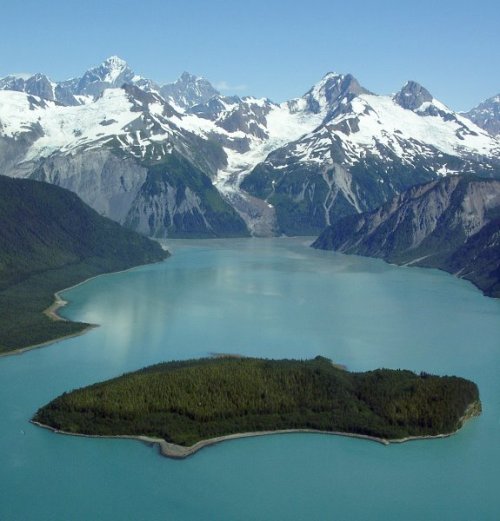
One of their most memorable and tragic periods was the time they spent in Lituya Bay, Alaska, which they called Port des Francais (map).

Lituya Bay, with Cenotaph Island in the foreground. Source; Panoramio user footsnviews.

Their mapping and illustration of Tlingit life are not unknown but also not that easy to find.  I recently came across an interesting site which has the best web presentation of these materials (actually reproduced from a 1798 British edition) I have seen: the images are highly zoomable, and the zoom is fast and crisp and smooth.  Linking to specific images is possible and the links don’t break.  With a little bit of effort, you can download the images (hint: “view source” of the page and search for ‘Size4″).  So zoom right in and see the details of pictures such as this one of a fish camp (are those halibut drying, or Pacific cod?), or this one of both a fine Tlingit dugout, and the construction of a skin vessel, with its seal skin hull removed and placed to one side.  The chart made by La Perouse is here and full of detail (again, these are English re-engravings of the originals).

While spending  time in Lituya Bay, tragedy befell the expedition. From here, an account of La Perouse’s time in Port des Francais:

1786 July Port des Francais / Lituya Bay

The next day, the narrow entrance to an inlet was located to the east of Cape Fairweather. De Pierrevert, from the Boussole, and Flassan, from the Astrolabe, were dispatched in small boats to investigate the inlet. Their favourable reports encouraged a somewhat reluctant La Pérouse to take the ships in. Their first approach was unsuccessful and they tacked offshore through the night before the tide carried them in the next morning. Even then, it was a precarious passage and the ships both nearly were driven onto rocks. They anchored just inside the entrance but La Pérouse was not happy with this spot, it having a shallow, rocky bottom. He sent men off to a find safer anchorage. D’Escures found a better location behind the large island in the inlet and the two ships transferred there. It was 3 July 1786.

Continue reading

Adawkhl Gitsegulka

Gitsegulka ca. 1909. Source: Adawhkl Gitsegulka.

Yesterday, while posting CanadaGood’s flickr set of “totem poles” I found a really interesting document at the web site of the Gitsegulka community of the Gitxsan First Nation on the Skeena River.  Called Adawkhl Gitsegulka, it is a history of the settlement written in 1979, by band members via consultation with hereditary chiefs.  So often we only see these historical pamphlets for settler communities; it is quite fun and interesting and a little bit sad to read through this one written by First Nations themselves.  For example, note how (page 7) the Indian Agent in 1909 respects the hierarchies of the hereditary chiefs, apparently only in order to establish himself as the highest ranking of the lot.  Scroll down to page 35 for a discussion of the motives and means of carving poles.

There is an interesting theme which runs through the whole document: the uneasy relationship between the deeply felt Christianity of many Gitsegulka Gitxsan, and the old ways and practices.  In its informal way, through consultation with numerous elders, with charming illustrations, the Adawkhl Gitsegulka is an intriguing source of information on how the community saw itself in the transformative years of the late 1970s, when land and title claims were once again rising.  Five years on, they were in court claiming rights and title to their territory, and not much more than 10 years later, the landmark, borderline racist, “McEachern decision” of the BC Supreme Court would be handed down (the Gitxsan-Wet’suwet’en case: Delgamuukw vs. the Queen, round 1) which started a transformation of aboriginal rights in Canada.  Delgamuukw 3  in 1997 eventually set the frame for the modern treaty process when the Supreme Court ordered a new trial.  The trial has never happened but the new Supreme Court terms and definitions structure our modern understanding that Aboriginal rights and title were never extinguished and must be reconciled.  The Adawkhl Gitsegulka is an indigenous perspective on a small community about to have its voice heard right across Canada.

The document ends with the slogan of the [then] Gitksan-Carrier Tribal Council:  “Walk on, walk on, on the breath of our grandfathers”.

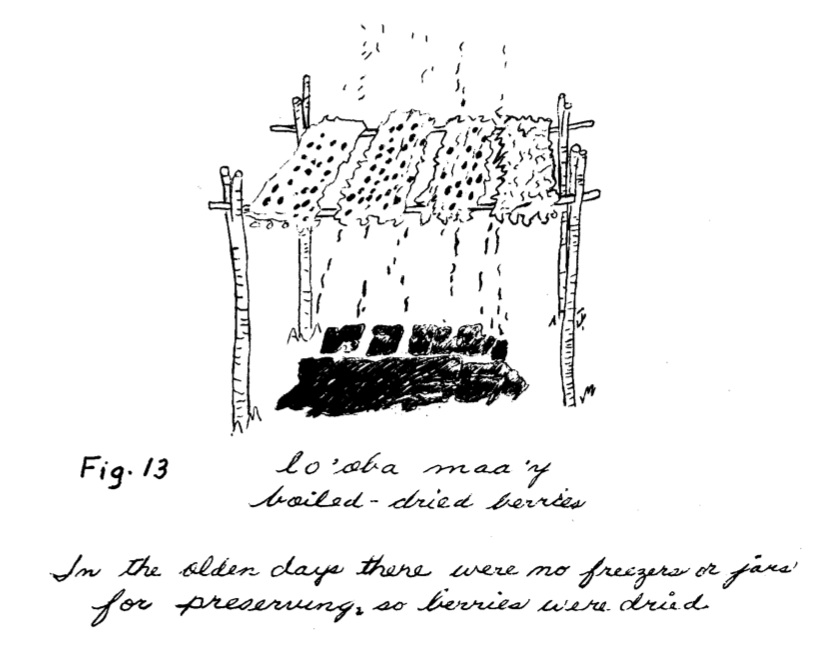
Drying Berries. Source: Adawhkl Gitsegulka.

Interior layout of a house. Source: Adawkhl Gitsegulka.

Flickr user CanadaGood’s pictures of poles

Fallen pole at Gitsegulka. Source: flickr.com user CanadaGood.

Someone posting under the username “CanadaGood” at flickr.com has put up an impressive array of over 100 photos of “totem poles”.  What I like about this set is that most of these are not the iconic ones from coffee table books or museums but rather are still standing (or lying) in communities, mostly along the Skeena River.  They aren’t the most technically accomplished photos or anything but they are undeniably atmospheric and they document the process of renewal and decay of poles which was an important part of the carving complex.  Each pole is the material instance of the right to carve and display a set of crests or images, often as a memorial to a dead person of high status, and therefore the “thing” must be set against the intangible, non-material property of rights and titles which it represents.  Proper treatment of the pole might therefore well include letting it return to the earth, replaced by a fresher copy.  I like the matter of fact way this one is set up on stumps and this rotting masterpiece at Gitanyow.  This figure is unusual for being “sculpture in the round”.   Kudos to CanadaGood for putting pictures of these less commonly seen poles on flickr, in high resolution, and under a Creative Commons licence to boot.

Tops of standing poles at Gitsegulka. Source: flickr user CanadaGood.