Category Archives: fieldwork

Fieldschool Update, and Public Lectures

Screenshot of Times Colonist article - click to go to the story.

I am in town briefly and see the Time-Colonist has an article and photo gallery about the UVIC-Parks Canada archaeological fieldschool in the Gulf Islands.  It’s a pretty good article with some nice quotes from the students about their experience, and which emphasizes how threatened some archaeological sites are.  It would have been nice to see more acknowledgment of local First Nations and of the hard work Parks Canada’s liaison team is doing to help build relationships around cultural resource management.  It’s very early days for the field school but in the medium term it hopes to be of service to First Nations and their archaeological questions and concerns. A big part of that is the specific focus on archaeological site assessment and management skills being taught by the course instructor, Dr Duncan McLaren, and another big part is the presence of paid First Nations interns who will be taking the field school – only one this year but more in the future it is hoped.  Anyway, the article tells part of the story very effectively and the reporter and photographer had an interesting time with the fieldschool and vice versa.

In related news, I’ll be giving a public talk about Salish Sea archaeology with a fieldschool update this Friday July 30 on Pender Island at 7.00 in the Anglican Hall.  Then, my mini road trip takes me to Saturna Island on July 31 for a talk at 7.30 at the Community Hall.  Otherwise, there probably will be no updates here until the middle of August.

Times-Colonist screenshot - click to go to story.

ASBC Victoria: May Public Lecture Tuesday 18th

Quartz Crystal projectile point with Stave Watershed in background.

Seven Thousand Years of Occupation at the Ruskin Dam Site, Stave River Watershed

Duncan McLaren, Ph.D. and Brendan Gray, M.A.

This month’s Archaeological Society of B.C. (Victoria Chapter) free public lecture will be about a fascinating site recently excavated by Cordillera Archaeology in the Stave River watershed, near Vancouver:

Excavations of the Ruskin Dam Site, located on the north side of the Fraser Valley, were conducted over four months in 2009 as part of a salvage project.  Our talk will discuss the significance of the major discoveries at the site including: the house features, quartz crystal tools, biface styles, woodworking technology, objects of personal adornment, and faunal remains which contain a high proportion of sturgeon bones.  Combined, the artifacts, radiocarbon dates, and site stratigraphy provide a unique opportunity for gaining a perspective on the long-term occupation of this strategically located archaeological site.

I expect this talk will also indirectly exemplify the leading role B.C. Hydro is playing in enlightened Cultural Resource Management in this province.

This talk is free and open to any member of the public.

Tuesday May 18 at 7.30 P.M.

Pacific Forestry Centre, 506 West Burnside Road.

For information,  e-mail asbcvictoria@gmail.com , or leave a comment/question below.

Capilano University Field School Blog

"At each logging camp a familiar discovery was a wood burning stove or oven. The one pictured {above} had stumped some former students of Muckle's in the past because the student who helped recover the stove had read an engraving on the side saying "To Jake". After pondering upon this curious inscription, it was realized that the "J" had incorrectly been read, and the whole etching had actually said "To Bake", commonly found on ovens." Source: http://archaeologyfieldschool.blogspot.com/

I noticed that the Capilano University Archaeology Field School, which just started a few days ago near Vancouver, has a blog.  So far there are three days worth of entries and it looks like it will be a lot of fun to follow along with the students who, under the direction of  Bob Muckle, will be continuing to work on the archaeology of historic logging in the Seymour River Watershed, which flows into Burrard Inlet.  Much of the logging was conducted by Japanese immigrants, making for a nice overlay of ethnicity and capitalism and material culture.

Continue reading

NE BC Archaeology Videos

Click to play video.

Click on the picture above to see a short video of an archaeologist working with Nenan Dane-zaa elders and youth, near Fort St. John.  It’s a nice example of some community archaeology by an unidentified archaeologist who appears to go by the name “Frank”.

Of course the weather in Northeastern B.C. is not always so sunny and warm, and yet (as we discussed a few weeks ago) archaeology continues or even accelerates in the winter months.

Continue reading

Annotation: Collison Bay

Annotation of the Collison Bay night-time, low tide excavations.

The Collison Bay site in Haida Gwaii  posed some unusual challenges, some natural and others of our own making.  The site is found in the intertidal zone and dates, like the Kilgii Gwaay site about 10 km away, to a brief window about 10,700 calendar years ago.  I posted the above picture before, but without annotation.  That previous post describes something of the site formation processes, which mean a site which was terrestrial when occupied is now in the intertidal zone, and excavation must take place between the tides.

Looking at the above, you can see we didn’t plan for the tides very well!  other projects required us to be elsewhere and when it was Collison Bay’s turn, the low tides were in the middle of the night.  This meant we had to get up at midnight to work until about 6.00 in the morning the first night to catch the falling tide, then we got up about 12.45, then about 1.30, and so on: tracking the procession of the low tides.  So, to the inherent complications of working in the intertidal zone we did it in the dark, running electric lights from a generator.  This actually worked really well and data recovery was excellent – we dug there on another occasion in the daytime (see below) and there was no real difference in quality of work.  Also part way through this project we were working until mid-morning and could see pretty well!

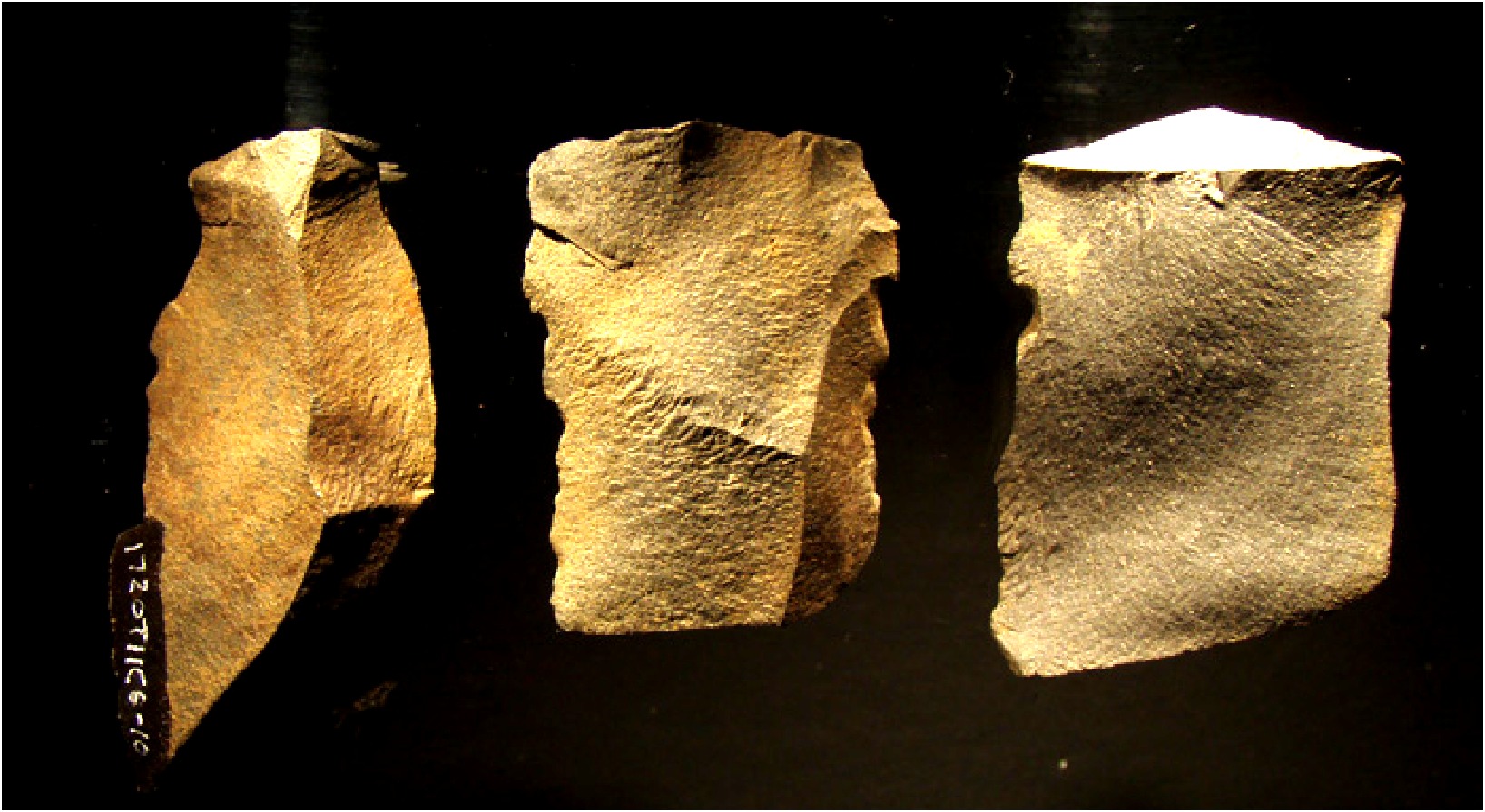
The site includes numerous water-worn stone tools on the surface and in the upper beach deposits, but in the lower beach deposits the tools are pristine and show no signs of water-rolling.  In many cases they lie flat, also suggesting a lack of disturbance, and they are encased in a thin, brown layer of jelly-like material which is the organic remains of a degraded soil.  Unlike at Kilgii Gwaay, there is no survival of bone or wood.  Nonetheless, the stone tools are very similar to that site, and speak to a terminal Pleistocene technological approach using discoidal and uni-directional cores to create large blade-like flakes.  Too much information for some readers I bet – but the take home message is this way of making stone tools might be peculiar to the  Pacific Rim and not the continental interior and therefore might, perhaps, maybe, one day, turn out to have significance for the coastal route of the First Peopling of the Americas.

Pristine, sharp blade-like flakes used as stone tools from 10,700 year old deposits in the beach at Collison Bay. Flake on right is about 6 cm long. Photo: D. Fedje

Establishing an excavation unit as soon as feasible on a falling tide to maximize digging window.

Memories of Ozette

Makah whaler Wilson Parker posing as a MAKAH WHALER for Edward Curtis, ca.1915

The magazine of Washington State University has a nice article on the archaeological project at Ozette, the UNESCO World Heritage Site on the west side of the Olympic Peninsula.  This Makah village site was covered by a landslide about three hundred years ago (animation), which created preservation conditions highly favourable to preservation of wooden artifacts.  The story begins

THERE’S A WELL-KNOWN PHOTOGRAPH taken by Native American chronicler Edward Curtis in 1915 of a Makah whaler. Dressed in an animal skin, the man is longhaired and wild. He had indeed been a whaler, as had generations of his people. But still, the photograph is a memory of a time already past. Curtis provided Wilson Parker with a hide and a wig to replace the European clothes the Makahs had adopted long before. In spite of Curtis’s fiction, however, there is much to be learned from Wilson Parker, the man in the photograph. As is always the case with a good myth, there is a deeper truth that lies beneath the surface story.

Parker is Sharon Kanichy’s great-great-grandfather, she tells me as we talk in the Makah cultural center in Neah Bay. Kanichy ’01 was born in February 1970. That same month, a powerful storm blew in off the Pacific, eroding the bank above the beach at Cape Alava, on the Olympic Coast, revealing something remarkable.

“All we knew was there was a burial site,” says Ed Claplanhoo of the buried longhouses revealed by that February storm. Claplanhoo ’56 was Makah tribal chairman in 1970, so it was he who got a phone call the first Saturday in February, from a hippie schoolteacher, as Claplanhoo describes him. A dubious character, says Claplanhoo, which is why he didn’t take the fellow seriously when he tried to warn Claplanhoo that “people” were getting in the “house” and taking “artifacts.” Claplanhoo knew everyone in Neah Bay and knew everyone who owned artifacts. He’d heard of no problems.

But the fellow persisted. The next Sunday, the same phone call. “Mr. Claplanhoo, they’re still taking artifacts out of the house.”

“So I said okay,” says Claplanhoo, “I’ll tell you what, you come to my house at seven o’clock tonight and we’ll talk about it.”

From there, the article recounts the story of the Ozette excavations from the point of view of both Makah and the archaeologist Richard Daugherty, who led the decade long excavation of “North America’s Pompeii.”  It nicely captures the importance of the site as well as the nature of the dig and the social relations formed which endure to this day.

Don’t miss the slideshow from the excavations — it’s an awkward interface but some very atmospheric pictures of life on a remote archaeological dig in the 1960s – as well as a few shots of the US Marines who helped airlift supplies in and treasures out.

Digging at the Ozette Site - the hoses were used to gently free the wooden artifacts, such as the house planks shown, from the mudflow which buried them. Source: WASU Magazine.

Annotation: Gaadu Din 2

Gaadu Din 2 is an archaeological site in a small limestone cave in Haida Gwaii.  It is a narrow, sinuous cave which probably was used on occasion by denning bears during the Younger Dryas cold period at the end of the Pleistocene:.  Currently it is at about 100 metres above sea level and 500 metres from the shore, but when occupied it was as much as 200 metres above the then-lower sea levels and up to 5 km from the shore.  The logistics of bringing excavation equipment to this mountainside location are significant, as is the care required by Parks Canada’s rigorous standards for the proper treatment and rehabilitation of karst post-project.

Among the interesting features of this cave is its very flat floor and very dry interior.  Thus, while narrow and cramped, it would have also offered some reasonable shelter to humans near the entrance, where there would have been daylight.  Based on this and other hints, we conducted a brief excavation at the entrance and quickly established that there had been – on at least four occasions spanning over 1,000 years — a small campfire built, around which people did a small amount of stone tool repair.  This was between about 10,800 and 13,000 years ago.  Probably this cave was used as a staging post for winter-time bear hunting in the other caves in the area, and bears may have been hunted in this cave itself as well.  You can imagine them, the day of the successful hunt, spending the night at this entrance, warming themselves by the fire, telling stories of the day’s dramatic events, and tweaking their toolkit to be ready for the next.

In any case, it is a remarkable thought that on at least four discrete occasions, separated by centuries, people came to this cave and built a fire in the same place as their ancestors had done.  It was a privilege to sit where they sat and, together with Haida archaeologists descended from these hunters, to recover the clues they left behind, which may well form the oldest known archaeological site in Canada.  There is no space here to relate all we know from these caves but suffice it to say for now that these are heritage sites that reveal not only hunting practices but the spirituality which surrounds those hunting practices and continues to inform and imbue Haida respect for bears to this day.

It is fortunate that these caves lie within Gwaii Haanas National Park Reserve, but many similar caves in BC, with similar materials undoubtedly within them, do not share this protection and are commonly destroyed.  This is because there is both insufficient protection for karst as a special landform with unique ecological attributes, and  a general lack of appreciation within the archaeological community about the potential that such caves hold for archaeological sites of the highest possible significance.

Annotation: Richardson Island Stratigraphy

Annotated stratigraphy of lowest Richardson Island archaeological deposits.

Richardson Island is a remarkable archaeological site in southern Haida Gwaii.  When it was occupied, sea levels were about 10 metres higher than today, and rising.  Then, sea levels stopped rising and occupation continued.  We have dates ranging from 10,500 cal BP to 2900 cal BP (calendar years before present).  However, the early part of the record includes the most impressive stratigraphy.  The shoreline configuration at that time likely included a supra-tidal marine berm feature, which would have had a flattish top and have been well-drained and probably vegetation free: a perfect place to camp.  Occasional storms or even tsunamis would build this berm in the winter, and with rising sea levels the berm was “pushed uphill” so to speak.  The berm-building process would have involved sudden dumps of sorted pea-gravel onto the occupation layers at the site, sealing and preserving them.  Overall, though, the site is in a well-protected location, at least relative to the enormously dynamic winter sea conditions of Haida Gwaii. Continue reading

UCLA-Stó:lō Field School at Welqámex

s’iltexwáwtxw

I see UCLA is running a fieldschool again this coming summer in Stó:lō territory at Welqámex, a village site on the  small island in the Fraser River near Hope.  Instruction is by Anthony Graesch (UCLA) and Dave Schaepe  (Stó:lō Research and Resource Management Centre).  The UCLA web site has been down as much as up recently (because it has so  many bells and freakin’ whistles it doesn’t know if it is coming or going — idiot web designers make such fragile shit these days), so you can also check the AIA web site.  Here is a direct link to their pamphlet (PDF).

Note the students wearing protective ochre daubing.

Videos of Gwaii Haanas Archaeology

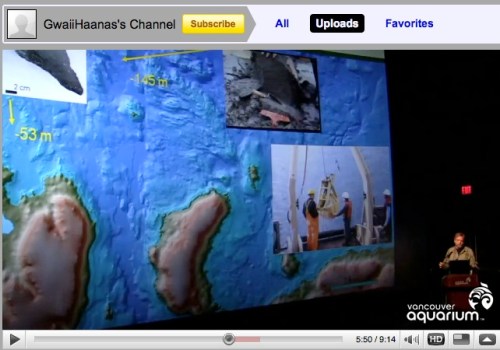
Daryl braves the barrage of bras to set the Vancouver Aquarium straight on the value of dead fish over living fish. Click to play part 1.

Rockwash superstars Nicole and Daryl show off their cool wares in a couple of videos I just found online – I vaguely remember them going off to give this talk at the Vancouver Aquarium.  It’s in two parts: 1 and 2.  Nicole looks fabulous and Daryl has trimmed his beard!  Win-Win.  The projects they describe sure were a lot of fun to take part in.   There are a few other talks up including Lyle Dick and Norm Sloan on Sea Otters on the Gwaii Haanas Youtube Channel.

A sandhill crane is a tough act fo follow but Nicole hammers home the righteous message of dead fish. Click to play part 2.