Category Archives: archives

Peabody Museum Ethnographic Collection

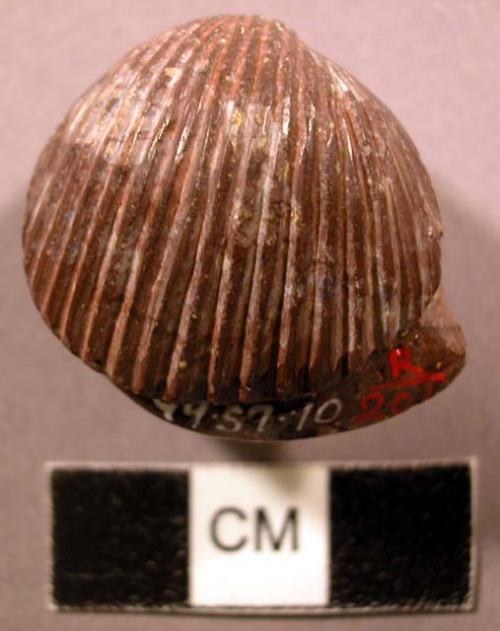
Haida carved cockle. Source: Peabody.

The Peabody Museum at Harvard has a predictably great collection from the Northwest Coast.  I’m more drawn to the archaeological-type artifacts vs. the masks and baskets and argillite, but fill your eyes with the charming Haida carving of a cockle, above, collected in “Massett Bay”.

One nice thing about this collection is the accession ledger is also scanned in and made available.  For example, if you go the the page for the cockle above here, you can click on the cockle picture for a higher resolution, on the first ledger page for the left hand side of the ledger book, and on the second for the right hand side.  It is possible in this way to do some ad hoc fact checking of their descriptions to finding additional information. For example, the cockle’s second page contains the notation “taken from the interior of R/200”.  Accession number R/200 turns out to be this unusual ?argillite carved box with inlaid shell.

Some of the other objects are equally unusual – I’d say there are more “wow – never seen one of those before” moments in this collection than any other I have seen.

Continue reading

Yuungnaqpiallerput: Yup’ik Science and Survival

Inflating the stomach of a beluga whale. Source: Yupikscience.org

Yuungnaqpiallerput (The Way We Genuinely Live): Masterworks of Yup’ik Science and Survival” is a fascinating and informative (and large!) website companion to a 2008 exhibition by the same name at the Anchorage MuseumBooks and catalogues are also available and look to be excellent.

I know that Yup’ik territory, on the southern flanks of the Bering Straits, is a long way from the Northwest Coast.  But there are many similarities in the ingenious tricks and tools of the trade needed for a maritime lifestyle, and this exhibition deftly combines historical, archaeological and ethnographic accounts into a compelling vision of people at ease on land and sea.

.

Continue reading

The Schieffelin Brothers Yukon River Prospecting Trip of 1882

Tanana woman returning from the hunt, 1882. Source: AKDC

Browsing in the Alaska Digital Archives I found an interesting photo album documenting a prospecting trip up the Yukon River by the Schieffelin Brothers, Ed and Al, who just a few years earlier had founded the famous desert mining town of Tombstone, Arizona.  Two pictures from this album struck me as particularly interesting, though the whole thing is worth browsing.

The first of these is the remarkable picture above, showing a Tanana woman with a long-gun, powder horn, and a couple of large rabbits.  While anthropologists and archaeologists have grudgingly revised their “Man the Hunter” stereotypes in recent years, it is nonetheless rare to see such a frank portrait of a competent woman with her prey.  I’ll be using this one in class, starting next week.

Continue reading

Photos of Victoria and Esquimalt, 1859

Victoria 1859. Source: LOC

In 1846, the Oregon Treaty established the boundary between British and American territory west of the Rockies (and unintentionally established the benchmark date for whether archaeological sites are automatically protected under the Heritage Conservation Act, but that’s another story).  Vancouver Island was to remain in British hands in its entirety, but otherwise the 49th parallel was to be the boundary on land.  The ocean boundary through the Salish Sea was resolved later, after the armed standoff on San Juan Island known as the “Pig War“.   An International Boundary Commission was struck, with the mandate of surveying the 49th parallel and one of its base camp headquarters in 1858 and 1859 was Esquimalt.  At this time, a series of photographs of the young Fort Victoria and surrounding buildings were taken, some of the earliest photographs from British Columbia I know of – including some remarkable pictures of First Nations people.

Continue reading

A Portal to Online Graduate Theses and Dissertations

If you look up you should see two more links have been added along the header of this page, just above the banner picture.

ARCHAEOLOGY THESES is a page of links to freely-available, online PDF copies of graduate dissertations and theses on Northwest Archaeology subjects (with a few palaeo-environment theses thrown in for fun).

OTHER THESES is a similar page, but where the focus is on Northwest Anthropology, First Nations Studies, History and related disciplines.

I am planning another page which will be for online archaeological, ethnographic and historic documents of note, in particular “classic” ethnographic works and major site reports which have been intentionally posted in online contexts.  Probably this will be a few weeks yet.

The impetus for these pages is that I have often said the M.A. thesis in particular is a significant backbone of B.C. Archaeology, and the dissertation even more so.  For years these substantial works languished on library shelves.  Now, libraries are increasingly making them available online, free to the public and the academy alike – that is, not behind password protection.

However, you have to know how to look, and where to look, and often you need to know in advance what you are looking for, in order to find this stuff.  I thought it would be useful to have a very simple portal for these graduate works.  Not only does this make them browsable by the more hardcore of my blog readers, but it will get them some google-love!

Not all theses ever written are available online (mine isn’t!):  as it notes on the pages, there are programs in place at UVIC and UBC to digitize their back-catalogue of theses and dissertations.  It would be great if institutions like Calgary, Toronto and McMaster could get their dSpaces full, and open. Unless, of course, they are ashamed of the quality of their graduate student work 😉

So, these pages will be updated periodically. I am not vouching for the quality of any of the ones I linked — indeed a few of them are exceptionally poorly reasoned,  naive, unsupported, badly written, or long-winded efforts -and  in at least one case, all of the above!  Most are very solid though, in my estimation, and a few are truly excellent.  If you know of useful and relevant graduate work that is freely available and not yet linked, let me know in a comment below, or send me an email qmackie [at] gmail.com.  In the meantime, happy browsing.

Ucluelet, 1859

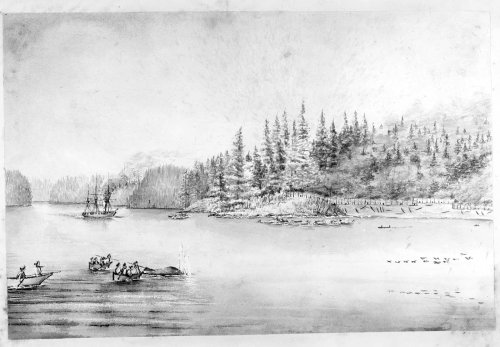
"Euclueliat village, Barclay Sound, Vancouver Island, N.W. Coast. H.M.S. Satellite" pen and ink and watercolor drawing 1859 Mar. Source: Yale. Click for original, click through for large size.

The above is a rendering of Ucluelet Inlet on the west coast of Vancouver Island, made in 1859.  You can clearly see the aboriginal village to the right. Artfully, the artist has caught a whale hunt at the exact moment of harpooning in the foreground.   I’ve zoomed in on the village below.

Detail of Ucluelet Inlet village.

Interestingly, the next picture in this folio from Yale University is labelled as a “Songhee” Village (below), yet rather than a Victoria area settlement, it fairly clearly shows what I think is another Ucluelet-area village, with the distinctive saddle-shaped hill to the east side of the inlet.  (The trees are different which makes me think it is a different one than above) Anyway, nothing earth-shaking but I had never seen these historic drawings before.

Songhee? Village. North West Coast Vancouver Island. Barclay Sound. H.M.S. Satellite." pen and ink and watercolor drawing 1859 Mar. Source: Yale. Click for original, then click through for large size.

Green cod heads and the case of the missing halibut

Copper kettle full of cod heads. Source: Alaska OHA.

I was feeling sick yesterday and this picture didn’t help: from the Castle Hill excavations at Sitka, Alaska (previously 1, 2) is the nearly complete copper kettle.  Inside, the archaeologists found the green-stained bones from the heads of three codfish (true cods, Gadidae, are 35% of the fish assemblage).  One of the great things about archaeology is to get these tiny slices of life: someone’s kettle of fish, set aside one day 200 years ago.

At a bigger scale, archaeology isn’t always so straightforward though.  Interestingly, from the site as a whole, only 1% of the fish bones are from halibut (11 bones in total).  This is despite the fact that:

Cod dominated the Castle Hill assemblage, and yet, Emmons (1991:148) stated that cod was considered an unimportant part of the Tlingit diet if salmon and halibut were available. Historic records confirm that cod was popular in Sitka, because it was available almost year around (Gibson 1976:40, Khlebnikov 1994). Halibut was also popular because of its year around availability and was sold to the Russians in large numbers. Between 22,000 and 138,000 pounds of halibut were purchased each year from the Tlingit from 1846 to 1866 in addition to the yearly average of 13,000 pounds of halibut the company procured itself (Gibson 1987:94). The emphasis on halibut brought to Sitka and sold to the Russian-American Company would lead to the prediction that halibut should dominate the assemblage, yet this is not the case. It may be a case where cod were readily available and not worthy of special consideration in historic documents.

Two things strike me about this.  One is that the Tlingit, using largely traditional methods at the time, were able to produce up to 138,000 pounds of excess halibut for trading purposes.  That’s a lot of fish.  The other is that so much halibut renders down to so few bones.  Halibut is long known on the NW Coast as being strongly under-represented in archaeological sites, probably because it may have been butchered on the beach and the bones, which separate cleanly from the meat, would end up in the intertidal zone and be washed away or eaten by dogs.  It also seems possible  that the Tlingit were trading in dried, boneless halibut (which makes the tonnage involved all the more impressive).  And certainly the entire site was not excavated, so there may be a mother lode of halibut bones somewhere.  But this case makes an interesting cautionary tale in zooarchaeology: we seldom have an accurate sense of the scale of the incoming fish quantities to compare to what is left in the ground, and when we do, the degree of difference between the written and material records is often quite startling!

Tlingit women and children cleaning fish on the beach, ca. 1907. Ignore the racist caption. Source: U. Washington.

Northwest Coast in New Zealand

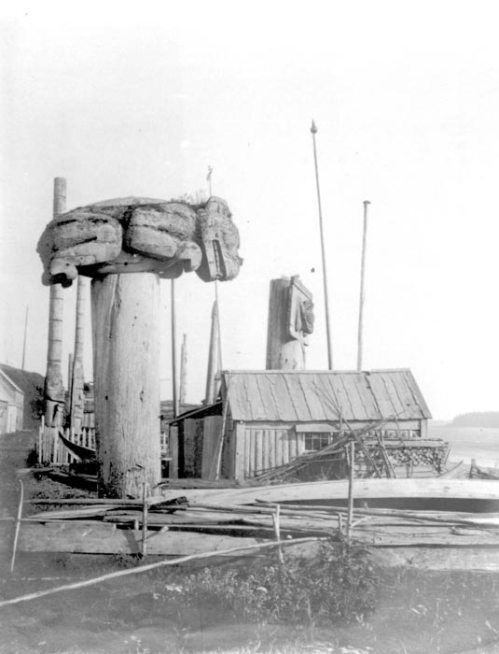
Masset, ca. 1924. Source: University of Canterbury, NZ.

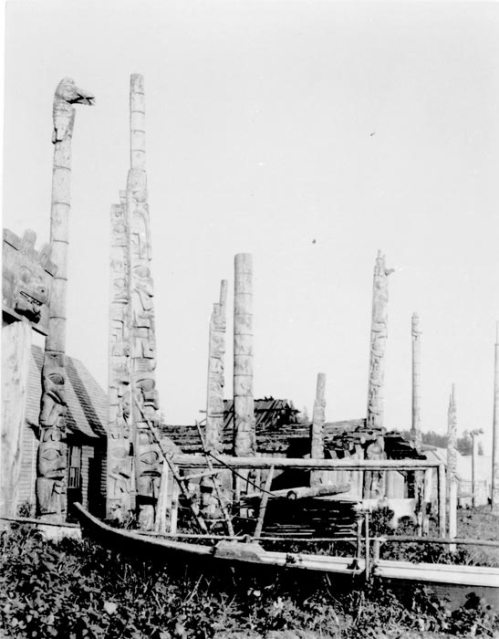
I found myself poking around in a New Zealand archive at the University of Canterbury the other day and found some nice historic pictures from the NW Coast.  These are assigned to the collection of John Macmillan Brown, an early New Zealand academic and, in retirement, an amateur anthropologist.  I am guessing these pictures were taken by him in retirement.  Most are undated; one carries a date of 1924.  The subjects are familiar yet the views are new – the more we can catalogue the world’s pictures of the NW Coast, the better we can understand the processes of transformation which continue to unfold.

Update: fixed links, sort of.  Note to web types: you should always provide stable URLs, none of this “your search has expired” junk.  If you want your collections used, and you do, because you put them on the web, you need to make it so the results can be bookmarked and shared.  Gosh.

Skidegate ca. 1924. Are those oarlocks on that canoe? Source: University of Canterbury.

Major expansion at the Royal B.C. Museum?

Proposed changes to the RBCM: the clear white structure to the back left is the new curatorial tower & archives; to the right is a new entrance and multi-functional area. Source: Times-Colonist.

The Victoria Times-Colonist had a story Saturday that the Royal B.C. Museum is proposing a major expansion, in which theirs quare footage would more than double, from 379,000 to 895,000 square feet.  The curatorial tower and the low-rise archives building on the NW side of the block would be demolished, replaced by a new multi-function complex which would also form the entrance to the museum.  The collections and curatorial facilities, and the archives, would move to a new 14 story building to the south of the current museum.  The RBCM C.E.O, Pauline Rafferty (an archaeologist by training) notes that ““We are now at a crossroads.  We have outgrown our on-site storage facilities and significant artifacts are stored below sea level.”  The article estimates the cost will be in the hundreds of millions of dollars which is easy to believe. The Times-Colonist weighs in with a strong editorial of support, citing the collapse of the Cologne archives last year with irreparable damage to the history of that City.  So: no-brainer, right?

Continue reading

Hoko River pictures are back

Hoko River project director Dale Croes, apparently wearing chaps, at the site in 1977.

(Edit 2018 October: look here for current location of these pictures)

Some time ago I pointed readers to the vast repository of Hoko River wet site excavation pictures put online by Dale Croes.  Unfortunately, those links broke but now, via  blog reader APM, I hear that the Hoko photo gallery is back online.  I will definitely be mining this repository for lots of posts.  Not only is this one of the most interesting sites ever excavated on the Northwest Coast, the pictures are a superb combination of excavation, artifact, and camp life – the latter a visual record of local archaeology as social practice in the 1970s. Also, as I mentioned previously, the lush, rich colour of the old Kodachrome slide film is stunning – you just don’t see that in modern digital cameras or even print film, despite the undeniable advantages of digital.

From the main page, many of the most interesting pictures are found under the “camp life” link.  There you will be confronted with an awkward frames-based link layout.  Not all links work still, but I’d say 90% do.  You can browse easily by clicking on the pictures that open on the right-hand frame to get the next picture.  This is easier than keeping the mouse centred on the picture number to the left.  Right click on the picture to bring it up in its own window or tab.  Some pages are organized as thumbnails, such as the wet site stratigraphy series. Because of the slightly awkward interface, I’ll aim to create a series of posts here which point to what I think are interesting aspects of this wonderful site.

Richard Daugherty and survey crew evaluate potential of Hoko Site in 1967 in WSU research vessel.