Category Archives: Archaeology

The Bill Reid Centre For Northwest Coast Art Studies

Gwayasdums house under construction 1899. Source: SFU.

The Bill Reid Centre for Northwest Coast Art Studies is part of the Department of Archaeology and First Nation Studies at Simon Fraser University, although it is physically located in downtown Vancouver. It  currently shares space with the Bill Reid Gallery on Hornby St., near SFU’s Harbour Centre Campus. They have a website that looks to be growing fast with some good content – and despite the name of the centre, it is not only about Haida Art, or even just about Art:

A major activity of the Centre is to visually document through photographs, drawings and other works, the depth and richness of Northwest Coast Art in the hundreds of communities in which monumental architecture and sculpture were recorded.

I’ll point out a few highlights and make some comments “after the jump”
Continue reading

“BC Studies” is now mostly free

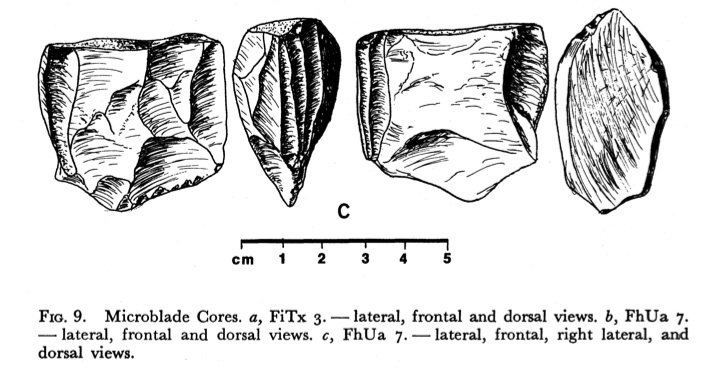
Haida Gwaii microblade cores. Source: Fladmark 1970. BC Studies.

The journal BC Studies is a respected, peer-reviewed publication that focuses on, well, studies of BC, but particularly on historical topics it seems.  It has long been an awkwardly circulated journal, in that it appears in few indexing databases and no PDFs were available, even via subscription or through paywalls such as university databases. These days, going to the library to photocopy is considered a hardship.   It is therefore extremely welcome to see that BC Studies has put almost its entire series of back issues online, open access, free. Wow.  You can download any article from inception in 1969 through the  Summer of 2008.  Interestingly, a number of the articles are also available as mp3 sound files, so you could listen to these on your daily commute.  Naturally you can browse it yourself but you won’t, so let me point out some of the highlights, with an eye on archaeology, ethnohistory and historical geography.

Continue reading

Glenrose Cannery Under Threat?

Anthropomorphic and zoomorphic sculpture from Glenrose and St Mungo Cannery sites. Source: Delta heritage passport

The Glenrose Cannery site, which lies on the Fraser River near the Alex Fraser bridge, is one of the mose significant archaeological sites in BC.  The human figure on the left, above, dates to the ‘St Mungo” phase, putting it at between 3500 and 5000 years old.  It might be the oldest known representation of a human being in British Columbia – well, to my knowledge, it is.  Yet, you can already see elements of the formline art appearing – look at the eyebrows, for example.  More importantly, look at the beard.  Look at the hair, pulled into a bun.  This is a portrait of an individual.  The artifact, which is probably a small handle for a chisel, is a masterpiece of Canadian art. The site in which it was found shows continuous occupation from the present to about 9,000 years ago and spans up to eight metres of vertical deposits.

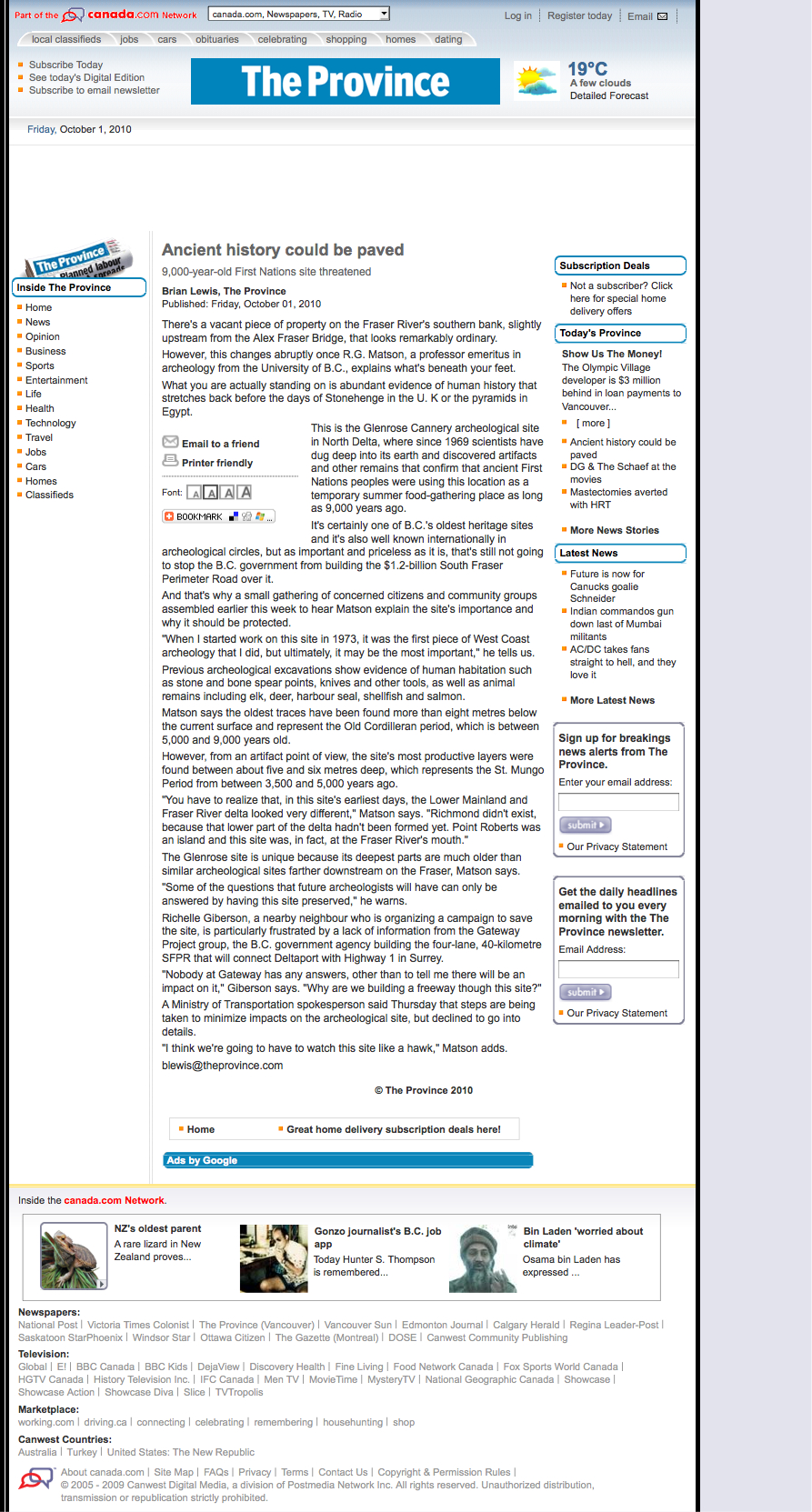
So it is disturbing to think that Glenrose might be further affected by development, in this case, road building associated with the “Gateway Project”, a transportation infrastructure megathrust to get stuff to and from the Ports of Vancouver faster. There is a short article in The Province yesterday (archive) in which UBC Professor Emeritus RG Matson, one of the key figures in BC Archaeology, visits the site.   We can’t preserve everything from the past, clearly, or all cultures at all times would have been glued to the footprints of their forebears.  But a site of such demonstrated significance as Glenrose should probably be completely off limits.

Continue reading

BC Archaeology Forum 2010

I got the news yesterday that the annual B.C. Archaeology Forum has been scheduled.  The event will be co-hosted by the Musqueam First Nation and the UBC Laboratory of Archaeology and held November 5-7.  You can download a registration form here (MS-Word document)

Continue reading

Oregon’s weird weirs

Dense fish trap / weir in an Oregon estuary. Source: Byram pdf @ WARP website

(edit: I completely stupidly mixed up who did the poster under discussion. Apologies all around, fixed the text below)

I mentioned the Wetland Archaeology Research Project (WARP) and their revamped website once before in reference to Nancy Greene’s pioneering fishtrap work at Comox.  I’m glad to see they have another interesting conference-style poster available for download, this one by Robert Losey (now at the University of Alberta) Scott Byram on the topic of Oregon fish weirs in unusual settings (PDF).

If a cow patch strikes you as an unusual setting, of course.

Continue reading

Dixon’s Underwater Entrance

Waters around OYK Cave. Source: Polarfield.com

E. James (Jim) Dixon, now at the University of New Mexico,  is pretty well known on the Northwest Coast for his pioneering work at the 10 to 12,000 year old 49-PET-408 (“On Your Knees Cave”) in the Alaskan Panhandle, and more recently for his exciting work on Alaskan Ice Patches. I see now that he apparently received some funding to go underwater during the summer of 2010 in the waters around PET-408, not far north from the aptly named Dixon Entrance, in Southeast Alaska (map).  This work could have implications for the coastal route of First Peopling of the Americas.

Continue reading

Long term salmon resilience

Salmon lice infestation. Source: Georgia Strait Alliance.

I’ve just dipped into an interesting paper (PDF) by Sarah Campbell and Virginia Butler, which explores 7,500 years of relationship between First Nations and Pacific Salmon.  While, as ever, the archaeological evidence is discontinuous and somewhat patchy, the authors reach profound conclusions that go far beyond the usual archaeological focus on the past, as if the past still exists other than in the present.

The Northwest Coast was estimated to have the second highest indigenous population density in North America (after California) at European contact, with population estimates ranging from 102,100 to 210,100 (Ubelaker 2006). Haggan et al. (2006) propose an annual average per person consumption rate of 230 kg/yr based on two 19th- century estimates. At this rate, 200,000 people would annually consume 46,000 metric tons (50,706 tons) of salmon, comparable in magnitude to the average yearly commercial catch between 1901 and 2000 (Jones 2002). (emphasis added)

Continue reading

East Wenatchee Clovis Photo Gallery

One of the East Wenatchee Clovis Points. Source: Washington State Historical Society.

A few months ago I posted about the surface finds, or other finds without archaeological context, of the Clovis archaeological culture in Puget Sound, noting that this shouldn’t be all that surprising considering the well-known East Wenatchee (Richey-Roberts) Clovis Cache from just east of the Cascades.  Clovis, as you may know, is an archaeological culture type long associated with the first peopling of the Americas, although a decreasing number of archaeologists think it reflects that series of events.

Anyway, you can review that other post for more details.  What I’ve subsequently found is that the Washington State Historical Society has a colour gallery of all 49 of the artifacts from East Wenatchee.  The pictures are not particularly high resolution but they are well-taken and well-lit and better than most you’ll find on the web.  You can match the projectile points up to this diagram if you are feeling keen, or compare to the pictures at the lithic casting lab, some of which have hands and other useful sizing aids in them.

Even so, since they were scanned from 4 X 5 inch format negatives, it’s disappointing there is no higher resolution downloadable.  For a fringe interest like this, and considering that bandwidth is practically free, let’s make this stuff available.  You can click on the view options to, for example, see both sides of the artifact displayed at once.  It’s also very surprising that there is no photo scale and dimensions are not given.

Continue reading

Still no Clovis Comet

Oh noes, my tusks are on fire. Source: wincustomize.com

I talked once before about the “Clovis Comet” theory, which suggested the widespread extinctions of megafauna in North America at the end of the last ice age was caused by a large comet impact.  At the same moment, the highly distinctive “Clovis” archaeological culture was terminated.  It was suggested this comet might have either airburst or struck the ice sheets, in either case not causing a visible crater.  However, abundant “nanodiamonds”, said to be highly diagnostic of an extraterrestrial impact, were found at a widespread boundary layer roughly associated with the end of Clovis – the start of the Younger Dryas cold period when the earth was suddenly thrust back into near-glacial conditions.

So, I said then and I’ll say again now: this theory didn’t pass the sniff test from the beginning because it is another example of “Clovis exceptionalism” – the skeptical leeway that the Clovis-First model of first peopling of the Americas has been afforded by segments of the archaeological community.  No Clovis model was so implausible that it wasn’t given much respectful beard-stroking by the usual silverbacks.

Anyway, subsequent studies of the nanodiamonds and associated evidence have failed utterly to reproduce the findings.  Now comes even more news that the comet theory is unsupported and that the original investigators may have mistaken nanodiamonds for, among other things . . .  [drumroll] . . .  “hardened faecal material from arthropods.”

Continue reading

Bella Coola Lichen

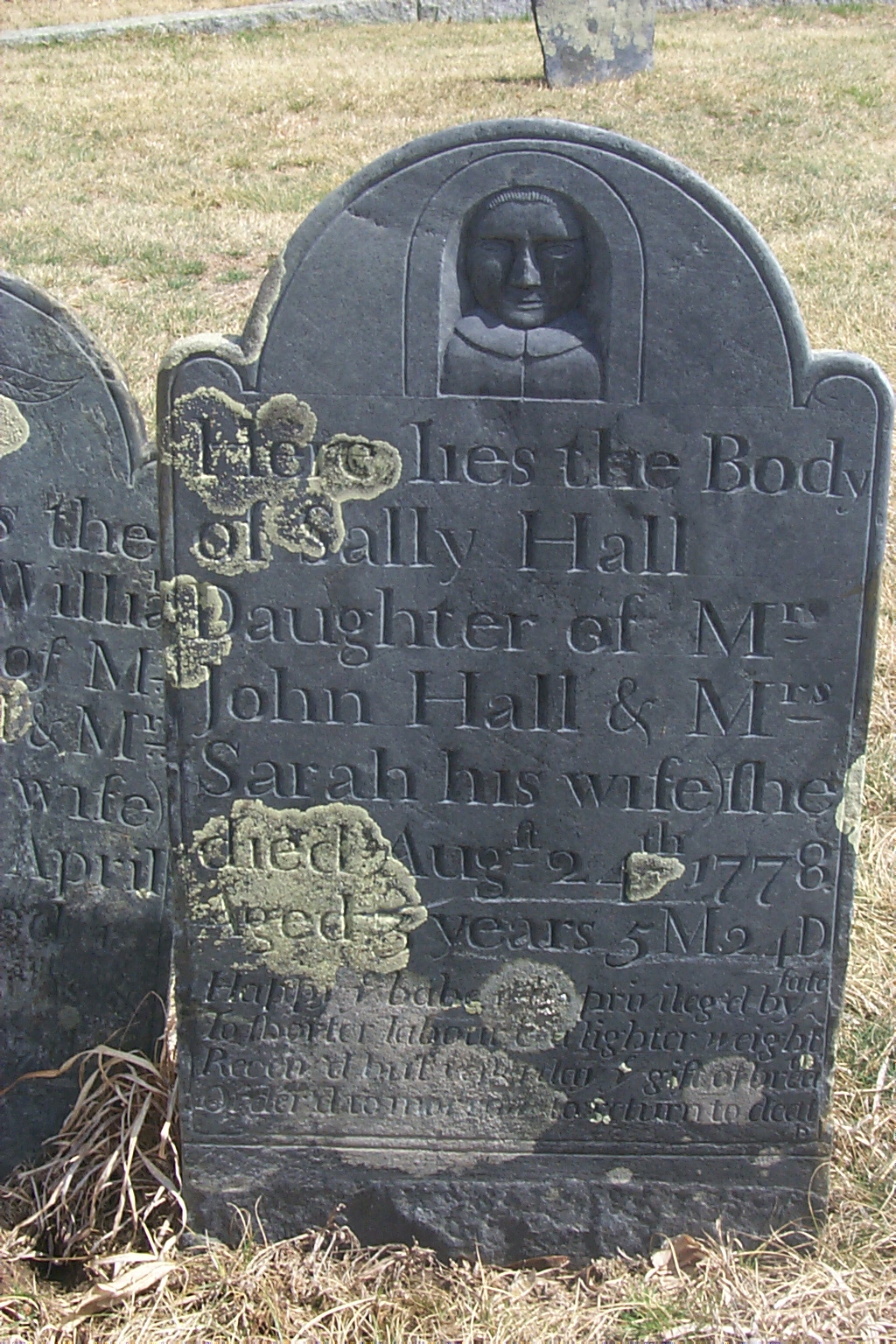
A gravestone with lichen growth. Source: designscience.com

I was reading the charming Bella Coola Blog the other day and came across an interesting post discussing how lichen had been used to date glacial features in the area.  So-called lichenometry is a well-established dating technique which relies on the principle that lichen grows in roughly circular patterns, and that there is a linear relationship between the diameter of the circle and the age of the lichen patch.  Now, such patches can be many hundreds of years old.  So for an event where rock is newly exposed and then lichen grows on it, the lichen will give a minimum date on when the bare rock was first available as a lichen environment.  Anytime you have a bare rock and a dating technique for when the rock became bare, the archaeology antennae rise.

Continue reading