Category Archives: anthropology

Handmade Garnet Musket Ball from New Archangel

Garnet musket ball from excavations at Sitka, Alaska. Source: Alaska OHA.

It is a common trick in archaeology classes to puzzle students with gunflints – part of the sparking mechanism of older muskets – which were made until recent times by the remnants of a European flaked stone industry until modern cartridges replaced them.  However, I had never heard of the use of stone musket balls before — but the picture above shows one made out of garnet, which is a heavy and dense mineral. This specimen is from a historic Tlingit-Russian site in Alaska.  As the caption notes:

“Large garnets can be found in schist… Because of the shortage of lead, the Kolosh [Tlingit]  use them instead of shot to kill sea animals.” [Khlebnikov’s 1817-1832 report, 1976:39]

It is typically ingenious for the Tlingit to have adapted traditional stone working technologies to the new, introduced technologies.

Over much of coastal Alaska the first contact aboriginal people had with Europeans was with Russians, rather than Americans, British, French or Spanish.  One of the most important Russian settlements was Novoarkhangelsk, or New Archangel, founded in 1799 at the present day town of Sitka (map).  The tumultous history of the founding of this outpost near a Tlingit village called Gajaa Héen, its subsequent capture by Tlingit warriors and ransom of Russian captives for 10,000 rubles, and its recapture 1804 by a Russian naval fleet during the “Battle of Sitka” is a subject for another day.

Suffice it to say that, as with all history, archaeology can fill in the stories of the everyday life of people and of events that go unrecorded by pen and paper.  In this respect, it is good to see the Alaska Office of History and Archaeology has a very full, very detailed report available online about archaeological work at “Castle Hill”, the ancient Tlingit fort known as Noow Tlein which subsequently became the cornerstone of the Russian defensive facilities at New Archangel.  You can browse the report chapters here, and the photos here and here.  No doubt I will post more in due course, as there are some extraordinary artifacts found at this site, not least among which is this hand-made toy musket.

The Russians may have won the battle of Sitka, but they eventually left, leaving behind the Sitka Tlingit tribes to continue their journey to the present, where their vibrant culture continues to thrive as this interactive place names map for the modern Town of Sitka makes clear.

Fort at New Arkhangel -- "View of the Establishment at Norfolk Sound," 1805-06 (from a watercolor by G.H. von Langsdorff). Source: Alaska OHA.

PS:  if you are skeptical about that Wikipedia link to the Battle of Sitka, then you can hear about the events in Tlingit here).

Plan of New Archangel, 1804. Fort site is to centre right. Source Alaska OHA.

Raven de La Perouse

Wooden and brass pipe representing Kan Lituya in the form of a Supernatural Frog, and his Bear Slave creating waves in Lituya Bay. Source: de Laguna, Volume. 3

My recent post on the 1786 visit by La Perouse to Tsunami-prone Lituya Bay, Alaska sent me scurrying to download the massive ethnography by Frederica de Laguna entitled Under Mount St. Elia Under Mount Saint Elias: The History and Culture of the Yakutat Tlingit.  As expected, there is a rich oral history of waves in this bay.  From Volume 1, page 94, she says

Emmons (1911, p. 295) recorded Indian beliefs about the dangers of Lituya Bay, caused by:
“… a monster of the deep who dwells in the ocean caverns near the entrance. He is known as Kan Lituya, ‘the Man of Lituya’ [qa htu ‘a?]. He resents any approach to his domain, and all of those whom he destroys become his slaves, and take the form of bears, and from their watch towers on the lofty mountains of the Mt Fairweather range they herald the approach of canoes, and with their master they grasp the surface water and shake it as if it were a sheet, causing tidal waves to rise and engulf the unwary.

De Laguna then continues to discuss an extraordinary wooden smoking pipe, illustrated above:

“This legend of Lituya is illustrated by a carved wooden pipe (fig. 50) [pi. 123], of splendid proportions, which was obtained in 1888 from the chief of the Tuck-tane-ton family of the Hoon-ah Kow [DAqdentan sib of Hoonah], who claimed this bay as his hereditary sea-otter hunting ground. It was used only upon occasions of particular ceremony—when the clan assembled to honor the dead, or to deliberate upon some important question of policy. At one end is shown a froglike figure with eyes of haliotis shell, which represents the Spirit of Lituya [possibly the Frog crest of the sib?], at the other end the bear slave sitting up on his haunches. Between them they hold the entrance of the bay, and the two brass-covered ridges are the tidal waves they have raised, underneath which, cut out of brass, is a canoe with two occupants, that has been engulfed. [Author’s note: This illustration was furnished through the courtesy of Mr George G. Heye, in whose collection the pipe now is.”]

One thng leading to another, I thought I would look into whether the Tlingit story of La Perouse’s visit had been passed on.  As it turns out, the early ethnographer G.T. Emmons records an account given by a Tlingit chief one hundred years after the visit of La Perouse to Lituya Bay.  This gives an indigenous perspective on what must have been an extraordinary series of events for both parties.  This account is well worth reading, so I am reproducing a portion of Emmons (1911) rendering below:

“In 1886, one hundred years after [the vist of la Perouse], Cowee, the principal chief of the Auk qwan of the Tlingit people, living at Sinta-ka- heenee, on Gastineaux Channel, told me the story of the first meeting of his ancestors with the white man, in Lituya Bay, where two boats of the strangers were upset and many of them were drowned. This narrative had been handed down by word of mouth for a century. These people possess no records nor had the chief, who spoke no word of our tongue, ever heard of La Perouse from outside sources; so we can here authenticate by an exact date a most interesting piece of native history in detail, the truth of which is substantiated by the fact that La Perouse was the only one of the early navigators to visit this locality in a large ship and by the attending loss of life in the destruction of his two boats.  Continue reading

Destruction of Kwalate Village

Major landslide scar near Kwalate Village. Source: panoramio user Obslord.

Yesterday’s post about Marianne Nicolson’s powerful pictograph in Kingcome Inlet and the post from a few days ago about the enormous Tsunami in Lituya Bay got me thinking again about recent work in Knight Inlet on the central B.C. Coast (map).

A recent project by a team of geomorphologists and an archaeologist, UVic’s own Duncan McLaren, investigated oral historical accounts about Kwalate Village of the A’wa’etlala and Da’naxda’xw peoples, of the Kwakwaka’wakw First Nations.  The accounts state that a landslide in Knight Inlet triggered a local Tsunami which swept this village away. This account is known anthropologically through a number of sources, including Franz Boas (1910, Kwakiutl Tales):

“About three generations ago, or possibly at an earlier date, a large portion of the mountain opposite Kwalate Point slid into the inlet causing a huge tidal wave which wiped out all of the inhabitants of the village opposite…and the vast slide is noticeable today”.

Of course, the story of the destruction of Kwalate is still told and the dead, unknown in number but perhaps up to one hundred, are still mourned and memorialized in the surrounding communities.  While it is not necessary, or even desirable or possible, for archaeology to confirm oral historical accounts, when that happens it can be of interest to archaeologists and First Nations people alike. Continue reading

Cliff Painting by Marianne Nicolson

Marianne Nicolson is a member of the Dzawada’enuxw Tribe of the Kwakwaka’wakw First Nations.  She is an internationally-known contemporary artist, and a Ph.D. candidate in the Departments of Linguistics and Anthropology at the University of Victoria.  Her work is outstanding and profound and if you get a chance to see her studio pieces, then by all means do so.

One work you will not be seeing in a gallery anytime soon is her massive pictograph, Cliff Painting, near the head of Kingcome Inlet in her traditional territory (map).  The work is over 15 metres high by 10 metres wide, emblazoned on a prominent cliff as you round the final corner heading into Kingcome (video, scroll down).  It formed the focal point of the book by Judith Williams Two Wolves at the Dawn of Time, which is highly recommended.  Painted using scaffolds lowered from above the cliff, the work is a profound statement of power and energy.  The image is of a “copper“, a large shield-shaped symbol of chiefly power, family prestige and spiritual inheritance, among many more nuanced meanings.  Many pictographs on the coast are fading away, rinsed by sun and rain, vandalized even.  This massive pictograph takes a stance for all the past, present, and future powers of the Kwakwaka’wakw First Nation.

Cliff Painting in Progress. Source: The Medicine Project.

Northwest Coast in New Zealand

Masset, ca. 1924. Source: University of Canterbury, NZ.

I found myself poking around in a New Zealand archive at the University of Canterbury the other day and found some nice historic pictures from the NW Coast.  These are assigned to the collection of John Macmillan Brown, an early New Zealand academic and, in retirement, an amateur anthropologist.  I am guessing these pictures were taken by him in retirement.  Most are undated; one carries a date of 1924.  The subjects are familiar yet the views are new – the more we can catalogue the world’s pictures of the NW Coast, the better we can understand the processes of transformation which continue to unfold.

Update: fixed links, sort of.  Note to web types: you should always provide stable URLs, none of this “your search has expired” junk.  If you want your collections used, and you do, because you put them on the web, you need to make it so the results can be bookmarked and shared.  Gosh.

Skidegate ca. 1924. Are those oarlocks on that canoe? Source: University of Canterbury.

Major expansion at the Royal B.C. Museum?

Proposed changes to the RBCM: the clear white structure to the back left is the new curatorial tower & archives; to the right is a new entrance and multi-functional area. Source: Times-Colonist.

The Victoria Times-Colonist had a story Saturday that the Royal B.C. Museum is proposing a major expansion, in which theirs quare footage would more than double, from 379,000 to 895,000 square feet.  The curatorial tower and the low-rise archives building on the NW side of the block would be demolished, replaced by a new multi-function complex which would also form the entrance to the museum.  The collections and curatorial facilities, and the archives, would move to a new 14 story building to the south of the current museum.  The RBCM C.E.O, Pauline Rafferty (an archaeologist by training) notes that ““We are now at a crossroads.  We have outgrown our on-site storage facilities and significant artifacts are stored below sea level.”  The article estimates the cost will be in the hundreds of millions of dollars which is easy to believe. The Times-Colonist weighs in with a strong editorial of support, citing the collapse of the Cologne archives last year with irreparable damage to the history of that City.  So: no-brainer, right?

Continue reading

Samuel Hancock witnesses smallpox among the Makah, 1852-53

Front page of Samuel Hancock's memoirs.

Samuel Hancock’s reminiscences were published in 1927 as a very small print run, and contain one of very few contemporary eyewitness accounts of the effects of smallpox on a Northwest Coast people, in this case the Makah Tribe of the Olympic Peninsula. So far as I know, these memoirs are not available anywhere online and are hard to find in libraries.  My brother Al Mackie (I told you only my family reads this thing) sent me a scan of parts of Hancock’s narrative relating to the smallpox epidemic, and so this is in essence his guest contribution.

The  excerpt  is a powerful and distressing account that hints at the social and cultural turmoil which arises from catastrophic depopulation and the witnessing of mass death, as noted elsewhere:

A smallpox epidemic in 1852 decimated the Makah population and caused one of the five ancient villages, Biheda, to be abandoned. This loss was not the only problem. The extreme number of fatalities further disrupted the line of authority in most families. In addition, knowledge of the critical components of some ceremonies and rituals were suddenly lost. People also died without transmitting ceremonial rights or privileges through a potlatch. The complicated social and ritual life that had existed for thousands of years began to fall apart.

The part of Hancock’s book quoted below is on pages 181-183 (PDF).  Such stories must have been passed down in Makah circles as well, much like the smallpox account of Skidegate Haida elder Solomon Wilson.  More detail on the author and source is given below the excerpt.

“Soon after this, a brig commanded by Capt. Fouber arrived here from San Francisco, having on board two natives who lived here, and also a white man with smallpox; the two natives left the brig, and went on shore among their friends, but in a few days were prostrate with the same disease, contracted on the vessel; one soon died and the other recovered, but the disease spread among the natives, proving very disastrous, for in a majority of instances it was fatal. After resorting to every means in their power to arrest its progress and fatality in vain, for their friends were dying in vast numbers daily, those who had escaped became almost frantic with grief and fear, and conceived the idea of crossing the Strait and going to the Nitanat tribe living on Vancouver’s Island. They crossed over to this place, carrying the infection with them, and soon nearly all those who fled from Neaah Bay, besides a great many of the native tribe, became victims to the epidemic.

“It was truly shocking to witness the ravages of this disease here at Neaah Bay. The natives after a time became so much alarmed that when any of their friends were attacked, all of the other occupants who lived in the house would at once leave it and the sick person with a piece of dried salmon and some water, laying all their personal effects by the sick persons, not intending to ever approach them again; sometimes the retreating ones would lie down anywhere on the beach till they died. I have, in walking along, encountered them lying in this situation when they would beg in the most supplicating manner for medicine or something to relieve them, promising to serve me as slaves all their lives should they recover, if I would contribute in some way to their recovery, while I did not have it in my power to do anything to ameliorate the sufferings of the poor creatures other than by furnishing them food or water if needed. Continue reading

Boundary Maintenance

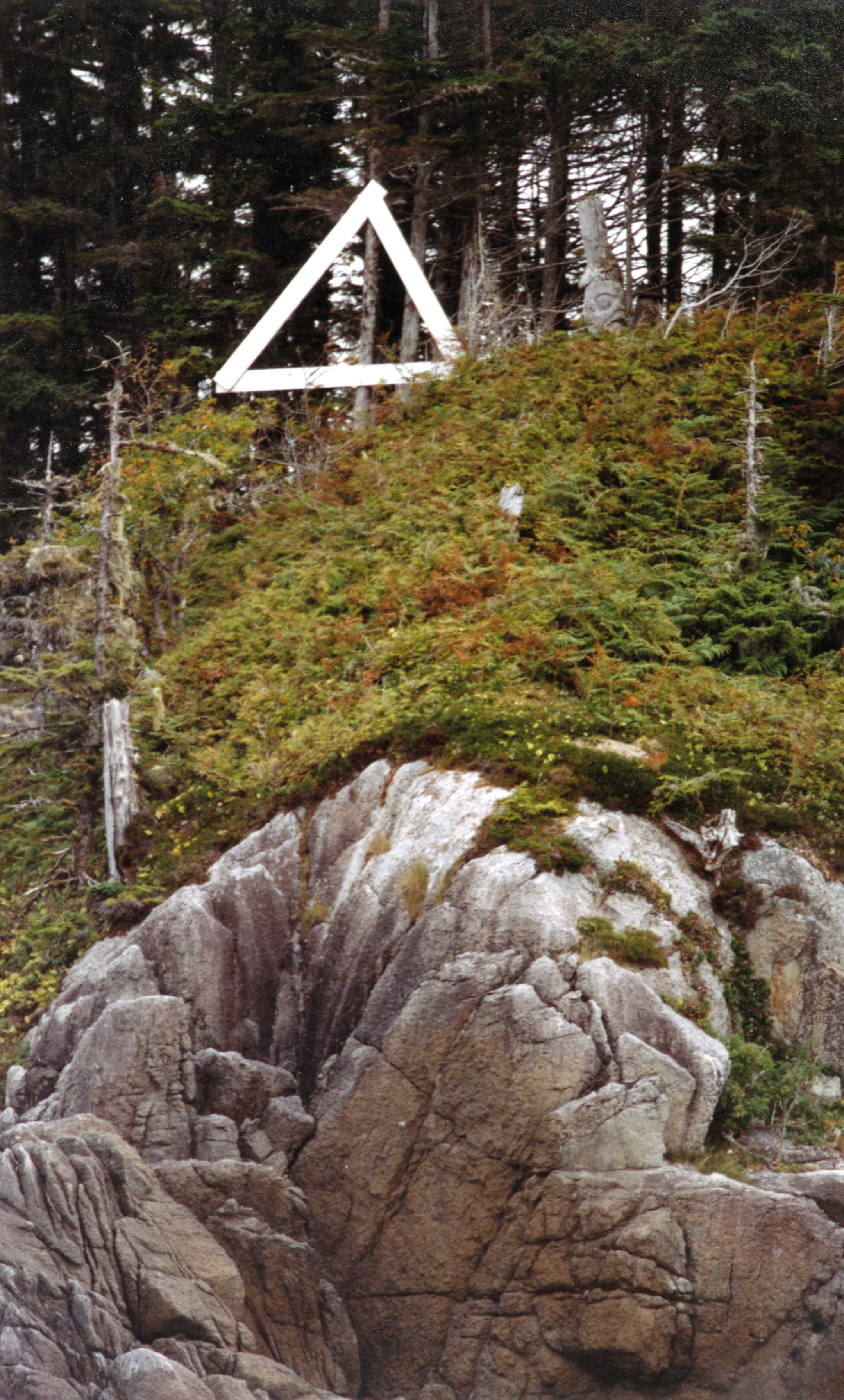
Headland with wooden markers. Click to zoom.

This is one of my favourite pictures of B.C. Archaeology, even though  it doesn’t look like much.  It’s a bit fuzzy: I took it with a zoom lens in about 1985 , rounding a headland in a small boat  on the Central Coast.  In fact, you might think it doesn’t look all that archaeological.  Look closer: sticking up to the right of the white triangle you can see the carved head of a pole.

The white triangle is a standard device used by Fisheries to demarcate the different fishing zones on the coast, for management purposes.  On one side of the triangle there might be different catch limits or closures or seasons of harvest enforced than on the other.

I don’t know much about the pole, but its location on such a prominent headland, facing the open Pacific, next stop Japan, is suggestive it marked a change of territory, a boundary shift, a movement from the control of one lineage or house to another. You don’t often see such a pole away from a village site.

Both wooden markers may ultimately serve the same purpose: boundary maintenance between zones of control; advertisements for power; watchful symbols of formal rights; the means of resource management.  It is intriguing and almost poetic to see them standing, side by side, on the same headland, guarding the same water.

Detail of wooden markers.

Adawkhl Gitsegulka

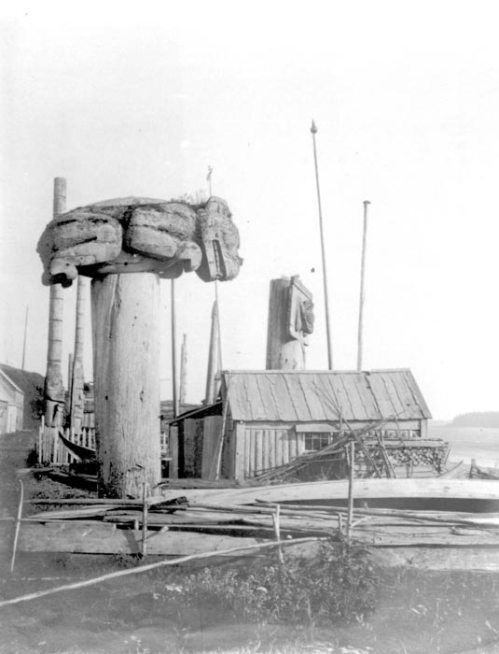
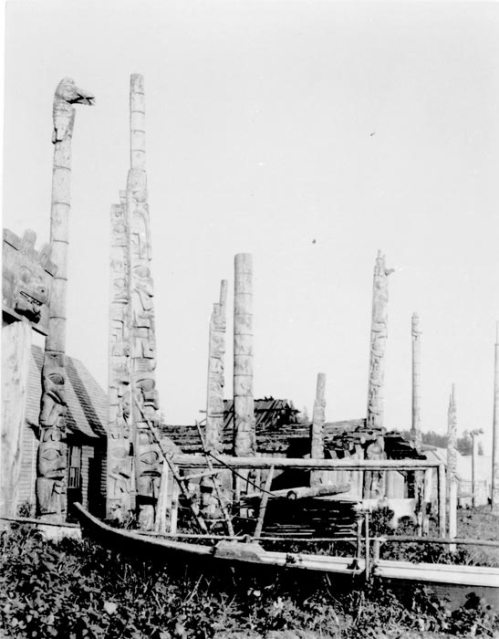
Gitsegulka ca. 1909. Source: Adawhkl Gitsegulka.

Yesterday, while posting CanadaGood’s flickr set of “totem poles” I found a really interesting document at the web site of the Gitsegulka community of the Gitxsan First Nation on the Skeena River.  Called Adawkhl Gitsegulka, it is a history of the settlement written in 1979, by band members via consultation with hereditary chiefs.  So often we only see these historical pamphlets for settler communities; it is quite fun and interesting and a little bit sad to read through this one written by First Nations themselves.  For example, note how (page 7) the Indian Agent in 1909 respects the hierarchies of the hereditary chiefs, apparently only in order to establish himself as the highest ranking of the lot.  Scroll down to page 35 for a discussion of the motives and means of carving poles.

There is an interesting theme which runs through the whole document: the uneasy relationship between the deeply felt Christianity of many Gitsegulka Gitxsan, and the old ways and practices.  In its informal way, through consultation with numerous elders, with charming illustrations, the Adawkhl Gitsegulka is an intriguing source of information on how the community saw itself in the transformative years of the late 1970s, when land and title claims were once again rising.  Five years on, they were in court claiming rights and title to their territory, and not much more than 10 years later, the landmark, borderline racist, “McEachern decision” of the BC Supreme Court would be handed down (the Gitxsan-Wet’suwet’en case: Delgamuukw vs. the Queen, round 1) which started a transformation of aboriginal rights in Canada.  Delgamuukw 3  in 1997 eventually set the frame for the modern treaty process when the Supreme Court ordered a new trial.  The trial has never happened but the new Supreme Court terms and definitions structure our modern understanding that Aboriginal rights and title were never extinguished and must be reconciled.  The Adawkhl Gitsegulka is an indigenous perspective on a small community about to have its voice heard right across Canada.

The document ends with the slogan of the [then] Gitksan-Carrier Tribal Council:  “Walk on, walk on, on the breath of our grandfathers”.

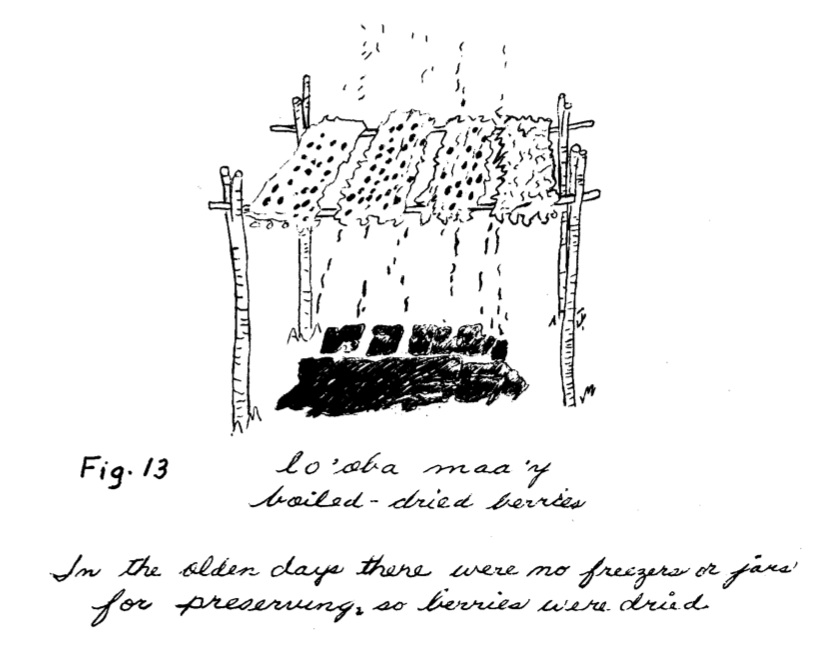
Drying Berries. Source: Adawhkl Gitsegulka.

Interior layout of a house. Source: Adawkhl Gitsegulka.

Flickr user CanadaGood’s pictures of poles

Fallen pole at Gitsegulka. Source: flickr.com user CanadaGood.

Someone posting under the username “CanadaGood” at flickr.com has put up an impressive array of over 100 photos of “totem poles”.  What I like about this set is that most of these are not the iconic ones from coffee table books or museums but rather are still standing (or lying) in communities, mostly along the Skeena River.  They aren’t the most technically accomplished photos or anything but they are undeniably atmospheric and they document the process of renewal and decay of poles which was an important part of the carving complex.  Each pole is the material instance of the right to carve and display a set of crests or images, often as a memorial to a dead person of high status, and therefore the “thing” must be set against the intangible, non-material property of rights and titles which it represents.  Proper treatment of the pole might therefore well include letting it return to the earth, replaced by a fresher copy.  I like the matter of fact way this one is set up on stumps and this rotting masterpiece at Gitanyow.  This figure is unusual for being “sculpture in the round”.   Kudos to CanadaGood for putting pictures of these less commonly seen poles on flickr, in high resolution, and under a Creative Commons licence to boot.

Tops of standing poles at Gitsegulka. Source: flickr user CanadaGood.