Category Archives: alaska

Handmade Garnet Musket Ball from New Archangel

Garnet musket ball from excavations at Sitka, Alaska. Source: Alaska OHA.

It is a common trick in archaeology classes to puzzle students with gunflints – part of the sparking mechanism of older muskets – which were made until recent times by the remnants of a European flaked stone industry until modern cartridges replaced them.  However, I had never heard of the use of stone musket balls before — but the picture above shows one made out of garnet, which is a heavy and dense mineral. This specimen is from a historic Tlingit-Russian site in Alaska.  As the caption notes:

“Large garnets can be found in schist… Because of the shortage of lead, the Kolosh [Tlingit]  use them instead of shot to kill sea animals.” [Khlebnikov’s 1817-1832 report, 1976:39]

It is typically ingenious for the Tlingit to have adapted traditional stone working technologies to the new, introduced technologies.

Over much of coastal Alaska the first contact aboriginal people had with Europeans was with Russians, rather than Americans, British, French or Spanish.  One of the most important Russian settlements was Novoarkhangelsk, or New Archangel, founded in 1799 at the present day town of Sitka (map).  The tumultous history of the founding of this outpost near a Tlingit village called Gajaa Héen, its subsequent capture by Tlingit warriors and ransom of Russian captives for 10,000 rubles, and its recapture 1804 by a Russian naval fleet during the “Battle of Sitka” is a subject for another day.

Suffice it to say that, as with all history, archaeology can fill in the stories of the everyday life of people and of events that go unrecorded by pen and paper.  In this respect, it is good to see the Alaska Office of History and Archaeology has a very full, very detailed report available online about archaeological work at “Castle Hill”, the ancient Tlingit fort known as Noow Tlein which subsequently became the cornerstone of the Russian defensive facilities at New Archangel.  You can browse the report chapters here, and the photos here and here.  No doubt I will post more in due course, as there are some extraordinary artifacts found at this site, not least among which is this hand-made toy musket.

The Russians may have won the battle of Sitka, but they eventually left, leaving behind the Sitka Tlingit tribes to continue their journey to the present, where their vibrant culture continues to thrive as this interactive place names map for the modern Town of Sitka makes clear.

Fort at New Arkhangel -- "View of the Establishment at Norfolk Sound," 1805-06 (from a watercolor by G.H. von Langsdorff). Source: Alaska OHA.

PS:  if you are skeptical about that Wikipedia link to the Battle of Sitka, then you can hear about the events in Tlingit here).

Plan of New Archangel, 1804. Fort site is to centre right. Source Alaska OHA.

Raven de La Perouse

Wooden and brass pipe representing Kan Lituya in the form of a Supernatural Frog, and his Bear Slave creating waves in Lituya Bay. Source: de Laguna, Volume. 3

My recent post on the 1786 visit by La Perouse to Tsunami-prone Lituya Bay, Alaska sent me scurrying to download the massive ethnography by Frederica de Laguna entitled Under Mount St. Elia Under Mount Saint Elias: The History and Culture of the Yakutat Tlingit.  As expected, there is a rich oral history of waves in this bay.  From Volume 1, page 94, she says

Emmons (1911, p. 295) recorded Indian beliefs about the dangers of Lituya Bay, caused by:
“… a monster of the deep who dwells in the ocean caverns near the entrance. He is known as Kan Lituya, ‘the Man of Lituya’ [qa htu ‘a?]. He resents any approach to his domain, and all of those whom he destroys become his slaves, and take the form of bears, and from their watch towers on the lofty mountains of the Mt Fairweather range they herald the approach of canoes, and with their master they grasp the surface water and shake it as if it were a sheet, causing tidal waves to rise and engulf the unwary.

De Laguna then continues to discuss an extraordinary wooden smoking pipe, illustrated above:

“This legend of Lituya is illustrated by a carved wooden pipe (fig. 50) [pi. 123], of splendid proportions, which was obtained in 1888 from the chief of the Tuck-tane-ton family of the Hoon-ah Kow [DAqdentan sib of Hoonah], who claimed this bay as his hereditary sea-otter hunting ground. It was used only upon occasions of particular ceremony—when the clan assembled to honor the dead, or to deliberate upon some important question of policy. At one end is shown a froglike figure with eyes of haliotis shell, which represents the Spirit of Lituya [possibly the Frog crest of the sib?], at the other end the bear slave sitting up on his haunches. Between them they hold the entrance of the bay, and the two brass-covered ridges are the tidal waves they have raised, underneath which, cut out of brass, is a canoe with two occupants, that has been engulfed. [Author’s note: This illustration was furnished through the courtesy of Mr George G. Heye, in whose collection the pipe now is.”]

One thng leading to another, I thought I would look into whether the Tlingit story of La Perouse’s visit had been passed on.  As it turns out, the early ethnographer G.T. Emmons records an account given by a Tlingit chief one hundred years after the visit of La Perouse to Lituya Bay.  This gives an indigenous perspective on what must have been an extraordinary series of events for both parties.  This account is well worth reading, so I am reproducing a portion of Emmons (1911) rendering below:

“In 1886, one hundred years after [the vist of la Perouse], Cowee, the principal chief of the Auk qwan of the Tlingit people, living at Sinta-ka- heenee, on Gastineaux Channel, told me the story of the first meeting of his ancestors with the white man, in Lituya Bay, where two boats of the strangers were upset and many of them were drowned. This narrative had been handed down by word of mouth for a century. These people possess no records nor had the chief, who spoke no word of our tongue, ever heard of La Perouse from outside sources; so we can here authenticate by an exact date a most interesting piece of native history in detail, the truth of which is substantiated by the fact that La Perouse was the only one of the early navigators to visit this locality in a large ship and by the attending loss of life in the destruction of his two boats.  Continue reading

La Perouse at Port des Francais (Lituya Bay)

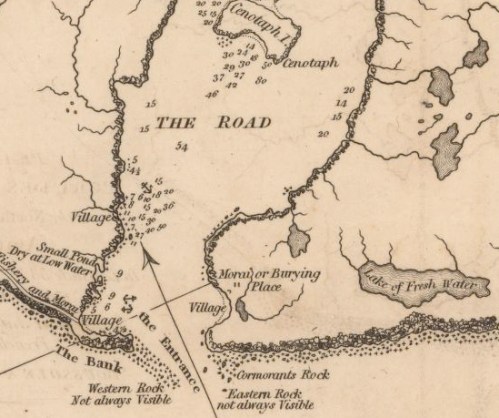
Detail of entrance of Port des Francais. Source: Brown University. Click for zoom version.

Most readers will be very familiar with Captains Vancouver and Cook and some of the other early European explorers of the Northwest Coast.  Less familiar is Jean-François de Galaup, Comte de La Pérouse, (1741-1788), who embarked on a world journey of exploration in 1785:

The French decided to mount a scientific and exploration voyage to rival that of Captain James Cook. Two ships, the Boussole and the Astrolabe, under La Perouse’s command left France in August 1785. They spent the summer of 1786 off the coasts of Alaska looking for a northwest passage then sailed down the west coast of North America in August and September 1786.

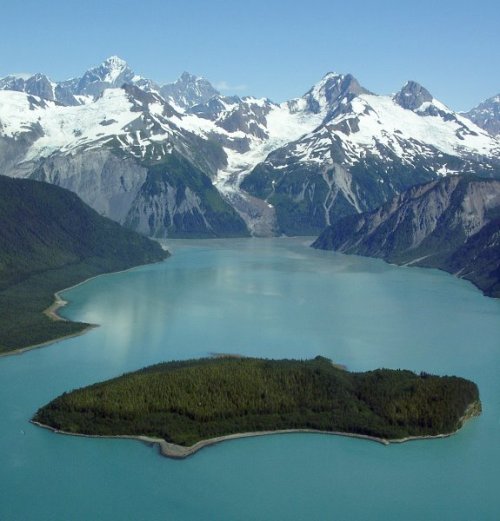
One of their most memorable and tragic periods was the time they spent in Lituya Bay, Alaska, which they called Port des Francais (map).

Lituya Bay, with Cenotaph Island in the foreground. Source; Panoramio user footsnviews.

Their mapping and illustration of Tlingit life are not unknown but also not that easy to find.  I recently came across an interesting site which has the best web presentation of these materials (actually reproduced from a 1798 British edition) I have seen: the images are highly zoomable, and the zoom is fast and crisp and smooth.  Linking to specific images is possible and the links don’t break.  With a little bit of effort, you can download the images (hint: “view source” of the page and search for ‘Size4″).  So zoom right in and see the details of pictures such as this one of a fish camp (are those halibut drying, or Pacific cod?), or this one of both a fine Tlingit dugout, and the construction of a skin vessel, with its seal skin hull removed and placed to one side.  The chart made by La Perouse is here and full of detail (again, these are English re-engravings of the originals).

While spending  time in Lituya Bay, tragedy befell the expedition. From here, an account of La Perouse’s time in Port des Francais:

1786 July Port des Francais / Lituya Bay

The next day, the narrow entrance to an inlet was located to the east of Cape Fairweather. De Pierrevert, from the Boussole, and Flassan, from the Astrolabe, were dispatched in small boats to investigate the inlet. Their favourable reports encouraged a somewhat reluctant La Pérouse to take the ships in. Their first approach was unsuccessful and they tacked offshore through the night before the tide carried them in the next morning. Even then, it was a precarious passage and the ships both nearly were driven onto rocks. They anchored just inside the entrance but La Pérouse was not happy with this spot, it having a shallow, rocky bottom. He sent men off to a find safer anchorage. D’Escures found a better location behind the large island in the inlet and the two ships transferred there. It was 3 July 1786.

Continue reading

Replica Tlingit Armour

Replicated Tlingit body armour.

The Tlingit artist Tommy Joseph has replicated a traditional set of armour:

… body armor made of alder slats and rods and woven together with hemp. Wooden panels are stitched together with leather lacing. Moosehide straps. Two alder toggles fasten the armor around the body.

It’s for sale: $3,500.

I was looking into this because of a recent post on Linen Armour (!) at Heather Pringle’s blog — I tried to leave a comment there in response to a question about NW Coast armour but wordpress ate it — probably because I had a bunch of links.  Dan form there, if you read this, most likely the armour Simon Fraser saw was made of two or more layers of stiffened elk hide.

Nettle winding around wooden slats and rods plus toggle fastening.


Archaeology in Action: a flickr.com photo pool

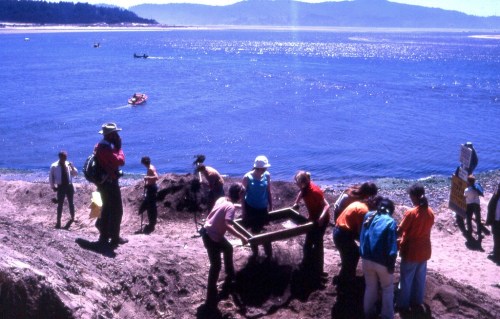
Archaeologists? No -- "Pothunters" destroying a site on the Columbia River, ca. 1966. Source: flickr user gbaku.

Archaeology in Action is a large set of pictures of archaeologists doing archaeology on the photo sharing website flickr.com.  Not too much Northwest Stuff there that I could find with the notable exception of many pictures put up by a former University of Oregon professor under the name of gbaku (you can find his real name easily enough).  His pictures are a wonderful tour of Oregon and Alaskan archaeology of the 1960s and 1970s – these are not sets of pictures of stratigraphy, or backdirt (interesting though those things are) but are predominately of, well, archaeologists in action.  It would be fun to see more NW Coast pictures up here — I know Grant has a large collection of pictures of archaeologists going about their business and I am sure we all have some pictures of people in with the endless pictures of yet another bone.

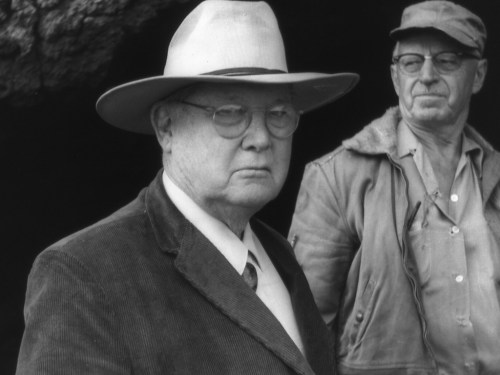
Erle Stanley Gardner, the author of the Perry Mason mysteries and many other books, and Luther Cressman, pioneering archaeologist and ex-husband of Margaret Mead, at Fort Rock Cave in 1966.

Northwest Anthropology Conference: NWAC 2010

The web site for NWAC 2010, to be hosted at Central Washington University March 24 – 27, 2010 in Ellensburg, Washington,  is up and running.  NWAC is a great conference which we were lucky to host in Victoria a couple of years ago.  In case you are wondering where Ellensburg is (no offence), it’s just to the east of the Cascades from Seattle, north of Yakima, about a 350 km drive from Victoria: map.

The theme of this year’s conference is the very welcome “At a Crossroads”:

Anthropology at the Crossroads” is the theme for the Northwest Anthropology Conference (NWAC), Ellensburg, Washington, March 24 – 27, 2010. While all submissions will be considered, this conference will offer opportunities for multiple perspectives on where we are as a discipline, society, and species, with a special emphasis on people and the environment. The “Anthropology at the Crossroads” conference will include symposia and presentations on subjects from archaeology, cultural and linguistic anthropology, paleoanthropology, primatology, medical anthropology, visual anthropology, and others. We invite submitters to use their own preposition in describing their presentation/symposia as “Anthropology at/of/on/etc the Crossroads.” Studying the past, understanding the present, and preparing for the future, makes Anthropology even more relevant today as the discipline continues to assert the importance of an appreciation for culturally diverse modes of interacting with our environment. Thus, this conference is a crossroads where the exchange of ideas better prepares us, our students, and our work to serve the communities we live in as we maintain our commitment to exchanging and transmitting our under-standings of all people, in all places, and at all times. “Anthropology at the Crossroads” also implies interaction among sub-disciplines and communities in an integrated fashion and in this manner encourages self reflection on the relevance of Anthropology today at a moment when we appear to be at several global crossroads.

Tlingit, Dene and Eskimo Metallurgy (1969)

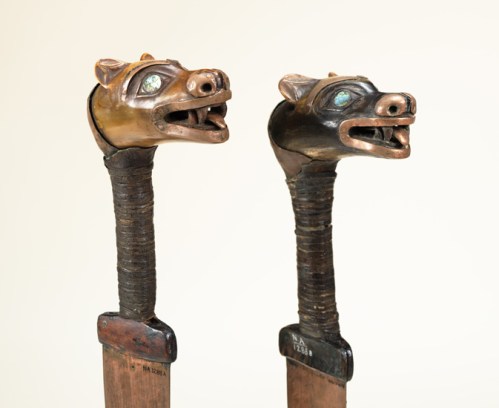
Tlingit dagger hafts, Kluckwan, Alaska. Purchased by George Gordon from Louis Shotridge at the Portland Fair, 1905. Penn Museum Objects NA1288a/b.

From the excellent University of Pennsylvannia Museum website, you can download back issues of their magazine “Expedition”, including this article on aboriginal metallurgy in Northwest North America (PDF).  The caption below is from that article: the two astonishing daggers being described are shown above.  Seriously, this is metalwork of the highest order, reminiscent of, say, Mycenaean pieces.

1969 caption describing the two daggers, above.

Seward Peninsula Mastodon Tusk – “too old”, therefore Too Old.

Worked 35,000 year old mammoth tusk from Alaska. Note scale! Source: Gelvin-Reymuller et al.

This is getting a little out of the area, but I’ve just run across a report by Gelvin-Reymuller et al.  (download PDF) on the finding of a worked mammoth tusk from the north side of the Seward Peninsula.  That is on the west-central Alaska coast near the closest approach to Asia, and hence smack in the middle of Beringia.  The tusk is interesting in its own right, of course, but doubly so when we see that it was dated to well before the last glacial maximum:

Though the age of the tusk is only peripherally relevant to the significance of the reduction described in this paper, the tusk was sampled for dating. A single bone collagen sample from the tusk was dated by Beta Analytic, Inc. following standard pretreatment and analytical procedures. A 5.2 g of sample was first removed from an inner area, well beneath a surficial treatment of Elmer’s Glue-All which the tusk’s discoverer had initially applied to the surface. The resultant AMS date was 35,150 +/- 530 BP (Beta-189092). …… The latest mammoth remains in mainland Alaska are dated to around 11,400 BP.   Since the age of this tusk places it beyond the range of initial human habitation in the New World, as currently understood, we posit that the tusk was worked by later inhabitants of the area.

The authors note that it is possible to diagnose from the reduction strategies used whether ivory was worked when fresh/green or when already subfossilized,  though curiously they draw no such conclusions about this particular piece.  I find it intriguing how a central Beringian artifact made on a 35,000 year old material is so readily characterized as a recent manufacture.  While this piece would pre-date the earliest known record of extreme NE Asia and while I wouldn’t second-guess the authors nor impugn their motives and while it is certainly possible that a fossil mammoth tusk was worked at a much later date, I’m, uh, just sayin’.   This paper is interesting on a number of levels, not least as an example of stickhandling around competing paradigms.

Detail of working method of Alaskan tusk. Source: Gelvin-Reymuller et al

Cache of Celts

tongass stone tools

Cache of stone woodworking tools found in Tongass National Forest

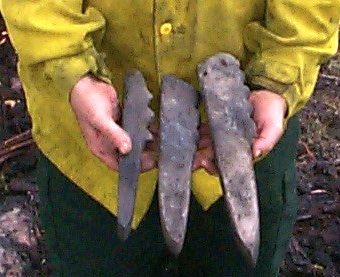
So maybe I am obsessed with ground stone celts, who isn’t, but nonetheless I liked this story of the lucky discovery of a cache of large pecked and ground stone woodworking tools in Tongass National Forest in the Alaska Panhandle.   The  article claims the hafting grooves are finger grips, which I think is unlikely.  More likely these are from elbow adzes, such as this one.

tongass stone tools detail


NW Coast Objects in Madrid

Tlingit adze with quillwork and copper insets in the Museo de América, Madrid.

Tlingit adze with quillwork and copper insets in the Museo de América, Madrid.

Even though the Spanish were among the first outsiders to eplore the NW Coast, you don’t hear much about collections they may have made while out here.  So it is welcome to see this (now, 10 year old) writeup on NW Coast items in Madrid’s Museo de América.  The article suggests that many such objects were collected but not retained in Royal Collections, perhaps because they were considered inferior to, say, Aztec and Inka pieces.  Either way, there are some spectacular objects illustrated in the article, though the photographs are not very sharp at all.

Going to the Museo de América’s website shows they have a search function and some online thumbnails.  This link should take you to their 52 pieces labelled as NW Coast, while this takes you to six pieces listed as from BC.   Most of the illustrations are extremely low resolution, though I found one or two which aren’t such as the outstanding Haida waterfowl, below.  Look how fluid the form-line rendering is in this 18th century piece.  Click the images on the Museo site for slightly higher resolution or go to the records page by clicking on “Ficha Completa” and then on “Ampliar Imagen”, where you can zoom in slightly using the magnifying glass.  Also worth checking out, this Tlingit clap-board style “rattle”, this foreshaft and point, and this rather spectacular hat.  Anyway, something to poke more: online catalogues in Spanish Museums.

EDIT:  I see their search function makes links to search results expire after a short time so I crossed them out, above.  Pretty lame, but there you go.  Get into the system via the generic system and then browse around, if you want.

18th Century Haida Waterfowl.

18th Century Haida waterfowl, listed as made from"Ivory".