Monthly Archives: September 2009

The Marmes Rockshelter Site

View out of the Marmes Rockshelter site.

View out of the Marmes Rockshelter site.

The Marmes rockshelter in eastern Washington State (map) is one of the oldest and most significant archaeological sites in NW North America. In its inundation by reservoir waters, it is also one of the sadder stories.  Washington State University has put a large amount of Marmes material online, including several photo galleries of work in progress.

The site was found in the early 1950s on land owned by Roland “Squirt” Marmes (pronounced “Mar-muss”)  a local rancher, but it wasn’t until 1962 that a large scale excavation commenced.
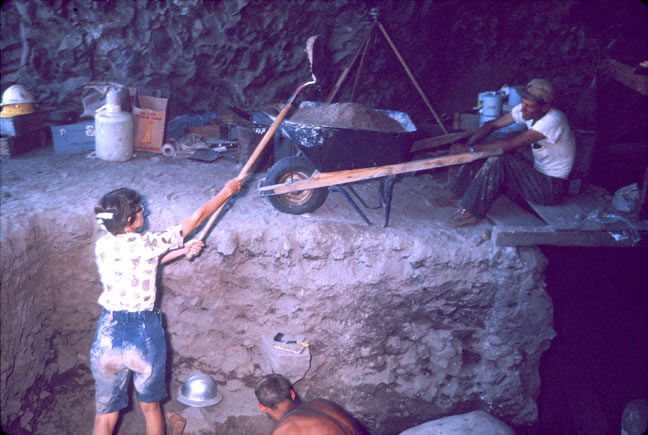
Shovel Bums of the Old School

Shovel Bums of the Old School

In soon order, there was a series of sensational finds of artifacts, fauna and human remains.  The oldest of these dated to 10,750 radiocarbon years ago, or, about 12,700 solar years ago.  At the time, these were the oldest human remains known from the Americas, and the artifacts represented one of the oldest known sites and one that was, interestingly, markedly different from the Clovis Culture type especially in the number and style of large, stemmed projectile points.  Among the other artifacts were distinctive crescentic stone blades, this exquisite bone needle, beads made of Olivella shell, which must have come from the Pacific Ocean.    HistoryLink.org, Washington State’s online encyclopedia, has a good summary article, and the WSU links above also give much more detail.  Indeed, WSU has been doing some wonderful digitization of old projects, which I will highlight in posts to come.  Things I have learned include the ubiquity of pipe smoking in the earlier days of Washington Archaeology.  My only criticism of this wonderful resource is the lack of captions on the photo galleries.  Who are these people, for example; who is under these splendid war bonnets?  Take a moment to tell us in a caption, or the file name.

The story of the inundation of the site by rising river impoundment is also of interest. Continue reading

Archives of “The Native Voice”

Native Voice banner

2018 edit: it appears the PDFs are now only available through the Internet Archive here.

The Native Voice is the official organ of the Native Brotherhood of British Columbia, an organization which has been active since 1931 and continues to do good work, especially in relation to aboriginal fishing rights, and aboriginal fishers themselves.  The NBBC has put PDF copies of  many editions of the Native Voice online from the years 1947-1955.  These archived issues offer a fascinating glimpse into the the mid-20th century state of First Nations politics, and everyday life besides.

To the right, for example, click on the text image to go to an issue wherein the NBBC riffs (positively, in this case) on  a Ruth Benedict article.

The Dionysians Strike Back

The Dionysians Strike Back

It is rare to see such responses (positive or negative) to the Anthropological Literature. Scroll lower in that article for 1947 ‘News from Ahousat”, a statement on segregation in PRince Rupert cinemas, and an odd “humour” column which seems rather offensive and patronizing in retrospect.    I am looking forward to trawling, or trolling, through these archives as the days go by.  Kudos to the NBBC for not only putting these documents online, but for the excellent, clear digitization — clearly someone took care making these files.

Heritage Burnaby

Ground stone wants to be flaked stone.

Ground stone wants to be flaked stone.

Billing itself as “personal history – collective memory”, the Burnaby Archives is a professionally presented and slick website.  As usual, the parochial frame extends only to non-aboriginal settlement.  Curious about whether the land on which Burnaby sits was occupied in more ancient times?  Well, they do link to 42 objects associated with aboriginal people.  Wondering if there might still be aboriginal people there today?  I couldn’t find anything.  I sure wish small town archives, and not so small ones as well, would wake up to the millennia of history under their feet.  Time did not start in 1892, Burnaby, much as some might like to think it did.  Or maybe it is just the prominent epigraph this site cites:  History is made with documents. Documents are the imprints left of the thoughts and the deeds of the men of former times. For nothing can take the place of documents. No documents, no history*.

No archaeology means a big honking hole in history, we might add, a hole shaped like colonial guilt.

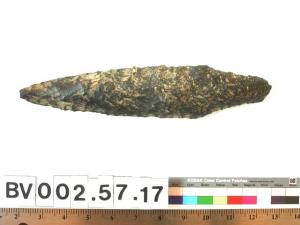
Elongate contracting stem point from Burnaby.

Elongate contracting stem point from Burnaby.

Having said that, two unusual artifacts are illustrated on their site.  Above left is a very distinctive ground stone point with a zig-zag motif.  I don’t recall seeing another one like it.  It almost appears to be a ground stone point designed to resemble a flaked stone point, something of a skeuomorph.   To the right is an elongate, contracting stem  flaked point or “dagger” that  appears to be about 14cm in length.  In size and appearance it is not the most common artifact in the world.

PS: Heritage Burnaby — your web site is nice and all, but breaking direct links to pictures is pretty lame.  Has there been that much bandwidth from hot-linked pictures?  Or are you so possessive about these artifacts you hold in trust for the Stó:lô, Musqueam, and Tsleil-Waututh First Nations?  Higher resolution would be nice as well — surely you have more than 72 dpi, 30 kb versions already taken?

* Incongruously cited as, “Charles Seignobos, Histoire de la civilisation contemporaine (1920). Translated by Eamon de Valera in a letter from prison to his personal secretary enjoining her to safeguard his papers.”

Fieldwork Picture of the Day 8

black bog abbey road

John, Walrus, George and the Sandhill Crane

In which we do our best impression of the Beatles Abbey Road cover on Porcher Island (map).  Lining up like this was necessary because the surface of this bog was so mucky we had to dismantle an old grow-op to make a trail across the surface (yes, we then dismantled our trail).  This bog is a few metres  above sea level, but quite quickly down in the core sample there was a clear break to marine sediments, showing sea level had once been higher than today and then dropped to or past modern.  Carbon dating a piece of sediment from the interface showed sea level had fallen past this point by  10,000 years ago.

Terrestrial (left) overlay marine (right) sediments.

Terrestrial (left) overlay marine (right) sediments.

The picture to the right shows the core sample, with the clear distinction made between the brown, terrestrial, pond deposits to the left (upper) side of the core) while in the right (lower, older) part of the core you can see the sediments turn to a greenish marine clay, which contained small shell fragments and salt-water diatoms.  Taking a number of these core samples from different elevations (and therefore of preumptively different dates of sea level change) allows us to stitch together a curve or graph of sea-level history.  Using this curve, we can then identify ancient coastlines (both underwater and above high tide) with greater certainty and accuracy, allowing for more efficient and productive archaeological survey on these ancient landforms.  On the map linked above, you can see the long linear lakes and ponds paralleling the modern shoreline.  These lakes highlight the former  eastern shores of  Oval Bay at higher sea levels.

Aboriginal history a la mode.

Being a mere archaeologist and not a sophisticated type, I like to reduce complex topics to simplistic graphs.  I showed this one to the first class of my new course on the Archaeology of BC.     The numbers for this are based on the emerging 13,000+ (calibrated) year old archaeological finds in Haida Gwaii,  so I expect the red slice to keep on growing.

If I were a paranoid type, I’d liken it to Pac-Man just getting his teeth into a ghost.

Reverse the colours to get the relative number of BC historians vs BC archaeologists in Universities – though I am all for historical archaeology as well, not to mention history, and BC history in particular.   All really good things.  But it is striking nonetheless to consider how weighted we are institutionally towards  the green slice.  As I said to the students, hearing the BC government natter on obsessively on the radio and in newspaper ads last year about the “150th Anniversary of British Columbia” just made my blood boil every time.  Seriously, Premier, do you want a new relationship with First Nations?  How about acknowledging the red slice of pie?  How about a celebration of 130 centuries of BC history?  Call off the government lawyers and other PR flacks who seem to think the world began 150 years ago.

While we are on the topic of letting the facts speak in the tongue of numbers,  where I work, the ratio of BC archaeology faculty members to all regular faculty members = 1:800.  As the kids say, Hello?

PS: Archaeologists are quintessentially “shovel ready” so maybe some stimulus money goes well with pie.  Try it.

Karst Mismanagement in British Columbia

Karst destroyed with approval of karst consultant.

Karst destroyed with approval of karst consultant.

The protection of BC karst landscapes falls into a sort of legal limbo.  There is only weak protection afforded through regulation, and only in some contexts.  If a cave can be shown to have archaeological deposits, it can be afforded very strong protection under the Heritage Conservation Act.  In theory, the HCA can also protect the cave if it has spiritual values to First Nations.  Nonetheless, the practice of karst assessment is controlled by a small cabal of self-appointed experts.  These folks make a living by doing impact assessments, mainly for forestry companies.  The picture at the left shows the results, a magnificent karst bluff destroyed after the karst consultant wrote the area off – from an office 500 miles distant, based on notes provided by a forest company employee.  In the report, archaeological values are dismissed from afar, doubly ridiculous since the karst consultant is notably ignorant about archaeology.  Continue reading

Dan Leen’s Petroglyph Page

Heiltsuk Petroglyphs including 2-headed Salmon Spirit

Heiltsuk Petroglyphs including 2-headed "Salmon Spirit"

I was just looking for a picture of a labret and instead found that Dan Leen has a nice page on NW petroglyphs, with lots of superb pictures and action shots of him recording rock art.  I haven’t seen Dan for quite a while, but we spent 10 weeks together on his 30 foot Trimaran “Teredo n.” back in the early 1980s, recording rock art in the Douglas Channel area.  A great trip all around.  I remember spotting this fantastic pictograph near Kemano, before breakfast one day, boat-made bread in one hand, hot coffee in another – I am pretty sure I took the picture since it was just Dan and me on Das Boot for quite some time. Dan is not the most silent guy in the world, and I heard a lot of great stories about his cabin in the Brook’s range of Alaska, his Hobo days, and so forth — so it is extra fun to see pictures of these places and times.  Dan is the most meticulous rock art researcher I have ever worked with, and it is great to see him putting some of his files, and insight online.

Oh yeah, I found the picture of the labret – one of these, almost identical, came out of my unit this afternoon.

Camas and Cairns

Lekwungen women harvesting camas bulbs on Beacon Hill. Illustration by Victoria graphic artist Gordon Friesen.

Lekwungen women harvesting camas bulbs on Beacon Hill. Illustration by Victoria graphic artist Gordon Friesen. (Edit: a bunch of their pictures are down, even on their site. Click to go to story)

Two small articles look at the archaeology of Beacon Hill Park in central Victoria.   Camas country includes charming illustrations and a knowledgeable write-up by Janis Ringuette, who also summarizes the remarkable story of how Beacon Hill Park workers consolidated a series of burial cairns (in the 1980s, no less), in order to facilitate mowing.  As she aptly notes:

Parks and Recreation Committee Chairman Geoff Young promised an interpretative sign. He said the Committee had been planning a marker well before the stones were “accidently disturbed.” He agreed a sign was needed because “They just look like ordinary rocks on the surface. It’s not a spectacular site. You have to know them.” Parks Director Al Smith said, “It’s going to be one of the more interesting features of the park, especially when we get the marker in place. We should have something showing the Indians were the original owners of the land.”

Continue reading

Hoko River pictures

Hoko barbed wooden point.

Hoko barbed wooden point.

Edited Feb 17/2010: Fixed the broken links.

October 2018: Hoko pictures are now here.

So, a new school year beckons.  Erk.  As a distraction, treat yourself to the huge photo library of the Hoko River site which was put online by Dale Croes.  A few dead links in there, but some pictures of fantastic artifacts, plus a sense of the project unfolding – slug fest included, as well as a visit from Hoko Site patron and “Clan of the Cave Bear Author” Jean Auel. The pictures are dusty, scanned-in transparencies (I think) which retain sense of nostalgia and the quiet punchiness of colour us old farts remember as fondly as we do the occasional upside-down slide at conferences.   I’ll probably occasionally use the Hoko site as the basis for future posts here.  On the left, a substantial barbed wooden(!!) point from the 2400 year old wet site deposits.