Tag Archives: Northwest Coast

dSpace: Lundy on Rock Art

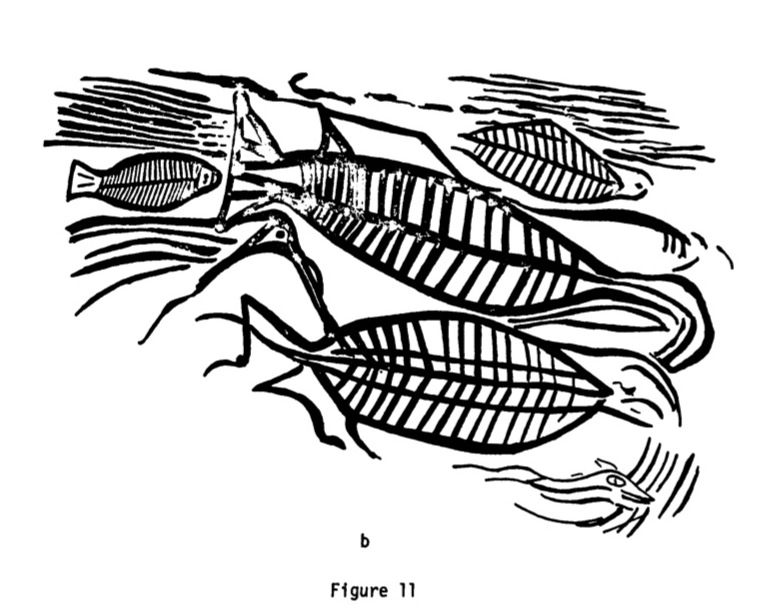
Salmon Petroglyph at Jack Point. From Lundy (1974: 111)

There is a wonderful trend of institutions putting old, grey literature online.  One widely used platform  for doing this is called “dSpace”, though the approach exists under other names.  Some of the best of this material are graduate theses and dissertations.  These are freely available if you walk into the University library, but may be essentially unavailable in any other form.  Unlike a lot of digital initiatives, the majority of these are not limited to students and faculty, but can be accessed by anyone – provided you know they are there.  Consider Doris Lundy’s monumental MA thesis on NW Coast Rock Art, obtained in 1974 from SFU.  Most of this 350+ page thesis was never published in any form.  Now you can download the whole thing from SFU (4 meg PDF). Despite being a rocky scan, the entire text is searchable.  There is some digital protection applied but I found it simple to save a copy to my hard drive.  The image to the left is the famous salmon petroglyph at Jack Point near Nanaimo in Snuneymuxw territory.  This is the petroglyph that would be painted with ochre and adorned with eagle down by ritualists if the salmon runs were late or meagre – one of the only such works which has specific beliefs recorded for it.

Let me know if you have problems downloading this: it works for me on and off campus, so I presume anyone can do it.
Annotate This

Surely they could have painted a mammoth on this somewhere.....

Surely they could have painted a mammoth on this somewhere.....

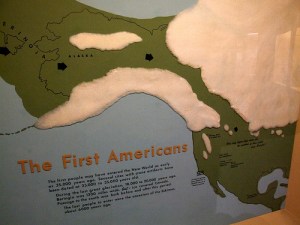
Flickr usr Travis S. does a nice, understated job of annotating this hilarious reconstruction of the “Ice Free corridor” from the Santa Barbara Museum of Natural History.  Click on the image to go to the original.  This picture pretty much sums up the absurdity of the Ice Free corridor — magical parting of the white sea while the coast is socked in under a mile of solid fog.  Funny how such reconstructions were made before serious geological investigation of their truth content, and funnier still how archaeologists just slurped up the ice free corridor as the answer to their need to get the FIRST AMERICANS (nevar forget!)  into Wyoming, well,  first.

Leland Gilsen’s Archaeology of Oregon

Replica of a Clatsop House.

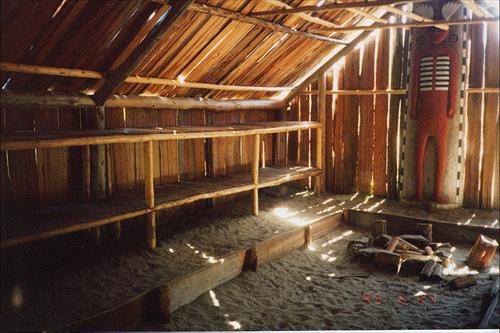
Replica of a Clatsop House.

Leland Gilsen, former State Archaeologist of Oregon has a pretty impressive website.   His extensive notes on aboriginal house styles are particularly worth a read — well referenced, well illustrated, and thoughtful, and he reproduces a lot of plan diagrams from the grey literature.  He also has good pages on “pyroculture” (deliberate landscape burning), and extensive notes and commentary on culture history, through a culture-ecological lens.  His image-rich virtual museum is a fun and educational slideshow.  Hmmm, someone should do a site like this for BC, or Vancouver Island at least.  Dr. Gilsen seems like a proud processualist of the Arizona school (not that there’s anything wrong with that) and a serious scholar.  At first glance, this web site could easily be used as an undergraduate textbook for a course on the Archaeology of Oregon.  Hats off, if I see you at NWAC, first beer is on me.

Archives of “The Native Voice”

Native Voice banner

2018 edit: it appears the PDFs are now only available through the Internet Archive here.

The Native Voice is the official organ of the Native Brotherhood of British Columbia, an organization which has been active since 1931 and continues to do good work, especially in relation to aboriginal fishing rights, and aboriginal fishers themselves.  The NBBC has put PDF copies of  many editions of the Native Voice online from the years 1947-1955.  These archived issues offer a fascinating glimpse into the the mid-20th century state of First Nations politics, and everyday life besides.

To the right, for example, click on the text image to go to an issue wherein the NBBC riffs (positively, in this case) on  a Ruth Benedict article.

The Dionysians Strike Back

The Dionysians Strike Back

It is rare to see such responses (positive or negative) to the Anthropological Literature. Scroll lower in that article for 1947 ‘News from Ahousat”, a statement on segregation in PRince Rupert cinemas, and an odd “humour” column which seems rather offensive and patronizing in retrospect.    I am looking forward to trawling, or trolling, through these archives as the days go by.  Kudos to the NBBC for not only putting these documents online, but for the excellent, clear digitization — clearly someone took care making these files.

Heritage Burnaby

Ground stone wants to be flaked stone.

Ground stone wants to be flaked stone.

Billing itself as “personal history – collective memory”, the Burnaby Archives is a professionally presented and slick website.  As usual, the parochial frame extends only to non-aboriginal settlement.  Curious about whether the land on which Burnaby sits was occupied in more ancient times?  Well, they do link to 42 objects associated with aboriginal people.  Wondering if there might still be aboriginal people there today?  I couldn’t find anything.  I sure wish small town archives, and not so small ones as well, would wake up to the millennia of history under their feet.  Time did not start in 1892, Burnaby, much as some might like to think it did.  Or maybe it is just the prominent epigraph this site cites:  History is made with documents. Documents are the imprints left of the thoughts and the deeds of the men of former times. For nothing can take the place of documents. No documents, no history*.

No archaeology means a big honking hole in history, we might add, a hole shaped like colonial guilt.

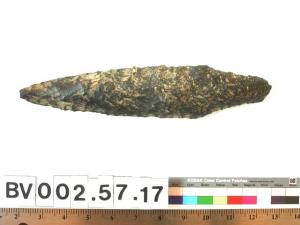
Elongate contracting stem point from Burnaby.

Elongate contracting stem point from Burnaby.

Having said that, two unusual artifacts are illustrated on their site.  Above left is a very distinctive ground stone point with a zig-zag motif.  I don’t recall seeing another one like it.  It almost appears to be a ground stone point designed to resemble a flaked stone point, something of a skeuomorph.   To the right is an elongate, contracting stem  flaked point or “dagger” that  appears to be about 14cm in length.  In size and appearance it is not the most common artifact in the world.

PS: Heritage Burnaby — your web site is nice and all, but breaking direct links to pictures is pretty lame.  Has there been that much bandwidth from hot-linked pictures?  Or are you so possessive about these artifacts you hold in trust for the Stó:lô, Musqueam, and Tsleil-Waututh First Nations?  Higher resolution would be nice as well — surely you have more than 72 dpi, 30 kb versions already taken?

* Incongruously cited as, “Charles Seignobos, Histoire de la civilisation contemporaine (1920). Translated by Eamon de Valera in a letter from prison to his personal secretary enjoining her to safeguard his papers.”

Fieldwork Picture of the Day 8

black bog abbey road

John, Walrus, George and the Sandhill Crane

In which we do our best impression of the Beatles Abbey Road cover on Porcher Island (map).  Lining up like this was necessary because the surface of this bog was so mucky we had to dismantle an old grow-op to make a trail across the surface (yes, we then dismantled our trail).  This bog is a few metres  above sea level, but quite quickly down in the core sample there was a clear break to marine sediments, showing sea level had once been higher than today and then dropped to or past modern.  Carbon dating a piece of sediment from the interface showed sea level had fallen past this point by  10,000 years ago.

Terrestrial (left) overlay marine (right) sediments.

Terrestrial (left) overlay marine (right) sediments.

The picture to the right shows the core sample, with the clear distinction made between the brown, terrestrial, pond deposits to the left (upper) side of the core) while in the right (lower, older) part of the core you can see the sediments turn to a greenish marine clay, which contained small shell fragments and salt-water diatoms.  Taking a number of these core samples from different elevations (and therefore of preumptively different dates of sea level change) allows us to stitch together a curve or graph of sea-level history.  Using this curve, we can then identify ancient coastlines (both underwater and above high tide) with greater certainty and accuracy, allowing for more efficient and productive archaeological survey on these ancient landforms.  On the map linked above, you can see the long linear lakes and ponds paralleling the modern shoreline.  These lakes highlight the former  eastern shores of  Oval Bay at higher sea levels.

Karst Mismanagement in British Columbia

Karst destroyed with approval of karst consultant.

Karst destroyed with approval of karst consultant.

The protection of BC karst landscapes falls into a sort of legal limbo.  There is only weak protection afforded through regulation, and only in some contexts.  If a cave can be shown to have archaeological deposits, it can be afforded very strong protection under the Heritage Conservation Act.  In theory, the HCA can also protect the cave if it has spiritual values to First Nations.  Nonetheless, the practice of karst assessment is controlled by a small cabal of self-appointed experts.  These folks make a living by doing impact assessments, mainly for forestry companies.  The picture at the left shows the results, a magnificent karst bluff destroyed after the karst consultant wrote the area off – from an office 500 miles distant, based on notes provided by a forest company employee.  In the report, archaeological values are dismissed from afar, doubly ridiculous since the karst consultant is notably ignorant about archaeology.  Continue reading

Hoko River pictures

Hoko barbed wooden point.

Hoko barbed wooden point.

Edited Feb 17/2010: Fixed the broken links.

October 2018: Hoko pictures are now here.

So, a new school year beckons.  Erk.  As a distraction, treat yourself to the huge photo library of the Hoko River site which was put online by Dale Croes.  A few dead links in there, but some pictures of fantastic artifacts, plus a sense of the project unfolding – slug fest included, as well as a visit from Hoko Site patron and “Clan of the Cave Bear Author” Jean Auel. The pictures are dusty, scanned-in transparencies (I think) which retain sense of nostalgia and the quiet punchiness of colour us old farts remember as fondly as we do the occasional upside-down slide at conferences.   I’ll probably occasionally use the Hoko site as the basis for future posts here.  On the left, a substantial barbed wooden(!!) point from the 2400 year old wet site deposits.

Fieldwork Picture of the Day 7

Excavations at Collison Bay, 2006

Excavations at Collison Bay, 2006

This is another intertidal dig – the Collison Bay site, which shares a lot of similarities with Kilgii Gwaay.  Both sites date to about 9450 C14 years ago and contain buried deposits in primary context below the modern beach.  While Kilgii Gwaay contains a rich organic assemblage, Collison Bay does not, though there is evidence for a brown palaeosol at varyiong depths.  In and around that palaeosol are numerous pristine lithics: stones tools and flakes that are sharp and clearly have not een rolled on a beach.  One of the striking things about these two sites is they show how a major event like a marine transgression can nonetheless leave intact cultural deposits.  We suspect that much of this has to do with the local topography.  Ideally, a bedrock rock rim allows for a small lagoon to form, creating an interlude of very low wave energy between when sea level rises over the site and when the full weight of waves can start to act on the surrounding shore.  By the time the waves are able to penetrate, the archaeological materials are already several metres below low tide which affords quite a lot of protection.

As with Kilgii Gwaay, working in the intertidal zone poses certain challenges, such as having only a six hour window to work.  In the case of Collison Bay, we compounded the issue by timing the project for when the best tides were in the middle of the night, which meant getting up at midnight and working to dawn in some cases (though we did have some good daytime digging as well).  In this picture you can see we are using electric lights run off a generator while Cynthia does the hard work down on the beach; this is probably around 2.00 in the morning.

High Resolution Pictures from the Smithsonian

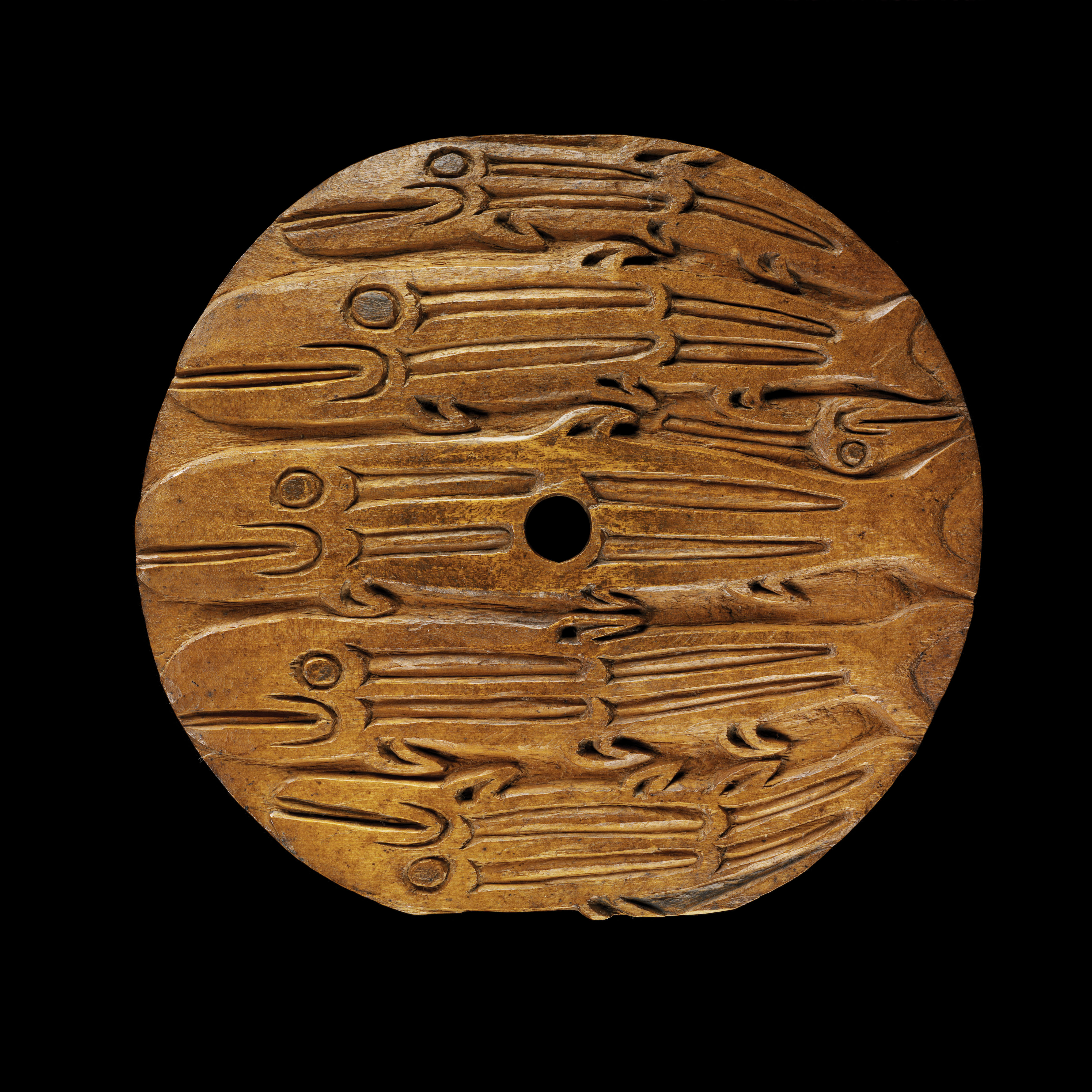
Cowichan Spindle Whorl, ©National Museum of the American Indian, Smithsonian Institution (15/8959)

Cowichan Spindle Whorl, ©National Museum of the American Indian, Smithsonian Institution (15/8959)

These seem to be squirreled away on the website in the “media releases” section at the Smithsonian! It is well worth getting the high-resolution images.  There is one solid, NWC art page here (from where the lovely Cowichan spindle whorl to the left is from)  but additionally here are high resolution pictures of:

an Alutiiq (Koniag) hunter’s hat, ca. 1950  Kodiak Island, Alaska (Spruce root, paint, glass beads, dentalium shells, wool cloth, sea lion whiskers National Museum of the American Indian, Smithsonian Institution Image: 6/9253)

Quinalt woman’s dentalia breastplate ca. 1880 Washington state (Hide, dentalium shells, glass beads, cordage National Museum of the American Indian, Smithsonian Institution Image: 2/7703)

Tlingit Rattle, ca. 1880 Alaska  (Alder or maple wood, hide National Museum of the American Indian, Smithsonian Institution Image: 8/1650AQ)

Raven Steals the Sun (in blown glass! by Preston Singletary (Tlingit) Seattle, Washington, 2003)

Continue reading