Tag Archives: fishing

Long term salmon resilience

Salmon lice infestation. Source: Georgia Strait Alliance.

I’ve just dipped into an interesting paper (PDF) by Sarah Campbell and Virginia Butler, which explores 7,500 years of relationship between First Nations and Pacific Salmon.  While, as ever, the archaeological evidence is discontinuous and somewhat patchy, the authors reach profound conclusions that go far beyond the usual archaeological focus on the past, as if the past still exists other than in the present.

The Northwest Coast was estimated to have the second highest indigenous population density in North America (after California) at European contact, with population estimates ranging from 102,100 to 210,100 (Ubelaker 2006). Haggan et al. (2006) propose an annual average per person consumption rate of 230 kg/yr based on two 19th- century estimates. At this rate, 200,000 people would annually consume 46,000 metric tons (50,706 tons) of salmon, comparable in magnitude to the average yearly commercial catch between 1901 and 2000 (Jones 2002). (emphasis added)

Continue reading

More on Comox Harbour Fishtraps

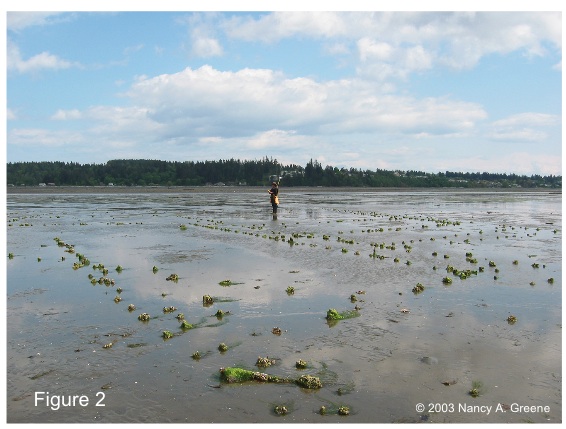
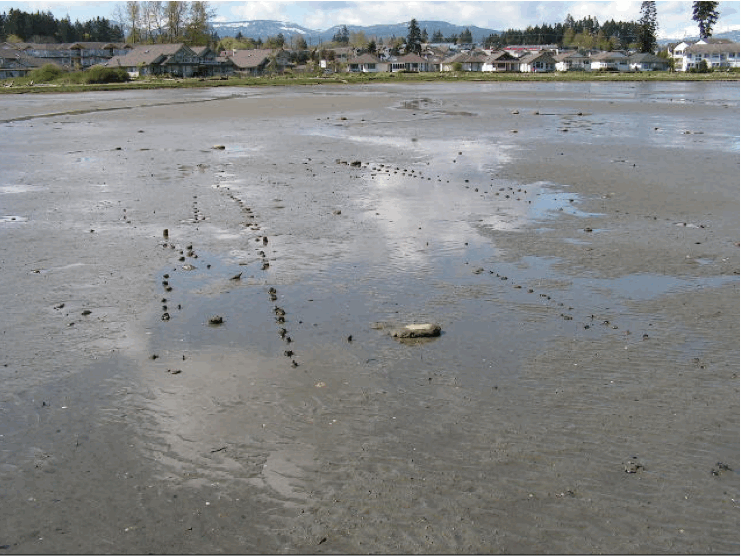
Fishtrap stakes delineating chevron patterns in the intertidal zone of Comox Harbour. Photo credit: Greene 2010.

I posted once before some time ago on the incredible fishtrap complexes in Comox Harbour on eastern Vancouver Island, highlighting Megan Caldwell’s M.A. thesis (downloadable) on the topic, and mentioning in passing that primacy of investigation should perhaps go to Nancy Greene, who has been mapping and dating these features for about a decade.  I was glad to find the other day that Nancy Greene has a 2010 downloadable poster on the topic (link starts a 4 meg PDF)  from an academic conference: WARP, the Wetland Archaeological Research Project, which itself has a nifty new website.

These Comox Harbour fishtraps are one of the wonders of B.C. Archaeology and it is highly welcome to see some more of Greene’s reconstructions and mapping.

Continue reading

Montana Creek Fish Trap, Alaska

Montana Creek Fishtrap being excavated, 1989. Source: Sealaska

In 1989 a nearly complete fish trap was found in Montana Creek, near Juneau Alaska in Aak’w Kwáan Tlingit territory. The cylindrical trap, measuring 3 metres long and 1 metre in diameter, was excavated and found to date to about 600 years ago.  The trap was preliminarily reported in Kathryn Bernick’s 1998 book Hidden Dimensions (UBC Press).  Fishtraps were supported by wood and/or stone weir structures which also  act to direct fish into the trap.  The trap would be removed at the end of each season and stored nearby or at camp.  Of course, being wood, they intrinsically don’t preserve very well except in anaerobic and wet conditions.  They are therefore rather rare since they would need to be left in the creek after use in order to preserve.  So this one is very unusual, and especially so since it was essentially complete (other than being flattened).  All credit to the finder, Paul Kissner, for being alert, recognizing the trap, and reporting it promptly.

But now, the fishtrap has become very much a living object.

Continue reading

The Schieffelin Brothers Yukon River Prospecting Trip of 1882

Tanana woman returning from the hunt, 1882. Source: AKDC

Browsing in the Alaska Digital Archives I found an interesting photo album documenting a prospecting trip up the Yukon River by the Schieffelin Brothers, Ed and Al, who just a few years earlier had founded the famous desert mining town of Tombstone, Arizona.  Two pictures from this album struck me as particularly interesting, though the whole thing is worth browsing.

The first of these is the remarkable picture above, showing a Tanana woman with a long-gun, powder horn, and a couple of large rabbits.  While anthropologists and archaeologists have grudgingly revised their “Man the Hunter” stereotypes in recent years, it is nonetheless rare to see such a frank portrait of a competent woman with her prey.  I’ll be using this one in class, starting next week.

Continue reading

Vanishing Eulachon

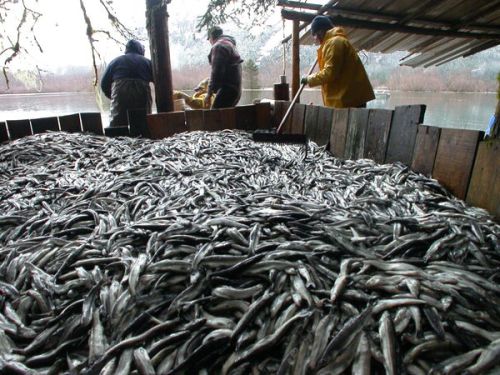
Eulachon. Source: Sitnews.net

I often use eulachon (Thaleichthys pacificus, a small, anadramous smelt) as an example of “archaeologically-invisible” food. They are also known as “candlefish”, on account of being so oily that a wick jammed down their throat will burn like a candle.

These small fish run by the millions up rivers to spawn, where they could be intercepted.   Traditionally, many or most eulachon would be processed into eulachon oil, or grease: a highly nutritious, calorie-dense substance that preserved very well and could also be used to preserve other foods such as berries.  The means of processing was to put them into a large container, perhaps an old canoe, known colloquially as a “stink box”, let them “rest” there for a week, and then heat them up, enabling the oil to rise and then be skimmed off, or pressed out.  The residue (bones, guts, brains, etc.) would then be returned to the river and few or no bones would make it away from the processing site.  In this way, eulachon provided a staple food, a nutritional supplement, a means of preservation, and an extremely valuable trade item – when Alexander Mackenzie arrived near Bella Coola in 1793, “Over Land, From Canada”, he did so on one of the well-worn grease trails that linked coast to interior. Since the fish arrive in the early Spring, they were hailed as starvation busters in lean years.  Nonetheless, archaeologically they are almost invisible, relative to their importance.

Haisla eulachon catch from the Kemano River. Source: living landscapes.

It is therefore sobering to read that U.S. President Obama has listed the Columbia River eulachon as an endangered species: eulachon are becoming almost invisible relative to the real world now, it seems.

Continue reading

Green cod heads and the case of the missing halibut

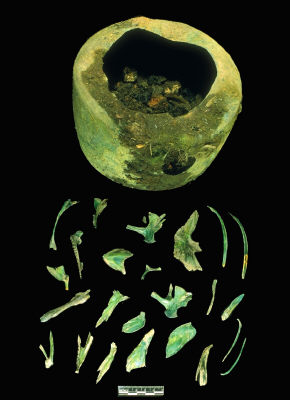
Copper kettle full of cod heads. Source: Alaska OHA.

I was feeling sick yesterday and this picture didn’t help: from the Castle Hill excavations at Sitka, Alaska (previously 1, 2) is the nearly complete copper kettle.  Inside, the archaeologists found the green-stained bones from the heads of three codfish (true cods, Gadidae, are 35% of the fish assemblage).  One of the great things about archaeology is to get these tiny slices of life: someone’s kettle of fish, set aside one day 200 years ago.

At a bigger scale, archaeology isn’t always so straightforward though.  Interestingly, from the site as a whole, only 1% of the fish bones are from halibut (11 bones in total).  This is despite the fact that:

Cod dominated the Castle Hill assemblage, and yet, Emmons (1991:148) stated that cod was considered an unimportant part of the Tlingit diet if salmon and halibut were available. Historic records confirm that cod was popular in Sitka, because it was available almost year around (Gibson 1976:40, Khlebnikov 1994). Halibut was also popular because of its year around availability and was sold to the Russians in large numbers. Between 22,000 and 138,000 pounds of halibut were purchased each year from the Tlingit from 1846 to 1866 in addition to the yearly average of 13,000 pounds of halibut the company procured itself (Gibson 1987:94). The emphasis on halibut brought to Sitka and sold to the Russian-American Company would lead to the prediction that halibut should dominate the assemblage, yet this is not the case. It may be a case where cod were readily available and not worthy of special consideration in historic documents.

Two things strike me about this.  One is that the Tlingit, using largely traditional methods at the time, were able to produce up to 138,000 pounds of excess halibut for trading purposes.  That’s a lot of fish.  The other is that so much halibut renders down to so few bones.  Halibut is long known on the NW Coast as being strongly under-represented in archaeological sites, probably because it may have been butchered on the beach and the bones, which separate cleanly from the meat, would end up in the intertidal zone and be washed away or eaten by dogs.  It also seems possible  that the Tlingit were trading in dried, boneless halibut (which makes the tonnage involved all the more impressive).  And certainly the entire site was not excavated, so there may be a mother lode of halibut bones somewhere.  But this case makes an interesting cautionary tale in zooarchaeology: we seldom have an accurate sense of the scale of the incoming fish quantities to compare to what is left in the ground, and when we do, the degree of difference between the written and material records is often quite startling!

Tlingit women and children cleaning fish on the beach, ca. 1907. Ignore the racist caption. Source: U. Washington.

Boundary Maintenance

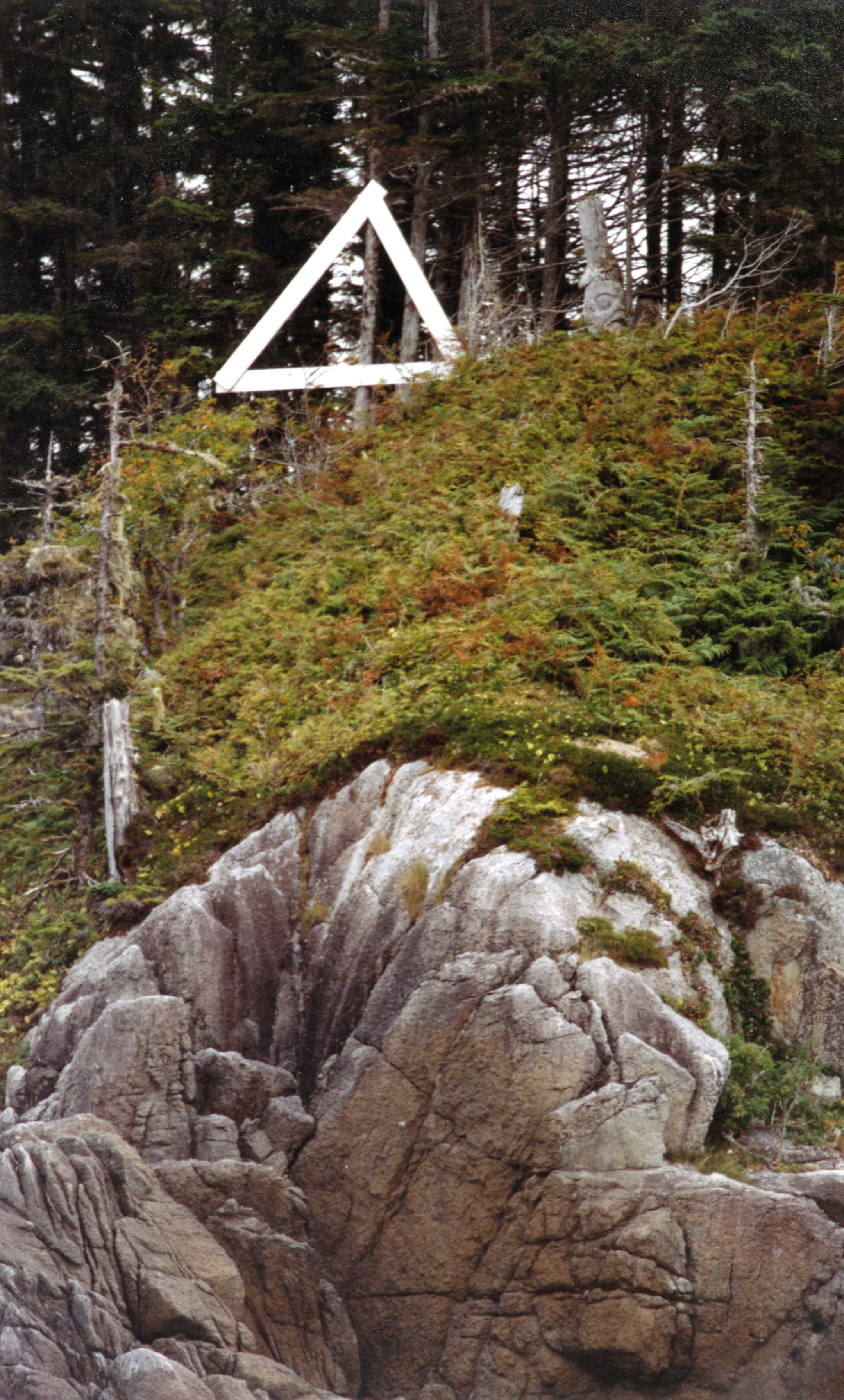
Headland with wooden markers. Click to zoom.

This is one of my favourite pictures of B.C. Archaeology, even though  it doesn’t look like much.  It’s a bit fuzzy: I took it with a zoom lens in about 1985 , rounding a headland in a small boat  on the Central Coast.  In fact, you might think it doesn’t look all that archaeological.  Look closer: sticking up to the right of the white triangle you can see the carved head of a pole.

The white triangle is a standard device used by Fisheries to demarcate the different fishing zones on the coast, for management purposes.  On one side of the triangle there might be different catch limits or closures or seasons of harvest enforced than on the other.

I don’t know much about the pole, but its location on such a prominent headland, facing the open Pacific, next stop Japan, is suggestive it marked a change of territory, a boundary shift, a movement from the control of one lineage or house to another. You don’t often see such a pole away from a village site.

Both wooden markers may ultimately serve the same purpose: boundary maintenance between zones of control; advertisements for power; watchful symbols of formal rights; the means of resource management.  It is intriguing and almost poetic to see them standing, side by side, on the same headland, guarding the same water.

Detail of wooden markers.

Videos of Gwaii Haanas Archaeology

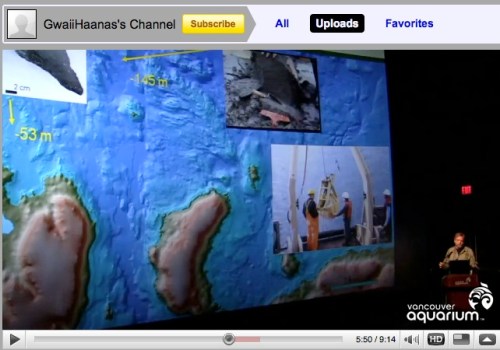
Daryl braves the barrage of bras to set the Vancouver Aquarium straight on the value of dead fish over living fish. Click to play part 1.

Rockwash superstars Nicole and Daryl show off their cool wares in a couple of videos I just found online – I vaguely remember them going off to give this talk at the Vancouver Aquarium.  It’s in two parts: 1 and 2.  Nicole looks fabulous and Daryl has trimmed his beard!  Win-Win.  The projects they describe sure were a lot of fun to take part in.   There are a few other talks up including Lyle Dick and Norm Sloan on Sea Otters on the Gwaii Haanas Youtube Channel.

A sandhill crane is a tough act fo follow but Nicole hammers home the righteous message of dead fish. Click to play part 2.

dSpace: Caldwell on Comox Harbour Fishtraps

Chevron-shaped fishtraps in Comox Harbour. From Caldwell 2008.

The University of Manitoba is in on the dSpace trend.  The most notable thesis I found there was Megan Caldwell’s excellent analysis of some Comox Harbour fishtraps in relation to the Q’umu?xs Village site (DkSf-19).  Sixteen carbon dates are now available on these traps, thanks mainly to the work of Nancy Greene.  Caldwell takes a theoretical stance of Optimal Foraging Theory, arguing that fishtraps amount to “artificial patches” which can alter choices made under Patch Selection principles.  Essentially, a similar and more holistic argument could be made using principles of the “built environment” in an Ingoldian sense, but OFT is more structured and maybe more suitable for an MA thesis.  Interestingly, Caldwell’s work on auger sampling of the Q’umu?xs Village site shows a preponderance of herring, which is also interpreted as the target prey of the fishtraps.  This runs against the grain of the ethnographic work she conducted, where she was told that salmon were more important — mind you, salmon have difficult taphonomy and site formation processes, which she acknowledges.  In any case, this is a well organized, focused thesis which reflects a lot of high quality original work and while I haven’t read the whole thing I intend to do so!  Caldwell mentions Nancy Greene is still working on her fish trap study and I hope to see the results of that soon as well — these Comox Harbour trap complexes are very likely the finest of their type anywhere on the Northwest Coast and may well offer key insight into cultural construction of the landscape and its resources.  Download her thesis here!

Map of Fishtrap Stakes in Comox Harbour. From Caldwell 2008.

Schematic of two basic fishtrap designs. From Caldwell 2008.

Single Hook

Pomeroy polynesian hook 1

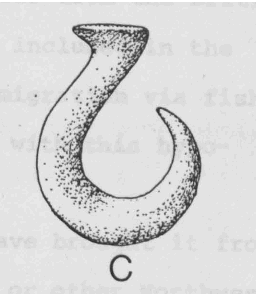
Polynesian-style fish hook found at McNaughton Island

John Pomeroy found this unusual shell (“scallop”) artifact at McNaughton Island (ElTb-10) on the central coast in 1972 (Pomeroy 1980: 321b).  It strongly resembles some Polynesian fish hooks, and is also similar to some Californian ones.  While no scale is given, by comparison to the text it appears about 5 cm long by 4 cm wide. Pomeroy offers three suggestions:

Pomeroy polynesian hook 2

Polynesian fishook from Beasley (1928) via Pomeroy (1980)

1. That it was traded from California

2.  That it was brought from Polynesia by early European explorers.

3. That it arrived inside a tuna.

He notes that there are no tuna remains at this site, which makes (3) less likely though not impossible.  While trade from California is possible, Pomeroy  notes that this specific artifact most closely resembles some from Polynesia and not from California – namely the one to the right from Beasley (1928).  The fact that it was found at a depth of 1.7 metres suggests that (2) is unlikely.  There is a date for about one metre below the surface at this site of 900 BP.  While the exact relationship of the date sample to this artifact is uncertain on my brief reading, it is most likely the date is above the artifact and thus more recent.  Certainly this general time frame of less than 1500 years is the time when eastern Polynesia is being settled and there may have been greater opportunity for drift items or other accidental contact to occur.  On the other hand, this is also said to be the time that the Californian examples arise.

Pomeroy leaves the matter unresolved.  I’m going to keep my eyes open for other examples including fragments that might be misclassified.

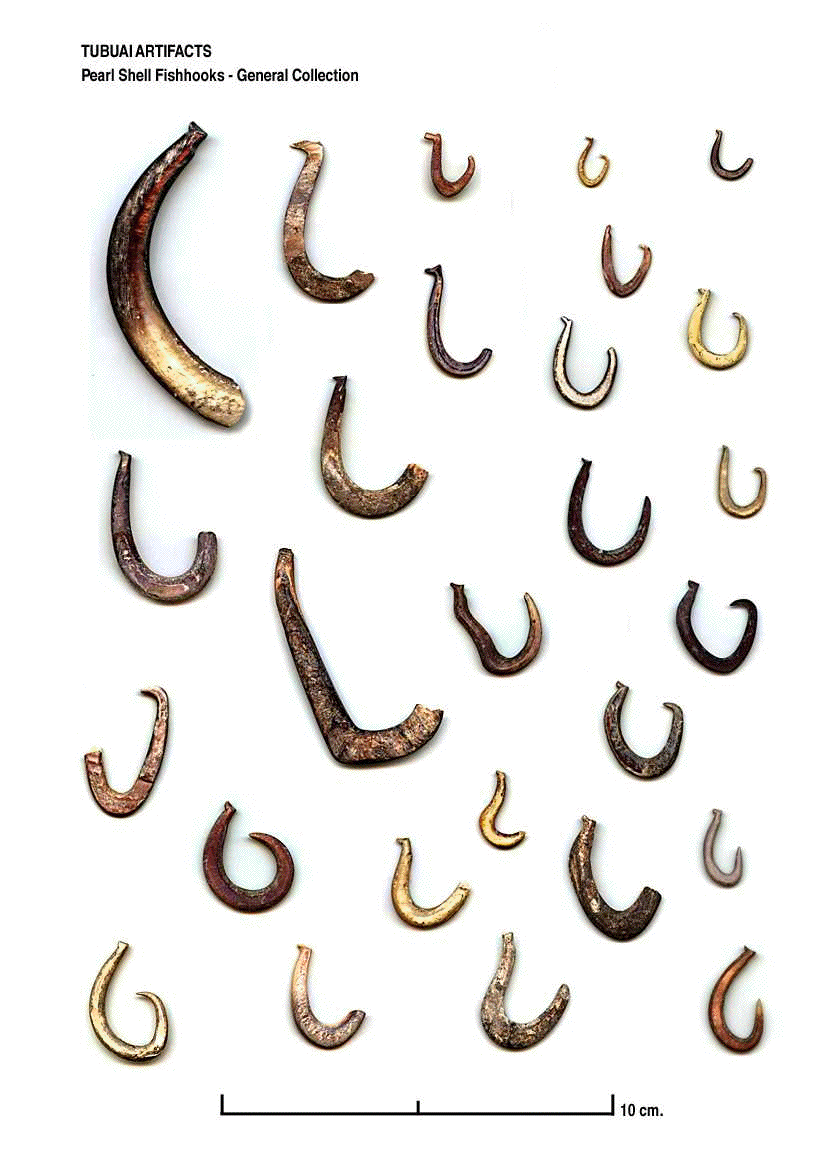
polynesian fishhooks

Polynesian Fish Hooks.